Washington: Speed and space — Part 3 Practice Test
Questions in this part include: “Which of these can excessive speeds do, according to the guide?” · “Which of these places does the guide name as one where you should reduce your speed?”
Independent educational site · not affiliated with any government agency or DMV
Ready? Test yourself
Answer to start, or tap Start below:
Which of these can excessive speeds do, according to the guide?
- Instant feedback with an explanation
- Every answer cites its source in the manual
- Your best score is saved on this device
- Keyboard: press 1 to 4 to answer and Enter for the next question
Questions are original and based on the official manual "Washington Driver Guide" (© 2025), Washington State Department of Licensing (DOL).
All 18 questions in this practice test
Take the test above first, then use this list to study. Tap “Show answer” to see the correct answer and explanation.
Show the questions and answersHide the questions
-
Which of these can excessive speeds do, according to the guide?
- Increase the effectiveness of seat belts
- Shorten your stopping distance
- Give you more time to scan for hazards
- Reduce the effectiveness of seat belts
Show answer
Correct answer: Reduce the effectiveness of seat belts
The guide says seat belts protect you in a crash, but their effectiveness decreases at higher speeds.
Source: Washington Driver Guide (© 2025), page 157 · Open this page in the manual (Manual page 157)
-
What happens to the time you have to scan the road ahead as you drive faster?
- You have more time to scan for hazards
- It stays the same on a straight road
- You have less time to scan for hazards
- It stays the same in clear weather
Show answer
Correct answer: You have less time to scan for hazards
The faster you drive, the less time you have to scan ahead for pedestrians, cyclists and other vehicles.
Source: Washington Driver Guide (© 2025), page 157 · Open this page in the manual (Manual page 157)
-
What can high speeds in adverse conditions like rain or snow lead to?
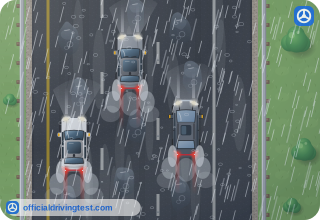
- Skidding or losing control entirely
- Better traction on the road surface
- A shorter stopping distance
- Less force of impact in a crash
Show answer
Correct answer: Skidding or losing control entirely
High speeds make a vehicle harder to control, especially in rain or snow, which can lead to skidding or loss of control.
Source: Washington Driver Guide (© 2025), page 157 · Open this page in the manual (Manual page 157)
-
How does a higher speed affect the distance and time needed to stop a vehicle?
- It takes the same time to stop
- It takes less time to stop
- It affects only the time and not the distance
- It takes longer to stop
Show answer
Correct answer: It takes longer to stop
Higher speed creates longer stopping distances, which raises the risk of a collision when you must brake suddenly.
Source: Washington Driver Guide (© 2025), page 157 · Open this page in the manual (Manual page 157)
-
How does speeding affect the time you have to react to curves, intersections, or obstacles?
- It gives you more time to react
- It gives you less time to react
- It makes no difference on straight roads
- It gives you more time on curves only
Show answer
Correct answer: It gives you less time to react
Speeding leaves less time to assess your path of travel and react to changes in the road.
Source: Washington Driver Guide (© 2025), page 157 · Open this page in the manual (Manual page 157)
-
What happens to the force of impact in a crash as speed increases?
- It increases, leading to more severe injuries
- It stays the same
- It decreases when the driver wears a seat belt
- It decreases on dry roads
Show answer
Correct answer: It increases, leading to more severe injuries
Higher speed means greater impact force, so injuries are more severe.
Source: Washington Driver Guide (© 2025), page 158 · Open this page in the manual (Manual page 158)
-
What do speed limits indicate, according to the guide?
- The speed you should always drive
- The average speed of traffic under ideal conditions
- The maximum speed legal under ideal conditions
- The speed that is safe in any weather
Show answer
Correct answer: The maximum speed legal under ideal conditions
The posted limit is the top legal speed under ideal conditions, not a speed that is safe in every condition.
Source: Washington Driver Guide (© 2025), page 158 · Open this page in the manual (Manual page 158)
-
What else does Washington law require of you besides staying within the speed limit?
- To drive 5 miles per hour below the limit in poor weather
- To drive at speeds that are safe for current road conditions
- To drive at the same speed as the vehicle ahead
- To drive at the minimum speed when traffic is heavy
Show answer
Correct answer: To drive at speeds that are safe for current road conditions
State law requires a speed that is safe for current conditions, which means slowing down when conditions are poor.
Source: Washington Driver Guide (© 2025), page 158 · Open this page in the manual (Manual page 158)
-
In which of these conditions does the guide say to reduce your speed?
- A straight, dry road with no other traffic
- A wide road with long sight distances
- A road you drive every day
- Sharp curves or hills where visibility is limited
Show answer
Correct answer: Sharp curves or hills where visibility is limited
The guide lists limited-visibility curves and hills among the conditions that call for a lower speed.
Source: Washington Driver Guide (© 2025), page 158 · Open this page in the manual (Manual page 158)
-
Which of these places does the guide name as one where you should reduce your speed?
- A divided road with light traffic
- A straight road in clear daylight
- Narrow bridges and tunnels
- A wide, flat country road
Show answer
Correct answer: Narrow bridges and tunnels
Narrow bridges and tunnels are on the guide's list of conditions that call for a reduced speed.
Source: Washington Driver Guide (© 2025), page 158 · Open this page in the manual (Manual page 158)
-
Which of these does the guide name as a reason to slow down?
- Shopping centers, parking lots, and areas with heavy foot traffic
- Roads where there are no pedestrians, children, or cyclists nearby
- Dry roads in daylight with light traffic
- Roads where the speed limit sign was just passed
Show answer
Correct answer: Shopping centers, parking lots, and areas with heavy foot traffic
Places with lots of people on foot, such as shopping centers and parking lots, call for a reduced speed.
Source: Washington Driver Guide (© 2025), page 158 · Open this page in the manual (Manual page 158)
-
Why are novice drivers at greater risk when judging space?
- They are not allowed to use their mirrors
- They cannot judge space by either distance or time
- They drive in more traffic than other drivers
- It can take time and practice before you are proficient
Show answer
Correct answer: It can take time and practice before you are proficient
Judging space is a valuable skill that takes time and practice to learn, so novice drivers face more risk.
Source: Washington Driver Guide (© 2025), page 159 · Open this page in the manual (Manual page 159)
-
What does leaving enough space around your vehicle give you?
- The right-of-way over nearby vehicles
- Time to determine an alternative path
- A way to avoid using your signals
- A quicker route through traffic
Show answer
Correct answer: Time to determine an alternative path
Space around your vehicle gives you time and room to find another path if there is a problem.
Source: Washington Driver Guide (© 2025), page 159 · Open this page in the manual (Manual page 159)
-
When you drive near other vehicles, what distance should you leave between you and the vehicle ahead?
- At least twice the length of your vehicle
- About half the length of your vehicle
- Exactly the length of your vehicle
- At least four times the length of your vehicle
Show answer
Correct answer: At least twice the length of your vehicle
The guide says to leave at least twice the length of your own vehicle between you and the vehicle ahead.
Source: Washington Driver Guide (© 2025), page 159 · Open this page in the manual (Manual page 159)
-
What is eye-lead time?
- A measure of how long your eyes may be off the road
- The time between a signal changing and your braking
- The time you need to adjust your mirrors
- A technique for scanning the road ahead for hazards
Show answer
Correct answer: A technique for scanning the road ahead for hazards
Eye-lead time is a scanning technique that gives you time to see, analyze and respond to hazards.
Source: Washington Driver Guide (© 2025), page 161 · Open this page in the manual (Manual page 161)
-
How far does the guide say to scan when using eye-lead time?
- Only as far as your headlights reach
- About one block ahead
- As far as you can see ahead and to the sides
- Only to the vehicle directly in front of you
Show answer
Correct answer: As far as you can see ahead and to the sides
With eye-lead time you scan as far ahead and to the sides as you can see, and use your mirrors for behind.
Source: Washington Driver Guide (© 2025), page 161 · Open this page in the manual (Manual page 161)
-
What is the benefit of identifying a hazard earlier?
- You have more time to prepare, and so do others
- You can drive faster through the hazard area
- You no longer need to check your mirrors
- You have the right-of-way over other road users
Show answer
Correct answer: You have more time to prepare, and so do others
The earlier you spot a hazard, the more time you and those around you have to adjust.
Source: Washington Driver Guide (© 2025), page 161 · Open this page in the manual (Manual page 161)
-
What does giving yourself enough time to stop or maneuver help reduce?
- The need to check your mirrors
- Panic and impulsive reactions
- The time it takes to reach your destination
- The need to use your signals
Show answer
Correct answer: Panic and impulsive reactions
With enough time you can evaluate and prioritize your decisions, which helps reduce panic and impulsive reactions.
Source: Washington Driver Guide (© 2025), page 162 · Open this page in the manual (Manual page 162)