Washington: Speed and space
Speed limits, school zones, following distance, merging, judging gaps, and managing your speed and space. Split into 4 shorter tests so you're not stuck in one long quiz.
Independent educational site · not affiliated with any government agency or DMV
Choose a part
Speed and space — Part 1
Questions in this part include: “Why should you avoid unnecessary firm or emergency braking?”
Speed and space — Part 2
Questions in this part include: “How does the guide define a hazard?”
Speed and space — Part 3
Questions in this part include: “Which of these can excessive speeds do, according to the guide?”
Speed and space — Part 4
Questions in this part include: “What does the guide say you should do to be prepared?”
Questions are original and based on the official manual "Washington Driver Guide" (© 2025), Washington State Department of Licensing (DOL).
All 71 Speed and space questions with answers
Choose a part above to take a practice test, or study every question and answer here.
Show the questions and answersHide the questions
1Part 118 questions
-
Why should you avoid unnecessary firm or emergency braking?
- It could surprise those behind you who expected a smooth stop
- It turns off the antilock brakes for several seconds
- It is illegal in every driving situation
- It shifts the weight of the vehicle toward the rear
Show answer
Correct answer: It could surprise those behind you who expected a smooth stop
Drivers behind you may be anticipating a smooth stop, so needless hard braking can catch them off guard.
Source: Washington Driver Guide (© 2025), page 59 · Open this page in the manual (Manual page 59)
-
When driving at night, within what distance should you be able to stop?
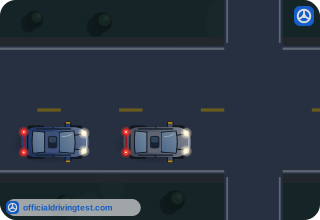
- Within the length of one car
- Inside the lit area created by your headlights
- Before you reach the next intersection
- Within the area lit by the vehicle ahead of you
Show answer
Correct answer: Inside the lit area created by your headlights
At night, you should reduce speed and increase following distance so you can stop inside the area your headlights light up.
Source: Washington Driver Guide (© 2025), page 70 · Open this page in the manual (Manual page 70)
-
What does scanning involve in addition to using your eyes to check your surroundings?
- Moving your head, neck, and body
- Using only your mirrors
- Keeping your eyes fixed on the vehicle ahead
- Turning on your headlights
Show answer
Correct answer: Moving your head, neck, and body
The guide says scanning also involves moving your head, neck, and body to see as much as possible around your vehicle.
Source: Washington Driver Guide (© 2025), page 87 · Open this page in the manual (Manual page 87)
-
What does visual searching mean?
- Looking only at the road directly ahead of your vehicle
- Checking your instrument panel and gauges regularly
- Using your eyes to actively check your surroundings
- Looking around for a legal place to park the vehicle
Show answer
Correct answer: Using your eyes to actively check your surroundings
The guide defines visual searching as using your eyes to actively check your surroundings.
Source: Washington Driver Guide (© 2025), page 87 · Open this page in the manual (Manual page 87)
-
What should the speed you travel at allow you to do?
- Keep up with the fastest traffic
- Search and scan effectively
- Pass slower vehicles quickly
- Avoid using your mirrors
Show answer
Correct answer: Search and scan effectively
The guide says to travel at a speed that supports your ability to search and scan effectively.
Source: Washington Driver Guide (© 2025), page 88 · Open this page in the manual (Manual page 88)
-
When you scan to the front, what should you look for in, under, and around parked vehicles?
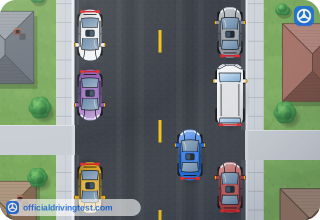
- Only license plates and bumpers
- Open windows and unlocked doors
- Brake lights and license plates
- Feet, wheels, shadows, and movement
Show answer
Correct answer: Feet, wheels, shadows, and movement
The guide says to watch for feet, wheels, shadows, and movement in, under, and around parked vehicles.
Source: Washington Driver Guide (© 2025), page 88 · Open this page in the manual (Manual page 88)
-
What does looking ahead help you avoid?
- Last-minute braking or sudden turning or swerving
- Needing to use your turn signals before every turn
- Having to scan to the side at intersections
- Having to check behind you before you slow down
Show answer
Correct answer: Last-minute braking or sudden turning or swerving
The guide says to look ahead to avoid last-minute braking or the need to turn or swerve suddenly.
Source: Washington Driver Guide (© 2025), page 88 · Open this page in the manual (Manual page 88)
-
When you scan to the front, which of these should you also pay attention to?
- Only the vehicle directly in front of you in your lane
- Only the lane you are driving in at that moment
- What is happening beyond the vehicle in front of you
- Only the traffic signals and signs along the road
Show answer
Correct answer: What is happening beyond the vehicle in front of you
The guide says to watch what is happening beyond the vehicle in front of you, not just the vehicle itself.
Source: Washington Driver Guide (© 2025), page 88 · Open this page in the manual (Manual page 88)
-
When foliage or other objects block your view to the sides, what should you watch for?
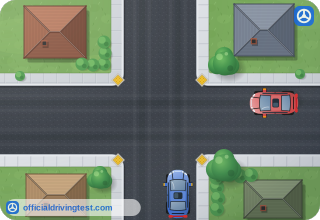
- Signs and signals that are hidden behind the foliage
- The brake lights of the vehicles that are ahead of you
- Changes in the color of the traffic signals ahead of you
- Movement that may show hazards or people planning to cross
Show answer
Correct answer: Movement that may show hazards or people planning to cross
The guide says to watch for movement to spot hazards and people who could be planning to cross the road.
Source: Washington Driver Guide (© 2025), page 88 · Open this page in the manual (Manual page 88)
-
Which of these is a time when the guide says it is essential to look for vehicles and cyclists behind you?
- When you are parked with the engine off
- When you are parked and waiting with the doors locked
- When you turn across a bicycle lane
- When you leave your vehicle to check a tire
Show answer
Correct answer: When you turn across a bicycle lane
The guide lists changing lanes, turning across a bicycle lane, slowing down, backing up, and driving down a long or steep hill.
Source: Washington Driver Guide (© 2025), page 88 · Open this page in the manual (Manual page 88)
-
When should you check traffic behind you more often?
- When traffic is light
- When traffic is heavy
- When the road is empty
- When you are parked
Show answer
Correct answer: When traffic is heavy
The guide says to check more often when traffic is heavy so you have time to react to someone following too closely or coming up too fast.
Source: Washington Driver Guide (© 2025), page 89 · Open this page in the manual (Manual page 89)
-
According to the guide, what uses more fuel?
- Driving smoothly
- Driving at a steady speed
- Keeping your tires properly inflated
- Speeding or braking hard
Show answer
Correct answer: Speeding or braking hard
The guide advises driving smoothly because speeding or braking hard uses more fuel.
Source: Washington Driver Guide (© 2025), page 90 · Open this page in the manual (Manual page 90)
-
May you exceed the speed limit when using the left lane to pass?
- Yes, but only by 5 mph
- No, follow speed limit laws even then
- Yes, if you return to the right lane soon
- Yes, if the traffic around you is speeding
Show answer
Correct answer: No, follow speed limit laws even then
Speed limit laws apply even when you use the left lane to pass.
Source: Washington Driver Guide (© 2025), page 108 · Open this page in the manual (Manual page 108)
-
Automated traffic safety cameras automatically record images if you exceed the speed limit where?
- On any road with a curve
- In a school zone
- In a construction zone with no workers present
- On the freeway ramp
Show answer
Correct answer: In a school zone
These cameras record drivers who exceed the speed limit in a school zone.
Source: Washington Driver Guide (© 2025), page 115 · Open this page in the manual (Manual page 115)
-
What does the maximum speed limit on a speed limit sign assume?
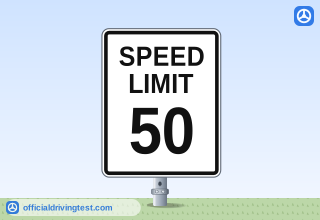
- Ideal conditions
- Heavy traffic
- Wet road surfaces
- Daytime driving only
Show answer
Correct answer: Ideal conditions
The maximum posted speed is for ideal conditions, so you must slow down when conditions are worse.
Source: Washington Driver Guide (© 2025), page 114 · Open this page in the manual (Manual page 114)
-
Can you get a ticket even if you are driving under the posted speed limit?
- No, driving at or under the posted limit is always lawful
- Yes, but only in a school zone or work zone
- No, unless the road is a freeway with a minimum speed
- Yes, if you are traveling too fast for road conditions
Show answer
Correct answer: Yes, if you are traveling too fast for road conditions
You can be ticketed for going too fast for conditions such as a slippery road or fog, even under the posted limit.
Source: Washington Driver Guide (© 2025), page 114 · Open this page in the manual (Manual page 114)
-
Why do some roads have minimum speed limits?
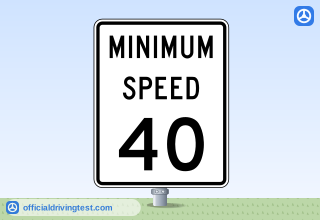
- So that you can save fuel on long trips
- So that you are not a hazard to other drivers
- So that traffic cameras can measure vehicle speeds
- So that you are not passed by faster vehicles
Show answer
Correct answer: So that you are not a hazard to other drivers
On roads with a minimum speed limit you must travel at least that fast so you do not endanger other drivers.
Source: Washington Driver Guide (© 2025), page 114 · Open this page in the manual (Manual page 114)
-
What is the speed limit on an ocean beach where driving is allowed?
- 15 mph
- 20 mph
- 25 mph
- 35 mph
Show answer
Correct answer: 25 mph
The beach speed limit is 25 mph.
Source: Washington Driver Guide (© 2025), page 152 · Open this page in the manual (Manual page 152)
2Part 218 questions
-
How does the guide define a hazard?
- Anything that requires you to make a change
- Only a danger that is moving toward your vehicle
- Any situation in which another driver breaks a traffic law
- A road condition that forces you to stop completely
Show answer
Correct answer: Anything that requires you to make a change
A hazard is anything that requires you to change something about your driving, such as speed or direction.
Source: Washington Driver Guide (© 2025), page 155 · Open this page in the manual (Manual page 155)
-
A hazard on the road can be which of the following?
- Moving only
- Stationary only
- Stationary or moving
- Another vehicle only
Show answer
Correct answer: Stationary or moving
A hazard is not limited to moving things; it can be stationary or moving, and it can be serious or minor.
Source: Washington Driver Guide (© 2025), page 155 · Open this page in the manual (Manual page 155)
-
What is your responsibility when there is more than one hazard at the same time?
- Come to a stop until only one hazard is left
- Determine which hazard requires the most urgent response
- Respond first to whichever hazard is closest to your vehicle
- Wait for other drivers to decide which hazard comes first
Show answer
Correct answer: Determine which hazard requires the most urgent response
With several hazards present, the driver must work out which one needs the most urgent response.
Source: Washington Driver Guide (© 2025), page 155 · Open this page in the manual (Manual page 155)
-
What should you do when you approach a hazard so that you have more time to make safe decisions?
- Drive faster to get past it
- Keep your speed exactly the same
- Move to the far edge of the road
- Drive slower
Show answer
Correct answer: Drive slower
Slowing down gives you more time and space to decide safely when a hazard is ahead.
Source: Washington Driver Guide (© 2025), page 155 · Open this page in the manual (Manual page 155)
-
What does the guide say hazard perception is?
- The ability to avoid every risk on the road
- The ability to remember where hazards were on a road you have driven before
- The ability to scan for potential risks and identify them before they become a problem
- The ability to steer around a hazard once it is directly in your path
Show answer
Correct answer: The ability to scan for potential risks and identify them before they become a problem
Hazard perception means spotting potential risks early, before they turn into problems.
Source: Washington Driver Guide (© 2025), page 155 · Open this page in the manual (Manual page 155)
-
Which of these does hazard perception require?
- Quick decision-making
- Driving only on familiar roads
- Using the horn to warn others
- Knowing the speed limit of every road
Show answer
Correct answer: Quick decision-making
Hazard perception requires attentiveness, quick decision-making and the ability to react appropriately to changing situations.
Source: Washington Driver Guide (© 2025), page 155 · Open this page in the manual (Manual page 155)
-
What does the guide say risk awareness is?
- Your ability to remove all risk from driving
- Your knowledge of the penalties for common traffic violations
- Your skill at controlling the vehicle if it starts to skid on a wet road
- Your ability to identify present and potential hazards on the road
Show answer
Correct answer: Your ability to identify present and potential hazards on the road
Risk awareness is spotting hazards that are present or might develop, so you can change your behavior to avoid a crash.
Source: Washington Driver Guide (© 2025), page 154 · Open this page in the manual (Manual page 154)
-
How does the guide say you can stay aware of what is happening in front of you, beside you, and behind you?
- By asking your passengers to watch for you
- By using your peripheral vision and mirrors
- By checking your mirrors only when you stop
- By watching only the vehicle directly ahead
Show answer
Correct answer: By using your peripheral vision and mirrors
The guide says to keep your head scanning continually, using peripheral vision and mirrors.
Source: Washington Driver Guide (© 2025), page 154 · Open this page in the manual (Manual page 154)
-
After you spot a hazard that requires you to make a change, what should you do?
- Check behind you for anything that affects your decision
- Sound your horn to warn drivers behind you
- Brake right away and keep your eyes on the hazard only
- Turn on your hazard lights and keep going at the same speed
Show answer
Correct answer: Check behind you for anything that affects your decision
What is happening behind you can affect your decision, so you check there after spotting the hazard.
Source: Washington Driver Guide (© 2025), page 155 · Open this page in the manual (Manual page 155)
-
Why should you leave enough space in front of your vehicle?
- To leave room for other drivers to pass you
- To stay out of the blind zones of other vehicles
- To see what is happening on the road ahead
- To keep from needing to use your signals
Show answer
Correct answer: To see what is happening on the road ahead
Enough space in front lets you see what is happening on the road ahead.
Source: Washington Driver Guide (© 2025), page 155 · Open this page in the manual (Manual page 155)
-
What does the guide say situational awareness is?
- Knowing the traffic laws and road conditions of every area you drive in
- Planning your whole route and your stops before you start the engine
- Watching only the vehicles that are closest to you on the road
- Observing what is happening all around you and predicting what to prepare for next
Show answer
Correct answer: Observing what is happening all around you and predicting what to prepare for next
Situational awareness is watching everything around you and predicting what to prepare for next, and you should do it constantly.
Source: Washington Driver Guide (© 2025), page 156 · Open this page in the manual (Manual page 156)
-
Who could be the most affected by your decisions while driving?
- The drivers coming toward you
- Pedestrians on the sidewalk
- The drivers behind you
- The passengers in your vehicle
Show answer
Correct answer: The drivers behind you
You need to know who might be affected by your actions, and the drivers behind you could be the most affected.
Source: Washington Driver Guide (© 2025), page 156 · Open this page in the manual (Manual page 156)
-
In the guide's hazard management routine, what do you do in the Plan step?
- Scan around you, check your rearview mirror, and decide if the change is safe
- Let others know what you plan to do by using your signals and your horn
- Make the change smoothly and try not to surprise anyone
- Think about how it went and decide how to adjust your routine
Show answer
Correct answer: Scan around you, check your rearview mirror, and decide if the change is safe
The Plan step is about scanning your surroundings, including behind you, and deciding whether the change is safe.
Source: Washington Driver Guide (© 2025), page 156 · Open this page in the manual (Manual page 156)
-
In the guide's hazard management routine, what do you do in the Communicate step?
- Check your mirrors and look over your shoulder for pedestrians
- Decide whether the change is safe
- Brake firmly to claim the space you need
- Use your signals so that everyone knows what you plan to do
Show answer
Correct answer: Use your signals so that everyone knows what you plan to do
In the Communicate step you let others know what you plan to do, using your signals.
Source: Washington Driver Guide (© 2025), page 156 · Open this page in the manual (Manual page 156)
-
In the guide's hazard management routine, what do you do in the Check step?
- Sound your horn to let all nearby drivers know that you are there
- Recheck mirrors and look over your shoulder for pedestrians and bicyclists
- Come to a stop to see whether other drivers yield
- Think about how the maneuver went
Show answer
Correct answer: Recheck mirrors and look over your shoulder for pedestrians and bicyclists
In the Check step you prepare your position and speed and recheck mirrors and blind areas for pedestrians, bicyclists and other drivers.
Source: Washington Driver Guide (© 2025), page 156 · Open this page in the manual (Manual page 156)
-
In the guide's hazard management routine, what do you do in the Execute step?
- Make the change smoothly and be ready to change your plan if needed
- Prepare your vehicle position and speed for the change
- Scan your environment to see what is happening around you
- Wait for other drivers to signal before you move
Show answer
Correct answer: Make the change smoothly and be ready to change your plan if needed
Execute means carrying out the change smoothly without surprising anyone, while staying ready to change the plan.
Source: Washington Driver Guide (© 2025), page 156 · Open this page in the manual (Manual page 156)
-
In the guide's hazard management routine, what do you do in the Evaluate step?
- Make sure no other driver is trying to move into the same space
- Use your signals to show your intentions
- Think about how it went and see if you need to adjust your routine
- Decide if the change you want to make is safe
Show answer
Correct answer: Think about how it went and see if you need to adjust your routine
The Evaluate step is a look back at how the maneuver went, so you can adjust your routine next time.
Source: Washington Driver Guide (© 2025), page 156 · Open this page in the manual (Manual page 156)
-
When you prepare your vehicle position and speed in the Check step, what should the space allow you to do?
- Make your change without using your signals
- Make your change with no more than medium braking
- Make your change without checking your mirrors
- Make your change at the speed limit
Show answer
Correct answer: Make your change with no more than medium braking
The Check step prepares your position and speed so there is enough space for the change with no more than medium braking.
Source: Washington Driver Guide (© 2025), page 156 · Open this page in the manual (Manual page 156)
3Part 318 questions
-
Which of these can excessive speeds do, according to the guide?
- Increase the effectiveness of seat belts
- Shorten your stopping distance
- Give you more time to scan for hazards
- Reduce the effectiveness of seat belts
Show answer
Correct answer: Reduce the effectiveness of seat belts
The guide says seat belts protect you in a crash, but their effectiveness decreases at higher speeds.
Source: Washington Driver Guide (© 2025), page 157 · Open this page in the manual (Manual page 157)
-
What happens to the time you have to scan the road ahead as you drive faster?
- You have more time to scan for hazards
- It stays the same on a straight road
- You have less time to scan for hazards
- It stays the same in clear weather
Show answer
Correct answer: You have less time to scan for hazards
The faster you drive, the less time you have to scan ahead for pedestrians, cyclists and other vehicles.
Source: Washington Driver Guide (© 2025), page 157 · Open this page in the manual (Manual page 157)
-
What can high speeds in adverse conditions like rain or snow lead to?
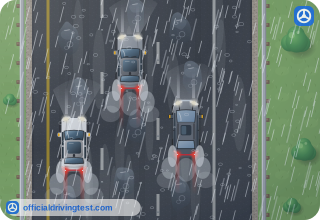
- Skidding or losing control entirely
- Better traction on the road surface
- A shorter stopping distance
- Less force of impact in a crash
Show answer
Correct answer: Skidding or losing control entirely
High speeds make a vehicle harder to control, especially in rain or snow, which can lead to skidding or loss of control.
Source: Washington Driver Guide (© 2025), page 157 · Open this page in the manual (Manual page 157)
-
How does a higher speed affect the distance and time needed to stop a vehicle?
- It takes the same time to stop
- It takes less time to stop
- It affects only the time and not the distance
- It takes longer to stop
Show answer
Correct answer: It takes longer to stop
Higher speed creates longer stopping distances, which raises the risk of a collision when you must brake suddenly.
Source: Washington Driver Guide (© 2025), page 157 · Open this page in the manual (Manual page 157)
-
How does speeding affect the time you have to react to curves, intersections, or obstacles?
- It gives you more time to react
- It gives you less time to react
- It makes no difference on straight roads
- It gives you more time on curves only
Show answer
Correct answer: It gives you less time to react
Speeding leaves less time to assess your path of travel and react to changes in the road.
Source: Washington Driver Guide (© 2025), page 157 · Open this page in the manual (Manual page 157)
-
What happens to the force of impact in a crash as speed increases?
- It increases, leading to more severe injuries
- It stays the same
- It decreases when the driver wears a seat belt
- It decreases on dry roads
Show answer
Correct answer: It increases, leading to more severe injuries
Higher speed means greater impact force, so injuries are more severe.
Source: Washington Driver Guide (© 2025), page 158 · Open this page in the manual (Manual page 158)
-
What do speed limits indicate, according to the guide?
- The speed you should always drive
- The average speed of traffic under ideal conditions
- The maximum speed legal under ideal conditions
- The speed that is safe in any weather
Show answer
Correct answer: The maximum speed legal under ideal conditions
The posted limit is the top legal speed under ideal conditions, not a speed that is safe in every condition.
Source: Washington Driver Guide (© 2025), page 158 · Open this page in the manual (Manual page 158)
-
What else does Washington law require of you besides staying within the speed limit?
- To drive 5 miles per hour below the limit in poor weather
- To drive at speeds that are safe for current road conditions
- To drive at the same speed as the vehicle ahead
- To drive at the minimum speed when traffic is heavy
Show answer
Correct answer: To drive at speeds that are safe for current road conditions
State law requires a speed that is safe for current conditions, which means slowing down when conditions are poor.
Source: Washington Driver Guide (© 2025), page 158 · Open this page in the manual (Manual page 158)
-
In which of these conditions does the guide say to reduce your speed?
- A straight, dry road with no other traffic
- A wide road with long sight distances
- A road you drive every day
- Sharp curves or hills where visibility is limited
Show answer
Correct answer: Sharp curves or hills where visibility is limited
The guide lists limited-visibility curves and hills among the conditions that call for a lower speed.
Source: Washington Driver Guide (© 2025), page 158 · Open this page in the manual (Manual page 158)
-
Which of these places does the guide name as one where you should reduce your speed?
- A divided road with light traffic
- A straight road in clear daylight
- Narrow bridges and tunnels
- A wide, flat country road
Show answer
Correct answer: Narrow bridges and tunnels
Narrow bridges and tunnels are on the guide's list of conditions that call for a reduced speed.
Source: Washington Driver Guide (© 2025), page 158 · Open this page in the manual (Manual page 158)
-
Which of these does the guide name as a reason to slow down?
- Shopping centers, parking lots, and areas with heavy foot traffic
- Roads where there are no pedestrians, children, or cyclists nearby
- Dry roads in daylight with light traffic
- Roads where the speed limit sign was just passed
Show answer
Correct answer: Shopping centers, parking lots, and areas with heavy foot traffic
Places with lots of people on foot, such as shopping centers and parking lots, call for a reduced speed.
Source: Washington Driver Guide (© 2025), page 158 · Open this page in the manual (Manual page 158)
-
Why are novice drivers at greater risk when judging space?
- They are not allowed to use their mirrors
- They cannot judge space by either distance or time
- They drive in more traffic than other drivers
- It can take time and practice before you are proficient
Show answer
Correct answer: It can take time and practice before you are proficient
Judging space is a valuable skill that takes time and practice to learn, so novice drivers face more risk.
Source: Washington Driver Guide (© 2025), page 159 · Open this page in the manual (Manual page 159)
-
What does leaving enough space around your vehicle give you?
- The right-of-way over nearby vehicles
- Time to determine an alternative path
- A way to avoid using your signals
- A quicker route through traffic
Show answer
Correct answer: Time to determine an alternative path
Space around your vehicle gives you time and room to find another path if there is a problem.
Source: Washington Driver Guide (© 2025), page 159 · Open this page in the manual (Manual page 159)
-
When you drive near other vehicles, what distance should you leave between you and the vehicle ahead?
- At least twice the length of your vehicle
- About half the length of your vehicle
- Exactly the length of your vehicle
- At least four times the length of your vehicle
Show answer
Correct answer: At least twice the length of your vehicle
The guide says to leave at least twice the length of your own vehicle between you and the vehicle ahead.
Source: Washington Driver Guide (© 2025), page 159 · Open this page in the manual (Manual page 159)
-
What is eye-lead time?
- A measure of how long your eyes may be off the road
- The time between a signal changing and your braking
- The time you need to adjust your mirrors
- A technique for scanning the road ahead for hazards
Show answer
Correct answer: A technique for scanning the road ahead for hazards
Eye-lead time is a scanning technique that gives you time to see, analyze and respond to hazards.
Source: Washington Driver Guide (© 2025), page 161 · Open this page in the manual (Manual page 161)
-
How far does the guide say to scan when using eye-lead time?
- Only as far as your headlights reach
- About one block ahead
- As far as you can see ahead and to the sides
- Only to the vehicle directly in front of you
Show answer
Correct answer: As far as you can see ahead and to the sides
With eye-lead time you scan as far ahead and to the sides as you can see, and use your mirrors for behind.
Source: Washington Driver Guide (© 2025), page 161 · Open this page in the manual (Manual page 161)
-
What is the benefit of identifying a hazard earlier?
- You have more time to prepare, and so do others
- You can drive faster through the hazard area
- You no longer need to check your mirrors
- You have the right-of-way over other road users
Show answer
Correct answer: You have more time to prepare, and so do others
The earlier you spot a hazard, the more time you and those around you have to adjust.
Source: Washington Driver Guide (© 2025), page 161 · Open this page in the manual (Manual page 161)
-
What does giving yourself enough time to stop or maneuver help reduce?
- The need to check your mirrors
- Panic and impulsive reactions
- The time it takes to reach your destination
- The need to use your signals
Show answer
Correct answer: Panic and impulsive reactions
With enough time you can evaluate and prioritize your decisions, which helps reduce panic and impulsive reactions.
Source: Washington Driver Guide (© 2025), page 162 · Open this page in the manual (Manual page 162)
4Part 417 questions
-
What does the guide say you should do to be prepared?
- Anticipate hazards by scanning the road ahead
- Turn off in-car entertainment systems
- Adjust your speed for road conditions and weather
- Check your phone before you start driving
Show answer
Correct answer: Anticipate hazards by scanning the road ahead
To be prepared, you anticipate hazards by scanning ahead and stay aware of your surroundings.
Source: Washington Driver Guide (© 2025), page 163 · Open this page in the manual (Manual page 163)
-
What does the guide say you should do to be proactive?
- Turn off your phone and in-car entertainment systems before you drive
- Scan the road ahead to anticipate hazards
- Keep the same speed on every road
- Adjust your speed and driving to road conditions, weather, and traffic
Show answer
Correct answer: Adjust your speed and driving to road conditions, weather, and traffic
Being proactive means changing your speed and driving to fit conditions, weather and traffic.
Source: Washington Driver Guide (© 2025), page 163 · Open this page in the manual (Manual page 163)
-
Which type of vision allows you to see detail straight in front of you?
- Fringe vision
- Peripheral vision
- Central vision
- Rear vision
Show answer
Correct answer: Central vision
Central vision is the focused vision straight ahead, like the vision you use to read.
Source: Washington Driver Guide (© 2025), page 164 · Open this page in the manual (Manual page 164)
-
Which type of vision is used to see what is to the side of you without losing focus on what is straight ahead?
- Central vision
- Peripheral vision
- Fringe vision
- Night vision
Show answer
Correct answer: Peripheral vision
Peripheral vision lets you see things to the side while keeping your focus ahead.
Source: Washington Driver Guide (© 2025), page 164 · Open this page in the manual (Manual page 164)
-
What does the guide say happens to the quality of your central, fringe, and peripheral vision at higher speeds?
- Only central vision is reduced in quality
- Only peripheral vision is reduced in quality
- Each type of vision is reduced in quality
- The quality of each stays the same
Show answer
Correct answer: Each type of vision is reduced in quality
The guide states that higher speeds reduce the quality of all three types of vision.
Source: Washington Driver Guide (© 2025), page 164 · Open this page in the manual (Manual page 164)
-
What does the guide say your path of travel is?
- The route or course you drive to get from one place to another
- The lane markings you drive between
- The distance between you and the vehicle in front of you
- The area you are scanning in your mirrors
Show answer
Correct answer: The route or course you drive to get from one place to another
Your path of travel is the course you take, and you may need to change it because of a hazard, weather or a new direction.
Source: Washington Driver Guide (© 2025), page 165 · Open this page in the manual (Manual page 165)
-
What does the guide say your line of sight is, once you pick the area where you want to be?
- The area directly beside your vehicle
- The area you see in your rearview mirror
- The route you drive to get there
- What is between you and that target
Show answer
Correct answer: What is between you and that target
Once you choose a target area, your line of sight is the space between you and that target.
Source: Washington Driver Guide (© 2025), page 165 · Open this page in the manual (Manual page 165)
-
What does the guide say a big part of driving is?
- Keeping your eyes fixed on the vehicle ahead and matching its speed
- Constantly shifting your focus between where you are and where you want to be
- Choosing a new path of travel every few seconds
- Matching your speed to the vehicle ahead
Show answer
Correct answer: Constantly shifting your focus between where you are and where you want to be
Driving requires you to keep shifting your visual focus and attention between your current position and your target.
Source: Washington Driver Guide (© 2025), page 165 · Open this page in the manual (Manual page 165)
-
You should drive slowly enough to stop within the glow of your headlights at night. About how far do the headlights usually light the road?
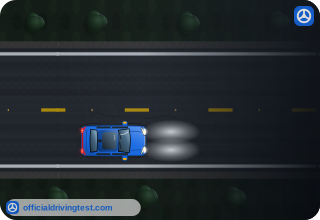
- 100 feet
- 250 feet
- 400 feet
- 600 feet
Show answer
Correct answer: 400 feet
The guide gives 400 feet as the usual distance within which you should be able to stop at night.
Source: Washington Driver Guide (© 2025), page 166 · Open this page in the manual (Manual page 166)
-
How should your following distance change for night driving and for unfamiliar roads at night?
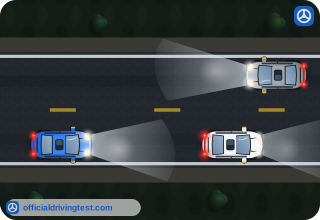
- Decrease it
- Keep it the same as in daytime
- Follow closely so you can use the other vehicle's lights
- Increase it
Show answer
Correct answer: Increase it
The guide tells drivers to leave more following distance at night and on unfamiliar roads at night.
Source: Washington Driver Guide (© 2025), page 167 · Open this page in the manual (Manual page 167)
-
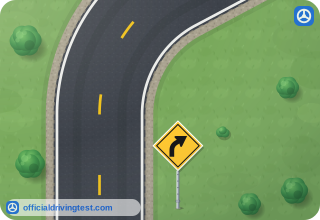
When should you reduce your speed for a curve?
- After you reach the middle of the curve
- Only after the vehicle begins to skid
- Before entering the curve
- Just as you leave the curve
Show answer
Correct answer: Before entering the curve
Slowing before the curve keeps traction and helps prevent skidding or leaving the road.
Source: Washington Driver Guide (© 2025), page 168 · Open this page in the manual (Manual page 168)
-
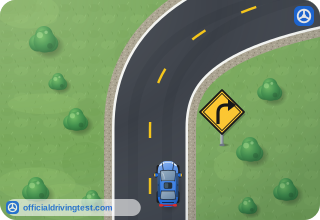
What might uphill and downhill curves require, according to the guide?
- Uphill curves could require more braking, while downhill curves might require more acceleration
- Both require the same steady speed with no changes
- Uphill curves could require more acceleration, while downhill curves might require more braking
- Both require shifting to neutral to keep speed steady
Show answer
Correct answer: Uphill curves could require more acceleration, while downhill curves might require more braking
Hills change how much power or braking a curve needs, so be ready to adjust.
Source: Washington Driver Guide (© 2025), page 168 · Open this page in the manual (Manual page 168)
-
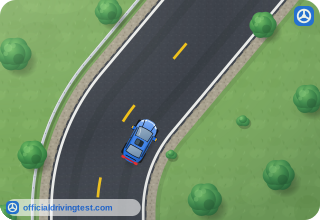
What should you do with your speed while you are in a curve?
- Brake firmly so that the vehicle stays under control
- Accelerate firmly to keep your momentum up
- Shift to neutral and let the vehicle coast
- Keep a steady speed; avoid sudden braking or accelerating
Show answer
Correct answer: Keep a steady speed; avoid sudden braking or accelerating
Sudden braking or accelerating in a curve can upset the balance of the vehicle and cause a loss of control.
Source: Washington Driver Guide (© 2025), page 168 · Open this page in the manual (Manual page 168)
-
As you exit a curve, how should you return to your desired speed?
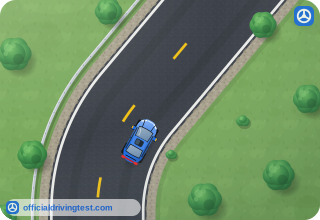
- Accelerate gradually
- Accelerate as hard as possible
- Brake lightly until the road is straight
- Stay at the curve speed for a few miles
Show answer
Correct answer: Accelerate gradually
Gentle acceleration keeps the vehicle stable as it returns to traveling straight.
Source: Washington Driver Guide (© 2025), page 168 · Open this page in the manual (Manual page 168)
-
What does the guide say about higher speeds?
- They lower kinetic energy, so the vehicle stops sooner
- They have no effect on the distance needed to turn
- They increase tire grip so turns are easier
- They create more energy, needing more time and space to stop
Show answer
Correct answer: They create more energy, needing more time and space to stop
Higher speeds create more energy, so you need more time and space to stop or change direction.
Source: Washington Driver Guide (© 2025), page 169 · Open this page in the manual (Manual page 169)
-
When the road is slippery, what might you need to do?
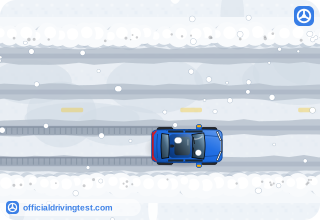
- Drive below the posted speed limit
- Drive at least at the posted speed limit
- Follow closer to share a path with other tires
- Switch to high beams
Show answer
Correct answer: Drive below the posted speed limit
The guide says you must adjust to the conditions, which might mean driving below the posted limit.
Source: Washington Driver Guide (© 2025), page 170 · Open this page in the manual (Manual page 170)
-
What do snowy roads require?
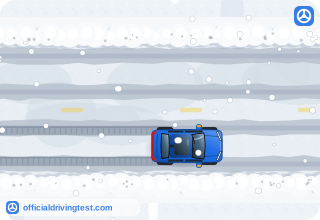
- A smaller following distance and the posted speed
- Only a slightly reduced speed on straight roads
- A shorter following distance to keep in sight of other cars
- A larger following distance and dramatically reduced speed
Show answer
Correct answer: A larger following distance and dramatically reduced speed
Snowy roads call for much more following distance and a far lower speed.
Source: Washington Driver Guide (© 2025), page 170 · Open this page in the manual (Manual page 170)