Washington: Hazardous conditions and collisions — Part 4 Practice Test
Questions in this part include: “After you jump clear of a vehicle in contact with power lines, how should you move away 35 feet?” · “Why does the guide suggest keeping a paper copy of important numbers in your vehicle?”
Independent educational site · not affiliated with any government agency or DMV
Ready? Test yourself
Answer to start, or tap Start below:
If power lines fall on your vehicle or you hit a transformer box, how far away should you encourage people to stay, when possible?
- Instant feedback with an explanation
- Every answer cites its source in the manual
- Your best score is saved on this device
- Keyboard: press 1 to 4 to answer and Enter for the next question
Questions are original and based on the official manual "Washington Driver Guide" (© 2025), Washington State Department of Licensing (DOL).
All 17 questions in this practice test
Take the test above first, then use this list to study. Tap “Show answer” to see the correct answer and explanation.
Show the questions and answersHide the questions
-
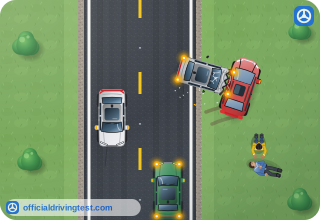
What is the first step if you see an injured person bleeding?
- Give the person water to drink
- Apply pressure with hands
- Have the person walk around
- Rinse the wound with water
Show answer
Correct answer: Apply pressure with hands
The first step in the guide's bleeding list is to apply pressure with your hands.
Source: Washington Driver Guide (© 2025), page 177 · Open this page in the manual (Manual page 177)
-
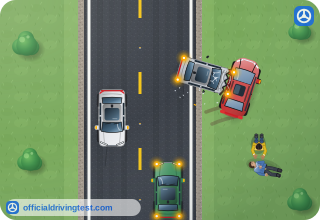
What should you give injured people to drink after a crash?
- Only small sips of water
- Warm tea or coffee
- Nothing, not even water
- Water, if they ask for it
Show answer
Correct answer: Nothing, not even water
The guide says not to give injured people anything to drink.
Source: Washington Driver Guide (© 2025), page 177 · Open this page in the manual (Manual page 177)
-
Why should you cover injured people with a blanket or coat?
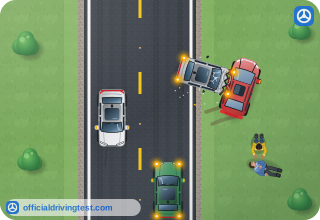
- To keep them warm and help prevent shock
- To protect them from broken glass
- To signal to other drivers that help is needed
- To stop bleeding
Show answer
Correct answer: To keep them warm and help prevent shock
Keeping an injured person warm helps prevent shock.
Source: Washington Driver Guide (© 2025), page 177 · Open this page in the manual (Manual page 177)
-
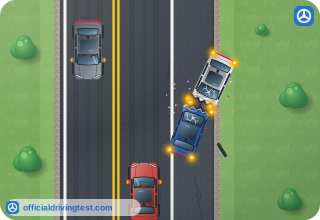
What should you tell a 911 dispatcher first after a crash?
- Only the name of your insurance company
- Your location, with any landmarks or mile markers
- Only your home address, then hang up
- Nothing until the dispatcher asks you twice
Show answer
Correct answer: Your location, with any landmarks or mile markers
Clearly giving your location, with landmarks or mile markers, helps responders find you.
Source: Washington Driver Guide (© 2025), page 177 · Open this page in the manual (Manual page 177)
-
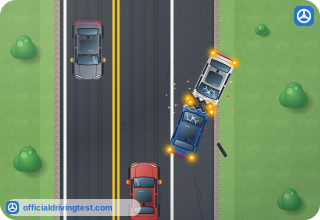
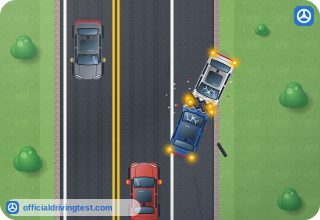
When you describe the crash to a 911 dispatcher, what should you include?
- The names of the drivers' employers and their ages
- The speed limit and the forecast for the day
- Who you think caused the crash and who is at fault
- The number of vehicles, the damage, and any injuries
Show answer
Correct answer: The number of vehicles, the damage, and any injuries
The guide says to give a brief description including vehicles, damage, and injuries.
Source: Washington Driver Guide (© 2025), page 177 · Open this page in the manual (Manual page 177)
-
How long should you stay on the phone with a 911 dispatcher after a crash?
- Until help arrives
- Until you have given your location
- Until the first officer calls you back
- For no more than one minute
Show answer
Correct answer: Until help arrives
The guide says to stay on the phone with the dispatcher until help arrives.
Source: Washington Driver Guide (© 2025), page 178 · Open this page in the manual (Manual page 178)
-
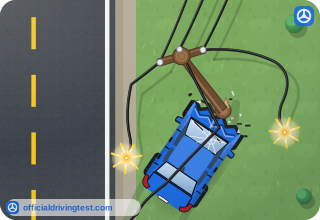
If a power line comes in contact with your vehicle, what should you do?
- Get out and run away from the vehicle
- Step out and move the line with a stick
- Do not get out of the vehicle
- Open the doors and wait outside
Show answer
Correct answer: Do not get out of the vehicle
Do not get out if a power line touches your vehicle. The one exception is a fire, when you must jump clear.
Source: Washington Driver Guide (© 2025), page 178 · Open this page in the manual (Manual page 178)
-
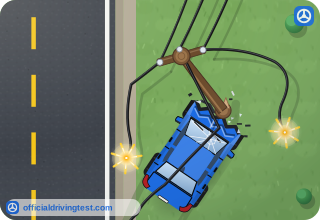
If a collision involves power lines, what should you do?
- Leave the engine running and walk to a safe place
- Drive away from the lines as fast as you can
- Turn off the engine, call 911, and stay inside
- Get out and check whether the lines are live
Show answer
Correct answer: Turn off the engine, call 911, and stay inside
If a collision involves power lines, turn off your engine, call 911, and stay inside until emergency responders arrive.
Source: Washington Driver Guide (© 2025), page 178 · Open this page in the manual (Manual page 178)
-
How should you treat downed or hanging power lines?
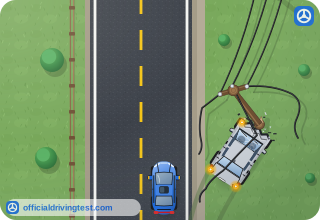
- Assume they are all energized
- Assume they are safe if they are not sparking
- Assume they are safe if the wires are on the ground
- Assume they are safe if the power is off in the area
Show answer
Correct answer: Assume they are all energized
The guide says you never know if a line is charged, so assume all of them are.
Source: Washington Driver Guide (© 2025), page 178 · Open this page in the manual (Manual page 178)
-
What should you do if you accidentally drive over a power line?
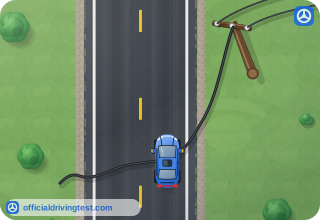
- Reverse off the line
- Drive forward quickly to clear it
- Get out and look at it
- Stop immediately
Show answer
Correct answer: Stop immediately
Moving forward or reversing puts you at risk of being electrocuted.
Source: Washington Driver Guide (© 2025), page 178 · Open this page in the manual (Manual page 178)
-
If power lines fall on your vehicle or you hit a transformer box, how far away should you encourage people to stay, when possible?
- At least 5 feet
- At least 35 feet
- At least 10 feet
- At least 100 feet
Show answer
Correct answer: At least 35 feet
The ground around the vehicle could also be energized, so bystanders should keep at least 35 feet away.
Source: Washington Driver Guide (© 2025), page 178 · Open this page in the manual (Manual page 178)
-
If your vehicle touches power lines and a fire starts, how should you get out of the vehicle?
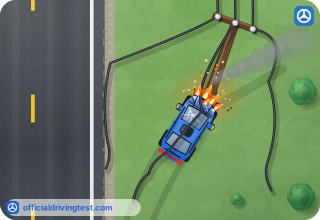
- Jump clear, arms at your sides, landing with both feet together
- Step out with one foot on the ground and one on the car
- Climb out slowly while holding on to the door frame
- Run out of the vehicle with your arms outstretched
Show answer
Correct answer: Jump clear, arms at your sides, landing with both feet together
The guide describes jumping away from the vehicle with feet together to avoid electric shock.
Source: Washington Driver Guide (© 2025), page 178 · Open this page in the manual (Manual page 178)
-
After you jump clear of a vehicle in contact with power lines, how should you move away 35 feet?
- Run
- Walk with long steps
- Shuffle
- Hop on one foot
Show answer
Correct answer: Shuffle
Shuffling is described as the way to avoid electric shock while moving away.
Source: Washington Driver Guide (© 2025), page 178 · Open this page in the manual (Manual page 178)
-
After escaping from a vehicle that touched power lines, when may you go back inside for belongings?
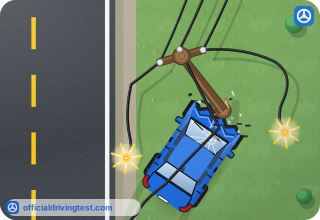
- Once the flames appear to be out
- Not until you are advised it is safe
- When the power line stops moving
- After one minute has passed
Show answer
Correct answer: Not until you are advised it is safe
The guide says not to return until you are told it is safe.
Source: Washington Driver Guide (© 2025), page 178 · Open this page in the manual (Manual page 178)
-
When you witness a crash, what should you do as you pass?
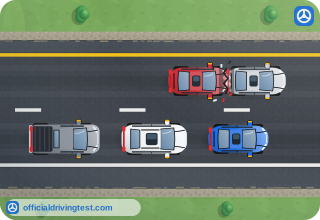
- Slow down so you can see how serious the crash is
- Stop in your lane to take photos of the scene
- Honk to let the drivers involved know you are there
- Focus on your driving instead of slowing down to stare
Show answer
Correct answer: Focus on your driving instead of slowing down to stare
Slowing down to stare creates traffic congestion; focus on driving instead.
Source: Washington Driver Guide (© 2025), page 179 · Open this page in the manual (Manual page 179)
-
What should you do when you witness a crash and emergency responders are at the scene?
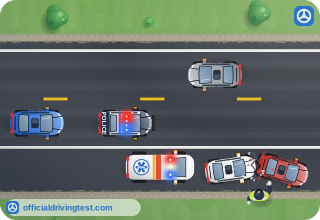
- Stop your vehicle near them and offer to help the officers
- Pass them while sounding your horn to warn others
- Drive around them using the shoulder to save time
- Do not block them; follow directions from police and firefighters
Show answer
Correct answer: Do not block them; follow directions from police and firefighters
The guide says not to block responders and to follow directions from authorized persons.
Source: Washington Driver Guide (© 2025), page 179 · Open this page in the manual (Manual page 179)
-
Why does the guide suggest keeping a paper copy of important numbers in your vehicle?
- It is required by state law if you carry a phone
- It helps if your phone dies and you must use another phone
- It lets you skip calling 911 in an emergency
- It replaces your proof of insurance if you lose it
Show answer
Correct answer: It helps if your phone dies and you must use another phone
A paper list of family and insurance numbers still works when your phone is dead.
Source: Washington Driver Guide (© 2025), page 179 · Open this page in the manual (Manual page 179)