Washington: Hazardous conditions and collisions — Part 2 Practice Test
Questions in this part include: “How far behind your disabled vehicle should you place emergency flares?” · “If the engine shuts off while you are driving, what should you know about the steering wheel?”
Independent educational site · not affiliated with any government agency or DMV
Ready? Test yourself
Answer to start, or tap Start below:
How far behind your disabled vehicle should you place emergency flares?
- Instant feedback with an explanation
- Every answer cites its source in the manual
- Your best score is saved on this device
- Keyboard: press 1 to 4 to answer and Enter for the next question
Questions are original and based on the official manual "Washington Driver Guide" (© 2025), Washington State Department of Licensing (DOL).
All 18 questions in this practice test
Take the test above first, then use this list to study. Tap “Show answer” to see the correct answer and explanation.
Show the questions and answersHide the questions
-
What is the first thing to do if your vehicle is skidding?
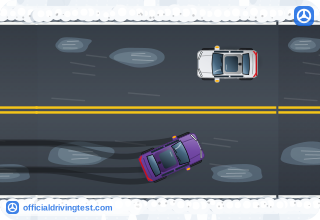
- Turn the wheel sharply away from the skid
- Shift into reverse
- Take your foot off the accelerator
- Press the accelerator to pull out of the skid
Show answer
Correct answer: Take your foot off the accelerator
The guide lists taking your foot off the accelerator as the first step in a skid.
Source: Washington Driver Guide (© 2025), page 171 · Open this page in the manual (Manual page 171)
-
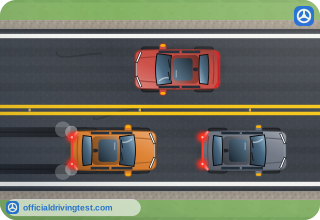
If your vehicle does not have antilock brakes and you are skidding, what could quickly pressing the brake pedal down do?
- Stop the skid right away
- Cause you to skid more
- Lock the steering for a smoother recovery
- Improve your steering control
Show answer
Correct answer: Cause you to skid more
Without antilock brakes, quickly pressing the brake pedal down could make the skid worse.
Source: Washington Driver Guide (© 2025), page 171 · Open this page in the manual (Manual page 171)
-
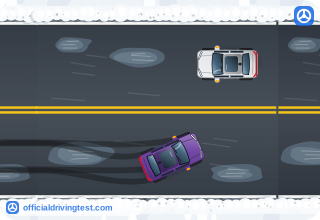
What do antilock brakes do in a skid?
- Prevent the vehicle from ever skidding again
- Keep the tires from touching the road
- Take over the steering for you
- Control wheel rotation and let you keep steering
Show answer
Correct answer: Control wheel rotation and let you keep steering
Antilock brakes control the rotation of the wheels and let you keep steering.
Source: Washington Driver Guide (© 2025), page 171 · Open this page in the manual (Manual page 171)
-
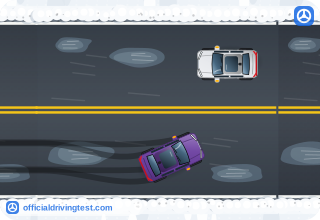
In which direction should you steer if your vehicle is skidding?
- In the opposite direction from the way the vehicle is moving
- Toward the nearest curb
- Straight ahead without adjusting
- In the same direction your vehicle is moving
Show answer
Correct answer: In the same direction your vehicle is moving
The guide says to steer the way the vehicle is moving and keep correcting until the tires regain traction.
Source: Washington Driver Guide (© 2025), page 172 · Open this page in the manual (Manual page 172)
-
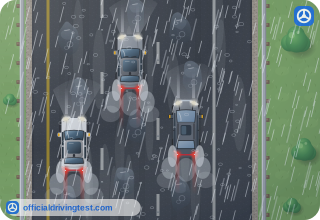
What is hydroplaning?
- Ice builds up between the tires and the road, causing a spin
- Water builds up between the tires and the road, causing a skid
- The tires overheat and lose air pressure on a hot road
- The brakes stick on a wet road and the wheels lock up
Show answer
Correct answer: Water builds up between the tires and the road, causing a skid
Hydroplaning is a loss of traction caused by water between the tires and the road.
Source: Washington Driver Guide (© 2025), page 172 · Open this page in the manual (Manual page 172)
-
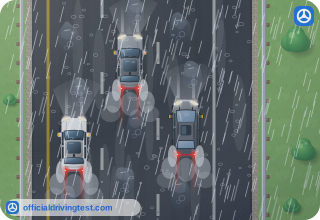
What is the best way to keep from hydroplaning?
- Drive faster to push the water aside
- Brake firmly as soon as the road is wet
- Slow down when the road is wet
- Use your high beams
Show answer
Correct answer: Slow down when the road is wet
Slowing down on a wet road is the guide's best way to avoid hydroplaning.
Source: Washington Driver Guide (© 2025), page 172 · Open this page in the manual (Manual page 172)
-
If you hydroplane, how should you handle the steering wheel?
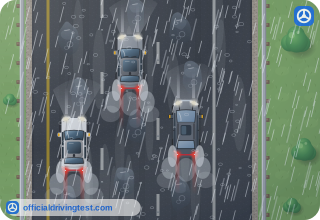
- Keep it steady; do not overcorrect or jerk it
- Turn it sharply in the direction of the skid
- Turn it back and forth to find traction
- Let go of it until the tires grip
Show answer
Correct answer: Keep it steady; do not overcorrect or jerk it
A steady wheel without overcorrection helps you regain control when the tires get traction again.
Source: Washington Driver Guide (© 2025), page 172 · Open this page in the manual (Manual page 172)
-
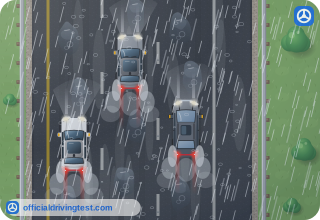
If you hydroplane, how should you press the brakes?
- Forcefully
- Gently
- Not at all, under any circumstances
- In short, rapid stabs
Show answer
Correct answer: Gently
The guide says to press the brakes gently; forceful pressing without antilock brakes could cause more hydroplaning.
Source: Washington Driver Guide (© 2025), page 172 · Open this page in the manual (Manual page 172)
-
If you have vehicle trouble on the road, where should you try to get your vehicle?
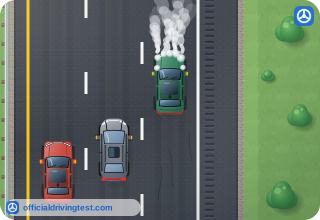
- To the middle of the lane so others see it
- Just over the top of a hill
- Around the nearest curve
- Off the road and away from traffic, if possible
Show answer
Correct answer: Off the road and away from traffic, if possible
Getting off the road and away from traffic is the first tip for vehicle trouble.
Source: Washington Driver Guide (© 2025), page 173 · Open this page in the manual (Manual page 173)
-
If you cannot get your disabled vehicle off the road, where should you stop?
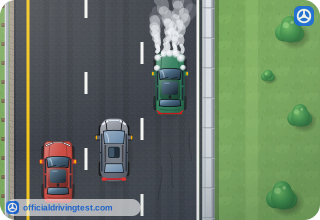
- Where other drivers have a clear view of your vehicle
- Just over a hill, off the side of the road
- Just around a curve, as close to the edge as possible
- Under a tree or bridge, in the shade
Show answer
Correct answer: Where other drivers have a clear view of your vehicle
Avoid stopping over a hill or around a curve so other drivers can see your vehicle.
Source: Washington Driver Guide (© 2025), page 173 · Open this page in the manual (Manual page 173)
-
What should you turn on when your vehicle has trouble on the road?
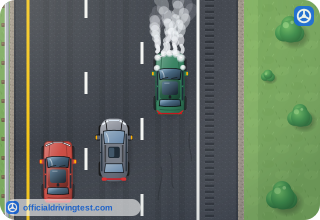
- Only your interior lights, to save the battery
- Your high beams only, without the flashers
- Your emergency flashers and headlights
- Nothing, so the battery does not run down
Show answer
Correct answer: Your emergency flashers and headlights
The guide says to turn on emergency flashers and headlights to warn others.
Source: Washington Driver Guide (© 2025), page 173 · Open this page in the manual (Manual page 173)
-
How far behind your disabled vehicle should you place emergency flares?
- 10 to 20 feet
- 50 to 75 feet
- 200 to 300 feet
- 500 to 600 feet
Show answer
Correct answer: 200 to 300 feet
Flares 200 to 300 feet behind the vehicle warn other road users.
Source: Washington Driver Guide (© 2025), page 173 · Open this page in the manual (Manual page 173)
-
If you have no emergency flares or other warning device, what should you do when your vehicle is disabled?
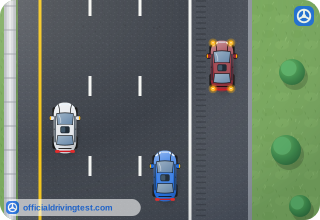
- Stand somewhere safe and wave traffic around the vehicle
- Stand behind the vehicle in the lane to warn drivers
- Wave traffic from the middle of the road
- Sit in the vehicle with all lights turned off
Show answer
Correct answer: Stand somewhere safe and wave traffic around the vehicle
The guide says to stand in a safe place and wave traffic around the vehicle.
Source: Washington Driver Guide (© 2025), page 173 · Open this page in the manual (Manual page 173)
-
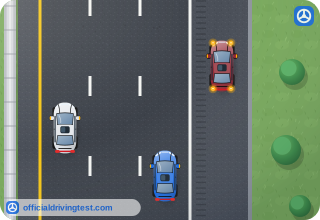
How can you signal an emergency if your vehicle is disabled?
- Honk the horn continuously until help comes
- Tie a red cloth to the license plate and wait
- Open all the doors and turn on the interior light
- Lift the hood or tie a white cloth to the vehicle
Show answer
Correct answer: Lift the hood or tie a white cloth to the vehicle
A raised hood or a white cloth tied to the vehicle signals that you need help.
Source: Washington Driver Guide (© 2025), page 173 · Open this page in the manual (Manual page 173)
-
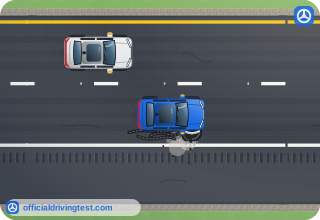
What should you do first if a tire blows out or suddenly goes flat?
- Brake hard to stop as quickly as you can
- Grip the wheel firmly and keep the vehicle straight
- Steer sharply toward the shoulder right away
- Shift into park and turn off the engine
Show answer
Correct answer: Grip the wheel firmly and keep the vehicle straight
The guide says to hold the wheel firmly, keep straight, and slow down gradually.
Source: Washington Driver Guide (© 2025), page 173 · Open this page in the manual (Manual page 173)
-
After a tire blowout, how should you slow your vehicle?
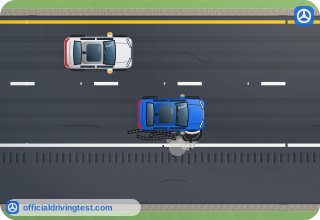
- Let it slow by itself, braking gently only if needed
- Brake as hard as you can to stop quickly
- Accelerate until you reach the road shoulder
- Turn the engine off and coast to a stop
Show answer
Correct answer: Let it slow by itself, braking gently only if needed
Hard braking is not advised after a blowout; the vehicle should slow gradually.
Source: Washington Driver Guide (© 2025), page 173 · Open this page in the manual (Manual page 173)
-
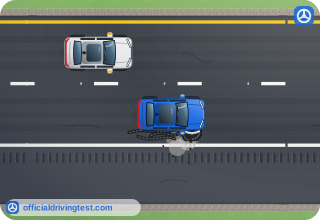
If a tire blows out and you cannot get to a safe place to change it, what should you do?
- Get out and change the tire beside the traffic lane
- Turn off all lights and walk to find a phone
- Use hazard lights, stay in your vehicle, and call for help
- Leave the vehicle and flag down passing drivers
Show answer
Correct answer: Use hazard lights, stay in your vehicle, and call for help
When there is no safe place to change the tire, you stay inside with hazard lights on and call for help.
Source: Washington Driver Guide (© 2025), page 173 · Open this page in the manual (Manual page 173)
-
If the engine shuts off while you are driving, what should you know about the steering wheel?
- It will lock up and cannot be turned at all
- It might be hard to turn, but you can turn it
- It will turn more easily than usual
- It will turn only to the right side
Show answer
Correct answer: It might be hard to turn, but you can turn it
Keep a strong grip: the steering wheel might be difficult to turn, but you can still turn it.
Source: Washington Driver Guide (© 2025), page 174 · Open this page in the manual (Manual page 174)