Washington: Emergency vehicles and work zones — Part 1 Practice Test
Questions in this part include: “Which vehicles using lights and/or sirens always have the right-of-way?” · “How should you adjust your speed in a work zone?”
Independent educational site · not affiliated with any government agency or DMV
Ready? Test yourself
Answer to start, or tap Start below:
Which vehicles using lights and/or sirens always have the right-of-way?
- Instant feedback with an explanation
- Every answer cites its source in the manual
- Your best score is saved on this device
- Keyboard: press 1 to 4 to answer and Enter for the next question
Questions are original and based on the official manual "Washington Driver Guide" (© 2025), Washington State Department of Licensing (DOL).
All 18 questions in this practice test
Take the test above first, then use this list to study. Tap “Show answer” to see the correct answer and explanation.
Show the questions and answersHide the questions
-
Which vehicles using lights and/or sirens always have the right-of-way?
- Fire trucks, ambulances, and police cars
- Only fire trucks and ambulances, not police cars
- Farm vehicles, rental trucks, and motorcycles
- Transit buses, delivery vans, and taxis
Show answer
Correct answer: Fire trucks, ambulances, and police cars
Fire trucks, ambulances and police cars using lights and/or sirens always have the right-of-way.
Source: Washington Driver Guide (© 2025), page 107 · Open this page in the manual (Manual page 107)
-
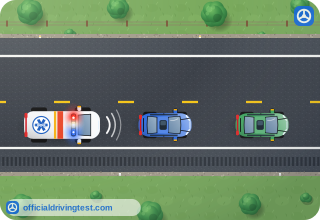
As soon as you see or hear the signals of an approaching emergency vehicle, what should you immediately do?
- Speed up to clear the lane
- Pull to the left side of the road and stop
- Pull to the right side of the road and stop
- Stop where you are in your lane
Show answer
Correct answer: Pull to the right side of the road and stop
Immediately pull your vehicle to the right side of the road and stop.
Source: Washington Driver Guide (© 2025), page 107 · Open this page in the manual (Manual page 107)
-
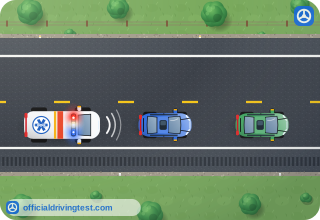
When should you signal and reenter traffic after pulling over for an emergency vehicle?
- As soon as the siren sounds quieter
- After the emergency vehicle has passed
- As soon as the emergency vehicle is beside you
- After the emergency vehicle's lights are turned off
Show answer
Correct answer: After the emergency vehicle has passed
Wait until the emergency vehicle has passed before signaling and reentering traffic.
Source: Washington Driver Guide (© 2025), page 107 · Open this page in the manual (Manual page 107)
-
In what order should you reenter traffic after an emergency vehicle has passed?
- Fastest vehicles first
- Largest vehicles first
- Vehicles closest to the road first
- In the order you were traveling before
Show answer
Correct answer: In the order you were traveling before
You should reenter traffic in the order you were traveling before.
Source: Washington Driver Guide (© 2025), page 107 · Open this page in the manual (Manual page 107)
-
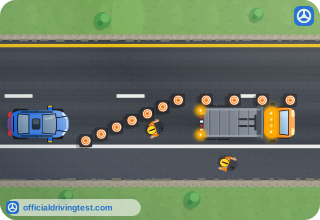
Inside a highway construction or maintenance work zone, who must yield to construction personnel, vehicles with flashing yellow lights, and equipment?
- Motorists only
- Motorists and bicyclists, but not pedestrians
- Motorists, pedestrians, and bicyclists
- Only vehicles that are larger than the equipment
Show answer
Correct answer: Motorists, pedestrians, and bicyclists
Everyone, whether driving, walking, or cycling, must yield to workers, flashing-yellow vehicles, and equipment inside a work zone.
Source: Washington Driver Guide (© 2025), page 117 · Open this page in the manual (Manual page 117)
-
What happens to fines for offenses committed in construction areas when workers are present?
- They double
- They are reduced if you slow down
- They stay the same as elsewhere
- They apply only to speeding
Show answer
Correct answer: They double
Fines are doubled for offenses in construction areas when workers are present.
Source: Washington Driver Guide (© 2025), page 117 · Open this page in the manual (Manual page 117)
-
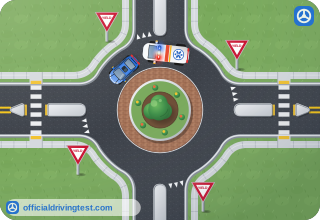
What should you do if an emergency vehicle approaches while you are in a roundabout?
- Stop immediately where you are in the circle
- Speed up and exit before it reaches you
- Pull onto the truck apron and wait
- Drive through the roundabout and pull over
Show answer
Correct answer: Drive through the roundabout and pull over
Handle it as at any other intersection: get through the roundabout and then pull over.
Source: Washington Driver Guide (© 2025), page 127 · Open this page in the manual (Manual page 127)
-
What is a work zone?
- An area where a tow truck has stopped at the roadside
- A road closed to all traffic until repairs end
- An area where roadwork or construction takes place
- A lane set aside for road crew vehicles to park
Show answer
Correct answer: An area where roadwork or construction takes place
A work zone is an area where roadwork or construction takes place; it can involve lane closures, detours and moving equipment.
Source: Washington Driver Guide (© 2025), page 141 · Open this page in the manual (Manual page 141)
-
How should you adjust your speed in a work zone?
- Reduce it only when workers are visible
- Always reduce it, even if there are no workers
- Keep it the same unless a sign says otherwise
- Reduce it only at night
Show answer
Correct answer: Always reduce it, even if there are no workers
Always slow down in a work zone, even with no workers present, because narrower lanes and rough pavement can be hazardous.
Source: Washington Driver Guide (© 2025), page 141 · Open this page in the manual (Manual page 141)
-
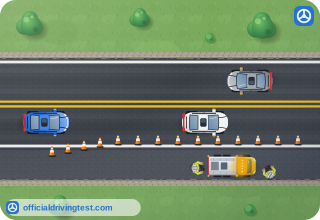
What should you do with your following distance in a work zone?
- Decrease it so traffic keeps moving
- Keep it the same as outside the zone
- Shorten it so no one cuts in front of you
- Increase it and be prepared to stop
Show answer
Correct answer: Increase it and be prepared to stop
In a work zone you should leave more space, watch the traffic around you and be ready to stop.
Source: Washington Driver Guide (© 2025), page 141 · Open this page in the manual (Manual page 141)
-
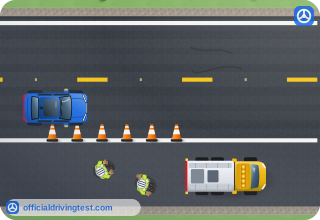
How can you reduce distractions as you approach a work zone?
- Turn up the radio to stay alert
- Talk with passengers to stay awake
- Turn down music and pause conversations
- Look only at the vehicle ahead and ignore signs
Show answer
Correct answer: Turn down music and pause conversations
Eliminating distractions such as loud music and conversation helps you focus near a work zone.
Source: Washington Driver Guide (© 2025), page 141 · Open this page in the manual (Manual page 141)
-
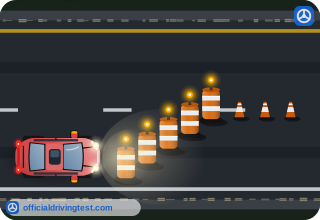
How should you drive through a work zone at night?
- With normal caution if no workers are visible
- With caution only when workers are in sight
- Faster, since there is less traffic
- With extreme caution, whether you see workers or not
Show answer
Correct answer: With extreme caution, whether you see workers or not
Night driving in a work zone calls for extreme caution even when no workers are visible.
Source: Washington Driver Guide (© 2025), page 142 · Open this page in the manual (Manual page 142)
-
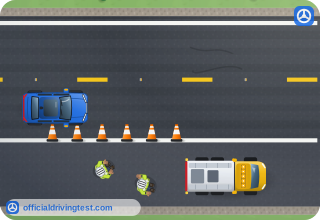
What should you do, when possible, to give workers and construction vehicles space?
- Sound your horn to warn them
- Move over
- Flash your high beams at them
- Drive as close to them as you can
Show answer
Correct answer: Move over
You should move over when possible to allow space for workers and construction vehicles.
Source: Washington Driver Guide (© 2025), page 142 · Open this page in the manual (Manual page 142)
-
Until you see which sign should you keep observing the posted work zone signs?
- End Road Work
- Road Narrows
- Detour Ahead
- Resume Speed
Show answer
Correct answer: End Road Work
The posted work zone signs apply until you reach the End Road Work sign.
Source: Washington Driver Guide (© 2025), page 142 · Open this page in the manual (Manual page 142)
-
What should you do about delays you expect in a work zone?
- Drive faster before and after the zone
- Leave at your usual time and speed up later
- Plan for them and leave early
- Follow the vehicle ahead closely to save time
Show answer
Correct answer: Plan for them and leave early
You should expect delays, plan for them and leave early so you still arrive on time.
Source: Washington Driver Guide (© 2025), page 142 · Open this page in the manual (Manual page 142)
-
What is advised if you want to avoid a work zone?
- Wait at the edge until workers wave you in
- Use a different route when possible
- Drive on the shoulder to bypass it
- Ask the workers to open a lane
Show answer
Correct answer: Use a different route when possible
Using a different route when possible helps you avoid work zones.
Source: Washington Driver Guide (© 2025), page 142 · Open this page in the manual (Manual page 142)
-
What is an emergency zone?
- A stretch of road that police close off for a public event
- An area around a hospital where a lower speed limit applies
- A lane kept free at all times for ambulances and fire trucks
- A zone created for a roadside situation needing immediate attention
Show answer
Correct answer: A zone created for a roadside situation needing immediate attention
An emergency zone arises from a roadside situation such as a crash, a broken vehicle or a person in distress.
Source: Washington Driver Guide (© 2025), page 142 · Open this page in the manual (Manual page 142)
-
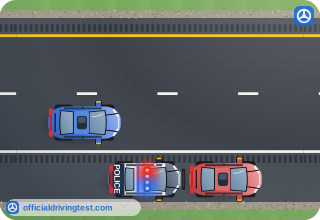
What must you do as soon as you see a roadside response vehicle with flashing lights?
- Stay in your lane and keep your speed if the shoulder is clear
- Slow to 5 mph below the limit and stay in the same lane
- Move to a farther lane or slow to 10 mph below the limit
- Speed up to clear the area before reaching the vehicle
Show answer
Correct answer: Move to a farther lane or slow to 10 mph below the limit
You must either move over into a farther lane or slow down to 10 mph below the posted speed limit.
Source: Washington Driver Guide (© 2025), page 143 · Open this page in the manual (Manual page 143)