Washington: Hazardous conditions and collisions — Part 1 Practice Test
Questions in this part include: “What are the four steps of the OODA Loop, in order?” · “In the OODA Loop, which step uses your knowledge and experience to understand what a change means?”
Independent educational site · not affiliated with any government agency or DMV
Ready? Test yourself
Answer to start, or tap Start below:
What are the four steps of the OODA Loop, in order?
- Instant feedback with an explanation
- Every answer cites its source in the manual
- Your best score is saved on this device
- Keyboard: press 1 to 4 to answer and Enter for the next question
Questions are original and based on the official manual "Washington Driver Guide" (© 2025), Washington State Department of Licensing (DOL).
All 18 questions in this practice test
Take the test above first, then use this list to study. Tap “Show answer” to see the correct answer and explanation.
Show the questions and answersHide the questions
-
How should you report an in-progress road rage incident?
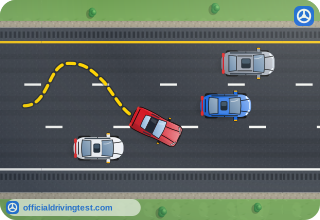
- By mailing a written report afterward
- Immediately by calling 911
- By asking the other driver to stop and explain
- By waiting until the next day to call
Show answer
Correct answer: Immediately by calling 911
The guide says to report in-progress road rage incidents immediately by calling 911.
Source: Washington Driver Guide (© 2025), page 80 · Open this page in the manual (Manual page 80)
-
When you call 911 about an aggressive driving act, which piece of information does the guide ask you to provide?
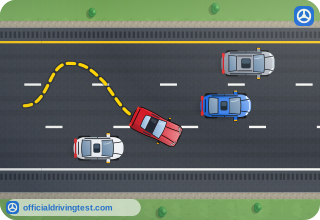
- The other driver’s full name
- The other driver’s phone number
- Your own driver license number
- The plate number, if known
Show answer
Correct answer: The plate number, if known
The guide lists the plate number, if known, among the information to give when you call 911 about aggressive driving.
Source: Washington Driver Guide (© 2025), page 80 · Open this page in the manual (Manual page 80)
-
Which change might solving a problem on the road require?
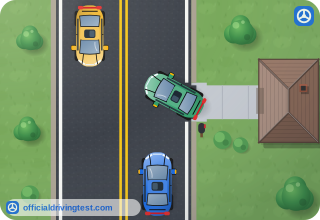
- Stopping immediately in the travel lane to reassess the situation
- Changing your direction to get to a safe place to reassess the situation
- Increasing your speed to leave the problem behind you quickly
- Turning off your headlights to avoid glare from other vehicles
Show answer
Correct answer: Changing your direction to get to a safe place to reassess the situation
The guide lists changing your direction or path of travel to reach a safe place and reassess as one possible change.
Source: Washington Driver Guide (© 2025), page 82 · Open this page in the manual (Manual page 82)
-
What are the four steps of the OODA Loop, in order?
- Observe, Decide, Orient, Act
- Orient, Observe, Act, Decide
- Observe, Act, Orient, Decide
- Observe, Orient, Decide, Act
Show answer
Correct answer: Observe, Orient, Decide, Act
The guide presents the OODA Loop as observe, orient, decide, and act, repeating as each situation leads to another.
Source: Washington Driver Guide (© 2025), page 83 · Open this page in the manual (Manual page 83)
-
Why is the OODA Loop called a loop?
- Because every situation leads to another
- Because you repeat each step three times
- Because it always ends where you started the trip
- Because it applies only on roundabouts
Show answer
Correct answer: Because every situation leads to another
The guide says it is a loop because every situation leads to another.
Source: Washington Driver Guide (© 2025), page 83 · Open this page in the manual (Manual page 83)
-
In the OODA Loop, which step asks you to look at what changed, such as a swerving car, a sudden obstacle, or a change in traffic flow?
- Orient
- Decide
- Observe
- Act
Show answer
Correct answer: Observe
In the Observe step you look at the situation and ask what changed.
Source: Washington Driver Guide (© 2025), page 83 · Open this page in the manual (Manual page 83)
-
In the OODA Loop, which step uses your knowledge and experience to understand what a change means?
- Observe
- Orient
- Decide
- Act
Show answer
Correct answer: Orient
In the Orient step you use knowledge and experience to understand what the change means for safety.
Source: Washington Driver Guide (© 2025), page 83 · Open this page in the manual (Manual page 83)
-
In the OODA Loop, which step has you choose the safest course of action?
- Observe
- Orient
- Act
- Decide
Show answer
Correct answer: Decide
In the Decide step you choose the safest course of action based on what you observed and understood.
Source: Washington Driver Guide (© 2025), page 83 · Open this page in the manual (Manual page 83)
-
In the OODA Loop, which step has you smoothly and decisively carry out your chosen action?
- Act
- Observe
- Orient
- Decide
Show answer
Correct answer: Act
In the Act step you execute your chosen action smoothly and decisively, communicating clearly with others.
Source: Washington Driver Guide (© 2025), page 83 · Open this page in the manual (Manual page 83)
-
What can rain, snow, or ice do to friction in curves?
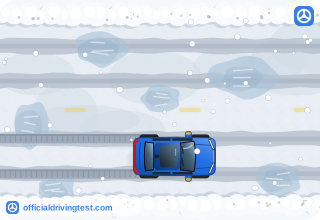
- Slightly increase it
- Remove the need to steer
- Significantly reduce it
- Have no effect on it
Show answer
Correct answer: Significantly reduce it
Slippery roads reduce friction a lot, so you should slow down even more and avoid sudden movements.
Source: Washington Driver Guide (© 2025), page 169 · Open this page in the manual (Manual page 169)
-
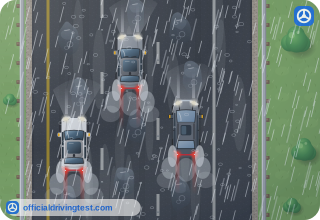
Why can the pavement be very slippery during the first few minutes of rain on a hot day?
- Hot pavement turns the rain into ice
- Heat brings oil in the asphalt to the surface
- Rain washes the lane markings onto the road
- Hot tires cannot grip wet pavement
Show answer
Correct answer: Heat brings oil in the asphalt to the surface
Heat brings oil in the asphalt to the surface, and the road stays slippery until the oil washes away.
Source: Washington Driver Guide (© 2025), page 170 · Open this page in the manual (Manual page 170)
-
How can you improve traction in the winter months?
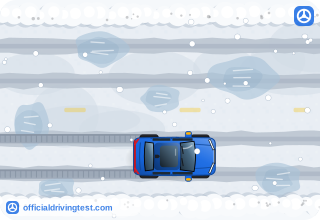
- Add chains or change to studded tires
- Reduce the air pressure in your tires
- Drive with the headlights off
- Brake harder on slippery spots
Show answer
Correct answer: Add chains or change to studded tires
The guide says chains or studded tires can improve traction during winter months.
Source: Washington Driver Guide (© 2025), page 171 · Open this page in the manual (Manual page 171)
-
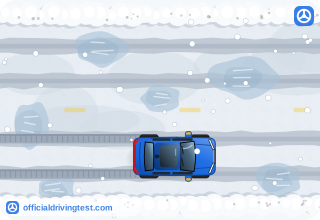
What should you do if you must drive on icy roads?
- Keep your speed up so you do not lose momentum
- Tailgate a vehicle that has already crossed the ice
- Slow down and leave extra space around your vehicle
- Brake firmly when you see ice
Show answer
Correct answer: Slow down and leave extra space around your vehicle
The guide advises slowing down and leaving extra room, and avoiding icy roads when you can.
Source: Washington Driver Guide (© 2025), page 171 · Open this page in the manual (Manual page 171)
-
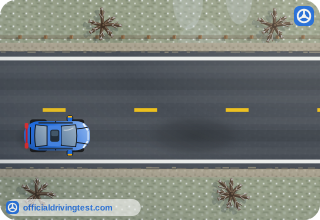
On cold, wet days, where can ice be found even when the rest of the road is not icy?
- Only on straight roads with no trees nearby
- Only on roads with painted center lines
- In shady spots and on overpasses and other bridges
- Only on the left side of the road
Show answer
Correct answer: In shady spots and on overpasses and other bridges
Shady spots can be icy, and bridges and overpasses can have icy spots even when the rest of the road does not.
Source: Washington Driver Guide (© 2025), page 171 · Open this page in the manual (Manual page 171)
-
Why can the road become more slippery when below-freezing temperatures warm up to near-freezing?
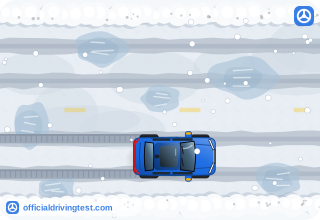
- Ice can melt and become wet
- Ice becomes thicker and rougher
- Snow turns into black ice instantly
- Tires lose air pressure
Show answer
Correct answer: Ice can melt and become wet
Melting ice leaves a wet layer, which makes the road more slippery.
Source: Washington Driver Guide (© 2025), page 171 · Open this page in the manual (Manual page 171)
-
What is black ice?
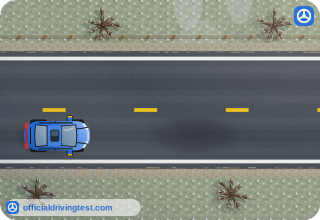
- Ice that has been darkened by road dirt and is easy to see
- A thick layer of packed snow
- Water frozen on the inside of your windshield
- A thin coating of ice that is hard for drivers to see
Show answer
Correct answer: A thin coating of ice that is hard for drivers to see
Black ice is a thin ice coating that drivers often cannot see, so be careful near or below freezing.
Source: Washington Driver Guide (© 2025), page 171 · Open this page in the manual (Manual page 171)
-
What causes a skid?
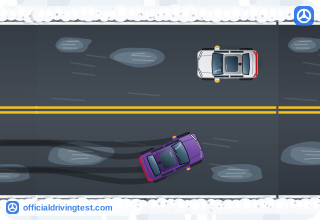
- The engine is running too cool
- The tires can no longer grip the road
- The steering wheel is held too loosely
- The vehicle is moving too slowly
Show answer
Correct answer: The tires can no longer grip the road
A skid happens when the tires lose their grip on the road surface.
Source: Washington Driver Guide (© 2025), page 171 · Open this page in the manual (Manual page 171)
-
What increases the possibility of skidding if you turn or stop suddenly?
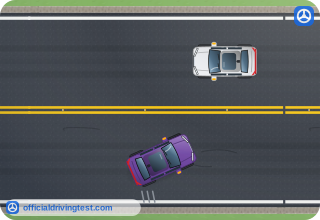
- High speeds and slippery roads
- Low speeds and dry roads
- Wide lanes and gentle curves
- Daylight and clear weather
Show answer
Correct answer: High speeds and slippery roads
Fast driving and slippery pavement make a sudden turn or stop more likely to cause a skid.
Source: Washington Driver Guide (© 2025), page 171 · Open this page in the manual (Manual page 171)