Washington: Hazardous conditions and collisions — Part 3 Practice Test
Questions in this part include: “How should you brake if the engine shuts off while you are driving?” · “After shifting to neutral when your vehicle keeps accelerating, what should you do?”
Independent educational site · not affiliated with any government agency or DMV
Ready? Test yourself
Answer to start, or tap Start below:
How should you brake if the engine shuts off while you are driving?
- Instant feedback with an explanation
- Every answer cites its source in the manual
- Your best score is saved on this device
- Keyboard: press 1 to 4 to answer and Enter for the next question
Questions are original and based on the official manual "Washington Driver Guide" (© 2025), Washington State Department of Licensing (DOL).
All 17 questions in this practice test
Take the test above first, then use this list to study. Tap “Show answer” to see the correct answer and explanation.
Show the questions and answersHide the questions
-
How should you brake if the engine shuts off while you are driving?
- As hard as you can, to stop in a short distance
- By standing on the pedal and holding it down hard
- By shifting into park to stop the engine
- With steady pressure, slowing down before pulling off
Show answer
Correct answer: With steady pressure, slowing down before pulling off
The guide says not to brake hard but to brake with steady pressure and pull off the roadway.
Source: Washington Driver Guide (© 2025), page 174 · Open this page in the manual (Manual page 174)
-
If you cannot restart the engine after it shuts off while you are driving, what should you do?
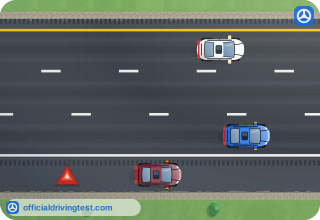
- Keep trying to start it until the battery is empty
- Leave the vehicle and walk along the lane
- Turn off the headlights and wait
- Raise the hood, use hazard lights, and call for help
Show answer
Correct answer: Raise the hood, use hazard lights, and call for help
After an unsuccessful restart, the hood and hazard lights signal trouble while you call for help.
Source: Washington Driver Guide (© 2025), page 174 · Open this page in the manual (Manual page 174)
-
What should you do if your headlights suddenly go out?
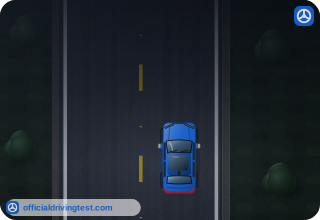
- Keep driving at the same speed until you get home or reach a service station
- Use hazard lights, turn signals, or fog lights, and pull off the road soon
- Turn on the interior lights and continue driving normally
- Stop in the lane and wait until they come back on
Show answer
Correct answer: Use hazard lights, turn signals, or fog lights, and pull off the road soon
Use whatever lights you still have to be seen, and get off the road quickly.
Source: Washington Driver Guide (© 2025), page 174 · Open this page in the manual (Manual page 174)
-
If your vehicle keeps going faster and faster, what should you do?
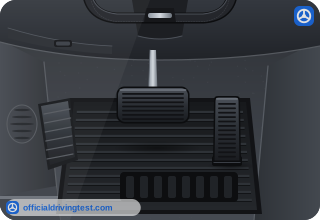
- Turn the engine off while driving at speed
- Shift into park
- Quickly shift to neutral
- Press the brake pedal and the accelerator together
Show answer
Correct answer: Quickly shift to neutral
Quickly shift to neutral, pull off the road when it is safe, and then turn off the engine.
Source: Washington Driver Guide (© 2025), page 174 · Open this page in the manual (Manual page 174)
-
After shifting to neutral when your vehicle keeps accelerating, what should you do?
- Pull off the road when safe, then turn off the engine
- Turn off the engine right away while still moving
- Stay on the road and coast until it slows
- Shift back into drive and drive on
Show answer
Correct answer: Pull off the road when safe, then turn off the engine
The order in the guide is neutral, pull off when safe, then turn off the engine.
Source: Washington Driver Guide (© 2025), page 174 · Open this page in the manual (Manual page 174)
-
Which of these is one of the typical causes of collisions?
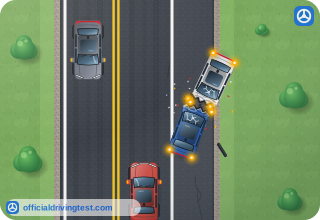
- Too much traffic on the road
- Too little space
- Too many passengers
- Too much daylight
Show answer
Correct answer: Too little space
The guide names too much speed, too little space, and insufficient situational awareness.
Source: Washington Driver Guide (© 2025), page 175 · Open this page in the manual (Manual page 175)
-
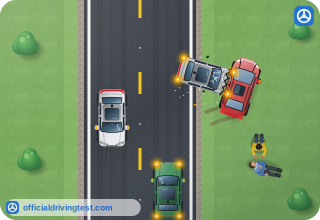
If anyone is injured or killed in a crash, what must you do?
- Move on and report it later
- Drive to the nearest police station
- Wait for a passing driver to call
- Call 911 and not drive away
Show answer
Correct answer: Call 911 and not drive away
Law enforcement must be notified when anyone is hurt or killed, and you must not leave.
Source: Washington Driver Guide (© 2025), page 175 · Open this page in the manual (Manual page 175)
-
After a crash, where should you move your vehicle if you can?
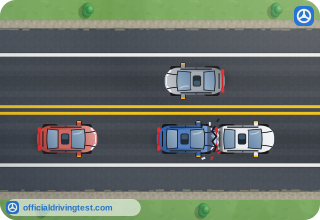
- To the side of the road, near the collision site
- To a parking lot far from the collision site
- To the middle of the road, to block traffic
- Several blocks away, before calling anyone
Show answer
Correct answer: To the side of the road, near the collision site
The guide says to move to the side of the road near the collision site as soon as possible.
Source: Washington Driver Guide (© 2025), page 175 · Open this page in the manual (Manual page 175)
-
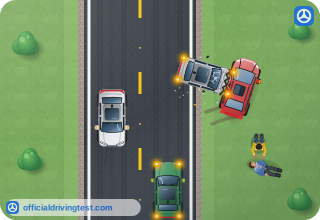
Why should you not stand or walk in traffic lanes after a collision?
- It blocks your phone signal
- It makes it harder to see the damage
- You could be struck by another vehicle
- It is a violation of the collision report law
Show answer
Correct answer: You could be struck by another vehicle
Standing in lanes puts you in the path of other traffic.
Source: Washington Driver Guide (© 2025), page 175 · Open this page in the manual (Manual page 175)
-
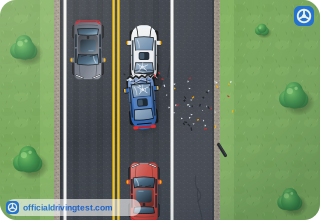
How can you alert other drivers of a collision?
- Turn off your hazard lights
- Flash your high beams at all traffic
- Use flares or other warning devices
- Park across the lane
Show answer
Correct answer: Use flares or other warning devices
Flares or similar devices warn drivers of the collision ahead.
Source: Washington Driver Guide (© 2025), page 176 · Open this page in the manual (Manual page 176)
-
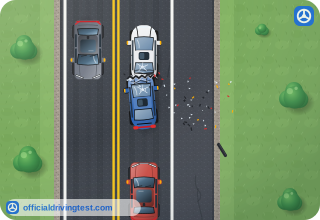
What should you do with wrecked vehicles after a collision?
- Turn them off
- Keep the engines running for heat
- Restart them to see if they work
- Leave the ignition on to run the lights
Show answer
Correct answer: Turn them off
The guide says to turn off wrecked vehicles.
Source: Washington Driver Guide (© 2025), page 176 · Open this page in the manual (Manual page 176)
-
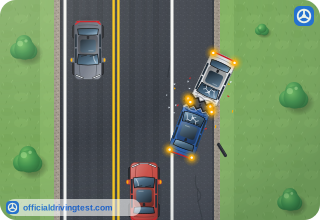
Why should you not smoke around wrecked vehicles?
- Smoke can block the view of other drivers on the road
- Smoking distracts police officers
- The smell of smoke hides gas leaks
- Fuel could have spilled, and fire is a real danger
Show answer
Correct answer: Fuel could have spilled, and fire is a real danger
Spilled fuel and fire are a real danger around wrecked vehicles.
Source: Washington Driver Guide (© 2025), page 176 · Open this page in the manual (Manual page 176)
-
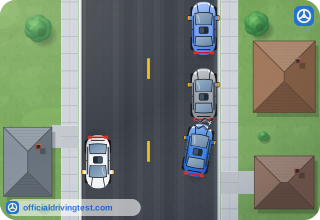
If your collision involves a parked vehicle and you cannot find its owner, what must you do?
- Leave without a note, since no one was injured in the collision
- Leave a note in plain view with the date, time, and contact information
- Take photos of the damage and leave without telling anyone
- Move the parked vehicle to another street, then leave the scene
Show answer
Correct answer: Leave a note in plain view with the date, time, and contact information
You must try to find the owner; if you cannot, a note with the date, time of the collision and your contact information is required.
Source: Washington Driver Guide (© 2025), page 176 · Open this page in the manual (Manual page 176)
-
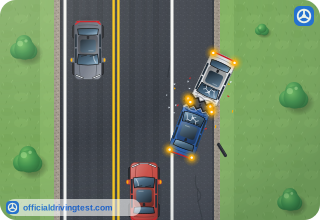
What does the guide suggest you do to document damage after a collision?
- Move the vehicles so the damage can be seen
- Wait several days before looking at the damage
- Take photos or videos of any damage to the vehicles
- Repair the damage before talking to anyone
Show answer
Correct answer: Take photos or videos of any damage to the vehicles
Photos or videos help you report the incident.
Source: Washington Driver Guide (© 2025), page 176 · Open this page in the manual (Manual page 176)
-
Within how many days of a crash must you file a collision report form if a law enforcement officer does not file one for you?
- 24 hours
- 4 days
- 10 days
- 30 days
Show answer
Correct answer: 4 days
State law requires the form within 4 days when no officer files it.
Source: Washington Driver Guide (© 2025), page 176 · Open this page in the manual (Manual page 176)
-
After a crash, when may you move an injured person?
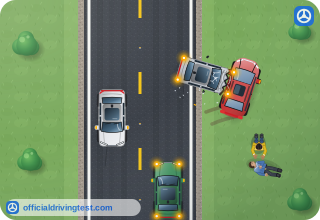
- When they say they are able to walk on their own
- When they are not wearing a seatbelt anymore
- When the ambulance has not yet been called
- When in a burning vehicle or in immediate danger
Show answer
Correct answer: When in a burning vehicle or in immediate danger
Do not move injured people unless they are in a burning vehicle or otherwise in immediate danger.
Source: Washington Driver Guide (© 2025), page 176 · Open this page in the manual (Manual page 176)
-
When helping injured people after a crash, what should you check for first, before bleeding?
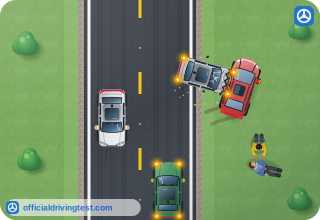
- A pulse in the wrist
- Broken bones
- Whether they can stand
- Breathing
Show answer
Correct answer: Breathing
The guide says to check for breathing, then check for bleeding.
Source: Washington Driver Guide (© 2025), page 177 · Open this page in the manual (Manual page 177)