Vermont: Sharing the road — Part 5 Practice Test
Questions in this part include: “What rights does a person riding an animal or driving an animal drawn vehicle have on a public highway?” · “What may happen to a motor vehicle operator for negligent operation around riders and driven animals?”
Independent educational site · not affiliated with any government agency or DMV
Ready? Test yourself
- Instant feedback with an explanation
- Every answer cites its source in the manual
- Your best score is saved on this device
- Keyboard: press 1 to 4 to answer and Enter for the next question
Questions are original and based on the official manual "Vermont Driver's Manual" (2025 edition (VN-007 07/2024)), Vermont Department of Motor Vehicles.
All 17 questions in this practice test
Take the test above first, then use this list to study. Tap “Show answer” to see the correct answer and explanation.
Show the questions and answersHide the questions
-
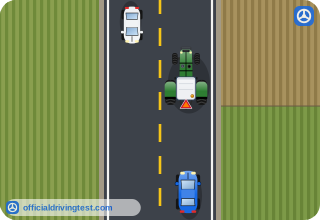
When may you pass a slow moving vehicle?
- Whenever you are in a great hurry to arrive
- Only when you can see the driver's face clearly
- Only when you are approaching a curve ahead
- Only if conditions are safe and no traffic is coming
Show answer
Correct answer: Only if conditions are safe and no traffic is coming
Pass slow moving vehicles cautiously, only when conditions are safe and no traffic is coming from the other direction.
Source: Vermont Driver's Manual (2025 edition (VN-007 07/2024)), page 44 · Open this page in the manual (Manual page 44)
-
An aggressive driver cuts you off. What should you do?
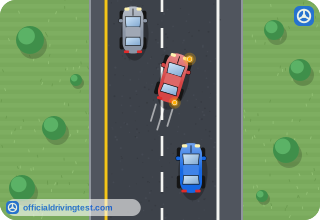
- Stay calm and get out of the driver's way
- Try to get even
- Honk and flash your lights at the driver
- Challenge the driver
Show answer
Correct answer: Stay calm and get out of the driver's way
The manual says not to try to get even; stay calm, get out of the way and do not challenge the driver.
Source: Vermont Driver's Manual (2025 edition (VN-007 07/2024)), page 45 · Open this page in the manual (Manual page 45)
-
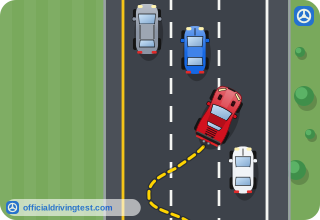
The manual says that actions such as driving too fast, failing to signal lane changes, weaving, following too closely and cutting off cars are what?
- Legal whenever traffic is light
- Legal if they do not cause a crash
- Unlawful and can result in tickets or worse
- Allowed on highways but not on roads
Show answer
Correct answer: Unlawful and can result in tickets or worse
Aggressive driving actions are unlawful and can lead to traffic tickets or worse.
Source: Vermont Driver's Manual (2025 edition (VN-007 07/2024)), page 45 · Open this page in the manual (Manual page 45)
-
What rights does a person riding an animal or driving an animal drawn vehicle have on a public highway?
- The right to use only the shoulder
- All the rights of a driver of a motor vehicle
- The right of way at every intersection
- No special rights
Show answer
Correct answer: All the rights of a driver of a motor vehicle
A rider or animal-drawn vehicle driver on a public highway has the same rights as a motor vehicle driver.
Source: Vermont Driver's Manual (2025 edition (VN-007 07/2024)), page 45 · Open this page in the manual (Manual page 45)
-
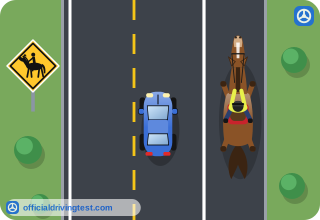
What is necessary when a motor vehicle operator comes upon a person riding an animal on the road?
- To pass quickly
- To move to the left of the center line
- To keep the same speed unless the animal moves
- To reduce speed, and possibly even stop
Show answer
Correct answer: To reduce speed, and possibly even stop
The operator must reduce speed and possibly stop so the animal is not frightened and the rider is safe.
Source: Vermont Driver's Manual (2025 edition (VN-007 07/2024)), page 45 · Open this page in the manual (Manual page 45)
-
When meeting, following or passing horses or other animals, what should a motor vehicle operator never do?
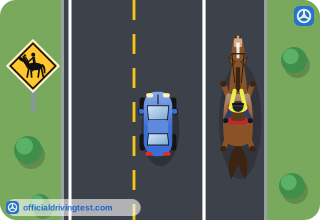
- Blow their horn or rev their engine
- Use the full traffic lane to pass
- Reduce speed
- Leave a following distance of at least 4 seconds
Show answer
Correct answer: Blow their horn or rev their engine
A horn or revving engine can startle the animals, so the manual says never to do either.
Source: Vermont Driver's Manual (2025 edition (VN-007 07/2024)), page 45 · Open this page in the manual (Manual page 45)
-
How should you pass a horse and rider on the road?
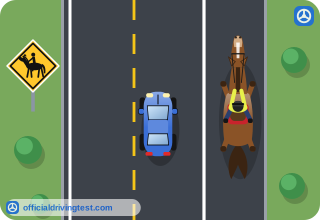
- Pass on the right shoulder at your normal speed
- Pass close to the horse in the same lane
- Use the full lane to pass and never cut quickly back
- Pass while sounding the horn at the rider
Show answer
Correct answer: Use the full lane to pass and never cut quickly back
Use the full traffic lane to completely pass the animal, and never cut quickly back into your lane.
Source: Vermont Driver's Manual (2025 edition (VN-007 07/2024)), page 45 · Open this page in the manual (Manual page 45)
-
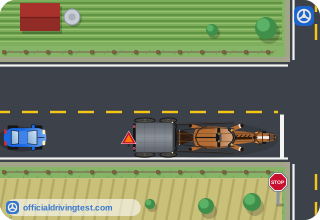
What is the minimum following distance when you are behind a horse with a rider, a horse and wagon, or herded animals?
- At least 1 second
- At least 4 seconds
- At least 2 seconds
- At least 3 seconds
Show answer
Correct answer: At least 4 seconds
The manual says to leave at least a 4 second following distance behind horses and herded animals.
Source: Vermont Driver's Manual (2025 edition (VN-007 07/2024)), page 45 · Open this page in the manual (Manual page 45)
-
What may happen to a motor vehicle operator for negligent operation around riders and driven animals?
- The operator may only receive a warning
- The operator may only lose the right to drive at night
- Nothing, because animals have no right of way
- The operator may be fined or imprisoned
Show answer
Correct answer: The operator may be fined or imprisoned
The manual states that negligent operation around such animals may bring a fine or imprisonment.
Source: Vermont Driver's Manual (2025 edition (VN-007 07/2024)), page 45 · Open this page in the manual (Manual page 45)
-
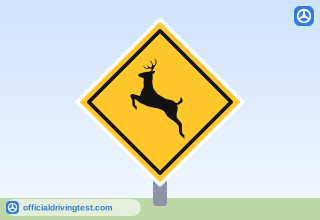
When is the presence of moose and deer on highways most likely?
- Late evening, night time and early morning
- During midday and the early afternoon
- During the afternoon rush hour only
- Mainly in the middle of a sunny day
Show answer
Correct answer: Late evening, night time and early morning
Moose and deer roam and feed mostly in late evening, at night and early in the morning, so extra caution is needed then.
Source: Vermont Driver's Manual (2025 edition (VN-007 07/2024)), page 45 · Open this page in the manual (Manual page 45)
-
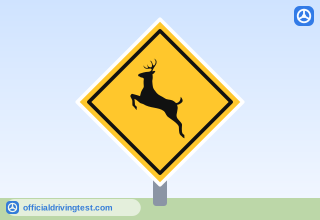
How does the manual say you can save lives and prevent injuries in areas marked with deer and moose crossing signs?
- By driving faster to clear the area
- By flashing your headlights
- By driving cautiously
- By driving only on the shoulder
Show answer
Correct answer: By driving cautiously
Driving cautiously where deer and moose crossing signs are posted can save lives and prevent injuries.
Source: Vermont Driver's Manual (2025 edition (VN-007 07/2024)), page 45 · Open this page in the manual (Manual page 45)
-
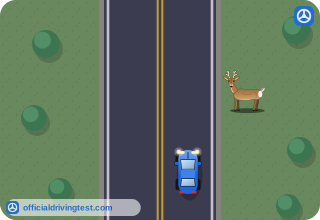
What may the light from a vehicle's headlights cause a deer to do?
- Walk slowly toward the vehicle’s headlights
- Temporarily freeze in front of the vehicle
- Lie down at the side of the road
- Stay calm and walk calmly off
Show answer
Correct answer: Temporarily freeze in front of the vehicle
Headlights can cause a deer to freeze for a moment, so it may not get out of the way.
Source: Vermont Driver's Manual (2025 edition (VN-007 07/2024)), page 45 · Open this page in the manual (Manual page 45)
-
A deer may bound toward its habitat at speeds up to how many miles per hour?
- 20 miles per hour
- 30 miles per hour
- 60 miles per hour
- 40 miles per hour
Show answer
Correct answer: 40 miles per hour
The manual says a deer may bound at speeds up to 40 miles per hour toward its habitat.
Source: Vermont Driver's Manual (2025 edition (VN-007 07/2024)), page 45 · Open this page in the manual (Manual page 45)
-
Why may a deer on the opposite side of the road from its habitat bolt in front of a vehicle?
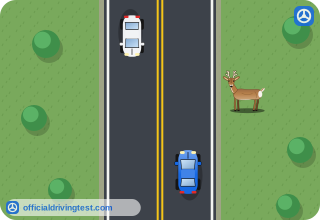
- It may turn and run toward its habitat
- It is attracted to the engine noise
- It is trying to cross to find a mate
- It cannot see anything in the dark
Show answer
Correct answer: It may turn and run toward its habitat
A deer bounding toward its habitat may turn and dash in front of a vehicle if it is on the opposite side of the road.
Source: Vermont Driver's Manual (2025 edition (VN-007 07/2024)), page 45 · Open this page in the manual (Manual page 45)
-
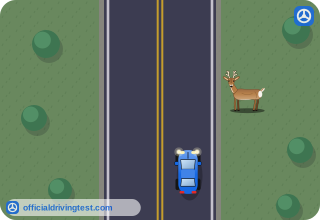
After you see one deer or moose, what should you be prepared for?
- That the area is clear
- That the animal will wait for you
- To see a second one
- That the second animal will cross behind you
Show answer
Correct answer: To see a second one
Animals travel in pairs, so a second animal is likely to be nearby.
Source: Vermont Driver's Manual (2025 edition (VN-007 07/2024)), page 45 · Open this page in the manual (Manual page 45)
-
In a collision, why can a moose be more deadly to motorists than a deer?
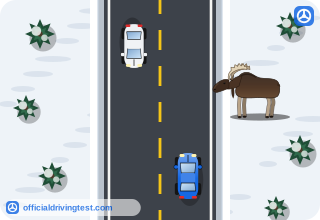
- It is much smaller and harder to see in the daytime
- It is much heavier and taller and can land on the car
- It runs much faster than a deer on a highway
- It always crosses the road in a large group
Show answer
Correct answer: It is much heavier and taller and can land on the car
Moose weigh more than a thousand pounds and are much taller than deer, so in a collision they can land on the vehicle with crushing force.
Source: Vermont Driver's Manual (2025 edition (VN-007 07/2024)), page 45 · Open this page in the manual (Manual page 45)
-
Why may a moose's eyes not reflect in a vehicle's headlights?
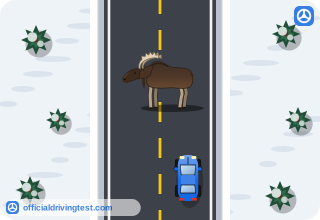
- Because moose are lighter in color
- Because moose are smaller than deer
- Because moose roam only in daylight
- Because moose are taller
Show answer
Correct answer: Because moose are taller
Moose are taller than deer, so their eyes may not reflect headlights, which makes them hard to see in the evening.
Source: Vermont Driver's Manual (2025 edition (VN-007 07/2024)), page 45 · Open this page in the manual (Manual page 45)