Vermont: Speed and space — Part 1 Practice Test
Questions in this part include: “How many things must happen to stop your vehicle?” · “When is the road especially slippery, which increases your braking distance?”
Independent educational site · not affiliated with any government agency or DMV
Ready? Test yourself
- Instant feedback with an explanation
- Every answer cites its source in the manual
- Your best score is saved on this device
- Keyboard: press 1 to 4 to answer and Enter for the next question
Questions are original and based on the official manual "Vermont Driver's Manual" (2025 edition (VN-007 07/2024)), Vermont Department of Motor Vehicles.
All 16 questions in this practice test
Take the test above first, then use this list to study. Tap “Show answer” to see the correct answer and explanation.
Show the questions and answersHide the questions
-
How many things must happen to stop your vehicle?
- Two
- Four
- Three
- Five
Show answer
Correct answer: Four
The manual lists four things that must happen to stop: seeing the danger, the brain telling the foot to brake, the foot operating the brake, and working brakes.
Source: Vermont Driver's Manual (2025 edition (VN-007 07/2024)), page 25 · Open this page in the manual (Manual page 25)
-
What is the distance your vehicle travels from the moment you see danger until you step on the brake called?
- Braking distance
- Following distance
- Warning distance
- Reaction distance
Show answer
Correct answer: Reaction distance
This distance, covered between seeing the danger and stepping on the brake, is called reaction distance.
Source: Vermont Driver's Manual (2025 edition (VN-007 07/2024)), page 26 · Open this page in the manual (Manual page 26)
-
What is the distance your vehicle travels from the time the brakes are applied until it is brought to a stop called?
- Braking distance
- Reaction distance
- Following distance
- Warning distance
Show answer
Correct answer: Braking distance
The distance traveled while the brakes are working until the vehicle stops is called braking distance.
Source: Vermont Driver's Manual (2025 edition (VN-007 07/2024)), page 26 · Open this page in the manual (Manual page 26)
-
About how long does it take the average driver to apply the brakes after seeing danger?
- About 1/4 of a second
- About 1 1/2 seconds
- About 3/4 of a second
- About 2 seconds
Show answer
Correct answer: About 3/4 of a second
The manual says the average driver needs about 3/4 of a second to apply the brakes after seeing danger.
Source: Vermont Driver's Manual (2025 edition (VN-007 07/2024)), page 26 · Open this page in the manual (Manual page 26)
-
How does driving speed affect how far your vehicle travels before you are able to apply the brakes?
- The higher the speed, the shorter the distance
- The higher the speed, the further it travels
- Speed has no effect on that distance
- Only the weight of the vehicle changes it
Show answer
Correct answer: The higher the speed, the further it travels
At higher speeds the vehicle covers more ground before the driver gets the brakes applied.
Source: Vermont Driver's Manual (2025 edition (VN-007 07/2024)), page 26 · Open this page in the manual (Manual page 26)
-
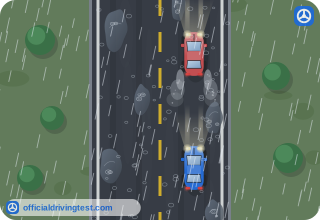
How does braking distance change on wet, icy or gravel roads?
- It becomes slightly shorter
- It stays the same
- It becomes longer only on gravel
- It becomes much longer
Show answer
Correct answer: It becomes much longer
On wet, icy or gravel roads the braking distance is much longer than on good roads.
Source: Vermont Driver's Manual (2025 edition (VN-007 07/2024)), page 26 · Open this page in the manual (Manual page 26)
-
When is the road especially slippery, which increases your braking distance?
- When it first starts to rain
- After it has rained for several hours
- Just after the rain has stopped
- Only when the temperature is below freezing
Show answer
Correct answer: When it first starts to rain
At the start of a rain, oil, rubber, dirt and water combine to make the road especially slippery.
Source: Vermont Driver's Manual (2025 edition (VN-007 07/2024)), page 26 · Open this page in the manual (Manual page 26)
-
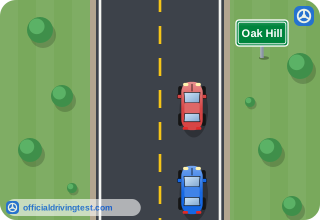
When should you allow more than four seconds of following distance?
- Only when driving on an interstate or other high-speed road
- Only when you are carrying several passengers in the vehicle
- In poor road conditions, poor visibility, or at higher speeds
- Only at night when the road surface is dry and clear
Show answer
Correct answer: In poor road conditions, poor visibility, or at higher speeds
The 4-second method is a minimum: poor road conditions, poor visibility or higher speeds call for more space.
Source: Vermont Driver's Manual (2025 edition (VN-007 07/2024)), page 27 · Open this page in the manual (Manual page 27)
-
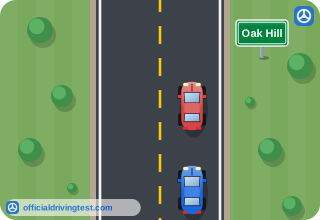
When counting your following distance, when do you start counting seconds?
- When the front of the vehicle ahead passes a checkpoint
- When the rear of the vehicle ahead passes a checkpoint
- When your front bumper passes a checkpoint
- When the vehicle ahead brakes
Show answer
Correct answer: When the rear of the vehicle ahead passes a checkpoint
You start counting as the rear of the vehicle ahead passes a fixed checkpoint such as a sign or pole, then stop when you reach it.
Source: Vermont Driver's Manual (2025 edition (VN-007 07/2024)), page 28 · Open this page in the manual (Manual page 28)
-
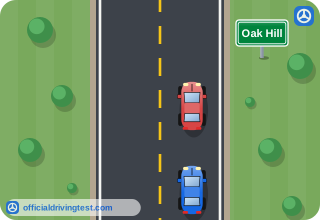
With the four-second method, what does it mean if it takes less than four seconds for your vehicle to reach the checkpoint?
- You are following at a safe distance for the conditions
- You may safely move up closer to the vehicle ahead now
- You should keep the same following distance as before
- You are following too closely and must increase your distance
Show answer
Correct answer: You are following too closely and must increase your distance
Less than four seconds means you are too close and must increase your following distance.
Source: Vermont Driver's Manual (2025 edition (VN-007 07/2024)), page 28 · Open this page in the manual (Manual page 28)
-
With the four-second method, how many seconds to pass the checkpoint show a safe following distance?
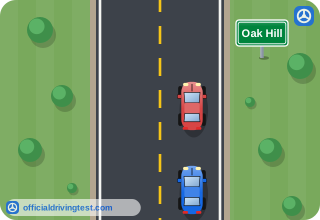
- Four or more seconds
- Two or more seconds
- Three seconds only
- Fewer than four seconds
Show answer
Correct answer: Four or more seconds
If it takes four or more seconds to pass the checkpoint, the following distance is safe.
Source: Vermont Driver's Manual (2025 edition (VN-007 07/2024)), page 28 · Open this page in the manual (Manual page 28)
-
What easy method does the manual give for counting seconds?
- Count "one, two, three, four" at a fast pace
- Count the lane markings you pass
- Count "one thousand one, one thousand two"
- Tap the steering wheel once per second
Show answer
Correct answer: Count "one thousand one, one thousand two"
The manual suggests counting "one thousand one, one thousand two" to measure seconds.
Source: Vermont Driver's Manual (2025 edition (VN-007 07/2024)), page 28 · Open this page in the manual (Manual page 28)
-
What is the maximum speed for any vehicle on all Vermont roads?
- 45 miles per hour or as posted
- 50 miles per hour or as posted
- 55 miles per hour or as posted
- 65 miles per hour or as posted
Show answer
Correct answer: 50 miles per hour or as posted
The manual gives 50 miles per hour, or the posted limit, as the maximum on Vermont roads.
Source: Vermont Driver's Manual (2025 edition (VN-007 07/2024)), page 28 · Open this page in the manual (Manual page 28)
-
What is the maximum speed for any vehicle on an Interstate in Vermont?
- 55 miles per hour or as posted
- 60 miles per hour or as posted
- 70 miles per hour or as posted
- 65 miles per hour or as posted
Show answer
Correct answer: 65 miles per hour or as posted
The manual gives 65 miles per hour, or the posted limit, as the maximum on an Interstate in Vermont.
Source: Vermont Driver's Manual (2025 edition (VN-007 07/2024)), page 28 · Open this page in the manual (Manual page 28)
-
According to the law, how must a motor vehicle be driven at all times?
- So that it is under control
- At the maximum posted speed
- At the same speed as the traffic around it
- At a steady speed with cruise control
Show answer
Correct answer: So that it is under control
The law says a motor vehicle must be driven at all times so that it is under control, at a speed reasonable for the dangers on the road.
Source: Vermont Driver's Manual (2025 edition (VN-007 07/2024)), page 28 · Open this page in the manual (Manual page 28)
-
What following distance does the manual tell drivers to maintain in a work zone?
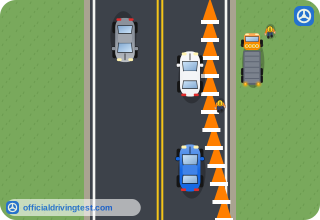
- 2 seconds
- 4 seconds
- 3 seconds
- 6 seconds
Show answer
Correct answer: 4 seconds
The work zone tips say to maintain a 4 second following distance.
Source: Vermont Driver's Manual (2025 edition (VN-007 07/2024)), page 35 · Open this page in the manual (Manual page 35)