Vermont: Sharing the road — Part 1 Practice Test
Questions in this part include: “What is a visual search pattern?” · “Which type of road is given as an example where bicyclists are prohibited?”
Independent educational site · not affiliated with any government agency or DMV
Ready? Test yourself
- Instant feedback with an explanation
- Every answer cites its source in the manual
- Your best score is saved on this device
- Keyboard: press 1 to 4 to answer and Enter for the next question
Questions are original and based on the official manual "Vermont Driver's Manual" (2025 edition (VN-007 07/2024)), Vermont Department of Motor Vehicles.
All 17 questions in this practice test
Take the test above first, then use this list to study. Tap “Show answer” to see the correct answer and explanation.
Show the questions and answersHide the questions
-
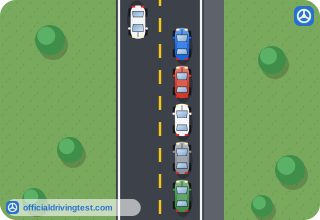
If traffic is backing up behind you because you are driving slowly, what are you required by law to do?
- Speed up to the posted limit until traffic clears
- Pull over when it is safe and let following vehicles go by
- Stop in your lane and wave the vehicles around you
- Turn on your hazard lights and stay in your lane
Show answer
Correct answer: Pull over when it is safe and let following vehicles go by
A slow driver who is holding up traffic must pull to the side when it is safe and let the vehicles behind pass.
Source: Vermont Driver's Manual (2025 edition (VN-007 07/2024)), page 25 · Open this page in the manual (Manual page 25)
-
What is a visual search pattern?
- An orderly way to search for hazards in all directions
- A way to read road signs from far away
- A method of judging the speed of other vehicles
- A routine for checking the vehicle's mirrors only
Show answer
Correct answer: An orderly way to search for hazards in all directions
A visual search pattern is an orderly way to look for hazards in every direction and notice changing conditions.
Source: Vermont Driver's Manual (2025 edition (VN-007 07/2024)), page 27 · Open this page in the manual (Manual page 27)
-
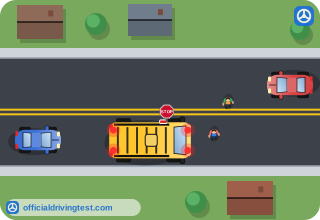
What does the manual say about passing a school bus that has stopped with its red warning lights on?
- It is allowed on a road with only two lanes
- It is allowed if you slow to 10 mph or less
- It is against the law to pass it from any direction
- It is allowed if no children are visible nearby
Show answer
Correct answer: It is against the law to pass it from any direction
Never pass a stopped school bus with red lights on, from any direction (with the divided-highway exception).
Source: Vermont Driver's Manual (2025 edition (VN-007 07/2024)), page 39 · Open this page in the manual (Manual page 39)
-
A school bus on the highway is about to pick up or discharge students. What does the driver activate first?
- Alternately flashing red lights
- Alternately flashing yellow lights
- Steady yellow hazard lights
- The horn
Show answer
Correct answer: Alternately flashing yellow lights
The yellow lights come first, while the bus slows, so you should prepare to stop.
Source: Vermont Driver's Manual (2025 edition (VN-007 07/2024)), page 39 · Open this page in the manual (Manual page 39)
-
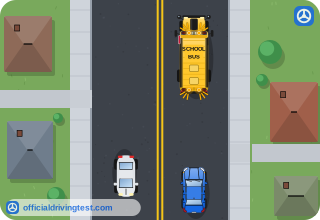
You see the alternately flashing yellow lights of a school bus that is slowing down. What should you do?
- Speed up to pass the bus
- Stop at once with your hazards on
- Ignore them, because the lights are only for the bus driver
- Prepare to stop
Show answer
Correct answer: Prepare to stop
The yellow lights warn that the bus will stop and the red lights will follow.
Source: Vermont Driver's Manual (2025 edition (VN-007 07/2024)), page 39 · Open this page in the manual (Manual page 39)
-
A school bus has stopped and its alternately flashing red warning lights have been activated. What must you do?
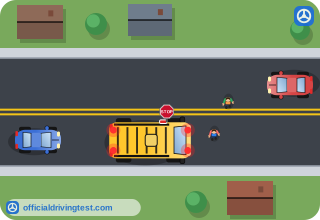
- Stop your vehicle
- Slow down and pass with care
- Stop only if students are in the road
- Pass if the bus is on your left
Show answer
Correct answer: Stop your vehicle
Once the red warning lights are on, you must stop.
Source: Vermont Driver's Manual (2025 edition (VN-007 07/2024)), page 40 · Open this page in the manual (Manual page 40)
-
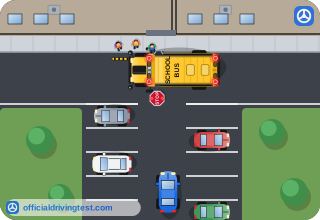
You are in a school yard and a stopped school bus has its alternately flashing red warning lights activated. What does the manual say?
- You may pass if driving under 10 mph
- You may pass because it is not a public road
- You must not pass the bus
- You may pass if the children are on the other side
Show answer
Correct answer: You must not pass the bus
A school yard is no exception: you must not pass a stopped school bus with flashing red lights.
Source: Vermont Driver's Manual (2025 edition (VN-007 07/2024)), page 40 · Open this page in the manual (Manual page 40)
-
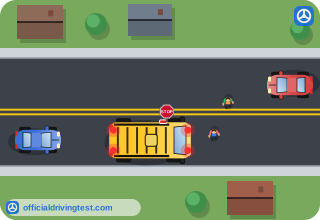
When do you NOT have to stop for a school bus with its red lights flashing?
- On any road that has a posted speed limit above 40 mph
- On a divided highway when the bus is traveling in the opposite direction
- On a road with more than two lanes in each direction
- When the bus is stopped at a railroad crossing ahead of you on the road
Show answer
Correct answer: On a divided highway when the bus is traveling in the opposite direction
The manual names the divided highway with the bus going the other way as an exception.
Source: Vermont Driver's Manual (2025 edition (VN-007 07/2024)), page 40 · Open this page in the manual (Manual page 40)
-
Where do bicyclists have the right to operate under state law?
- On all roads, unless specially prohibited
- Only on roads with a bike lane
- Only on roads with a speed limit under 35 mph
- Only on roads with no sidewalk
Show answer
Correct answer: On all roads, unless specially prohibited
Bicyclists may use all roads except where prohibited, such as limited-access highways.
Source: Vermont Driver's Manual (2025 edition (VN-007 07/2024)), page 40 · Open this page in the manual (Manual page 40)
-
Which type of road is given as an example where bicyclists are prohibited?
- Residential streets with no sidewalks
- Roads that have a narrow bridge
- Limited-access highways like the Interstate
- Roads with a 25 mph speed limit
Show answer
Correct answer: Limited-access highways like the Interstate
The manual names limited-access highways such as the Interstate as places bicyclists are prohibited.
Source: Vermont Driver's Manual (2025 edition (VN-007 07/2024)), page 40 · Open this page in the manual (Manual page 40)
-
How do traffic rules and regulations apply to bicyclists?
- Bicyclists are exempt from most of the rules that drivers follow
- The same rules that apply to vehicle drivers apply to them
- Only the signal rules apply to bicyclists
- The rules apply only on roads without sidewalks
Show answer
Correct answer: The same rules that apply to vehicle drivers apply to them
Bicyclists have the same rights and duties as motor vehicle operators.
Source: Vermont Driver's Manual (2025 edition (VN-007 07/2024)), page 40 · Open this page in the manual (Manual page 40)
-
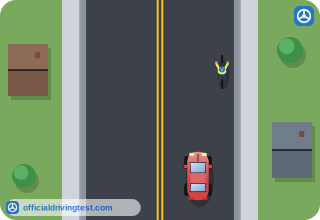
Why should you not honk at a bicyclist unless you have good cause to warn them?
- Honking at a bicyclist is against the law
- Bicyclists are never able to hear a car horn
- The horn would make the driver lose attention on the road
- The loud noise could startle the rider and cause a loss of control
Show answer
Correct answer: The loud noise could startle the rider and cause a loss of control
A sudden loud noise may make the bicyclist lose control.
Source: Vermont Driver's Manual (2025 edition (VN-007 07/2024)), page 40 · Open this page in the manual (Manual page 40)
-
As a driver, why should you drive defensively around a bicyclist?
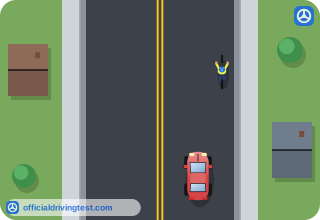
- Because the slightest mistake could cause serious injury or death
- Because bicyclists are required to ride on the shoulder
- Because bicyclists always travel faster than cars
- Because bicyclists may not use the road at night
Show answer
Correct answer: Because the slightest mistake could cause serious injury or death
Bicycles are quieter and less visible than other vehicles, so mistakes can be deadly.
Source: Vermont Driver's Manual (2025 edition (VN-007 07/2024)), page 40 · Open this page in the manual (Manual page 40)
-
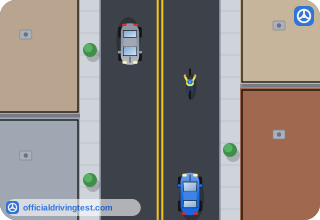
Which of these is given as a reason a bicyclist may ride toward the center of the lane?
- To keep drivers from passing at any time
- To avoid the need for hand signals
- Roadway hazards that motorists cannot see
- Because bicycles must always use the center of the lane
Show answer
Correct answer: Roadway hazards that motorists cannot see
Hazards not visible to motorists, or correct lane position, can be reasons to ride in the travel lane.
Source: Vermont Driver's Manual (2025 edition (VN-007 07/2024)), page 40 · Open this page in the manual (Manual page 40)
-
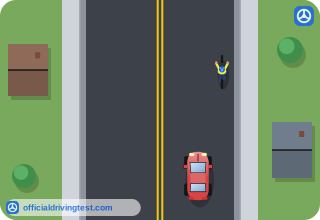
Which of these is named as a hazard for cyclists that you should give adequate space to maneuver around?
- Painted crosswalks
- Drain grates
- Wide shoulders
- Bike racks
Show answer
Correct answer: Drain grates
Potholes, drain grates, railroad tracks and narrow bridges or roadways are hazardous to cyclists.
Source: Vermont Driver's Manual (2025 edition (VN-007 07/2024)), page 40 · Open this page in the manual (Manual page 40)
-
What does the manual say a bicyclist making a left turn should do?
- Move to the right edge of the road and wait for traffic to clear
- Dismount at the curb and walk the bicycle across the intersection
- Stay in the right lane and turn from there
- Signal and move to the left side of the lane or into the turning lane
Show answer
Correct answer: Signal and move to the left side of the lane or into the turning lane
This is the proper maneuver, and the cyclist should be allowed to finish before motor vehicles overtake.
Source: Vermont Driver's Manual (2025 edition (VN-007 07/2024)), page 40 · Open this page in the manual (Manual page 40)
-
How much passing space does the manual say to leave between your vehicle and a bicyclist?
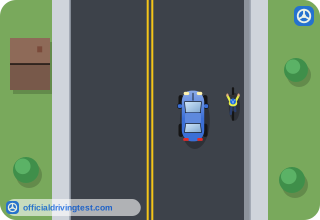
- At least four feet
- At least one foot
- At least two feet
- At least ten feet
Show answer
Correct answer: At least four feet
The manual calls for at least four feet of passing space.
Source: Vermont Driver's Manual (2025 edition (VN-007 07/2024)), page 40 · Open this page in the manual (Manual page 40)