Vermont: Sharing the road — Part 2 Practice Test
Questions in this part include: “Is a license required to ride a bicycle, according to the manual?” · “A bicyclist approaches a right turn lane but intends to go straight. What should the bicyclist do?”
Independent educational site · not affiliated with any government agency or DMV
Ready? Test yourself
- Instant feedback with an explanation
- Every answer cites its source in the manual
- Your best score is saved on this device
- Keyboard: press 1 to 4 to answer and Enter for the next question
Questions are original and based on the official manual "Vermont Driver's Manual" (2025 edition (VN-007 07/2024)), Vermont Department of Motor Vehicles.
All 17 questions in this practice test
Take the test above first, then use this list to study. Tap “Show answer” to see the correct answer and explanation.
Show the questions and answersHide the questions
-
The road is too narrow for motor vehicles and bicycles to ride safely side by side. What should you do?
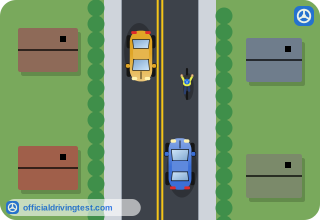
- Pass closely and sound your horn to warn the bicyclist
- Pass the bicyclist on the shoulder of the road
- Wait until it is safe to pass without forcing the bicyclist off the road
- Follow the bicyclist closely until you come to a wider road ahead
Show answer
Correct answer: Wait until it is safe to pass without forcing the bicyclist off the road
You may not squeeze the bicyclist off the road; wait for a safe chance to pass.
Source: Vermont Driver's Manual (2025 edition (VN-007 07/2024)), page 40 · Open this page in the manual (Manual page 40)
-
Two bicyclists are riding side by side ahead of you. What does the manual say?
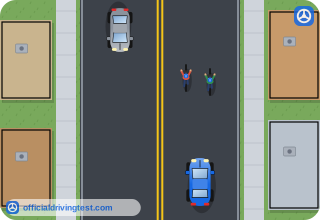
- It is illegal, so you may honk to make them separate and ride single file
- This is legal; slow down until it is safe to pass, or give them time to adjust
- You may pass at once on the right side of them
- They must stop at the side of the road until you pass
Show answer
Correct answer: This is legal; slow down until it is safe to pass, or give them time to adjust
Two bicyclists may legally ride side by side, so you slow down and pass only when it is safe.
Source: Vermont Driver's Manual (2025 edition (VN-007 07/2024)), page 41 · Open this page in the manual (Manual page 41)
-
Which of these is listed as a common error that could cause you to strike a bicyclist?
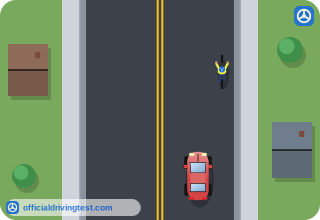
- Opening a vehicle door into the path of a bicyclist
- Passing a bicyclist with four feet of space
- Slowing down when you approach a bicyclist
- Yielding to an oncoming bicyclist when turning left
Show answer
Correct answer: Opening a vehicle door into the path of a bicyclist
Opening a car door into a bicyclist’s path is one of the four common vehicle-caused collisions.
Source: Vermont Driver's Manual (2025 edition (VN-007 07/2024)), page 41 · Open this page in the manual (Manual page 41)
-
Which is a common error when turning right at an intersection or driveway?
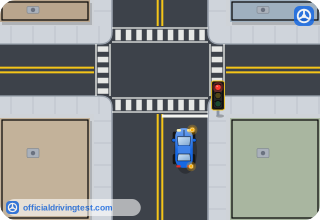
- Signaling your turn too early before you reach the intersection or driveway
- Turning from the right-hand lane when a bicyclist is behind you
- Not checking for a bicyclist on the right who is going straight or coming off a sidewalk
- Stopping before the crosswalk when you are about to turn right
Show answer
Correct answer: Not checking for a bicyclist on the right who is going straight or coming off a sidewalk
A bicyclist continuing straight ahead on your right is easy to miss when you turn.
Source: Vermont Driver's Manual (2025 edition (VN-007 07/2024)), page 41 · Open this page in the manual (Manual page 41)
-
Is a license required to ride a bicycle, according to the manual?
- Yes, a learner’s permit is required
- No, but bicyclists must obey all the rules of the road
- Yes, but only on roads with traffic signals
- No, and bicyclists are exempt from the rules of the road
Show answer
Correct answer: No, but bicyclists must obey all the rules of the road
No license is needed, yet bicyclists have the same rights and responsibilities as other drivers.
Source: Vermont Driver's Manual (2025 edition (VN-007 07/2024)), page 41 · Open this page in the manual (Manual page 41)
-
When are bicyclists allowed to ride two abreast?
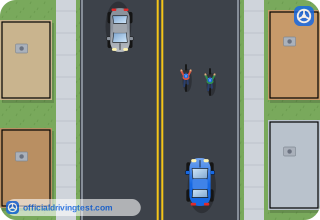
- Only on roads that have a marked bicycle lane
- Only on roads that have no other traffic at all
- Never, because riding two abreast is not allowed under any condition
- So long as they do not impede the normal and reasonable flow of traffic
Show answer
Correct answer: So long as they do not impede the normal and reasonable flow of traffic
Riding two abreast is permitted if it does not impede normal and reasonable traffic flow.
Source: Vermont Driver's Manual (2025 edition (VN-007 07/2024)), page 41 · Open this page in the manual (Manual page 41)
-
A bicyclist breaks a traffic law. What does the manual say?
- The bicyclist is subject to a ticket and fines
- Nothing, because the rules do not apply to bicycles
- The bicyclist loses points on a driver’s license
- The bicyclist only receives a warning
Show answer
Correct answer: The bicyclist is subject to a ticket and fines
Bicyclists must obey signals and signs and can be ticketed.
Source: Vermont Driver's Manual (2025 edition (VN-007 07/2024)), page 41 · Open this page in the manual (Manual page 41)
-
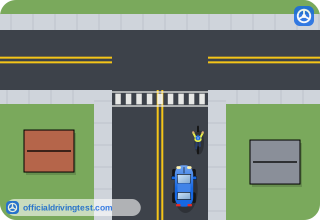
A bicyclist approaches a right turn lane but intends to go straight. What should the bicyclist do?
- Enter the right turn lane and signal
- Dismount and walk across the intersection
- Not enter the right turn lane
- Ride on the sidewalk
Show answer
Correct answer: Not enter the right turn lane
Bicyclists should ride with through traffic and not enter the right turn lane when going straight.
Source: Vermont Driver's Manual (2025 edition (VN-007 07/2024)), page 41 · Open this page in the manual (Manual page 41)
-
The road is too narrow for a bicycle and a vehicle to travel side by side. What should the bicyclist do?
- Speed up to stay ahead of the vehicle
- Occupy the lane until it is safe to move back to the right
- Stop and wait at the side for the vehicle to pass
- Ride on the sidewalk until the road becomes wider
Show answer
Correct answer: Occupy the lane until it is safe to move back to the right
The bicyclist occupies the lane until it is safe to move back to the right.
Source: Vermont Driver's Manual (2025 edition (VN-007 07/2024)), page 41 · Open this page in the manual (Manual page 41)
-
How often must a bicyclist signal an intent to turn?
- Only when riding at night
- Only when cars are behind the bicyclist
- Only on roads with a bike lane
- Always, using the proper hand signals
Show answer
Correct answer: Always, using the proper hand signals
Bicyclists must always signal turns with the proper hand signals.
Source: Vermont Driver's Manual (2025 edition (VN-007 07/2024)), page 41 · Open this page in the manual (Manual page 41)
-
A bicyclist holds the left arm bent upward at the elbow, with the hand up. What does this hand signal mean?
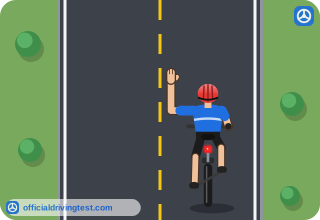
- Right turn
- Left turn
- Stopping
- Alternate right turn
Show answer
Correct answer: Right turn
A left arm bent upward at the elbow is the bicyclist’s right turn signal.
Source: Vermont Driver's Manual (2025 edition (VN-007 07/2024)), page 41 · Open this page in the manual (Manual page 41)
-
A bicyclist holds the left arm bent downward at the elbow, with the hand down. What does this hand signal mean?
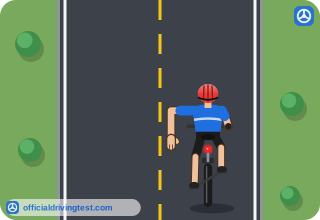
- Left turn
- Right turn
- Stopping
- Alternate right turn
Show answer
Correct answer: Stopping
A left arm bent downward at the elbow is the bicyclist’s stopping signal.
Source: Vermont Driver's Manual (2025 edition (VN-007 07/2024)), page 41 · Open this page in the manual (Manual page 41)
-
A bicyclist holds the right arm straight out to the side. What does this hand signal mean?
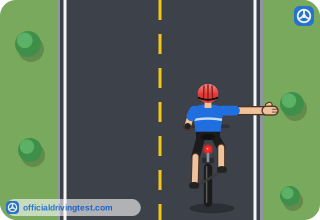
- Left turn
- Alternate right turn
- Stopping
- Slow down
Show answer
Correct answer: Alternate right turn
A right arm held straight out is the bicyclist’s alternate right turn signal.
Source: Vermont Driver's Manual (2025 edition (VN-007 07/2024)), page 41 · Open this page in the manual (Manual page 41)
-
A bicyclist holds the left arm straight out to the side. What does this hand signal mean?
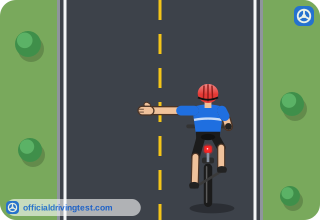
- Right turn
- Stopping
- Alternate right turn
- Left turn
Show answer
Correct answer: Left turn
A left arm held straight out is the bicyclist’s left turn signal.
Source: Vermont Driver's Manual (2025 edition (VN-007 07/2024)), page 41 · Open this page in the manual (Manual page 41)
-
What does the manual say about users of skateboards, scooters, roller blades and similar devices on the roadway?
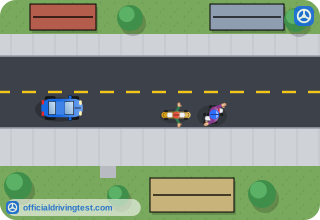
- They can move abruptly and change direction unexpectedly into your path
- They are not allowed to use any road in Vermont
- They always travel slower than bicyclists and keep a steady path
- They must yield to all other vehicles on the road
Show answer
Correct answer: They can move abruptly and change direction unexpectedly into your path
These users can be traveling at a significant speed and change direction without warning, so be especially alert.
Source: Vermont Driver's Manual (2025 edition (VN-007 07/2024)), page 42 · Open this page in the manual (Manual page 42)
-
How do the rights and responsibilities of a motorcyclist on the highway compare with those of drivers of other vehicles?
- Motorcyclists have the right-of-way
- Motorcyclists have fewer rights
- They are the same
- Motorcyclists are exempt from lane rules
Show answer
Correct answer: They are the same
Motorists should not crowd motorcycles or take the right-of-way from cyclists.
Source: Vermont Driver's Manual (2025 edition (VN-007 07/2024)), page 42 · Open this page in the manual (Manual page 42)
-
Why should you make sure that a motorcycle’s turn signal is "for real"?
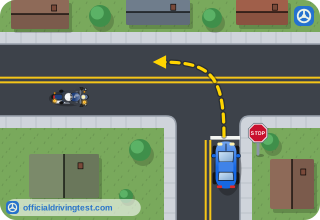
- Motorcycles are not able to signal left turns at all
- Motorcycle signals are always flashing by design
- Motorcycle turn signals stay on all the time while riding
- Signals usually are not self-canceling, so riders may forget them
Show answer
Correct answer: Signals usually are not self-canceling, so riders may forget them
Riders, especially beginners, sometimes leave the signal on after a turn or lane change.
Source: Vermont Driver's Manual (2025 edition (VN-007 07/2024)), page 42 · Open this page in the manual (Manual page 42)