Vermont: Sharing the road — Part 4 Practice Test
Questions in this part include: “How is a slow moving vehicle such as a tractor identified?” · “Do agricultural vehicle operators have a right to drive their vehicles on the road?”
Independent educational site · not affiliated with any government agency or DMV
Ready? Test yourself
- Instant feedback with an explanation
- Every answer cites its source in the manual
- Your best score is saved on this device
- Keyboard: press 1 to 4 to answer and Enter for the next question
Questions are original and based on the official manual "Vermont Driver's Manual" (2025 edition (VN-007 07/2024)), Vermont Department of Motor Vehicles.
All 17 questions in this practice test
Take the test above first, then use this list to study. Tap “Show answer” to see the correct answer and explanation.
Show the questions and answersHide the questions
-
How should you drive while passing a large truck?
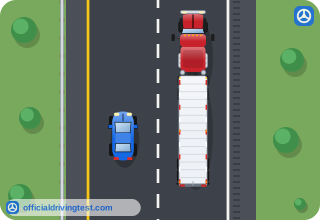
- Speed up and then slow down
- Maintain a consistent speed
- Slow down beside the truck
- Stay beside the truck for a while
Show answer
Correct answer: Maintain a consistent speed
Passing a large truck takes longer, so you should keep a consistent speed while you pass.
Source: Vermont Driver's Manual (2025 edition (VN-007 07/2024)), page 43 · Open this page in the manual (Manual page 43)
-
After passing a large truck, when is it safe to return to the right lane?
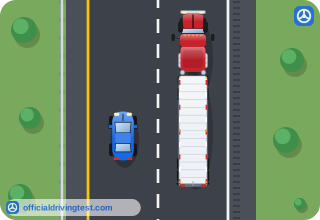
- As soon as your bumper is past the truck's cab
- When the truck's right turn signal comes on
- After you have counted two seconds beside it
- When you can see the cab in your inside rearview mirror
Show answer
Correct answer: When you can see the cab in your inside rearview mirror
You should see the truck's cab in your inside rearview mirror before returning to the right lane, so you do not pull in too soon.
Source: Vermont Driver's Manual (2025 edition (VN-007 07/2024)), page 43 · Open this page in the manual (Manual page 43)
-
What may a truck driver have to do when vehicles pull in front of a truck too soon?
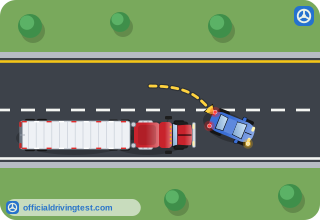
- Act quickly to avoid a crash
- Pull over to the shoulder at once
- Honk and keep the same speed
- Turn on the hazard lights and wait
Show answer
Correct answer: Act quickly to avoid a crash
A vehicle that pulls in front of a truck too soon may force the truck driver to act quickly to avoid a crash.
Source: Vermont Driver's Manual (2025 edition (VN-007 07/2024)), page 43 · Open this page in the manual (Manual page 43)
-
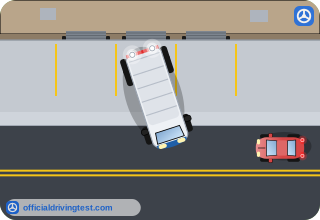
What should you never do when a truck is preparing to back up or is backing up?
- Wait behind the truck
- Stay well back from the truck
- Go around the truck
- Watch the truck's signals
Show answer
Correct answer: Go around the truck
A backing truck may have to block the street, and if you go around it you can enter a blind spot where the driver cannot see you.
Source: Vermont Driver's Manual (2025 edition (VN-007 07/2024)), page 43 · Open this page in the manual (Manual page 43)
-
Where do trucks have long blind spots, unlike other motor vehicles?
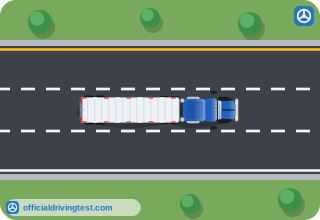
- Only directly in front of them
- Directly behind them
- Only above the trailer
- Only at intersections
Show answer
Correct answer: Directly behind them
Trucks have long blind spots directly behind them, and the driver cannot see a vehicle there.
Source: Vermont Driver's Manual (2025 edition (VN-007 07/2024)), page 44 · Open this page in the manual (Manual page 44)
-
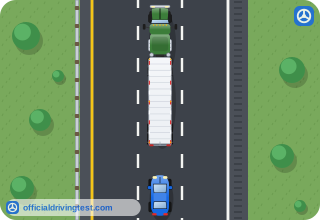
What greatly increases your chance of a rear-end collision with a truck?
- Following at a safe distance
- Driving in the right lane
- Driving with your headlights on
- Following too closely
Show answer
Correct answer: Following too closely
Following a truck too closely puts you in its rear blind spot and greatly increases the chance of a rear-end collision.
Source: Vermont Driver's Manual (2025 edition (VN-007 07/2024)), page 44 · Open this page in the manual (Manual page 44)
-
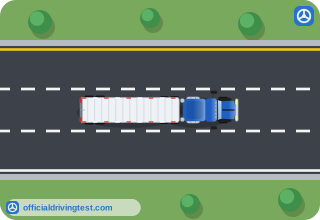
Compared with passenger vehicles, how large are the blind spots on the sides of a truck?
- Much larger
- Slightly smaller
- About the same size
- Larger on the left side only
Show answer
Correct answer: Much larger
Trucks have much larger blind spots on both sides than passenger vehicles do.
Source: Vermont Driver's Manual (2025 edition (VN-007 07/2024)), page 44 · Open this page in the manual (Manual page 44)
-
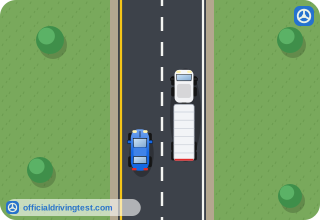
Why could a serious crash occur if your vehicle is in a truck driver's side blind spot?
- Trucks always drift out of their own lane
- Truck drivers cannot hear the horns of cars
- The driver may change lanes quickly and not see you
- Trucks cannot slow down on a highway road
Show answer
Correct answer: The driver may change lanes quickly and not see you
If the truck driver needs to change lanes quickly while you are in the blind spot, the driver cannot see you and a serious crash could result.
Source: Vermont Driver's Manual (2025 edition (VN-007 07/2024)), page 44 · Open this page in the manual (Manual page 44)
-
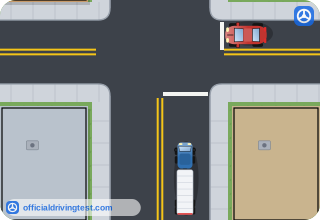
A large truck is about to make a right turn. What do truck drivers often need to do?
- Swing wide to the right
- Swing wide to the left
- Stop in the middle of the intersection
- Turn from the far right lane only
Show answer
Correct answer: Swing wide to the left
Truck drivers often swing wide to the left in order to make a right turn.
Source: Vermont Driver's Manual (2025 edition (VN-007 07/2024)), page 44 · Open this page in the manual (Manual page 44)
-
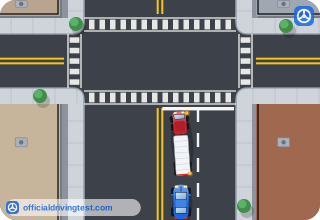
A truck is making a wide right turn. What should you not do?
- Look for the truck's turn signals
- Stay well behind the turning truck
- Allow the truck extra room to swing
- Cut in between the truck and the curb
Show answer
Correct answer: Cut in between the truck and the curb
Squeezing between the truck and the curb increases the possibility of a crash.
Source: Vermont Driver's Manual (2025 edition (VN-007 07/2024)), page 44 · Open this page in the manual (Manual page 44)
-
How is a slow moving vehicle such as a tractor identified?
- By an orange and red triangular sign
- By a flashing blue light on its roof
- By a yellow square sign on its front
- By a white rectangular sign on its side
Show answer
Correct answer: By an orange and red triangular sign
A slow moving vehicle carries an orange and red triangular sign on the rear so that drivers can recognize it sooner.
Source: Vermont Driver's Manual (2025 edition (VN-007 07/2024)), page 44 · Open this page in the manual (Manual page 44)
-
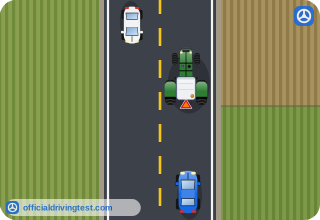
Why does the orange and red triangular sign on a slow moving vehicle help you?
- It shows the vehicle will stop at the next corner
- It means other vehicles may pass at any time
- You recognize the vehicle sooner and have time to slow
- It shows the vehicle is on a government job
Show answer
Correct answer: You recognize the vehicle sooner and have time to slow
The sooner you identify a slow moving vehicle, the more time you have to respond by reducing your speed.
Source: Vermont Driver's Manual (2025 edition (VN-007 07/2024)), page 44 · Open this page in the manual (Manual page 44)
-
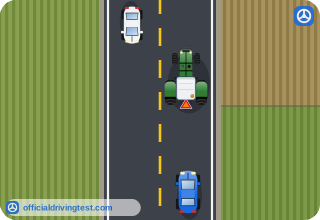
Where may slow moving vehicles make wide turns?
- Only at marked intersections of two roads
- At unmarked entrances to the right or left
- Only at traffic signals on busy streets
- Only on roads with two lanes each way
Show answer
Correct answer: At unmarked entrances to the right or left
The manual warns that slow moving vehicles may make wide turns at unmarked entrances on either side of the road.
Source: Vermont Driver's Manual (2025 edition (VN-007 07/2024)), page 44 · Open this page in the manual (Manual page 44)
-
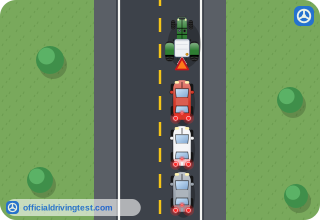
What may the operator of a slow moving vehicle do when it causes traffic delays?
- Stop in the travel lane to let others by
- Drive faster until traffic has cleared
- Drive on the shoulder at all times
- Pull over if and when it is possible and safe
Show answer
Correct answer: Pull over if and when it is possible and safe
The operator may pull over, when and if it is possible and safe, to let others go by.
Source: Vermont Driver's Manual (2025 edition (VN-007 07/2024)), page 44 · Open this page in the manual (Manual page 44)
-
Do agricultural vehicle operators have a right to drive their vehicles on the road?
- Yes
- No, only on private roads
- No, only at night
- Yes, but only on roads with a shoulder
Show answer
Correct answer: Yes
The manual states that agricultural vehicle operators have a right to drive their vehicles on the road.
Source: Vermont Driver's Manual (2025 edition (VN-007 07/2024)), page 44 · Open this page in the manual (Manual page 44)
-
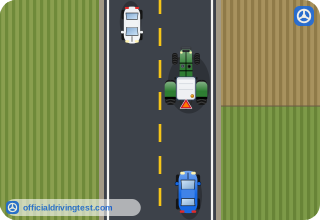
How much following distance may be needed behind a slow moving vehicle?
- Less than a two second following distance
- Exactly one car length
- More than a four second following distance
- No more than three seconds
Show answer
Correct answer: More than a four second following distance
The manual says it may be necessary to allow for more than a four second following distance behind slow moving vehicles.
Source: Vermont Driver's Manual (2025 edition (VN-007 07/2024)), page 44 · Open this page in the manual (Manual page 44)
-
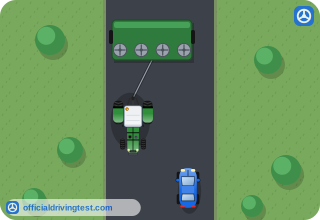
What should you do on a narrow road when you meet wide equipment?
- Speed up to pass it quickly
- Yield to it
- Flash your high beams
- Stay as close as you can behind it
Show answer
Correct answer: Yield to it
The manual says to yield to wide equipment on narrow roads.
Source: Vermont Driver's Manual (2025 edition (VN-007 07/2024)), page 44 · Open this page in the manual (Manual page 44)