Utah: Sharing the road — Motor-Assisted Scooters and Motorcycles Practice Test
Questions in this part include: “A motor-assisted scooter must follow the same rules as which of these?” · “What is Utah law on lane splitting, riding between cars moving at higher speeds?”
Independent educational site · not affiliated with any government agency or DMV
Ready? Test yourself
- Instant feedback with an explanation
- Every answer cites its source in the manual
- Your best score is saved on this device
- Keyboard: press 1 to 4 to answer and Enter for the next question
Questions are original and based on the official manual "Utah Driver Handbook" (2026 edition (new 2026 laws effective May 6, 2026)), Utah Department of Public Safety, Driver License Division.
All 17 questions in this practice test
Take the test above first, then use this list to study. Tap “Show answer” to see the correct answer and explanation.
Show the questions and answersHide the questions
-
A motor-assisted scooter must follow the same rules as which of these?
- A passenger car and nothing else
- A pedestrian only
- A bicycle, moped, or motorcycle
- A farm tractor
Show answer
Correct answer: A bicycle, moped, or motorcycle
Motor-assisted scooters follow the same rules as a bicycle, moped or motorcycle.
Source: Utah Driver Handbook (2026 edition (new 2026 laws effective May 6, 2026)), page 81 · Open this page in the manual (Manual page 81)
-
A person under age 15 can ride a motor-assisted scooter only with what?
- A signed note from the school district
- Parent supervision or a course certificate
- A learner permit and a signed school form
- A motorcycle endorsement
Show answer
Correct answer: Parent supervision or a course certificate
Riders under 15 may use a motor-assisted scooter only with a parent supervising or with a course certificate.
Source: Utah Driver Handbook (2026 edition (new 2026 laws effective May 6, 2026)), page 81 · Open this page in the manual (Manual page 81)
-
A person of any age may not operate a motor-assisted scooter on a highway with a posted speed limit greater than what?
- 25 mph
- 35 mph
- 45 mph
- 15 mph
Show answer
Correct answer: 15 mph
A motor-assisted scooter may not be used on a highway whose posted speed limit is above 15 mph.
Source: Utah Driver Handbook (2026 edition (new 2026 laws effective May 6, 2026)), page 81 · Open this page in the manual (Manual page 81)
-
A person of any age may not operate a motor-assisted scooter on a highway with at least how many lanes?
- Two
- Three
- Six
- Four
Show answer
Correct answer: Four
Motor-assisted scooters are not allowed on a highway with four or more lanes.
Source: Utah Driver Handbook (2026 edition (new 2026 laws effective May 6, 2026)), page 81 · Open this page in the manual (Manual page 81)
-
How much of a lane should you give a motorcycle?
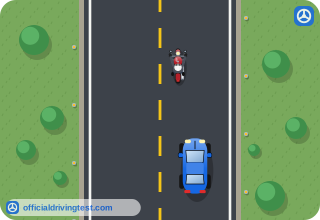
- Half of the lane
- An entire lane
- Whatever is left beside your car
- The part of the lane next to the center line
Show answer
Correct answer: An entire lane
Motorcycles need space to react to other traffic, so you should not share a lane with one.
Source: Utah Driver Handbook (2026 edition (new 2026 laws effective May 6, 2026)), page 81 · Open this page in the manual (Manual page 81)
-
Why should you always check your mirrors and blind spots for motorcycles?
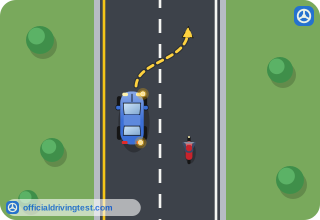
- They always ride in the blind spot
- They cannot use turn signals
- They are small and can be challenging to see
- They travel faster than other vehicles
Show answer
Correct answer: They are small and can be challenging to see
Motorcycles are small and hard to see, so a careful check of mirrors and blind spots is needed.
Source: Utah Driver Handbook (2026 edition (new 2026 laws effective May 6, 2026)), page 81 · Open this page in the manual (Manual page 81)
-
Before turning left, where should you look carefully for motorcycles?
- At the front and sides
- Only in the rear-view mirror
- Only behind you
- Only at the road shoulder
Show answer
Correct answer: At the front and sides
Before a left turn you should look carefully at the front and sides of your vehicle for motorcycles.
Source: Utah Driver Handbook (2026 edition (new 2026 laws effective May 6, 2026)), page 81 · Open this page in the manual (Manual page 81)
-
Why should you not assume a motorcycle is turning just because its turn signal is flashing?
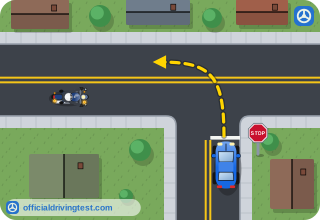
- Motorcycles cannot turn while a signal flashes
- Many motorcycle turn signals do not self-cancel
- Motorcycle signals flash for braking
- Riders must signal for a full block before a turn
Show answer
Correct answer: Many motorcycle turn signals do not self-cancel
The rider may have forgotten to cancel the signal because many motorcycle turn signals do not turn off by themselves.
Source: Utah Driver Handbook (2026 edition (new 2026 laws effective May 6, 2026)), page 81 · Open this page in the manual (Manual page 81)
-
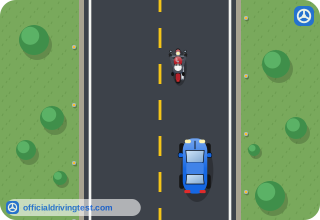
Why might a motorcycle rider suddenly change speed or lane position?
- To make room for passing cars and large trucks
- To warm up the engine
- To avoid potholes, gravel, or wet or slick places
- To signal a driver behind to pass
Show answer
Correct answer: To avoid potholes, gravel, or wet or slick places
Riders adjust speed or position to avoid road hazards like potholes, gravel and slick spots, which can be deadly to them.
Source: Utah Driver Handbook (2026 edition (new 2026 laws effective May 6, 2026)), page 81 · Open this page in the manual (Manual page 81)
-
How does the speed of scooters and mopeds compare with motorcycles?
- They travel at the same speed
- They travel at a slightly higher speed
- They travel at a much lower speed
- They travel faster on wet roads
Show answer
Correct answer: They travel at a much lower speed
Drivers are reminded that scooters and mopeds travel much slower than motorcycles.
Source: Utah Driver Handbook (2026 edition (new 2026 laws effective May 6, 2026)), page 82 · Open this page in the manual (Manual page 82)
-
What is Utah law on lane splitting, riding between cars moving at higher speeds?
- It is illegal
- It is legal on any road with two or more lanes
- It is legal only on freeways
- It is legal only in daylight
Show answer
Correct answer: It is illegal
Lane splitting between cars moving at higher speeds is illegal in Utah and considered dangerous.
Source: Utah Driver Handbook (2026 edition (new 2026 laws effective May 6, 2026)), page 82 · Open this page in the manual (Manual page 82)
-
A motorcycle may legally lane filter only when it is traveling at what speed?
- 25 mph or less
- 35 mph or less
- 45 mph or less
- 15 mph or less
Show answer
Correct answer: 15 mph or less
One condition of legal lane filtering is that the motorcycle travels at 15 mph or less.
Source: Utah Driver Handbook (2026 edition (new 2026 laws effective May 6, 2026)), page 82 · Open this page in the manual (Manual page 82)
-
What is the highest speed limit on a roadway where lane filtering is legal (an off-ramp is also allowed)?
- 25 mph or less
- 45 mph or less
- 35 mph or less
- 55 mph or less
Show answer
Correct answer: 45 mph or less
Lane filtering is allowed on a roadway with a speed limit of 45 mph or less, or on an off-ramp.
Source: Utah Driver Handbook (2026 edition (new 2026 laws effective May 6, 2026)), page 82 · Open this page in the manual (Manual page 82)
-
Where is lane filtering not permitted?
- On an on-ramp
- On an off-ramp
- On a roadway with two lanes in the same direction
- On a roadway with a speed limit of 40 mph
Show answer
Correct answer: On an on-ramp
Lane filtering is not permitted on an on-ramp.
Source: Utah Driver Handbook (2026 edition (new 2026 laws effective May 6, 2026)), page 82 · Open this page in the manual (Manual page 82)
-
For legal lane filtering, what must be true of the vehicle the motorcycle overtakes in the same lane?
- It is moving slower than 15 mph
- It has its turn signal on
- It is stopped
- It is a commercial vehicle
Show answer
Correct answer: It is stopped
A motorcycle may filter past a vehicle only when that vehicle is stopped in the same lane.
Source: Utah Driver Handbook (2026 edition (new 2026 laws effective May 6, 2026)), page 82 · Open this page in the manual (Manual page 82)
-
What does the handbook say to do because rules for motorcycles, e-bikes, mopeds and scooters vary from city to city?
- Follow the state rules only
- Assume all cities use the same rules
- Ask the Driver License Division in each city
- Check local laws and ordinances
Show answer
Correct answer: Check local laws and ordinances
Rules for these vehicles differ by city, so check the local laws and ordinances.
Source: Utah Driver Handbook (2026 edition (new 2026 laws effective May 6, 2026)), page 82 · Open this page in the manual (Manual page 82)
-
What should riders of motorcycles and bicycles avoid doing when approaching a railroad crossing?
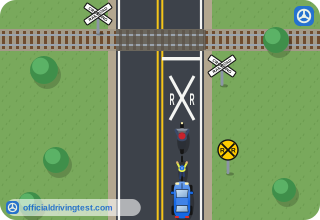
- Approaching the crossing with caution
- Slowing down before the tracks
- Looking both ways for a train
- Swerving to get a better angle for crossing
Show answer
Correct answer: Swerving to get a better angle for crossing
Riders should approach with caution and must not swerve to find a better crossing angle.
Source: Utah Driver Handbook (2026 edition (new 2026 laws effective May 6, 2026)), page 87 · Open this page in the manual (Manual page 87)