Utah: Sharing the road
Bicycles and e-bikes, motorcycles, large trucks and their No-Zones, school buses, scooters, mobility vehicles, street-legal ATVs and towing. Split into 7 shorter tests so you're not stuck in one long quiz.
Independent educational site · not affiliated with any government agency or DMV
Choose a part
Sharing the road — Definitions and School Bus Stopping
Questions in this part include: “In the handbook’s definition of a bicycle, the wheels are not less than what diameter?”
StartSharing the road — Road Rage, Animals and Slow Moving Vehicles
Questions in this part include: “How does the handbook describe aggressive driving?”
StartSharing the road — Vulnerable Users and Drivers Near Bicycles
Questions in this part include: “Where should you scan and check traffic?”
StartSharing the road — Bicyclist Rules and Electric-Assisted Bicycles
Questions in this part include: “How many hands must a bicyclist keep on the handlebars at all times, at a minimum?”
StartSharing the road — Large Trucks: Size, Weight and Maneuverability
Questions in this part include: “What is the maximum total outside width of a single vehicle, including its load?”
StartSharing the road — Large Trucks: Turns, Blind Spots and No-Zones
Questions in this part include: “A loaded truck traveling at 55 mph takes at least how far to stop?”
StartSharing the road — Motor-Assisted Scooters and Motorcycles
Questions in this part include: “A motor-assisted scooter must follow the same rules as which of these?”
StartAll 135 Sharing the road questions with answers
Choose a part above to take a practice test, or study every question and answer here.
Show the questions and answersHide the questions
-
In the handbook’s definition of a bicycle, the wheels are not less than what diameter?
- 14 inches
- 10 inches
- 12 inches
- 16 inches
Show answer
Correct answer: 14 inches
A bicycle’s wheels must be at least 14 inches in diameter under the definition.
Source: Utah Driver Handbook (2026 edition (new 2026 laws effective May 6, 2026)), page 1 · Open this page in the manual (Manual page 1)
-
A low-speed vehicle is designed to be operated at no more than what speed?
- 15 miles per hour
- 25 miles per hour
- 35 miles per hour
- 45 miles per hour
Show answer
Correct answer: 25 miles per hour
A low-speed vehicle is a four-wheeled electric vehicle designed for speeds of not more than 25 miles per hour.
Source: Utah Driver Handbook (2026 edition (new 2026 laws effective May 6, 2026)), page 2 · Open this page in the manual (Manual page 2)
-
A low-speed vehicle has a capacity of not more than how many passengers, including the driver?
- Two
- Six
- Eight
- Four
Show answer
Correct answer: Four
The definition limits a low-speed vehicle to four passengers including the driver.
Source: Utah Driver Handbook (2026 edition (new 2026 laws effective May 6, 2026)), page 2 · Open this page in the manual (Manual page 2)
-
Which agency issues a mobility vehicle permit, which specifies the conditions for a person with a physical disability to drive a mobility vehicle?
- The Division of Motor Vehicles
- The Utah Highway Patrol
- The Driver License Division
- The Utah State Tax Commission
Show answer
Correct answer: The Driver License Division
The permit is issued by the division, meaning the Driver License Division of the Department of Public Safety.
Source: Utah Driver Handbook (2026 edition (new 2026 laws effective May 6, 2026)), page 2 · Open this page in the manual (Manual page 2)
-
A pedestrian vehicle, designed for persons with a physical disability, must not be capable of exceeding what speed?
- 20 miles per hour
- 30 miles per hour
- 25 miles per hour
- 35 miles per hour
Show answer
Correct answer: 30 miles per hour
The definition says a pedestrian vehicle must not be capable of exceeding 30 m.p.h.
Source: Utah Driver Handbook (2026 edition (new 2026 laws effective May 6, 2026)), page 3 · Open this page in the manual (Manual page 3)
-
Which description fits a personal motorized mobility device?
- A self-propelled device with four wheels and a seat on which one rider sits to operate it
- A self-propelled device with three wheels and handlebars that the rider uses to steer it
- A self-propelled device with two wheels in line and a saddle on which the rider sits
- A self-propelled device with two non-tandem wheels and a deck on which a person stands to operate it
Show answer
Correct answer: A self-propelled device with two non-tandem wheels and a deck on which a person stands to operate it
It has two non-tandem wheels, steering and stopping controls, a limited motor, and a deck designed for a standing rider.
Source: Utah Driver Handbook (2026 edition (new 2026 laws effective May 6, 2026)), page 3 · Open this page in the manual (Manual page 3)
-
In the handbook’s definitions, what is a school bus?
- Any passenger vehicle, whether commercial or private, that carries at least one student at a time
- A non-commercial vehicle used by parents to carry their own children to and from school each day
- A commercial motor vehicle used to transport school students to and from home and school or school-sponsored events
- A commercial vehicle that carries adult passengers to and from their place of work each day
Show answer
Correct answer: A commercial motor vehicle used to transport school students to and from home and school or school-sponsored events
A school bus is a commercial motor vehicle that carries pre-primary, primary, or secondary students to and from home, school, or school-sponsored events.
Source: Utah Driver Handbook (2026 edition (new 2026 laws effective May 6, 2026)), page 3 · Open this page in the manual (Manual page 3)
-
In the handbook’s definitions, what is a street-legal all-terrain vehicle?
- Any all-terrain vehicle that crosses a highway to reach a trail
- An all-terrain type I or utility-type vehicle modified to operate on highways
- A motorcycle that is modified for use on unpaved roads
- A four-wheeled electric vehicle built to travel at 25 miles per hour
Show answer
Correct answer: An all-terrain type I or utility-type vehicle modified to operate on highways
A street-legal all-terrain vehicle is a type I all-terrain or utility-type vehicle modified so it can be operated on highways.
Source: Utah Driver Handbook (2026 edition (new 2026 laws effective May 6, 2026)), page 3 · Open this page in the manual (Manual page 3)
-
In the handbook’s definitions, what is a farm tractor?
- A trailer towed behind a pickup truck to haul crops to market
- Any truck with a gross weight of 26,001 pounds or more used for hauling feed
- A four-wheeled electric vehicle used on a farm at no more than 25 miles per hour
- A self-propelled vehicle designed and used primarily as a farm implement of husbandry
Show answer
Correct answer: A self-propelled vehicle designed and used primarily as a farm implement of husbandry
A farm tractor is a self-propelled vehicle designed and used mainly as farm equipment.
Source: Utah Driver Handbook (2026 edition (new 2026 laws effective May 6, 2026)), page 1 · Open this page in the manual (Manual page 1)
-
Where should you scan and check traffic?
- Only at intersections that are controlled by traffic signals
- Only on roads where the posted speed limit is higher than 45 mph
- Only in places where a crossing guard is present at the time
- In high-volume areas and areas where pedestrians are expected to be present
Show answer
Correct answer: In high-volume areas and areas where pedestrians are expected to be present
Scanning applies to high-volume areas and places where pedestrians are expected.
Source: Utah Driver Handbook (2026 edition (new 2026 laws effective May 6, 2026)), page 31 · Open this page in the manual (Manual page 31)
-
When stopping behind another vehicle, what should you be able to see?
- The license plate of the vehicle in front of you
- The rear wheels of the vehicle in front of you
- The brake lights of the second vehicle ahead
- The turn signal of the vehicle behind you
Show answer
Correct answer: The rear wheels of the vehicle in front of you
Leave enough room that you can see the rear wheels of the vehicle in front.
Source: Utah Driver Handbook (2026 edition (new 2026 laws effective May 6, 2026)), page 31 · Open this page in the manual (Manual page 31)
-
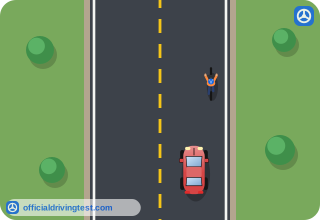
What should you do when passing bicyclists?
- Sound your horn to warn them before you pass
- Keep your speed the same so you do not confuse them
- Slow down to give them as much space as possible
- Stay close behind them until they turn
Show answer
Correct answer: Slow down to give them as much space as possible
The handbook says to slow down when passing bicyclists so they have as much space as possible.
Source: Utah Driver Handbook (2026 edition (new 2026 laws effective May 6, 2026)), page 34 · Open this page in the manual (Manual page 34)
-
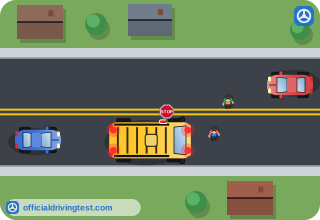
A school bus displays alternating flashing red lights visible from the front or rear. What must you do?
- Slow down and pass with caution
- Slow to 20 miles per hour and pass carefully
- Stop immediately before reaching the bus
- Stop only if you can see children outside
Show answer
Correct answer: Stop immediately before reaching the bus
You must stop immediately before reaching a school bus that displays alternating flashing red lights.
Source: Utah Driver Handbook (2026 edition (new 2026 laws effective May 6, 2026)), page 36 · Open this page in the manual (Manual page 36)
-
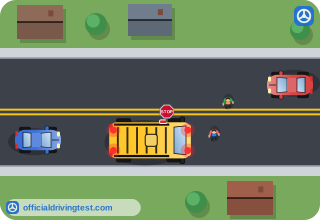
After stopping for a school bus with flashing red lights, when may you proceed?
- When the bus driver waves you on
- When the flashing red light has stopped
- When all children are out of sight
- When two minutes have passed
Show answer
Correct answer: When the flashing red light has stopped
You do not proceed until the flashing red light or signal has stopped.
Source: Utah Driver Handbook (2026 edition (new 2026 laws effective May 6, 2026)), page 36 · Open this page in the manual (Manual page 36)
-
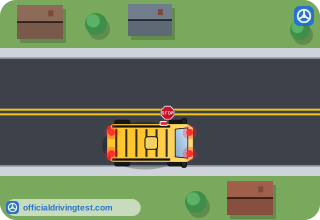
On a two-lane roadway, who must stop for a school bus with alternating flashing red lights?
- Only traffic traveling behind the bus
- Only traffic traveling toward the bus
- Only the vehicle closest to the bus
- Traffic in both directions
Show answer
Correct answer: Traffic in both directions
On a two-lane roadway, traffic in both directions must stop.
Source: Utah Driver Handbook (2026 edition (new 2026 laws effective May 6, 2026)), page 36 · Open this page in the manual (Manual page 36)
-
On a divided highway with four or more lanes and a median, who must stop for a school bus with alternating flashing red lights?
- Traffic in both directions
- Only the vehicles in both lanes behind the bus
- Only the vehicles in the lane next to the bus
- Only the oncoming traffic
Show answer
Correct answer: Only the vehicles in both lanes behind the bus
With a median separating the traffic, only vehicles in both lanes behind the bus must stop, not the opposite direction.
Source: Utah Driver Handbook (2026 edition (new 2026 laws effective May 6, 2026)), page 36 · Open this page in the manual (Manual page 36)
-
On a four-lane roadway without a median, who must stop for a school bus with alternating flashing red lights?
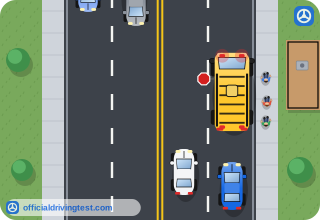
- Traffic in both directions
- Only the vehicles in both lanes behind the bus
- Only the vehicles in the lane next to the bus
- Only the vehicles in the lane nearest the curb
Show answer
Correct answer: Traffic in both directions
On a four-lane roadway without a median, traffic in both directions is required to stop.
Source: Utah Driver Handbook (2026 edition (new 2026 laws effective May 6, 2026)), page 36 · Open this page in the manual (Manual page 36)
-
On a highway with five or more lanes and a shared center turn lane, what is required of vehicles traveling in the opposite direction from a stopped school bus?
- They must stop
- They must stop only if children are crossing
- They must slow to 20 miles per hour
- They are not legally required to stop
Show answer
Correct answer: They are not legally required to stop
On a highway with five or more lanes and a shared center turn lane, only vehicles behind the bus must stop; oncoming vehicles are not legally required to.
Source: Utah Driver Handbook (2026 edition (new 2026 laws effective May 6, 2026)), page 36 · Open this page in the manual (Manual page 36)
-
What does the handbook say to do when driving near school buses?
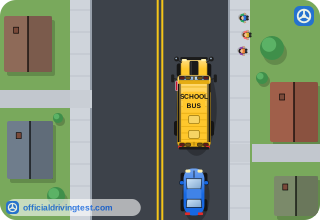
- Pass them quickly to clear the area
- Keep your usual speed unless a bus stops
- Use caution and adjust your speed accordingly
- Sound your horn to warn children
Show answer
Correct answer: Use caution and adjust your speed accordingly
Children are unpredictable, so you use caution near school buses and adjust your speed.
Source: Utah Driver Handbook (2026 edition (new 2026 laws effective May 6, 2026)), page 36 · Open this page in the manual (Manual page 36)
-
According to the handbook, how high can fines run for improperly passing a school bus?
- Up to $3000
- Up to $300
- Up to $500
- Up to $1000
Show answer
Correct answer: Up to $3000
The handbook says fines for illegally passing a school bus can run up to $3000.
Source: Utah Driver Handbook (2026 edition (new 2026 laws effective May 6, 2026)), page 36 · Open this page in the manual (Manual page 36)
-
What may happen when a school bus driver reports a vehicle that improperly passed the bus?
- The report stays with the school district and goes no further
- The report may be forwarded to local law enforcement for investigation
- Your license is suspended at once
- The report is dropped unless police saw the pass
Show answer
Correct answer: The report may be forwarded to local law enforcement for investigation
School bus drivers may report improper passing, and the report may go to the local law enforcement agency for investigation.
Source: Utah Driver Handbook (2026 edition (new 2026 laws effective May 6, 2026)), page 36 · Open this page in the manual (Manual page 36)
-
How does the handbook describe aggressive driving?
- Driving faster than the posted limit whenever the road ahead is clear
- Committing moving traffic offenses that endanger persons or property
- Honking the horn or flashing your lights at another driver in traffic
- Making a mistake in traffic that makes another driver brake hard
Show answer
Correct answer: Committing moving traffic offenses that endanger persons or property
Aggressive driving is committing moving traffic offenses so as to endanger other persons or property, including assault with a motor vehicle.
Source: Utah Driver Handbook (2026 edition (new 2026 laws effective May 6, 2026)), page 56 · Open this page in the manual (Manual page 56)
-
How should you respond when other drivers make mistakes or act rudely?
- Be patient and courteous to others
- Stay close behind them to show your displeasure
- Flash your headlights to let them know
- Speed up to put distance between you and them
Show answer
Correct answer: Be patient and courteous to others
The handbook says not to get angry at other drivers' mistakes or rudeness, but to be patient and courteous.
Source: Utah Driver Handbook (2026 edition (new 2026 laws effective May 6, 2026)), page 56 · Open this page in the manual (Manual page 56)
-
Under Utah law, road rage is a criminal offense by a vehicle operator committed with what intent?
- To pass a slower vehicle that is blocking the lane
- To reach a destination before a set deadline
- To endanger or intimidate an individual in another vehicle
- To warn another driver about a safety hazard
Show answer
Correct answer: To endanger or intimidate an individual in another vehicle
Utah law defines road rage as a criminal offense by a vehicle operator, in response to an incident on a roadway, with the intent to endanger or intimidate someone in another vehicle.
Source: Utah Driver Handbook (2026 edition (new 2026 laws effective May 6, 2026)), page 56 · Open this page in the manual (Manual page 56)
-
When are animals most active, according to the handbook?
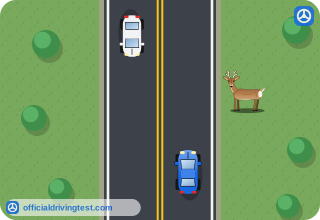
- At midday and early afternoon
- At midnight and early morning
- Only during the winter months
- At dawn and dusk
Show answer
Correct answer: At dawn and dusk
The handbook advises using caution at dawn and dusk because animals are most active then.
Source: Utah Driver Handbook (2026 edition (new 2026 laws effective May 6, 2026)), page 56 · Open this page in the manual (Manual page 56)
-
Where are animal crossing signs placed?
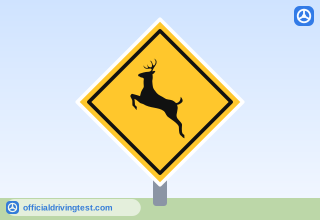
- Only on roads that pass through national forests
- Only where fences have been built along the road
- In areas with many animal/vehicle collisions
- Only where animals have been seen that week
Show answer
Correct answer: In areas with many animal/vehicle collisions
The handbook explains that animal crossing signs are placed in areas with many animal and vehicle collisions, so drivers should be alert there.
Source: Utah Driver Handbook (2026 edition (new 2026 laws effective May 6, 2026)), page 57 · Open this page in the manual (Manual page 57)
-
Why should you slow down and use caution when approaching animals standing near the roadway?
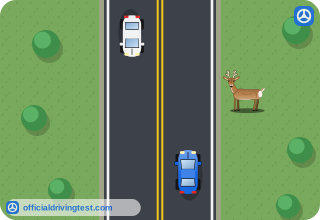
- They may bolt or change direction at the last minute
- Animals near the road will stay where they are standing
- Slow vehicles scare animals farther from the road
- Only the first animal you see will be on the road
Show answer
Correct answer: They may bolt or change direction at the last minute
The handbook warns that animals near the road may bolt or change direction at the last minute, and other animals may follow.
Source: Utah Driver Handbook (2026 edition (new 2026 laws effective May 6, 2026)), page 57 · Open this page in the manual (Manual page 57)
-
If an animal is in your path, which action does the handbook recommend?
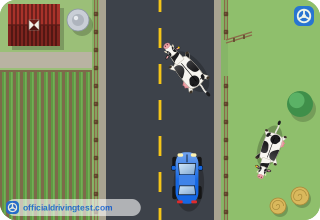
- Swerve into the next lane to go around the animal
- Speed up to get past the animal before it moves
- Brake hard and steer onto the shoulder at once
- Do not swerve; stay in control and in the travel lane
Show answer
Correct answer: Do not swerve; stay in control and in the travel lane
The handbook says not to swerve to avoid an animal because your risk of personal injury may be greater, and to keep your vehicle under control and in the travel lane.
Source: Utah Driver Handbook (2026 edition (new 2026 laws effective May 6, 2026)), page 57 · Open this page in the manual (Manual page 57)
-
Under Utah law, which of these people is a vulnerable user of the highway?
- A person riding an animal
- The driver of a passenger car
- The driver of a pickup truck
- The driver of a minivan
Show answer
Correct answer: A person riding an animal
Utah law counts pedestrians, people riding animals and users of bicycles, scooters, wheelchairs and similar devices as vulnerable users, not drivers of enclosed cars.
Source: Utah Driver Handbook (2026 edition (new 2026 laws effective May 6, 2026)), page 74 · Open this page in the manual (Manual page 74)
-
What must a driver always be ready to do around people walking, jogging, or riding bicycles on the roadway?
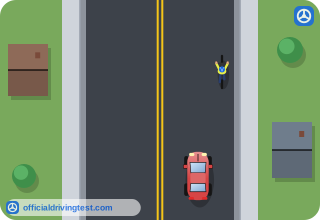
- Stop completely whenever any of them is in sight
- React to any sudden action of others using the roadway
- Sound the horn so that they move off the roadway
- Drive in the center of the road to give them room
Show answer
Correct answer: React to any sudden action of others using the roadway
Because these road users are hard to see and sometimes do the unexpected, a driver must keep the car under control and be ready to react.
Source: Utah Driver Handbook (2026 edition (new 2026 laws effective May 6, 2026)), page 74 · Open this page in the manual (Manual page 74)
-
Which rules of the road must bicyclists follow when on roadways?
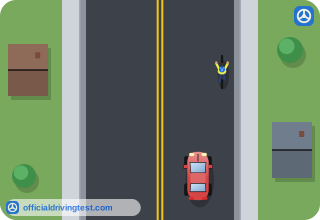
- Only the rules that apply to pedestrians
- Only the rules posted on bicycle route signs
- Special rules that never match the rules for motorists
- The same rules as motorized vehicles
Show answer
Correct answer: The same rules as motorized vehicles
Bicycles are considered vehicles on roadways, so bicyclists follow the same rules as motorists.
Source: Utah Driver Handbook (2026 edition (new 2026 laws effective May 6, 2026)), page 74 · Open this page in the manual (Manual page 74)
-
In which situation may a driver drive on a designated bicycle path or lane?
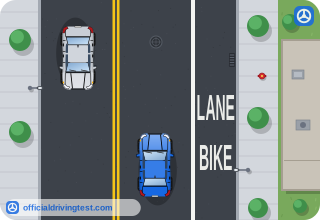
- When passing slower traffic
- When entering or leaving an alley or driveway
- When the lane is empty
- When traffic ahead is stopped at a signal
Show answer
Correct answer: When entering or leaving an alley or driveway
Driving on a bike path or lane is allowed only to enter or leave an alley or driveway, for official duties directed by a police officer, or in an emergency.
Source: Utah Driver Handbook (2026 edition (new 2026 laws effective May 6, 2026)), page 74 · Open this page in the manual (Manual page 74)
-
Why should a driver avoid slowing down or stopping quickly when near bicyclists?
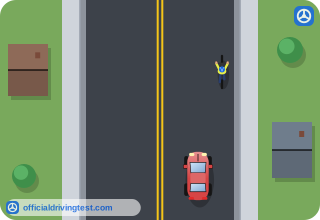
- A bicycle’s brakes are more powerful than a motor vehicle’s
- Bicyclists cannot see brake lights of cars at all
- A motor vehicle’s brakes are more powerful than a bicycle’s
- Sudden stops damage the pavement of bicycle lanes
Show answer
Correct answer: A motor vehicle’s brakes are more powerful than a bicycle’s
Cars stop faster than bicycles, so a sudden stop in front of a bicyclist could cause a crash.
Source: Utah Driver Handbook (2026 edition (new 2026 laws effective May 6, 2026)), page 74 · Open this page in the manual (Manual page 74)
-
When should a driver sound the horn close to bicyclists?
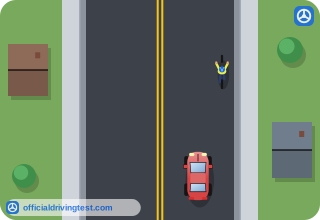
- Whenever passing, to let them know you are there
- Only when there is a chance of a crash
- Whenever a bicyclist rides in your lane
- Before every turn near a bicyclist
Show answer
Correct answer: Only when there is a chance of a crash
A horn may startle bicyclists and make them steer into your path, so use it only when a crash is possible.
Source: Utah Driver Handbook (2026 edition (new 2026 laws effective May 6, 2026)), page 74 · Open this page in the manual (Manual page 74)
-
Why should a driver be especially careful when seeing children riding bikes on the sidewalk?
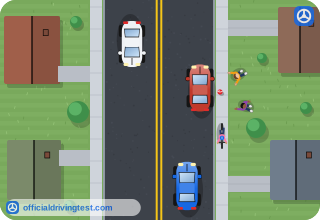
- Children on sidewalks must always stop before reaching the road
- Children ride faster than adult bicyclists do on the road
- Children are required to yield to cars at every driveway
- They may come onto the road and may not see you before pulling out
Show answer
Correct answer: They may come onto the road and may not see you before pulling out
Children may come onto the road, may not see you even if they glance toward you, and have trouble judging speed and distance.
Source: Utah Driver Handbook (2026 edition (new 2026 laws effective May 6, 2026)), page 75 · Open this page in the manual (Manual page 75)
-
What minimum distance does Utah law require when passing a bicyclist or vulnerable user of the highway?
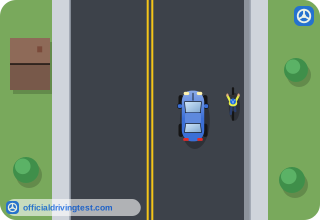
- Three feet
- Two feet
- Five feet
- Six feet
Show answer
Correct answer: Three feet
Utah law requires at least three feet of distance when passing a bicyclist or other vulnerable user.
Source: Utah Driver Handbook (2026 edition (new 2026 laws effective May 6, 2026)), page 75 · Open this page in the manual (Manual page 75)
-
If a bicyclist travels at less than a reasonable speed, where may you drive?
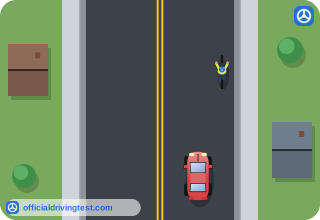
- On the shoulder of the road beside the bicyclist
- In the bicycle lane beside the bicyclist
- In a center lane (a two-way left turn lane)
- On the sidewalk beside the bicyclist
Show answer
Correct answer: In a center lane (a two-way left turn lane)
You may use the two-way left turn lane (center lane) to get around a bicyclist who is traveling at less than a reasonable speed.
Source: Utah Driver Handbook (2026 edition (new 2026 laws effective May 6, 2026)), page 75 · Open this page in the manual (Manual page 75)
-
At night, within what distance should you dim your headlights when approaching or overtaking bicyclists?
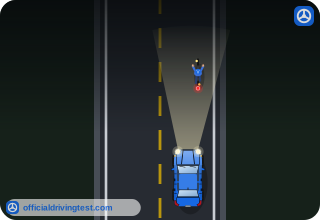
- 100 feet
- 500 feet
- 200 feet
- 300 feet
Show answer
Correct answer: 500 feet
The handbook says to dim headlights within 500 feet of bicyclists at night.
Source: Utah Driver Handbook (2026 edition (new 2026 laws effective May 6, 2026)), page 75 · Open this page in the manual (Manual page 75)
-
Which road conditions affect bicycles much more than vehicles?
- Dry, smooth pavement in clear weather
- A straight, level road with light traffic
- Bright sunshine on a dry, smooth road
- A wet roadway or one covered with sand or gravel
Show answer
Correct answer: A wet roadway or one covered with sand or gravel
Wet roads, sand and gravel affect bicycles much more than vehicles, so drivers should take extra care near bicyclists.
Source: Utah Driver Handbook (2026 edition (new 2026 laws effective May 6, 2026)), page 75 · Open this page in the manual (Manual page 75)
-
Before opening your vehicle door after parking on the street, what should you check for?
- Bicyclists to the sides and rear
- Vehicles parked ahead of you, not behind you
- Traffic signals ahead, not the sides or rear
- The sidewalk by the door, not the road behind
Show answer
Correct answer: Bicyclists to the sides and rear
Drivers should check to the sides and rear for bicyclists before opening a door.
Source: Utah Driver Handbook (2026 edition (new 2026 laws effective May 6, 2026)), page 75 · Open this page in the manual (Manual page 75)
-
Where should you be especially cautious about bicyclists when backing?
- On freeways and freeway ramps
- Near railroad crossings and bridges
- Near schools or residential areas
- On mountain roads with no shoulder
Show answer
Correct answer: Near schools or residential areas
You should always check for bicyclists before backing, particularly near schools or residential areas.
Source: Utah Driver Handbook (2026 edition (new 2026 laws effective May 6, 2026)), page 75 · Open this page in the manual (Manual page 75)
-
What are bicyclists required to use when turning and stopping?
- A bell or horn
- Hand signals
- A flashing headlight
- A turn-signal light on the helmet
Show answer
Correct answer: Hand signals
Bicyclists must use hand signals when turning and stopping, although they may be unable to signal when conditions require both hands on the handlebars.
Source: Utah Driver Handbook (2026 edition (new 2026 laws effective May 6, 2026)), page 75 · Open this page in the manual (Manual page 75)
-
Which clue can show what a bicyclist who cannot give a hand signal intends to do?
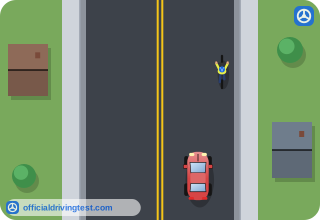
- Pedaling faster than before the change
- Riding closer to the curb than before
- Slowing the pedaling to a stop in the lane
- Turning the head or looking over the shoulder
Show answer
Correct answer: Turning the head or looking over the shoulder
A bicyclist who keeps both hands on the handlebars may show intent by turning the head or looking over the shoulder.
Source: Utah Driver Handbook (2026 edition (new 2026 laws effective May 6, 2026)), page 75 · Open this page in the manual (Manual page 75)
-
Under which condition may a driver not pass a bicycle?
- On a straight, level road with a clear view
- When no traffic is coming from either direction
- When approaching a curve where the view is obstructed
- When the bicyclist is at the right edge of the road
Show answer
Correct answer: When approaching a curve where the view is obstructed
A driver may not pass a bicycle if the pass cannot be made safely, including at the crest of a grade or a curve where the view is obstructed.
Source: Utah Driver Handbook (2026 edition (new 2026 laws effective May 6, 2026)), page 75 · Open this page in the manual (Manual page 75)
-
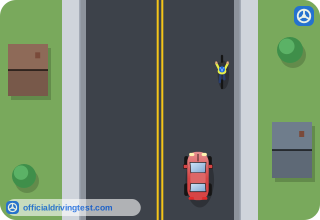
Within how many feet of an intersection or railroad grade crossing may a driver not pass a bicycle, unless a traffic control device indicates otherwise?
- 50 feet
- 100 feet
- 200 feet
- 300 feet
Show answer
Correct answer: 100 feet
A driver may not pass a bicycle when approaching within 100 feet of, or crossing, an intersection or railroad crossing.
Source: Utah Driver Handbook (2026 edition (new 2026 laws effective May 6, 2026)), page 75 · Open this page in the manual (Manual page 75)
-
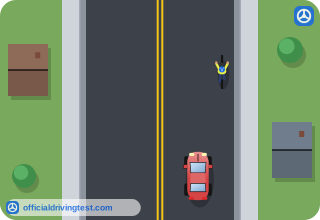
A driver may not pass a bicycle when the view is obstructed within 100 feet of what?
- Any school crossing
- Any shopping center entrance
- Any traffic light
- Any bridge, viaduct, or tunnel
Show answer
Correct answer: Any bridge, viaduct, or tunnel
Passing a bicycle is not allowed when the view is obstructed within 100 feet of a bridge, viaduct, or tunnel.
Source: Utah Driver Handbook (2026 edition (new 2026 laws effective May 6, 2026)), page 75 · Open this page in the manual (Manual page 75)
-
What does a skillful bicyclist do?
- Rides predictably and holds a steady line
- Swerves to show other road users where to go
- Rides without a light at night
- Ignores traffic signals on quiet streets
Show answer
Correct answer: Rides predictably and holds a steady line
A skillful bicyclist is predictable and holds a steady line, while an unskillful one may swerve, ignore signs and signals, or ride without a light.
Source: Utah Driver Handbook (2026 edition (new 2026 laws effective May 6, 2026)), page 74 · Open this page in the manual (Manual page 74)
-
How many hands must a bicyclist keep on the handlebars at all times, at a minimum?
- Both hands
- At least one hand
- No hands, as long as the rider is going slowly
- Both hands, but only on roads with no bike lane
Show answer
Correct answer: At least one hand
A bicyclist must keep at least one hand on the handlebars and must never carry an item that prevents using both hands to control the bicycle.
Source: Utah Driver Handbook (2026 edition (new 2026 laws effective May 6, 2026)), page 75 · Open this page in the manual (Manual page 75)
-
Every bicycle must have a brake or brake system that enables the rider to stop within what distance from a speed of 10 mph?
- 10 feet
- 50 feet
- 100 feet
- 25 feet
Show answer
Correct answer: 25 feet
Every bicycle must be able to stop within 25 feet from 10 mph.
Source: Utah Driver Handbook (2026 edition (new 2026 laws effective May 6, 2026)), page 76 · Open this page in the manual (Manual page 76)
-
What lighting must a bicyclist have when riding earlier than a half-hour before sunrise or later than a half-hour after sunset?
- A white headlight, a red taillight or reflector, and side reflectors
- A yellow headlight and a white taillight with side lights
- A white headlight only, with no taillight or reflectors
- A red headlight and red reflectors on both sides
Show answer
Correct answer: A white headlight, a red taillight or reflector, and side reflectors
Bicyclists must have a white headlight, a red taillight or reflector, and side reflectors when riding in the dark hours around sunrise and sunset.
Source: Utah Driver Handbook (2026 edition (new 2026 laws effective May 6, 2026)), page 76 · Open this page in the manual (Manual page 76)
-
A bicyclist’s required headlight, taillight or reflector, and side reflectors must be visible for at least how far?
- 100 feet
- 250 feet
- 500 feet
- 300 feet
Show answer
Correct answer: 500 feet
The required lights and reflectors must be visible for at least 500 feet.
Source: Utah Driver Handbook (2026 edition (new 2026 laws effective May 6, 2026)), page 76 · Open this page in the manual (Manual page 76)
-
Where may a bicyclist’s required lights be placed?
- Only on the bicycle frame
- On the bicycle or on the rider
- Only on the handlebars
- Only on the rider’s helmet
Show answer
Correct answer: On the bicycle or on the rider
The required lights may be on the bicycle or on the rider.
Source: Utah Driver Handbook (2026 edition (new 2026 laws effective May 6, 2026)), page 76 · Open this page in the manual (Manual page 76)
-
Besides the half-hour around sunrise and sunset, when must a bicyclist have a headlight, taillight or reflector, and side reflectors?
- Whenever riding on a road with more than two lanes of traffic
- Whenever riding in a bike lane next to parked cars
- Whenever riding with a passenger or a child on board
- Whenever it is otherwise hard to make out vehicles 1000 feet away
Show answer
Correct answer: Whenever it is otherwise hard to make out vehicles 1000 feet away
Bicyclists must also have lights and reflectors whenever it is hard to make out vehicles 1000 feet away.
Source: Utah Driver Handbook (2026 edition (new 2026 laws effective May 6, 2026)), page 76 · Open this page in the manual (Manual page 76)
-
What should a bicyclist assume about drivers?
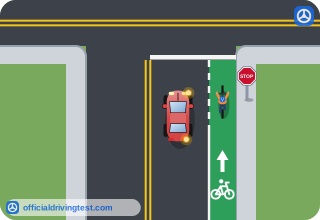
- That they do not see you and may pull out in front of you
- That they will yield whenever the bicyclist signals
- That they always see a bicyclist who is in a bike lane
- That they will stop for the bicyclist at every driveway
Show answer
Correct answer: That they do not see you and may pull out in front of you
A bicyclist should make eye contact and assume drivers do not see them.
Source: Utah Driver Handbook (2026 edition (new 2026 laws effective May 6, 2026)), page 76 · Open this page in the manual (Manual page 76)
-
What must a bicyclist do when riding on a sidewalk or crosswalk?
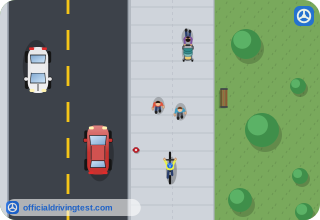
- Ride at normal road speed and expect pedestrians to move aside quickly
- Ride in silence so as not to startle any pedestrians nearby
- Ride slowly, yield to pedestrians, and give an audible signal before passing
- Dismount and walk the bicycle at all times on the sidewalk
Show answer
Correct answer: Ride slowly, yield to pedestrians, and give an audible signal before passing
On sidewalks and crosswalks, bicyclists must ride slowly, yield to any pedestrian, and give an audible signal before overtaking and passing.
Source: Utah Driver Handbook (2026 edition (new 2026 laws effective May 6, 2026)), page 76 · Open this page in the manual (Manual page 76)
-
On a one-way street in a city, where may bicyclists ride?
- Only as near as possible to the right side
- As near as possible to either the right or left side
- Only as near as possible to the left side
- In the center of the street, away from parked cars
Show answer
Correct answer: As near as possible to either the right or left side
On a one-way street in a city, bicyclists may ride near either side.
Source: Utah Driver Handbook (2026 edition (new 2026 laws effective May 6, 2026)), page 76 · Open this page in the manual (Manual page 76)
-
Which action is prohibited for a bicyclist on the highway?
- Riding to the right side of the road
- Using a rear-view mirror while riding
- Looking back over the shoulder while riding
- Attaching the bicycle to a moving vehicle
Show answer
Correct answer: Attaching the bicycle to a moving vehicle
A bicyclist must never attach themselves or the bicycle to any vehicle moving on the highway.
Source: Utah Driver Handbook (2026 edition (new 2026 laws effective May 6, 2026)), page 76 · Open this page in the manual (Manual page 76)
-
Which equipment can a bicycle not have?
- A siren or whistle
- A rear-view mirror
- A red taillight
- Side reflectors
Show answer
Correct answer: A siren or whistle
A bicycle may not be equipped with a siren or whistle.
Source: Utah Driver Handbook (2026 edition (new 2026 laws effective May 6, 2026)), page 76 · Open this page in the manual (Manual page 76)
-
How many bicyclists may ride abreast?
- Up to three, if the traffic on the road is light
- Only one, because riding two abreast is never allowed
- No more than two, and only if traffic is not impeded
- Any number of riders, if a bike lane is present
Show answer
Correct answer: No more than two, and only if traffic is not impeded
Bicyclists may ride no more than two abreast, and only when that does not impede traffic.
Source: Utah Driver Handbook (2026 edition (new 2026 laws effective May 6, 2026)), page 76 · Open this page in the manual (Manual page 76)
-
What is the exception to the rule that a bicycle may not carry more persons than it is designed or equipped for?
- A child may sit on the handlebars while holding on tightly
- An adult may carry a child securely attached in a backpack or sling
- An adult rider may carry a child in one arm while riding
- A passenger may sit on the top tube if holding on to the rider
Show answer
Correct answer: An adult may carry a child securely attached in a backpack or sling
The only exception is an adult carrying a child securely attached in a backpack or sling.
Source: Utah Driver Handbook (2026 edition (new 2026 laws effective May 6, 2026)), page 76 · Open this page in the manual (Manual page 76)
-
A bicyclist holds one arm bent at the elbow with the forearm pointing downward. What does this hand signal mean?
- Left turn
- Right turn
- Pass me
- Stop
Show answer
Correct answer: Stop
In the handbook’s bicyclist hand signals, an arm bent down means stop.
Source: Utah Driver Handbook (2026 edition (new 2026 laws effective May 6, 2026)), page 76 · Open this page in the manual (Manual page 76)
-
A bicyclist extends the left arm straight out to the left side. What does this hand signal mean?
- Left turn
- Right turn
- Stop
- Pass me
Show answer
Correct answer: Left turn
In the handbook’s bicyclist hand signals, the left arm held straight out to the side means a left turn.
Source: Utah Driver Handbook (2026 edition (new 2026 laws effective May 6, 2026)), page 76 · Open this page in the manual (Manual page 76)
-
An electric-assisted bicycle has a power output of not more than how many watts?
- 250 watts
- 500 watts
- 750 watts
- 1,000 watts
Show answer
Correct answer: 750 watts
An electric-assisted bicycle may not have a power output greater than 750 watts.
Source: Utah Driver Handbook (2026 edition (new 2026 laws effective May 6, 2026)), page 76 · Open this page in the manual (Manual page 76)
-
Which statement describes an electric-assisted bicycle?
- It can be operated only while the electric motor is running
- It is fully operable as a bicycle without the electric motor
- It has no pedals and is powered only by the electric motor
- It has a motor with a power output of more than 750 watts
Show answer
Correct answer: It is fully operable as a bicycle without the electric motor
An electric-assisted bicycle has fully operable pedals and works as a bicycle without the motor.
Source: Utah Driver Handbook (2026 edition (new 2026 laws effective May 6, 2026)), page 76 · Open this page in the manual (Manual page 76)
-
A Class 1 electric-assisted bicycle gives assistance only when the rider is pedaling and stops assisting at what speed?
- 15 mph
- 25 mph
- 30 mph
- 20 mph
Show answer
Correct answer: 20 mph
Class 1 assistance ceases when the bicycle reaches 20 mph.
Source: Utah Driver Handbook (2026 edition (new 2026 laws effective May 6, 2026)), page 76 · Open this page in the manual (Manual page 76)
-
Which class of electric-assisted bicycle has a motor that may be used exclusively to propel the bicycle?
- Class 2
- Class 1
- Class 3
- Every class
Show answer
Correct answer: Class 2
A Class 2 electric-assisted bicycle may be propelled by the motor alone, with assistance ending at 28 mph.
Source: Utah Driver Handbook (2026 edition (new 2026 laws effective May 6, 2026)), page 76 · Open this page in the manual (Manual page 76)
-
Which class of electric-assisted bicycle is equipped with a speedometer?
- Class 1
- Class 2
- Class 3
- All three classes
Show answer
Correct answer: Class 3
Class 3 is the class described as equipped with a speedometer.
Source: Utah Driver Handbook (2026 edition (new 2026 laws effective May 6, 2026)), page 77 · Open this page in the manual (Manual page 77)
-
A Class 3 electric-assisted bicycle gives assistance only when the rider is pedaling and stops assisting at what speed?
- 35 mph
- 28 mph
- 25 mph
- 30 mph
Show answer
Correct answer: 28 mph
Class 3 assistance ceases when the bicycle reaches 28 mph.
Source: Utah Driver Handbook (2026 edition (new 2026 laws effective May 6, 2026)), page 77 · Open this page in the manual (Manual page 77)
-
Under what age may an individual not operate an electric-assisted bicycle on any public property, highway, path, or sidewalk?
- Six
- Ten
- Twelve
- Eight
Show answer
Correct answer: Eight
Anyone under eight years old may not operate an electric-assisted bicycle on public property, highways, paths or sidewalks.
Source: Utah Driver Handbook (2026 edition (new 2026 laws effective May 6, 2026)), page 77 · Open this page in the manual (Manual page 77)
-
An individual under 14 years old may not operate an electric-assisted bicycle on public property unless what condition is met?
- Under direct supervision of a parent or guardian
- Riding no faster than 10 mph at all times
- Riding only in daylight on bicycle paths
- Holding a learner permit for a motor vehicle
Show answer
Correct answer: Under direct supervision of a parent or guardian
Those under 14 may operate an electric-assisted bicycle only under the direct supervision of a parent or guardian.
Source: Utah Driver Handbook (2026 edition (new 2026 laws effective May 6, 2026)), page 77 · Open this page in the manual (Manual page 77)
-
An individual under what age may not operate a Class 3 electric-assisted bicycle?
- 12
- 15
- 16
- 18
Show answer
Correct answer: 16
A person under 16 years old may not operate a Class 3 electric-assisted bicycle.
Source: Utah Driver Handbook (2026 edition (new 2026 laws effective May 6, 2026)), page 77 · Open this page in the manual (Manual page 77)
-
What is the maximum total outside width of a single vehicle, including its load?
- 7 feet
- 8 1/2 feet
- 10 feet
- 12 feet
Show answer
Correct answer: 8 1/2 feet
No vehicle may have a total outside width, including its load, of more than 8 1/2 feet.
Source: Utah Driver Handbook (2026 edition (new 2026 laws effective May 6, 2026)), page 78 · Open this page in the manual (Manual page 78)
-
What is the maximum width allowed for farm tractors?
- 10 feet
- 11 feet
- 12 feet
- 9 feet
Show answer
Correct answer: 9 feet
Farm tractors are the exception to the width rule, but their width may not exceed 9 feet.
Source: Utah Driver Handbook (2026 edition (new 2026 laws effective May 6, 2026)), page 78 · Open this page in the manual (Manual page 78)
-
What is the maximum height of a vehicle, including any load it carries?
- 14 feet
- 10 feet
- 12 feet
- 16 feet
Show answer
Correct answer: 14 feet
No vehicle may exceed 14 feet in height, load included.
Source: Utah Driver Handbook (2026 edition (new 2026 laws effective May 6, 2026)), page 78 · Open this page in the manual (Manual page 78)
-
What is the maximum overall length of a single vehicle, including the front and rear bumpers, other than fire-fighting equipment?
- 35 feet
- 40 feet
- 45 feet
- 55 feet
Show answer
Correct answer: 45 feet
A single vehicle may not exceed an overall length of 45 feet, except fire-fighting equipment.
Source: Utah Driver Handbook (2026 edition (new 2026 laws effective May 6, 2026)), page 78 · Open this page in the manual (Manual page 78)
-
For the length rule, how is a truck tractor coupled to a semi-trailer considered?
- One vehicle
- Two vehicles
- Three vehicles
- A combination exempt from the length rule
Show answer
Correct answer: Two vehicles
A truck tractor with a semi-trailer or trailers is counted as two vehicles.
Source: Utah Driver Handbook (2026 edition (new 2026 laws effective May 6, 2026)), page 78 · Open this page in the manual (Manual page 78)
-
What is the maximum total length for other combinations of vehicles, such as a motor home pulling a boat?
- 45 feet
- 55 feet
- 75 feet
- 65 feet
Show answer
Correct answer: 65 feet
Other combinations of vehicles may not exceed 65 feet in total length.
Source: Utah Driver Handbook (2026 edition (new 2026 laws effective May 6, 2026)), page 78 · Open this page in the manual (Manual page 78)
-
A vehicle registered for 16,001 pounds or more must display what on both its left and right sides?
- The weight for which it is registered
- Its empty weight when unloaded
- Its maximum legal speed on highways
- The number of axles it has
Show answer
Correct answer: The weight for which it is registered
Vehicles registered for 16,001 pounds or more must display their registered weight on both sides.
Source: Utah Driver Handbook (2026 edition (new 2026 laws effective May 6, 2026)), page 78 · Open this page in the manual (Manual page 78)
-
The registered weight displayed on a vehicle must be in letters not less than how high?
- One inch
- Four inches
- Two inches
- Six inches
Show answer
Correct answer: Two inches
The registered weight must be shown in letters at least two inches high in an easily visible location.
Source: Utah Driver Handbook (2026 edition (new 2026 laws effective May 6, 2026)), page 78 · Open this page in the manual (Manual page 78)
-
When the clearance of your vehicle is under how many inches, should you slow down to be safe?
- Two inches
- Six inches
- Twelve inches
- Eighteen inches
Show answer
Correct answer: Six inches
With less than six inches of clearance, slow down because rough roads could make the vehicle bounce into a low ceiling or swerve into a wall.
Source: Utah Driver Handbook (2026 edition (new 2026 laws effective May 6, 2026)), page 78 · Open this page in the manual (Manual page 78)
-
If you have doubts about whether a car and a truck can pass through a bridge or tunnel at the same time, what should you do?
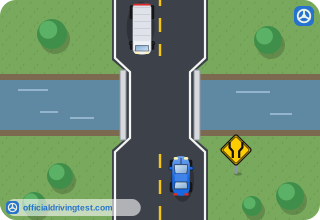
- Go through first and sound the horn
- Drive through side by side slowly
- Speed up to pass through quickly
- Let the other vehicle go through first
Show answer
Correct answer: Let the other vehicle go through first
Some bridges and tunnels are not made for a car and a truck at the same time, so with any doubt let the other vehicle go first.
Source: Utah Driver Handbook (2026 edition (new 2026 laws effective May 6, 2026)), page 78 · Open this page in the manual (Manual page 78)
-
How far may a load extend to the front of a vehicle’s body?
- No more than three feet
- No more than one foot
- No more than five feet
- No more than ten feet
Show answer
Correct answer: No more than three feet
A load may not extend more than three feet to the front of the vehicle’s body.
Source: Utah Driver Handbook (2026 edition (new 2026 laws effective May 6, 2026)), page 78 · Open this page in the manual (Manual page 78)
-
How far may a load extend to the rear of a vehicle’s body?
- No more than four feet
- No more than ten feet
- No more than six feet
- No more than twelve feet
Show answer
Correct answer: No more than six feet
A load may not extend more than six feet to the rear of the vehicle’s body.
Source: Utah Driver Handbook (2026 edition (new 2026 laws effective May 6, 2026)), page 78 · Open this page in the manual (Manual page 78)
-
How far may a load extend beyond the line of the fenders on the right side of a vehicle?
- No more than one foot
- No more than six inches
- No more than two feet
- No more than three feet
Show answer
Correct answer: No more than six inches
A load may extend no more than six inches beyond the fender line on the right side.
Source: Utah Driver Handbook (2026 edition (new 2026 laws effective May 6, 2026)), page 79 · Open this page in the manual (Manual page 79)
-
How far may a load extend beyond the line of the fenders on the left side of a vehicle?
- Three inches
- Six inches
- One foot
- Not at all
Show answer
Correct answer: Not at all
No load may extend beyond the line of the fenders on the left side.
Source: Utah Driver Handbook (2026 edition (new 2026 laws effective May 6, 2026)), page 79 · Open this page in the manual (Manual page 79)
-
How do trucks compare with cars?
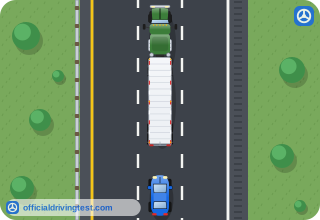
- Longer stopping and accelerating distances, and wider turning areas
- Shorter stopping distances because they are heavier than cars
- Narrower turning areas because they are longer than cars
- Faster acceleration because they have larger engines than cars
Show answer
Correct answer: Longer stopping and accelerating distances, and wider turning areas
Trucks are not as maneuverable as cars: they need longer stopping and accelerating distances and wider turning areas, and they weigh more.
Source: Utah Driver Handbook (2026 edition (new 2026 laws effective May 6, 2026)), page 79 · Open this page in the manual (Manual page 79)
-
On multi-lane highways, which lane do tractor-trailers stay in to help with local traffic flow?
- The far left lane
- The far right lane
- The center lane
- The HOV lane
Show answer
Correct answer: The center lane
Tractor-trailers stay in the center lane, which also gives the truck driver more options if switching lanes to avoid danger.
Source: Utah Driver Handbook (2026 edition (new 2026 laws effective May 6, 2026)), page 79 · Open this page in the manual (Manual page 79)
-
Why is cutting into the open space in front of a truck dangerous?
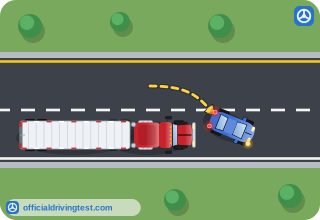
- It blocks the truck driver’s view of the road signs
- It removes the truck driver’s cushion of safety
- It causes the truck’s brakes to overheat
- It forces the truck to change into the next lane
Show answer
Correct answer: It removes the truck driver’s cushion of safety
The open space in front of a truck is the driver’s cushion of safety, and cutting into it can cause a crash.
Source: Utah Driver Handbook (2026 edition (new 2026 laws effective May 6, 2026)), page 79 · Open this page in the manual (Manual page 79)
-
What should you do instead of cutting off a truck to reach your exit?
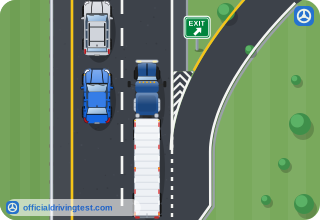
- Speed up and cut in front of it
- Flash your headlights so it slows down
- Change lanes just ahead of its bumper
- Slow down and exit behind the truck
Show answer
Correct answer: Slow down and exit behind the truck
Slowing down and exiting behind a truck takes only a few extra seconds and avoids causing a crash.
Source: Utah Driver Handbook (2026 edition (new 2026 laws effective May 6, 2026)), page 79 · Open this page in the manual (Manual page 79)
-
How should you pass a tractor-trailer?
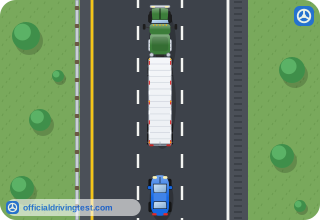
- Completely, and always on the left side
- On the right side, because it is less dangerous
- By staying alongside it for a while to check its load
- Slowly, on whichever side has room
Show answer
Correct answer: Completely, and always on the left side
A tractor-trailer should always be passed completely and on the left side.
Source: Utah Driver Handbook (2026 edition (new 2026 laws effective May 6, 2026)), page 79 · Open this page in the manual (Manual page 79)
-
Why should you not linger alongside a truck when passing it?
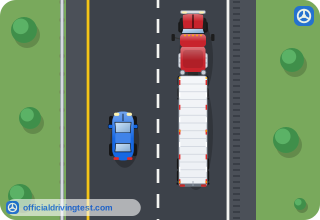
- The truck is required to slow down while you are passing it
- Your horn will confuse the trucker who is beside you
- The trucker cannot take evasive action if an obstacle appears ahead
- Trucks cannot be passed on the left side at all times
Show answer
Correct answer: The trucker cannot take evasive action if an obstacle appears ahead
Lingering alongside leaves the trucker no room to swerve or avoid something ahead.
Source: Utah Driver Handbook (2026 edition (new 2026 laws effective May 6, 2026)), page 79 · Open this page in the manual (Manual page 79)
-
Because of its large size, how does an approaching tractor-trailer often appear?
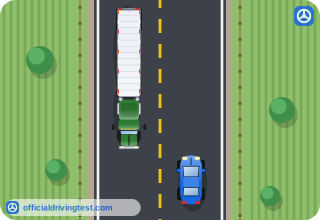
- To be traveling faster than it is
- To be farther away than the stop line
- To be traveling at its true speed
- To be traveling slower than it is
Show answer
Correct answer: To be traveling slower than it is
A tractor-trailer often looks slower than it is, so drivers should not underestimate its size and speed.
Source: Utah Driver Handbook (2026 edition (new 2026 laws effective May 6, 2026)), page 79 · Open this page in the manual (Manual page 79)
-
Where does a substantial number of car-truck collisions occur?
- At intersections
- On steep downgrades
- In construction zones
- On freeway entrance ramps
Show answer
Correct answer: At intersections
Many car-truck collisions happen at intersections because the car driver does not realize how close the truck is or how fast it is approaching.
Source: Utah Driver Handbook (2026 edition (new 2026 laws effective May 6, 2026)), page 79 · Open this page in the manual (Manual page 79)
-
What do large vehicles sometimes do on a right turn?
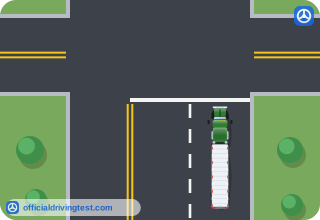
- Swing wide to the right into the shoulder
- Stop in the crosswalk before turning
- Turn only from the left lane
- Swing wide to the left to clear a curb
Show answer
Correct answer: Swing wide to the left to clear a curb
Large vehicles sometimes swing wide to the left to clear the curb when turning right.
Source: Utah Driver Handbook (2026 edition (new 2026 laws effective May 6, 2026)), page 79 · Open this page in the manual (Manual page 79)
-
How can you avoid wind blasts when you meet a truck?
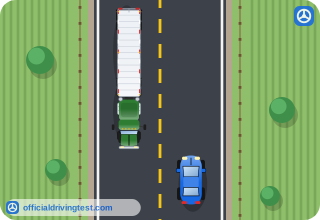
- Move toward the center line of the road
- Speed up so that you pass the truck quickly
- Move as far as you can to the right side of the road
- Flash your headlights so that the truck driver slows
Show answer
Correct answer: Move as far as you can to the right side of the road
Moving as far right as you can helps avoid the wind blast of an oncoming truck.
Source: Utah Driver Handbook (2026 edition (new 2026 laws effective May 6, 2026)), page 79 · Open this page in the manual (Manual page 79)
-
When a long vehicle makes a turn, how does the path of its rear wheels compare with the path of its front wheels?
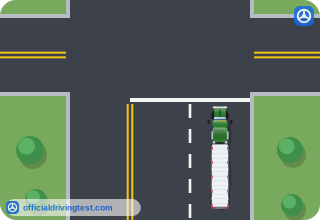
- It is a shorter path
- It is a longer path
- It is the same path
- It is a wider path on the outside of the curve
Show answer
Correct answer: It is a shorter path
With any turning vehicle the rear wheels take a shorter path than the front wheels, and the longer the vehicle, the bigger the difference.
Source: Utah Driver Handbook (2026 edition (new 2026 laws effective May 6, 2026)), page 80 · Open this page in the manual (Manual page 80)
-
What must drivers of tractor-trailers often do as the first step in making a right turn?
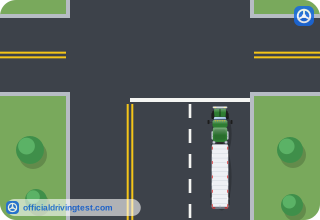
- Move onto the right shoulder
- Stop and let traffic pass first
- Swing out to the left
- Signal left and slow down
Show answer
Correct answer: Swing out to the left
Because the rear wheels follow a shorter path, tractor-trailer drivers must often swing out to the left first when turning right.
Source: Utah Driver Handbook (2026 edition (new 2026 laws effective May 6, 2026)), page 80 · Open this page in the manual (Manual page 80)
-
You are following a tractor-trailer that appears to be starting a left turn. What should you do before passing on the right?
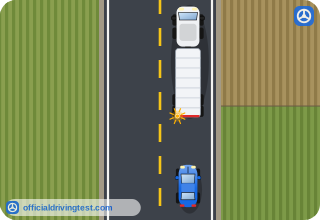
- Pass at once while the driver is slowing down
- Wait a moment to see which way the driver will turn
- Sound your horn to warn the driver
- Move up close behind the trailer
Show answer
Correct answer: Wait a moment to see which way the driver will turn
The truck may really be setting up a right turn, so you should wait and see which way it goes before passing.
Source: Utah Driver Handbook (2026 edition (new 2026 laws effective May 6, 2026)), page 80 · Open this page in the manual (Manual page 80)
-
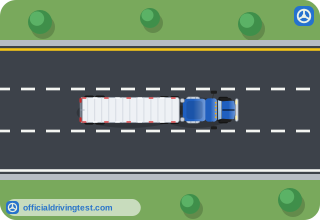
How far in front of the cab can a tractor-trailer's blind spot reach?
- Up to 5 feet
- Up to 10 feet
- Up to 50 feet
- Up to 20 feet
Show answer
Correct answer: Up to 20 feet
Truckers have serious blind spots up to 20 feet in front of the cab, where a car can disappear from view.
Source: Utah Driver Handbook (2026 edition (new 2026 laws effective May 6, 2026)), page 80 · Open this page in the manual (Manual page 80)
-
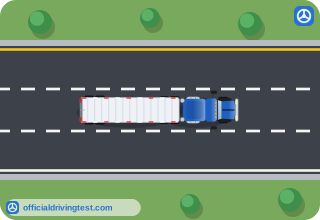
How far behind a large vehicle can its blind spot reach?
- Up to 20 feet
- Up to 50 feet
- Up to 100 feet
- Up to 200 feet
Show answer
Correct answer: Up to 200 feet
Large vehicles have huge rear blind spots, up to 200 feet behind them.
Source: Utah Driver Handbook (2026 edition (new 2026 laws effective May 6, 2026)), page 80 · Open this page in the manual (Manual page 80)
-
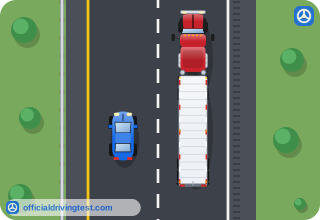
If you cannot see a truck driver in the truck's side mirror, what is true?
- The driver is about to brake
- The driver cannot see you
- The driver can see you in the rear-view mirror
- The driver will yield to you
Show answer
Correct answer: The driver cannot see you
If you can't see the driver's face in the side mirror, the driver can't see you, so you are in a blind spot.
Source: Utah Driver Handbook (2026 edition (new 2026 laws effective May 6, 2026)), page 80 · Open this page in the manual (Manual page 80)
-
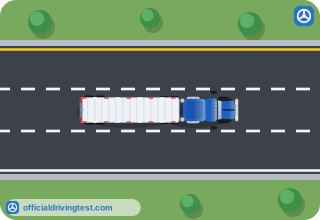
On which side of a truck is its largest blind spot?
- The left side
- The front only
- The right side
- The rear only
Show answer
Correct answer: The right side
A truck's largest blind spot is on the right side, starting behind the cab and running the length of the truck.
Source: Utah Driver Handbook (2026 edition (new 2026 laws effective May 6, 2026)), page 80 · Open this page in the manual (Manual page 80)
-
How long should you drive alongside a large vehicle?
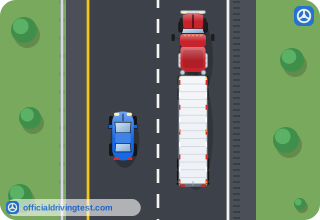
- No longer than you have to
- Long enough to be sure the driver sees you
- As long as your speed matches theirs
- Only while the truck is climbing a hill
Show answer
Correct answer: No longer than you have to
If the driver must swerve or change lanes while you are alongside, you could collide, so stay beside a large vehicle as briefly as possible.
Source: Utah Driver Handbook (2026 edition (new 2026 laws effective May 6, 2026)), page 80 · Open this page in the manual (Manual page 80)
-
A loaded truck traveling at 55 mph takes at least how far to stop?
- 185 feet
- 335 feet
- 225 feet
- 450 feet
Show answer
Correct answer: 335 feet
Large vehicles are big and heavy, so a loaded truck at 55 mph needs at least 335 feet to stop, more than 1.5 times a car's distance.
Source: Utah Driver Handbook (2026 edition (new 2026 laws effective May 6, 2026)), page 80 · Open this page in the manual (Manual page 80)
-
Which of these should you never do around a large vehicle?
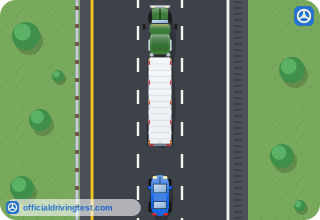
- Keep a safe distance behind it
- Stay where its driver can see you
- Leave extra room when stopping behind it
- Pull out or change lanes in front of it
Show answer
Correct answer: Pull out or change lanes in front of it
Large vehicles take longer to stop, so pulling out or changing lanes in front of one is dangerous.
Source: Utah Driver Handbook (2026 edition (new 2026 laws effective May 6, 2026)), page 80 · Open this page in the manual (Manual page 80)
-
When you pass a large vehicle, when may you pull back into the lane in front of it?
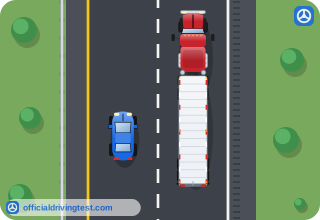
- When you can see the whole front of it in your rear-view mirror
- As soon as your car is even with the front of its cab
- When its driver flashes the headlights
- After you have passed its rear wheels
Show answer
Correct answer: When you can see the whole front of it in your rear-view mirror
Wait until the entire front of the vehicle is visible in your rear-view mirror before pulling back into the lane.
Source: Utah Driver Handbook (2026 edition (new 2026 laws effective May 6, 2026)), page 80 · Open this page in the manual (Manual page 80)
-
What happens if you follow a large vehicle too closely?
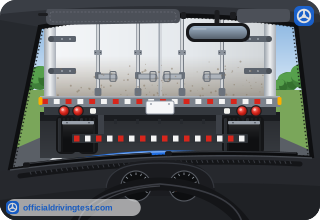
- The driver can see you in the mirrors but you cannot see ahead
- You can see ahead but the driver cannot see you
- The driver cannot see your vehicle and you cannot see what is ahead
- Neither problem happens if you stay in your lane
Show answer
Correct answer: The driver cannot see your vehicle and you cannot see what is ahead
Too close to the rear of a large vehicle, you are in its blind spot and your own view of the road ahead is blocked.
Source: Utah Driver Handbook (2026 edition (new 2026 laws effective May 6, 2026)), page 80 · Open this page in the manual (Manual page 80)
-
Where should you position yourself behind a large vehicle?
- Directly behind the trailer, as close as you can
- Beside the cab on its right side
- Where the driver can see you in the side mirrors
- Just ahead of the cab, within 20 feet
Show answer
Correct answer: Where the driver can see you in the side mirrors
You should place your vehicle so that the driver can see you in the side mirrors, not in a blind spot.
Source: Utah Driver Handbook (2026 edition (new 2026 laws effective May 6, 2026)), page 80 · Open this page in the manual (Manual page 80)
-
Why should you take care when stopped behind a large vehicle on a hill?
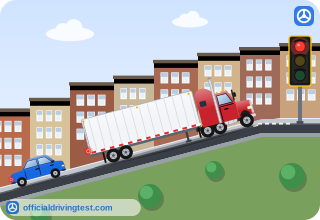
- It may stall or roll backward into your vehicle
- It may release its brakes and speed up quickly
- It may turn sharply across your lane
- Its driver cannot hear your horn
Show answer
Correct answer: It may stall or roll backward into your vehicle
On a hill a large vehicle can stall or roll backward, so leave room between you and it.
Source: Utah Driver Handbook (2026 edition (new 2026 laws effective May 6, 2026)), page 80 · Open this page in the manual (Manual page 80)
-
A motor-assisted scooter must follow the same rules as which of these?
- A passenger car and nothing else
- A pedestrian only
- A bicycle, moped, or motorcycle
- A farm tractor
Show answer
Correct answer: A bicycle, moped, or motorcycle
Motor-assisted scooters follow the same rules as a bicycle, moped or motorcycle.
Source: Utah Driver Handbook (2026 edition (new 2026 laws effective May 6, 2026)), page 81 · Open this page in the manual (Manual page 81)
-
A person under age 15 can ride a motor-assisted scooter only with what?
- A signed note from the school district
- Parent supervision or a course certificate
- A learner permit and a signed school form
- A motorcycle endorsement
Show answer
Correct answer: Parent supervision or a course certificate
Riders under 15 may use a motor-assisted scooter only with a parent supervising or with a course certificate.
Source: Utah Driver Handbook (2026 edition (new 2026 laws effective May 6, 2026)), page 81 · Open this page in the manual (Manual page 81)
-
A person of any age may not operate a motor-assisted scooter on a highway with a posted speed limit greater than what?
- 25 mph
- 35 mph
- 45 mph
- 15 mph
Show answer
Correct answer: 15 mph
A motor-assisted scooter may not be used on a highway whose posted speed limit is above 15 mph.
Source: Utah Driver Handbook (2026 edition (new 2026 laws effective May 6, 2026)), page 81 · Open this page in the manual (Manual page 81)
-
A person of any age may not operate a motor-assisted scooter on a highway with at least how many lanes?
- Two
- Three
- Six
- Four
Show answer
Correct answer: Four
Motor-assisted scooters are not allowed on a highway with four or more lanes.
Source: Utah Driver Handbook (2026 edition (new 2026 laws effective May 6, 2026)), page 81 · Open this page in the manual (Manual page 81)
-
How much of a lane should you give a motorcycle?
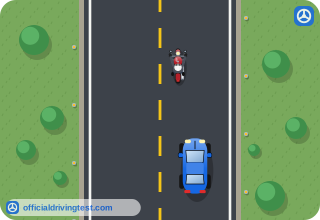
- Half of the lane
- An entire lane
- Whatever is left beside your car
- The part of the lane next to the center line
Show answer
Correct answer: An entire lane
Motorcycles need space to react to other traffic, so you should not share a lane with one.
Source: Utah Driver Handbook (2026 edition (new 2026 laws effective May 6, 2026)), page 81 · Open this page in the manual (Manual page 81)
-
Why should you always check your mirrors and blind spots for motorcycles?
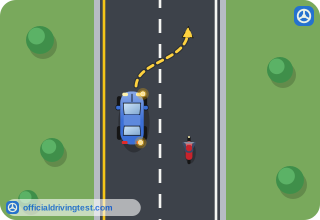
- They always ride in the blind spot
- They cannot use turn signals
- They are small and can be challenging to see
- They travel faster than other vehicles
Show answer
Correct answer: They are small and can be challenging to see
Motorcycles are small and hard to see, so a careful check of mirrors and blind spots is needed.
Source: Utah Driver Handbook (2026 edition (new 2026 laws effective May 6, 2026)), page 81 · Open this page in the manual (Manual page 81)
-
Before turning left, where should you look carefully for motorcycles?
- At the front and sides
- Only in the rear-view mirror
- Only behind you
- Only at the road shoulder
Show answer
Correct answer: At the front and sides
Before a left turn you should look carefully at the front and sides of your vehicle for motorcycles.
Source: Utah Driver Handbook (2026 edition (new 2026 laws effective May 6, 2026)), page 81 · Open this page in the manual (Manual page 81)
-
Why should you not assume a motorcycle is turning just because its turn signal is flashing?
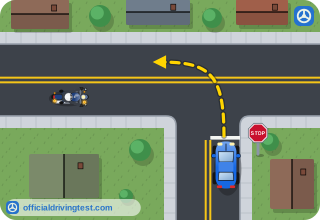
- Motorcycles cannot turn while a signal flashes
- Many motorcycle turn signals do not self-cancel
- Motorcycle signals flash for braking
- Riders must signal for a full block before a turn
Show answer
Correct answer: Many motorcycle turn signals do not self-cancel
The rider may have forgotten to cancel the signal because many motorcycle turn signals do not turn off by themselves.
Source: Utah Driver Handbook (2026 edition (new 2026 laws effective May 6, 2026)), page 81 · Open this page in the manual (Manual page 81)
-
Why might a motorcycle rider suddenly change speed or lane position?
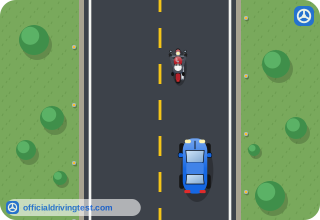
- To make room for passing cars and large trucks
- To warm up the engine
- To avoid potholes, gravel, or wet or slick places
- To signal a driver behind to pass
Show answer
Correct answer: To avoid potholes, gravel, or wet or slick places
Riders adjust speed or position to avoid road hazards like potholes, gravel and slick spots, which can be deadly to them.
Source: Utah Driver Handbook (2026 edition (new 2026 laws effective May 6, 2026)), page 81 · Open this page in the manual (Manual page 81)
-
How does the speed of scooters and mopeds compare with motorcycles?
- They travel at the same speed
- They travel at a slightly higher speed
- They travel at a much lower speed
- They travel faster on wet roads
Show answer
Correct answer: They travel at a much lower speed
Drivers are reminded that scooters and mopeds travel much slower than motorcycles.
Source: Utah Driver Handbook (2026 edition (new 2026 laws effective May 6, 2026)), page 82 · Open this page in the manual (Manual page 82)
-
What is Utah law on lane splitting, riding between cars moving at higher speeds?
- It is illegal
- It is legal on any road with two or more lanes
- It is legal only on freeways
- It is legal only in daylight
Show answer
Correct answer: It is illegal
Lane splitting between cars moving at higher speeds is illegal in Utah and considered dangerous.
Source: Utah Driver Handbook (2026 edition (new 2026 laws effective May 6, 2026)), page 82 · Open this page in the manual (Manual page 82)
-
A motorcycle may legally lane filter only when it is traveling at what speed?
- 25 mph or less
- 35 mph or less
- 45 mph or less
- 15 mph or less
Show answer
Correct answer: 15 mph or less
One condition of legal lane filtering is that the motorcycle travels at 15 mph or less.
Source: Utah Driver Handbook (2026 edition (new 2026 laws effective May 6, 2026)), page 82 · Open this page in the manual (Manual page 82)
-
What is the highest speed limit on a roadway where lane filtering is legal (an off-ramp is also allowed)?
- 25 mph or less
- 45 mph or less
- 35 mph or less
- 55 mph or less
Show answer
Correct answer: 45 mph or less
Lane filtering is allowed on a roadway with a speed limit of 45 mph or less, or on an off-ramp.
Source: Utah Driver Handbook (2026 edition (new 2026 laws effective May 6, 2026)), page 82 · Open this page in the manual (Manual page 82)
-
Where is lane filtering not permitted?
- On an on-ramp
- On an off-ramp
- On a roadway with two lanes in the same direction
- On a roadway with a speed limit of 40 mph
Show answer
Correct answer: On an on-ramp
Lane filtering is not permitted on an on-ramp.
Source: Utah Driver Handbook (2026 edition (new 2026 laws effective May 6, 2026)), page 82 · Open this page in the manual (Manual page 82)
-
For legal lane filtering, what must be true of the vehicle the motorcycle overtakes in the same lane?
- It is moving slower than 15 mph
- It has its turn signal on
- It is stopped
- It is a commercial vehicle
Show answer
Correct answer: It is stopped
A motorcycle may filter past a vehicle only when that vehicle is stopped in the same lane.
Source: Utah Driver Handbook (2026 edition (new 2026 laws effective May 6, 2026)), page 82 · Open this page in the manual (Manual page 82)
-
What does the handbook say to do because rules for motorcycles, e-bikes, mopeds and scooters vary from city to city?
- Follow the state rules only
- Assume all cities use the same rules
- Ask the Driver License Division in each city
- Check local laws and ordinances
Show answer
Correct answer: Check local laws and ordinances
Rules for these vehicles differ by city, so check the local laws and ordinances.
Source: Utah Driver Handbook (2026 edition (new 2026 laws effective May 6, 2026)), page 82 · Open this page in the manual (Manual page 82)
-
What does a fluorescent or reflective orange and red triangle on the rear of a vehicle mean?
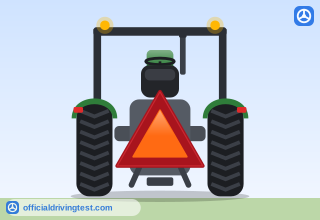
- The vehicle is moving less than 15 mph
- The vehicle is moving less than 35 mph
- The vehicle is moving less than 25 mph
- The vehicle is carrying a wide load
Show answer
Correct answer: The vehicle is moving less than 25 mph
The orange and red triangle marks a slow-moving vehicle going less than 25 mph.
Source: Utah Driver Handbook (2026 edition (new 2026 laws effective May 6, 2026)), page 84 · Open this page in the manual (Manual page 84)
-
What should you do when you see a slow-moving vehicle?
- Pass immediately
- Use caution and make sure it is safe before you pass
- Follow it at a distance of about two car lengths
- Honk to tell the driver to move over
Show answer
Correct answer: Use caution and make sure it is safe before you pass
Use caution near slow-moving vehicles and pass only when it is safe.
Source: Utah Driver Handbook (2026 edition (new 2026 laws effective May 6, 2026)), page 84 · Open this page in the manual (Manual page 84)
-
What should you remember when you pass farm machinery?
- The driver will always move over
- The driver can hear your horn clearly
- Farm machinery never enters state highways
- The driver cannot hear your vehicle
Show answer
Correct answer: The driver cannot hear your vehicle
Passing farm equipment requires care because the driver cannot hear your vehicle.
Source: Utah Driver Handbook (2026 edition (new 2026 laws effective May 6, 2026)), page 84 · Open this page in the manual (Manual page 84)
-
Who may pass ordinances that allow golf carts to be operated on designated public roads?
- The Division of Motor Vehicles
- The Highway Safety Office
- The county emissions program
- Local municipalities
Show answer
Correct answer: Local municipalities
Local municipalities can allow golf carts on designated public roads by ordinance, so operators must check local ordinances.
Source: Utah Driver Handbook (2026 edition (new 2026 laws effective May 6, 2026)), page 84 · Open this page in the manual (Manual page 84)
-
Golf cart operators must comply with the same rules as which of these?
- A motorcycle
- A bicycle
- A passenger car
- A moped
Show answer
Correct answer: A bicycle
The handbook says golf cart operators shall comply with the same rules as a bicycle.
Source: Utah Driver Handbook (2026 edition (new 2026 laws effective May 6, 2026)), page 84 · Open this page in the manual (Manual page 84)
-
What right to the road do horse-drawn vehicles and horseback riders have?
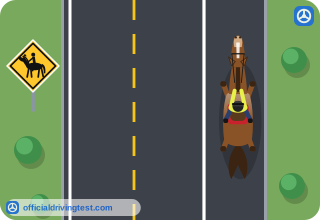
- The same right as a motor vehicle
- They have the right of way over cars
- They may use the road only at night
- They must stay off state highways
Show answer
Correct answer: The same right as a motor vehicle
They have the same right to the road as a motor vehicle and must follow the same rules.
Source: Utah Driver Handbook (2026 edition (new 2026 laws effective May 6, 2026)), page 84 · Open this page in the manual (Manual page 84)
-
Which should you avoid doing when you pass a horse?
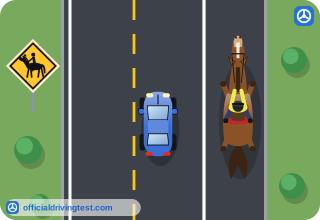
- Passing with care
- Using your horn or revving the engine
- Watching for left turns into fields and driveways
- Giving the rider the same right to the road
Show answer
Correct answer: Using your horn or revving the engine
A horn or a revved engine may scare the horse and cause a crash.
Source: Utah Driver Handbook (2026 edition (new 2026 laws effective May 6, 2026)), page 84 · Open this page in the manual (Manual page 84)
-
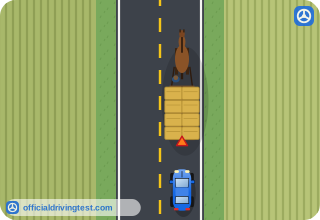
When you share the road with horse-drawn vehicles or horseback riders, what should you watch out for?
- U-turns on the shoulder
- Sudden stops at intersections only
- Right turns onto the freeway
- Left turns into fields and driveways
Show answer
Correct answer: Left turns into fields and driveways
These riders may turn left into fields and driveways, so be alert.
Source: Utah Driver Handbook (2026 edition (new 2026 laws effective May 6, 2026)), page 84 · Open this page in the manual (Manual page 84)
-
On a highway with a posted speed higher than 50 miles per hour, where must a street-legal ATV/UTV be operated?
- In the center of the travel lane when traffic is light
- On the left-hand side of the roadway, near the median
- On the extreme right-hand side of the roadway
- On the shoulder only after dark, with lights on
Show answer
Correct answer: On the extreme right-hand side of the roadway
Where the posted speed is above 50 mph, these vehicles must keep to the extreme right-hand side of the roadway.
Source: Utah Driver Handbook (2026 edition (new 2026 laws effective May 6, 2026)), page 86 · Open this page in the manual (Manual page 86)
-
What should riders of motorcycles and bicycles avoid doing when approaching a railroad crossing?
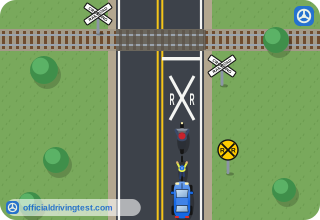
- Approaching the crossing with caution
- Slowing down before the tracks
- Looking both ways for a train
- Swerving to get a better angle for crossing
Show answer
Correct answer: Swerving to get a better angle for crossing
Riders should approach with caution and must not swerve to find a better crossing angle.
Source: Utah Driver Handbook (2026 edition (new 2026 laws effective May 6, 2026)), page 87 · Open this page in the manual (Manual page 87)