Utah: Sharing the road — Bicyclist Rules and Electric-Assisted Bicycles Practice Test
Questions in this part include: “How many hands must a bicyclist keep on the handlebars at all times, at a minimum?” · “What is the exception to the rule that a bicycle may not carry more persons than it is designed or equipped for?”
Independent educational site · not affiliated with any government agency or DMV
Ready? Test yourself
- Instant feedback with an explanation
- Every answer cites its source in the manual
- Your best score is saved on this device
- Keyboard: press 1 to 4 to answer and Enter for the next question
Questions are original and based on the official manual "Utah Driver Handbook" (2026 edition (new 2026 laws effective May 6, 2026)), Utah Department of Public Safety, Driver License Division.
All 24 questions in this practice test
Take the test above first, then use this list to study. Tap “Show answer” to see the correct answer and explanation.
Show the questions and answersHide the questions
-
How many hands must a bicyclist keep on the handlebars at all times, at a minimum?
- Both hands
- At least one hand
- No hands, as long as the rider is going slowly
- Both hands, but only on roads with no bike lane
Show answer
Correct answer: At least one hand
A bicyclist must keep at least one hand on the handlebars and must never carry an item that prevents using both hands to control the bicycle.
Source: Utah Driver Handbook (2026 edition (new 2026 laws effective May 6, 2026)), page 75 · Open this page in the manual (Manual page 75)
-
Every bicycle must have a brake or brake system that enables the rider to stop within what distance from a speed of 10 mph?
- 10 feet
- 50 feet
- 100 feet
- 25 feet
Show answer
Correct answer: 25 feet
Every bicycle must be able to stop within 25 feet from 10 mph.
Source: Utah Driver Handbook (2026 edition (new 2026 laws effective May 6, 2026)), page 76 · Open this page in the manual (Manual page 76)
-
What lighting must a bicyclist have when riding earlier than a half-hour before sunrise or later than a half-hour after sunset?
- A white headlight, a red taillight or reflector, and side reflectors
- A yellow headlight and a white taillight with side lights
- A white headlight only, with no taillight or reflectors
- A red headlight and red reflectors on both sides
Show answer
Correct answer: A white headlight, a red taillight or reflector, and side reflectors
Bicyclists must have a white headlight, a red taillight or reflector, and side reflectors when riding in the dark hours around sunrise and sunset.
Source: Utah Driver Handbook (2026 edition (new 2026 laws effective May 6, 2026)), page 76 · Open this page in the manual (Manual page 76)
-
A bicyclist’s required headlight, taillight or reflector, and side reflectors must be visible for at least how far?
- 100 feet
- 250 feet
- 500 feet
- 300 feet
Show answer
Correct answer: 500 feet
The required lights and reflectors must be visible for at least 500 feet.
Source: Utah Driver Handbook (2026 edition (new 2026 laws effective May 6, 2026)), page 76 · Open this page in the manual (Manual page 76)
-
Where may a bicyclist’s required lights be placed?
- Only on the bicycle frame
- On the bicycle or on the rider
- Only on the handlebars
- Only on the rider’s helmet
Show answer
Correct answer: On the bicycle or on the rider
The required lights may be on the bicycle or on the rider.
Source: Utah Driver Handbook (2026 edition (new 2026 laws effective May 6, 2026)), page 76 · Open this page in the manual (Manual page 76)
-
Besides the half-hour around sunrise and sunset, when must a bicyclist have a headlight, taillight or reflector, and side reflectors?
- Whenever riding on a road with more than two lanes of traffic
- Whenever riding in a bike lane next to parked cars
- Whenever riding with a passenger or a child on board
- Whenever it is otherwise hard to make out vehicles 1000 feet away
Show answer
Correct answer: Whenever it is otherwise hard to make out vehicles 1000 feet away
Bicyclists must also have lights and reflectors whenever it is hard to make out vehicles 1000 feet away.
Source: Utah Driver Handbook (2026 edition (new 2026 laws effective May 6, 2026)), page 76 · Open this page in the manual (Manual page 76)
-
What should a bicyclist assume about drivers?
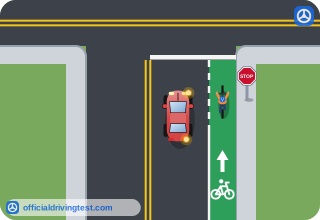
- That they do not see you and may pull out in front of you
- That they will yield whenever the bicyclist signals
- That they always see a bicyclist who is in a bike lane
- That they will stop for the bicyclist at every driveway
Show answer
Correct answer: That they do not see you and may pull out in front of you
A bicyclist should make eye contact and assume drivers do not see them.
Source: Utah Driver Handbook (2026 edition (new 2026 laws effective May 6, 2026)), page 76 · Open this page in the manual (Manual page 76)
-
What must a bicyclist do when riding on a sidewalk or crosswalk?
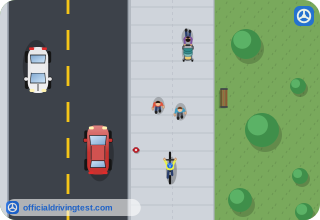
- Ride at normal road speed and expect pedestrians to move aside quickly
- Ride in silence so as not to startle any pedestrians nearby
- Ride slowly, yield to pedestrians, and give an audible signal before passing
- Dismount and walk the bicycle at all times on the sidewalk
Show answer
Correct answer: Ride slowly, yield to pedestrians, and give an audible signal before passing
On sidewalks and crosswalks, bicyclists must ride slowly, yield to any pedestrian, and give an audible signal before overtaking and passing.
Source: Utah Driver Handbook (2026 edition (new 2026 laws effective May 6, 2026)), page 76 · Open this page in the manual (Manual page 76)
-
On a one-way street in a city, where may bicyclists ride?
- Only as near as possible to the right side
- As near as possible to either the right or left side
- Only as near as possible to the left side
- In the center of the street, away from parked cars
Show answer
Correct answer: As near as possible to either the right or left side
On a one-way street in a city, bicyclists may ride near either side.
Source: Utah Driver Handbook (2026 edition (new 2026 laws effective May 6, 2026)), page 76 · Open this page in the manual (Manual page 76)
-
Which action is prohibited for a bicyclist on the highway?
- Riding to the right side of the road
- Using a rear-view mirror while riding
- Looking back over the shoulder while riding
- Attaching the bicycle to a moving vehicle
Show answer
Correct answer: Attaching the bicycle to a moving vehicle
A bicyclist must never attach themselves or the bicycle to any vehicle moving on the highway.
Source: Utah Driver Handbook (2026 edition (new 2026 laws effective May 6, 2026)), page 76 · Open this page in the manual (Manual page 76)
-
Which equipment can a bicycle not have?
- A siren or whistle
- A rear-view mirror
- A red taillight
- Side reflectors
Show answer
Correct answer: A siren or whistle
A bicycle may not be equipped with a siren or whistle.
Source: Utah Driver Handbook (2026 edition (new 2026 laws effective May 6, 2026)), page 76 · Open this page in the manual (Manual page 76)
-
How many bicyclists may ride abreast?
- Up to three, if the traffic on the road is light
- Only one, because riding two abreast is never allowed
- No more than two, and only if traffic is not impeded
- Any number of riders, if a bike lane is present
Show answer
Correct answer: No more than two, and only if traffic is not impeded
Bicyclists may ride no more than two abreast, and only when that does not impede traffic.
Source: Utah Driver Handbook (2026 edition (new 2026 laws effective May 6, 2026)), page 76 · Open this page in the manual (Manual page 76)
-
What is the exception to the rule that a bicycle may not carry more persons than it is designed or equipped for?
- A child may sit on the handlebars while holding on tightly
- An adult may carry a child securely attached in a backpack or sling
- An adult rider may carry a child in one arm while riding
- A passenger may sit on the top tube if holding on to the rider
Show answer
Correct answer: An adult may carry a child securely attached in a backpack or sling
The only exception is an adult carrying a child securely attached in a backpack or sling.
Source: Utah Driver Handbook (2026 edition (new 2026 laws effective May 6, 2026)), page 76 · Open this page in the manual (Manual page 76)
-
A bicyclist holds one arm bent at the elbow with the forearm pointing downward. What does this hand signal mean?
- Left turn
- Right turn
- Pass me
- Stop
Show answer
Correct answer: Stop
In the handbook’s bicyclist hand signals, an arm bent down means stop.
Source: Utah Driver Handbook (2026 edition (new 2026 laws effective May 6, 2026)), page 76 · Open this page in the manual (Manual page 76)
-
A bicyclist extends the left arm straight out to the left side. What does this hand signal mean?
- Left turn
- Right turn
- Stop
- Pass me
Show answer
Correct answer: Left turn
In the handbook’s bicyclist hand signals, the left arm held straight out to the side means a left turn.
Source: Utah Driver Handbook (2026 edition (new 2026 laws effective May 6, 2026)), page 76 · Open this page in the manual (Manual page 76)
-
An electric-assisted bicycle has a power output of not more than how many watts?
- 250 watts
- 500 watts
- 750 watts
- 1,000 watts
Show answer
Correct answer: 750 watts
An electric-assisted bicycle may not have a power output greater than 750 watts.
Source: Utah Driver Handbook (2026 edition (new 2026 laws effective May 6, 2026)), page 76 · Open this page in the manual (Manual page 76)
-
Which statement describes an electric-assisted bicycle?
- It can be operated only while the electric motor is running
- It is fully operable as a bicycle without the electric motor
- It has no pedals and is powered only by the electric motor
- It has a motor with a power output of more than 750 watts
Show answer
Correct answer: It is fully operable as a bicycle without the electric motor
An electric-assisted bicycle has fully operable pedals and works as a bicycle without the motor.
Source: Utah Driver Handbook (2026 edition (new 2026 laws effective May 6, 2026)), page 76 · Open this page in the manual (Manual page 76)
-
A Class 1 electric-assisted bicycle gives assistance only when the rider is pedaling and stops assisting at what speed?
- 15 mph
- 25 mph
- 30 mph
- 20 mph
Show answer
Correct answer: 20 mph
Class 1 assistance ceases when the bicycle reaches 20 mph.
Source: Utah Driver Handbook (2026 edition (new 2026 laws effective May 6, 2026)), page 76 · Open this page in the manual (Manual page 76)
-
Which class of electric-assisted bicycle has a motor that may be used exclusively to propel the bicycle?
- Class 2
- Class 1
- Class 3
- Every class
Show answer
Correct answer: Class 2
A Class 2 electric-assisted bicycle may be propelled by the motor alone, with assistance ending at 28 mph.
Source: Utah Driver Handbook (2026 edition (new 2026 laws effective May 6, 2026)), page 76 · Open this page in the manual (Manual page 76)
-
Which class of electric-assisted bicycle is equipped with a speedometer?
- Class 1
- Class 2
- Class 3
- All three classes
Show answer
Correct answer: Class 3
Class 3 is the class described as equipped with a speedometer.
Source: Utah Driver Handbook (2026 edition (new 2026 laws effective May 6, 2026)), page 77 · Open this page in the manual (Manual page 77)
-
A Class 3 electric-assisted bicycle gives assistance only when the rider is pedaling and stops assisting at what speed?
- 35 mph
- 28 mph
- 25 mph
- 30 mph
Show answer
Correct answer: 28 mph
Class 3 assistance ceases when the bicycle reaches 28 mph.
Source: Utah Driver Handbook (2026 edition (new 2026 laws effective May 6, 2026)), page 77 · Open this page in the manual (Manual page 77)
-
Under what age may an individual not operate an electric-assisted bicycle on any public property, highway, path, or sidewalk?
- Six
- Ten
- Twelve
- Eight
Show answer
Correct answer: Eight
Anyone under eight years old may not operate an electric-assisted bicycle on public property, highways, paths or sidewalks.
Source: Utah Driver Handbook (2026 edition (new 2026 laws effective May 6, 2026)), page 77 · Open this page in the manual (Manual page 77)
-
An individual under 14 years old may not operate an electric-assisted bicycle on public property unless what condition is met?
- Under direct supervision of a parent or guardian
- Riding no faster than 10 mph at all times
- Riding only in daylight on bicycle paths
- Holding a learner permit for a motor vehicle
Show answer
Correct answer: Under direct supervision of a parent or guardian
Those under 14 may operate an electric-assisted bicycle only under the direct supervision of a parent or guardian.
Source: Utah Driver Handbook (2026 edition (new 2026 laws effective May 6, 2026)), page 77 · Open this page in the manual (Manual page 77)
-
An individual under what age may not operate a Class 3 electric-assisted bicycle?
- 12
- 15
- 16
- 18
Show answer
Correct answer: 16
A person under 16 years old may not operate a Class 3 electric-assisted bicycle.
Source: Utah Driver Handbook (2026 edition (new 2026 laws effective May 6, 2026)), page 77 · Open this page in the manual (Manual page 77)