Utah: Sharing the road — Large Trucks: Turns, Blind Spots and No-Zones Practice Test
Questions in this part include: “A loaded truck traveling at 55 mph takes at least how far to stop?” · “Where should you position yourself behind a large vehicle?”
Independent educational site · not affiliated with any government agency or DMV
Ready? Test yourself
- Instant feedback with an explanation
- Every answer cites its source in the manual
- Your best score is saved on this device
- Keyboard: press 1 to 4 to answer and Enter for the next question
Questions are original and based on the official manual "Utah Driver Handbook" (2026 edition (new 2026 laws effective May 6, 2026)), Utah Department of Public Safety, Driver License Division.
All 16 questions in this practice test
Take the test above first, then use this list to study. Tap “Show answer” to see the correct answer and explanation.
Show the questions and answersHide the questions
-
What do large vehicles sometimes do on a right turn?
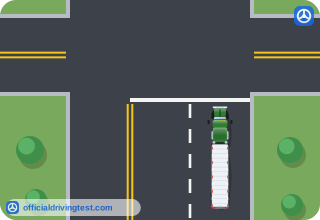
- Swing wide to the right into the shoulder
- Stop in the crosswalk before turning
- Turn only from the left lane
- Swing wide to the left to clear a curb
Show answer
Correct answer: Swing wide to the left to clear a curb
Large vehicles sometimes swing wide to the left to clear the curb when turning right.
Source: Utah Driver Handbook (2026 edition (new 2026 laws effective May 6, 2026)), page 79 · Open this page in the manual (Manual page 79)
-
How can you avoid wind blasts when you meet a truck?
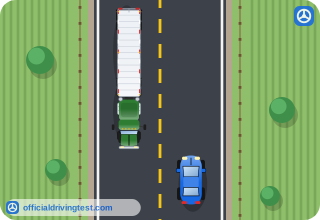
- Move toward the center line of the road
- Speed up so that you pass the truck quickly
- Move as far as you can to the right side of the road
- Flash your headlights so that the truck driver slows
Show answer
Correct answer: Move as far as you can to the right side of the road
Moving as far right as you can helps avoid the wind blast of an oncoming truck.
Source: Utah Driver Handbook (2026 edition (new 2026 laws effective May 6, 2026)), page 79 · Open this page in the manual (Manual page 79)
-
When a long vehicle makes a turn, how does the path of its rear wheels compare with the path of its front wheels?
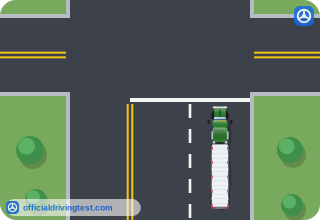
- It is a shorter path
- It is a longer path
- It is the same path
- It is a wider path on the outside of the curve
Show answer
Correct answer: It is a shorter path
With any turning vehicle the rear wheels take a shorter path than the front wheels, and the longer the vehicle, the bigger the difference.
Source: Utah Driver Handbook (2026 edition (new 2026 laws effective May 6, 2026)), page 80 · Open this page in the manual (Manual page 80)
-
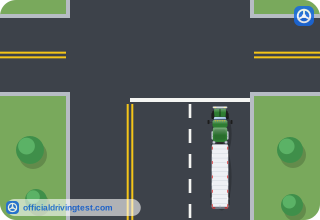
What must drivers of tractor-trailers often do as the first step in making a right turn?
- Move onto the right shoulder
- Stop and let traffic pass first
- Swing out to the left
- Signal left and slow down
Show answer
Correct answer: Swing out to the left
Because the rear wheels follow a shorter path, tractor-trailer drivers must often swing out to the left first when turning right.
Source: Utah Driver Handbook (2026 edition (new 2026 laws effective May 6, 2026)), page 80 · Open this page in the manual (Manual page 80)
-
You are following a tractor-trailer that appears to be starting a left turn. What should you do before passing on the right?
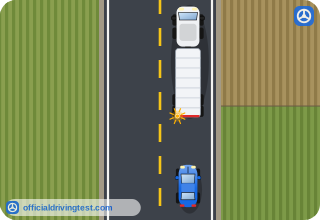
- Pass at once while the driver is slowing down
- Wait a moment to see which way the driver will turn
- Sound your horn to warn the driver
- Move up close behind the trailer
Show answer
Correct answer: Wait a moment to see which way the driver will turn
The truck may really be setting up a right turn, so you should wait and see which way it goes before passing.
Source: Utah Driver Handbook (2026 edition (new 2026 laws effective May 6, 2026)), page 80 · Open this page in the manual (Manual page 80)
-
How far in front of the cab can a tractor-trailer's blind spot reach?
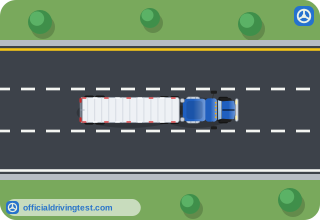
- Up to 5 feet
- Up to 10 feet
- Up to 50 feet
- Up to 20 feet
Show answer
Correct answer: Up to 20 feet
Truckers have serious blind spots up to 20 feet in front of the cab, where a car can disappear from view.
Source: Utah Driver Handbook (2026 edition (new 2026 laws effective May 6, 2026)), page 80 · Open this page in the manual (Manual page 80)
-
How far behind a large vehicle can its blind spot reach?
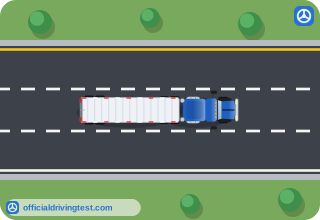
- Up to 20 feet
- Up to 50 feet
- Up to 100 feet
- Up to 200 feet
Show answer
Correct answer: Up to 200 feet
Large vehicles have huge rear blind spots, up to 200 feet behind them.
Source: Utah Driver Handbook (2026 edition (new 2026 laws effective May 6, 2026)), page 80 · Open this page in the manual (Manual page 80)
-
If you cannot see a truck driver in the truck's side mirror, what is true?
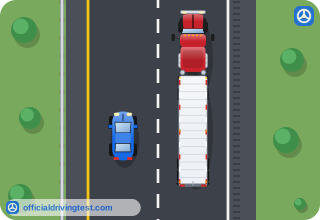
- The driver is about to brake
- The driver cannot see you
- The driver can see you in the rear-view mirror
- The driver will yield to you
Show answer
Correct answer: The driver cannot see you
If you can't see the driver's face in the side mirror, the driver can't see you, so you are in a blind spot.
Source: Utah Driver Handbook (2026 edition (new 2026 laws effective May 6, 2026)), page 80 · Open this page in the manual (Manual page 80)
-
On which side of a truck is its largest blind spot?
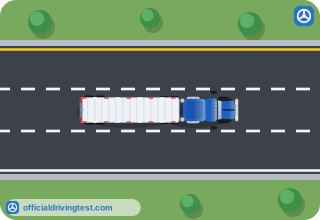
- The left side
- The front only
- The right side
- The rear only
Show answer
Correct answer: The right side
A truck's largest blind spot is on the right side, starting behind the cab and running the length of the truck.
Source: Utah Driver Handbook (2026 edition (new 2026 laws effective May 6, 2026)), page 80 · Open this page in the manual (Manual page 80)
-
How long should you drive alongside a large vehicle?
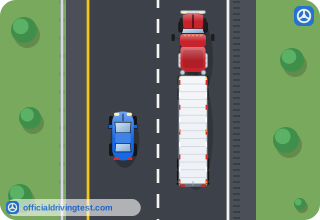
- No longer than you have to
- Long enough to be sure the driver sees you
- As long as your speed matches theirs
- Only while the truck is climbing a hill
Show answer
Correct answer: No longer than you have to
If the driver must swerve or change lanes while you are alongside, you could collide, so stay beside a large vehicle as briefly as possible.
Source: Utah Driver Handbook (2026 edition (new 2026 laws effective May 6, 2026)), page 80 · Open this page in the manual (Manual page 80)
-
A loaded truck traveling at 55 mph takes at least how far to stop?
- 185 feet
- 335 feet
- 225 feet
- 450 feet
Show answer
Correct answer: 335 feet
Large vehicles are big and heavy, so a loaded truck at 55 mph needs at least 335 feet to stop, more than 1.5 times a car's distance.
Source: Utah Driver Handbook (2026 edition (new 2026 laws effective May 6, 2026)), page 80 · Open this page in the manual (Manual page 80)
-
Which of these should you never do around a large vehicle?
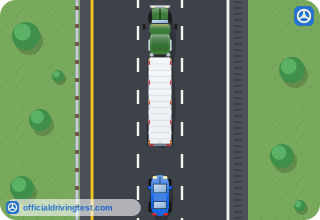
- Keep a safe distance behind it
- Stay where its driver can see you
- Leave extra room when stopping behind it
- Pull out or change lanes in front of it
Show answer
Correct answer: Pull out or change lanes in front of it
Large vehicles take longer to stop, so pulling out or changing lanes in front of one is dangerous.
Source: Utah Driver Handbook (2026 edition (new 2026 laws effective May 6, 2026)), page 80 · Open this page in the manual (Manual page 80)
-
When you pass a large vehicle, when may you pull back into the lane in front of it?
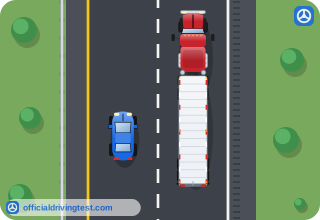
- When you can see the whole front of it in your rear-view mirror
- As soon as your car is even with the front of its cab
- When its driver flashes the headlights
- After you have passed its rear wheels
Show answer
Correct answer: When you can see the whole front of it in your rear-view mirror
Wait until the entire front of the vehicle is visible in your rear-view mirror before pulling back into the lane.
Source: Utah Driver Handbook (2026 edition (new 2026 laws effective May 6, 2026)), page 80 · Open this page in the manual (Manual page 80)
-
What happens if you follow a large vehicle too closely?
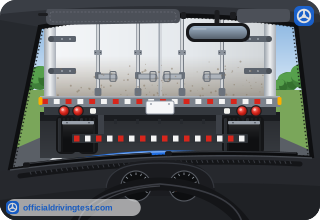
- The driver can see you in the mirrors but you cannot see ahead
- You can see ahead but the driver cannot see you
- The driver cannot see your vehicle and you cannot see what is ahead
- Neither problem happens if you stay in your lane
Show answer
Correct answer: The driver cannot see your vehicle and you cannot see what is ahead
Too close to the rear of a large vehicle, you are in its blind spot and your own view of the road ahead is blocked.
Source: Utah Driver Handbook (2026 edition (new 2026 laws effective May 6, 2026)), page 80 · Open this page in the manual (Manual page 80)
-
Where should you position yourself behind a large vehicle?
- Directly behind the trailer, as close as you can
- Beside the cab on its right side
- Where the driver can see you in the side mirrors
- Just ahead of the cab, within 20 feet
Show answer
Correct answer: Where the driver can see you in the side mirrors
You should place your vehicle so that the driver can see you in the side mirrors, not in a blind spot.
Source: Utah Driver Handbook (2026 edition (new 2026 laws effective May 6, 2026)), page 80 · Open this page in the manual (Manual page 80)
-
Why should you take care when stopped behind a large vehicle on a hill?
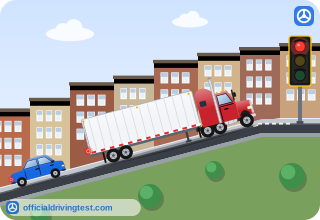
- It may stall or roll backward into your vehicle
- It may release its brakes and speed up quickly
- It may turn sharply across your lane
- Its driver cannot hear your horn
Show answer
Correct answer: It may stall or roll backward into your vehicle
On a hill a large vehicle can stall or roll backward, so leave room between you and it.
Source: Utah Driver Handbook (2026 edition (new 2026 laws effective May 6, 2026)), page 80 · Open this page in the manual (Manual page 80)