Utah: Sharing the road — Large Trucks: Size, Weight and Maneuverability Practice Test
Questions in this part include: “What is the maximum total outside width of a single vehicle, including its load?” · “When the clearance of your vehicle is under how many inches, should you slow down to be safe?”
Independent educational site · not affiliated with any government agency or DMV
Ready? Test yourself
- Instant feedback with an explanation
- Every answer cites its source in the manual
- Your best score is saved on this device
- Keyboard: press 1 to 4 to answer and Enter for the next question
Questions are original and based on the official manual "Utah Driver Handbook" (2026 edition (new 2026 laws effective May 6, 2026)), Utah Department of Public Safety, Driver License Division.
All 22 questions in this practice test
Take the test above first, then use this list to study. Tap “Show answer” to see the correct answer and explanation.
Show the questions and answersHide the questions
-
What is the maximum total outside width of a single vehicle, including its load?
- 7 feet
- 8 1/2 feet
- 10 feet
- 12 feet
Show answer
Correct answer: 8 1/2 feet
No vehicle may have a total outside width, including its load, of more than 8 1/2 feet.
Source: Utah Driver Handbook (2026 edition (new 2026 laws effective May 6, 2026)), page 78 · Open this page in the manual (Manual page 78)
-
What is the maximum width allowed for farm tractors?
- 10 feet
- 11 feet
- 12 feet
- 9 feet
Show answer
Correct answer: 9 feet
Farm tractors are the exception to the width rule, but their width may not exceed 9 feet.
Source: Utah Driver Handbook (2026 edition (new 2026 laws effective May 6, 2026)), page 78 · Open this page in the manual (Manual page 78)
-
What is the maximum height of a vehicle, including any load it carries?
- 14 feet
- 10 feet
- 12 feet
- 16 feet
Show answer
Correct answer: 14 feet
No vehicle may exceed 14 feet in height, load included.
Source: Utah Driver Handbook (2026 edition (new 2026 laws effective May 6, 2026)), page 78 · Open this page in the manual (Manual page 78)
-
What is the maximum overall length of a single vehicle, including the front and rear bumpers, other than fire-fighting equipment?
- 35 feet
- 40 feet
- 45 feet
- 55 feet
Show answer
Correct answer: 45 feet
A single vehicle may not exceed an overall length of 45 feet, except fire-fighting equipment.
Source: Utah Driver Handbook (2026 edition (new 2026 laws effective May 6, 2026)), page 78 · Open this page in the manual (Manual page 78)
-
For the length rule, how is a truck tractor coupled to a semi-trailer considered?
- One vehicle
- Two vehicles
- Three vehicles
- A combination exempt from the length rule
Show answer
Correct answer: Two vehicles
A truck tractor with a semi-trailer or trailers is counted as two vehicles.
Source: Utah Driver Handbook (2026 edition (new 2026 laws effective May 6, 2026)), page 78 · Open this page in the manual (Manual page 78)
-
What is the maximum total length for other combinations of vehicles, such as a motor home pulling a boat?
- 45 feet
- 55 feet
- 75 feet
- 65 feet
Show answer
Correct answer: 65 feet
Other combinations of vehicles may not exceed 65 feet in total length.
Source: Utah Driver Handbook (2026 edition (new 2026 laws effective May 6, 2026)), page 78 · Open this page in the manual (Manual page 78)
-
A vehicle registered for 16,001 pounds or more must display what on both its left and right sides?
- The weight for which it is registered
- Its empty weight when unloaded
- Its maximum legal speed on highways
- The number of axles it has
Show answer
Correct answer: The weight for which it is registered
Vehicles registered for 16,001 pounds or more must display their registered weight on both sides.
Source: Utah Driver Handbook (2026 edition (new 2026 laws effective May 6, 2026)), page 78 · Open this page in the manual (Manual page 78)
-
The registered weight displayed on a vehicle must be in letters not less than how high?
- One inch
- Four inches
- Two inches
- Six inches
Show answer
Correct answer: Two inches
The registered weight must be shown in letters at least two inches high in an easily visible location.
Source: Utah Driver Handbook (2026 edition (new 2026 laws effective May 6, 2026)), page 78 · Open this page in the manual (Manual page 78)
-
When the clearance of your vehicle is under how many inches, should you slow down to be safe?
- Two inches
- Six inches
- Twelve inches
- Eighteen inches
Show answer
Correct answer: Six inches
With less than six inches of clearance, slow down because rough roads could make the vehicle bounce into a low ceiling or swerve into a wall.
Source: Utah Driver Handbook (2026 edition (new 2026 laws effective May 6, 2026)), page 78 · Open this page in the manual (Manual page 78)
-
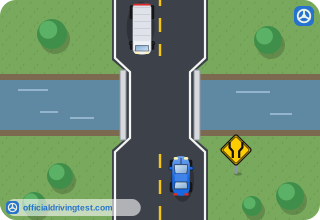
If you have doubts about whether a car and a truck can pass through a bridge or tunnel at the same time, what should you do?
- Go through first and sound the horn
- Drive through side by side slowly
- Speed up to pass through quickly
- Let the other vehicle go through first
Show answer
Correct answer: Let the other vehicle go through first
Some bridges and tunnels are not made for a car and a truck at the same time, so with any doubt let the other vehicle go first.
Source: Utah Driver Handbook (2026 edition (new 2026 laws effective May 6, 2026)), page 78 · Open this page in the manual (Manual page 78)
-
How far may a load extend to the front of a vehicle’s body?
- No more than three feet
- No more than one foot
- No more than five feet
- No more than ten feet
Show answer
Correct answer: No more than three feet
A load may not extend more than three feet to the front of the vehicle’s body.
Source: Utah Driver Handbook (2026 edition (new 2026 laws effective May 6, 2026)), page 78 · Open this page in the manual (Manual page 78)
-
How far may a load extend to the rear of a vehicle’s body?
- No more than four feet
- No more than ten feet
- No more than six feet
- No more than twelve feet
Show answer
Correct answer: No more than six feet
A load may not extend more than six feet to the rear of the vehicle’s body.
Source: Utah Driver Handbook (2026 edition (new 2026 laws effective May 6, 2026)), page 78 · Open this page in the manual (Manual page 78)
-
How far may a load extend beyond the line of the fenders on the right side of a vehicle?
- No more than one foot
- No more than six inches
- No more than two feet
- No more than three feet
Show answer
Correct answer: No more than six inches
A load may extend no more than six inches beyond the fender line on the right side.
Source: Utah Driver Handbook (2026 edition (new 2026 laws effective May 6, 2026)), page 79 · Open this page in the manual (Manual page 79)
-
How far may a load extend beyond the line of the fenders on the left side of a vehicle?
- Three inches
- Six inches
- One foot
- Not at all
Show answer
Correct answer: Not at all
No load may extend beyond the line of the fenders on the left side.
Source: Utah Driver Handbook (2026 edition (new 2026 laws effective May 6, 2026)), page 79 · Open this page in the manual (Manual page 79)
-
How do trucks compare with cars?
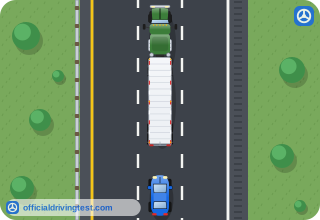
- Longer stopping and accelerating distances, and wider turning areas
- Shorter stopping distances because they are heavier than cars
- Narrower turning areas because they are longer than cars
- Faster acceleration because they have larger engines than cars
Show answer
Correct answer: Longer stopping and accelerating distances, and wider turning areas
Trucks are not as maneuverable as cars: they need longer stopping and accelerating distances and wider turning areas, and they weigh more.
Source: Utah Driver Handbook (2026 edition (new 2026 laws effective May 6, 2026)), page 79 · Open this page in the manual (Manual page 79)
-
On multi-lane highways, which lane do tractor-trailers stay in to help with local traffic flow?
- The far left lane
- The far right lane
- The center lane
- The HOV lane
Show answer
Correct answer: The center lane
Tractor-trailers stay in the center lane, which also gives the truck driver more options if switching lanes to avoid danger.
Source: Utah Driver Handbook (2026 edition (new 2026 laws effective May 6, 2026)), page 79 · Open this page in the manual (Manual page 79)
-
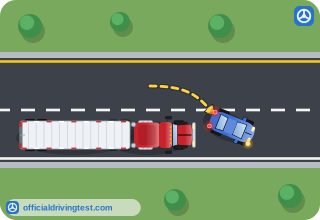
Why is cutting into the open space in front of a truck dangerous?
- It blocks the truck driver’s view of the road signs
- It removes the truck driver’s cushion of safety
- It causes the truck’s brakes to overheat
- It forces the truck to change into the next lane
Show answer
Correct answer: It removes the truck driver’s cushion of safety
The open space in front of a truck is the driver’s cushion of safety, and cutting into it can cause a crash.
Source: Utah Driver Handbook (2026 edition (new 2026 laws effective May 6, 2026)), page 79 · Open this page in the manual (Manual page 79)
-
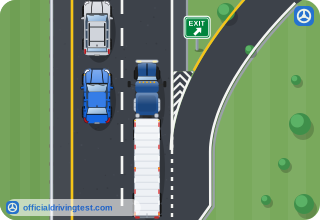
What should you do instead of cutting off a truck to reach your exit?
- Speed up and cut in front of it
- Flash your headlights so it slows down
- Change lanes just ahead of its bumper
- Slow down and exit behind the truck
Show answer
Correct answer: Slow down and exit behind the truck
Slowing down and exiting behind a truck takes only a few extra seconds and avoids causing a crash.
Source: Utah Driver Handbook (2026 edition (new 2026 laws effective May 6, 2026)), page 79 · Open this page in the manual (Manual page 79)
-
How should you pass a tractor-trailer?
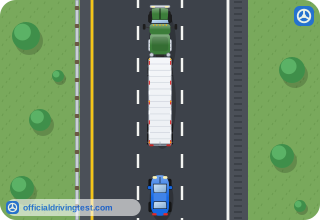
- Completely, and always on the left side
- On the right side, because it is less dangerous
- By staying alongside it for a while to check its load
- Slowly, on whichever side has room
Show answer
Correct answer: Completely, and always on the left side
A tractor-trailer should always be passed completely and on the left side.
Source: Utah Driver Handbook (2026 edition (new 2026 laws effective May 6, 2026)), page 79 · Open this page in the manual (Manual page 79)
-
Why should you not linger alongside a truck when passing it?
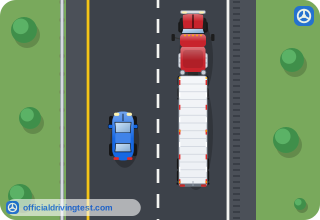
- The truck is required to slow down while you are passing it
- Your horn will confuse the trucker who is beside you
- The trucker cannot take evasive action if an obstacle appears ahead
- Trucks cannot be passed on the left side at all times
Show answer
Correct answer: The trucker cannot take evasive action if an obstacle appears ahead
Lingering alongside leaves the trucker no room to swerve or avoid something ahead.
Source: Utah Driver Handbook (2026 edition (new 2026 laws effective May 6, 2026)), page 79 · Open this page in the manual (Manual page 79)
-
Because of its large size, how does an approaching tractor-trailer often appear?
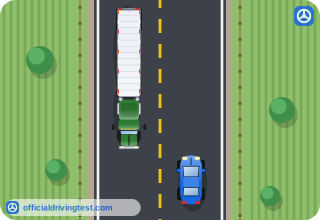
- To be traveling faster than it is
- To be farther away than the stop line
- To be traveling at its true speed
- To be traveling slower than it is
Show answer
Correct answer: To be traveling slower than it is
A tractor-trailer often looks slower than it is, so drivers should not underestimate its size and speed.
Source: Utah Driver Handbook (2026 edition (new 2026 laws effective May 6, 2026)), page 79 · Open this page in the manual (Manual page 79)
-
Where does a substantial number of car-truck collisions occur?
- At intersections
- On steep downgrades
- In construction zones
- On freeway entrance ramps
Show answer
Correct answer: At intersections
Many car-truck collisions happen at intersections because the car driver does not realize how close the truck is or how fast it is approaching.
Source: Utah Driver Handbook (2026 edition (new 2026 laws effective May 6, 2026)), page 79 · Open this page in the manual (Manual page 79)