Utah: Sharing the road — Definitions and School Bus Stopping Practice Test
Questions in this part include: “In the handbook’s definition of a bicycle, the wheels are not less than what diameter?” · “In the handbook’s definitions, what is a school bus?”
Independent educational site · not affiliated with any government agency or DMV
Ready? Test yourself
- Instant feedback with an explanation
- Every answer cites its source in the manual
- Your best score is saved on this device
- Keyboard: press 1 to 4 to answer and Enter for the next question
Questions are original and based on the official manual "Utah Driver Handbook" (2026 edition (new 2026 laws effective May 6, 2026)), Utah Department of Public Safety, Driver License Division.
All 19 questions in this practice test
Take the test above first, then use this list to study. Tap “Show answer” to see the correct answer and explanation.
Show the questions and answersHide the questions
-
In the handbook’s definition of a bicycle, the wheels are not less than what diameter?
- 14 inches
- 10 inches
- 12 inches
- 16 inches
Show answer
Correct answer: 14 inches
A bicycle’s wheels must be at least 14 inches in diameter under the definition.
Source: Utah Driver Handbook (2026 edition (new 2026 laws effective May 6, 2026)), page 1 · Open this page in the manual (Manual page 1)
-
A low-speed vehicle is designed to be operated at no more than what speed?
- 15 miles per hour
- 25 miles per hour
- 35 miles per hour
- 45 miles per hour
Show answer
Correct answer: 25 miles per hour
A low-speed vehicle is a four-wheeled electric vehicle designed for speeds of not more than 25 miles per hour.
Source: Utah Driver Handbook (2026 edition (new 2026 laws effective May 6, 2026)), page 2 · Open this page in the manual (Manual page 2)
-
A low-speed vehicle has a capacity of not more than how many passengers, including the driver?
- Two
- Six
- Eight
- Four
Show answer
Correct answer: Four
The definition limits a low-speed vehicle to four passengers including the driver.
Source: Utah Driver Handbook (2026 edition (new 2026 laws effective May 6, 2026)), page 2 · Open this page in the manual (Manual page 2)
-
Which agency issues a mobility vehicle permit, which specifies the conditions for a person with a physical disability to drive a mobility vehicle?
- The Division of Motor Vehicles
- The Utah Highway Patrol
- The Driver License Division
- The Utah State Tax Commission
Show answer
Correct answer: The Driver License Division
The permit is issued by the division, meaning the Driver License Division of the Department of Public Safety.
Source: Utah Driver Handbook (2026 edition (new 2026 laws effective May 6, 2026)), page 2 · Open this page in the manual (Manual page 2)
-
A pedestrian vehicle, designed for persons with a physical disability, must not be capable of exceeding what speed?
- 20 miles per hour
- 30 miles per hour
- 25 miles per hour
- 35 miles per hour
Show answer
Correct answer: 30 miles per hour
The definition says a pedestrian vehicle must not be capable of exceeding 30 m.p.h.
Source: Utah Driver Handbook (2026 edition (new 2026 laws effective May 6, 2026)), page 3 · Open this page in the manual (Manual page 3)
-
Which description fits a personal motorized mobility device?
- A self-propelled device with four wheels and a seat on which one rider sits to operate it
- A self-propelled device with three wheels and handlebars that the rider uses to steer it
- A self-propelled device with two wheels in line and a saddle on which the rider sits
- A self-propelled device with two non-tandem wheels and a deck on which a person stands to operate it
Show answer
Correct answer: A self-propelled device with two non-tandem wheels and a deck on which a person stands to operate it
It has two non-tandem wheels, steering and stopping controls, a limited motor, and a deck designed for a standing rider.
Source: Utah Driver Handbook (2026 edition (new 2026 laws effective May 6, 2026)), page 3 · Open this page in the manual (Manual page 3)
-
In the handbook’s definitions, what is a school bus?
- Any passenger vehicle, whether commercial or private, that carries at least one student at a time
- A non-commercial vehicle used by parents to carry their own children to and from school each day
- A commercial motor vehicle used to transport school students to and from home and school or school-sponsored events
- A commercial vehicle that carries adult passengers to and from their place of work each day
Show answer
Correct answer: A commercial motor vehicle used to transport school students to and from home and school or school-sponsored events
A school bus is a commercial motor vehicle that carries pre-primary, primary, or secondary students to and from home, school, or school-sponsored events.
Source: Utah Driver Handbook (2026 edition (new 2026 laws effective May 6, 2026)), page 3 · Open this page in the manual (Manual page 3)
-
In the handbook’s definitions, what is a street-legal all-terrain vehicle?
- Any all-terrain vehicle that crosses a highway to reach a trail
- An all-terrain type I or utility-type vehicle modified to operate on highways
- A motorcycle that is modified for use on unpaved roads
- A four-wheeled electric vehicle built to travel at 25 miles per hour
Show answer
Correct answer: An all-terrain type I or utility-type vehicle modified to operate on highways
A street-legal all-terrain vehicle is a type I all-terrain or utility-type vehicle modified so it can be operated on highways.
Source: Utah Driver Handbook (2026 edition (new 2026 laws effective May 6, 2026)), page 3 · Open this page in the manual (Manual page 3)
-
In the handbook’s definitions, what is a farm tractor?
- A trailer towed behind a pickup truck to haul crops to market
- Any truck with a gross weight of 26,001 pounds or more used for hauling feed
- A four-wheeled electric vehicle used on a farm at no more than 25 miles per hour
- A self-propelled vehicle designed and used primarily as a farm implement of husbandry
Show answer
Correct answer: A self-propelled vehicle designed and used primarily as a farm implement of husbandry
A farm tractor is a self-propelled vehicle designed and used mainly as farm equipment.
Source: Utah Driver Handbook (2026 edition (new 2026 laws effective May 6, 2026)), page 1 · Open this page in the manual (Manual page 1)
-
When stopping behind another vehicle, what should you be able to see?
- The license plate of the vehicle in front of you
- The rear wheels of the vehicle in front of you
- The brake lights of the second vehicle ahead
- The turn signal of the vehicle behind you
Show answer
Correct answer: The rear wheels of the vehicle in front of you
Leave enough room that you can see the rear wheels of the vehicle in front.
Source: Utah Driver Handbook (2026 edition (new 2026 laws effective May 6, 2026)), page 31 · Open this page in the manual (Manual page 31)
-
A school bus displays alternating flashing red lights visible from the front or rear. What must you do?
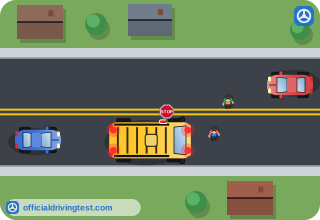
- Slow down and pass with caution
- Slow to 20 miles per hour and pass carefully
- Stop immediately before reaching the bus
- Stop only if you can see children outside
Show answer
Correct answer: Stop immediately before reaching the bus
You must stop immediately before reaching a school bus that displays alternating flashing red lights.
Source: Utah Driver Handbook (2026 edition (new 2026 laws effective May 6, 2026)), page 36 · Open this page in the manual (Manual page 36)
-
After stopping for a school bus with flashing red lights, when may you proceed?
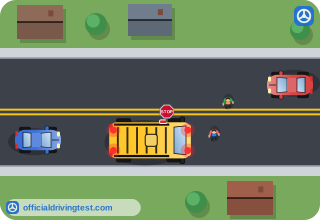
- When the bus driver waves you on
- When the flashing red light has stopped
- When all children are out of sight
- When two minutes have passed
Show answer
Correct answer: When the flashing red light has stopped
You do not proceed until the flashing red light or signal has stopped.
Source: Utah Driver Handbook (2026 edition (new 2026 laws effective May 6, 2026)), page 36 · Open this page in the manual (Manual page 36)
-
On a two-lane roadway, who must stop for a school bus with alternating flashing red lights?
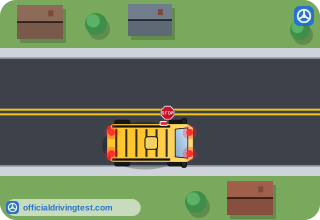
- Only traffic traveling behind the bus
- Only traffic traveling toward the bus
- Only the vehicle closest to the bus
- Traffic in both directions
Show answer
Correct answer: Traffic in both directions
On a two-lane roadway, traffic in both directions must stop.
Source: Utah Driver Handbook (2026 edition (new 2026 laws effective May 6, 2026)), page 36 · Open this page in the manual (Manual page 36)
-
On a divided highway with four or more lanes and a median, who must stop for a school bus with alternating flashing red lights?
- Traffic in both directions
- Only the vehicles in both lanes behind the bus
- Only the vehicles in the lane next to the bus
- Only the oncoming traffic
Show answer
Correct answer: Only the vehicles in both lanes behind the bus
With a median separating the traffic, only vehicles in both lanes behind the bus must stop, not the opposite direction.
Source: Utah Driver Handbook (2026 edition (new 2026 laws effective May 6, 2026)), page 36 · Open this page in the manual (Manual page 36)
-
On a four-lane roadway without a median, who must stop for a school bus with alternating flashing red lights?
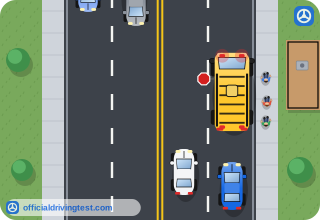
- Traffic in both directions
- Only the vehicles in both lanes behind the bus
- Only the vehicles in the lane next to the bus
- Only the vehicles in the lane nearest the curb
Show answer
Correct answer: Traffic in both directions
On a four-lane roadway without a median, traffic in both directions is required to stop.
Source: Utah Driver Handbook (2026 edition (new 2026 laws effective May 6, 2026)), page 36 · Open this page in the manual (Manual page 36)
-
On a highway with five or more lanes and a shared center turn lane, what is required of vehicles traveling in the opposite direction from a stopped school bus?
- They must stop
- They must stop only if children are crossing
- They must slow to 20 miles per hour
- They are not legally required to stop
Show answer
Correct answer: They are not legally required to stop
On a highway with five or more lanes and a shared center turn lane, only vehicles behind the bus must stop; oncoming vehicles are not legally required to.
Source: Utah Driver Handbook (2026 edition (new 2026 laws effective May 6, 2026)), page 36 · Open this page in the manual (Manual page 36)
-
What does the handbook say to do when driving near school buses?
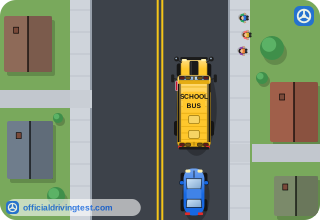
- Pass them quickly to clear the area
- Keep your usual speed unless a bus stops
- Use caution and adjust your speed accordingly
- Sound your horn to warn children
Show answer
Correct answer: Use caution and adjust your speed accordingly
Children are unpredictable, so you use caution near school buses and adjust your speed.
Source: Utah Driver Handbook (2026 edition (new 2026 laws effective May 6, 2026)), page 36 · Open this page in the manual (Manual page 36)
-
According to the handbook, how high can fines run for improperly passing a school bus?
- Up to $3000
- Up to $300
- Up to $500
- Up to $1000
Show answer
Correct answer: Up to $3000
The handbook says fines for illegally passing a school bus can run up to $3000.
Source: Utah Driver Handbook (2026 edition (new 2026 laws effective May 6, 2026)), page 36 · Open this page in the manual (Manual page 36)
-
What may happen when a school bus driver reports a vehicle that improperly passed the bus?
- The report stays with the school district and goes no further
- The report may be forwarded to local law enforcement for investigation
- Your license is suspended at once
- The report is dropped unless police saw the pass
Show answer
Correct answer: The report may be forwarded to local law enforcement for investigation
School bus drivers may report improper passing, and the report may go to the local law enforcement agency for investigation.
Source: Utah Driver Handbook (2026 edition (new 2026 laws effective May 6, 2026)), page 36 · Open this page in the manual (Manual page 36)