Utah: Speed and space — Part 1 Practice Test
Questions in this part include: “Which rule do the safe driving tips say to use to follow at a safe distance?” · “In which situation must you never pass another vehicle?”
Independent educational site · not affiliated with any government agency or DMV
Ready? Test yourself
- Instant feedback with an explanation
- Every answer cites its source in the manual
- Your best score is saved on this device
- Keyboard: press 1 to 4 to answer and Enter for the next question
Questions are original and based on the official manual "Utah Driver Handbook" (2026 edition (new 2026 laws effective May 6, 2026)), Utah Department of Public Safety, Driver License Division.
All 21 questions in this practice test
Take the test above first, then use this list to study. Tap “Show answer” to see the correct answer and explanation.
Show the questions and answersHide the questions
-
According to the safe driving tips, what should you do with your speed to adjust for weather, road, and other traffic conditions?
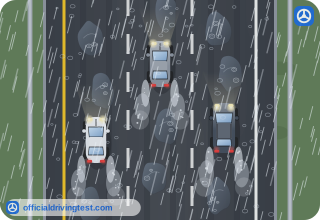
- Match the fastest vehicle nearby
- Stay at the posted limit no matter what
- Reduce your speed if needed
- Increase your speed to leave the area sooner
Show answer
Correct answer: Reduce your speed if needed
Always obey posted speed limits and, if needed, reduce your speed to adjust for weather, road, and traffic conditions.
Source: Utah Driver Handbook (2026 edition (new 2026 laws effective May 6, 2026)), page 26 · Open this page in the manual (Manual page 26)
-
Which rule do the safe driving tips say to use to follow at a safe distance?
- The one-second rule
- The two-second rule
- The three-second rule
- The five-second rule
Show answer
Correct answer: The two-second rule
The tips say to follow at a safe distance by using the two-second rule.
Source: Utah Driver Handbook (2026 edition (new 2026 laws effective May 6, 2026)), page 26 · Open this page in the manual (Manual page 26)
-
When do the safe driving tips say to increase your following distance?
- On dry roads in clear daylight
- When the road is empty
- When driving in residential areas
- In bad weather or poor visibility
Show answer
Correct answer: In bad weather or poor visibility
Following distance should be increased in bad weather or poor visibility.
Source: Utah Driver Handbook (2026 edition (new 2026 laws effective May 6, 2026)), page 26 · Open this page in the manual (Manual page 26)
-
What do the safe driving tips say about driving defensively?
- Expect other drivers to always follow the rules
- Anticipate another driver’s errors
- Assume other drivers will yield to you
- Rely on other drivers to signal their moves
Show answer
Correct answer: Anticipate another driver’s errors
Driving defensively means anticipating another driver’s errors.
Source: Utah Driver Handbook (2026 edition (new 2026 laws effective May 6, 2026)), page 26 · Open this page in the manual (Manual page 26)
-
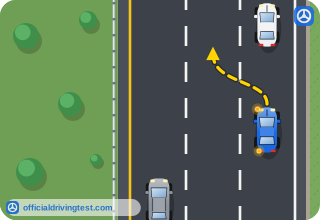
After completing a lane change, how should you adjust your speed?
- Slow down to let following vehicles pass
- Maintain or adjust it to go with the flow of traffic
- Speed up until you are the fastest vehicle in the lane
- Hold the speed you had before you signaled, whatever traffic does
Show answer
Correct answer: Maintain or adjust it to go with the flow of traffic
After the change you should maintain or adjust your speed to go with the flow of traffic.
Source: Utah Driver Handbook (2026 edition (new 2026 laws effective May 6, 2026)), page 31 · Open this page in the manual (Manual page 31)
-
On a multi-lane road, what is the left lane for?
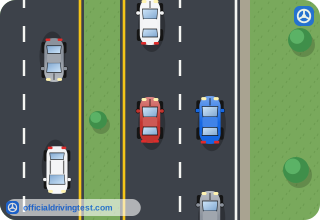
- Passing slower vehicles
- Stopping briefly to check directions
- Turning right at the next intersection
- Driving at the speed of the slowest vehicle
Show answer
Correct answer: Passing slower vehicles
The handbook says the left lane on multi-lane roads is for passing slower vehicles.
Source: Utah Driver Handbook (2026 edition (new 2026 laws effective May 6, 2026)), page 34 · Open this page in the manual (Manual page 34)
-
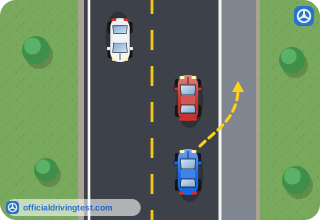
When may you pass another vehicle by driving on the shoulder?
- When the shoulder is paved and wide enough
- When the vehicle ahead is turning left
- Never
- When traffic ahead has stopped
Show answer
Correct answer: Never
The handbook says never to pass on the shoulder.
Source: Utah Driver Handbook (2026 edition (new 2026 laws effective May 6, 2026)), page 34 · Open this page in the manual (Manual page 34)
-
When you finish passing, how far from oncoming vehicles must you be when you return to the right-hand lane?
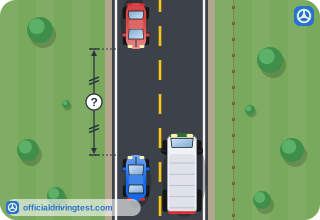
- No less than 50 feet
- No less than 200 feet
- No less than 100 feet
- No less than 500 feet
Show answer
Correct answer: No less than 200 feet
You must return to the right-hand lane no less than 200 feet from oncoming vehicles.
Source: Utah Driver Handbook (2026 edition (new 2026 laws effective May 6, 2026)), page 34 · Open this page in the manual (Manual page 34)
-
Before you return to the right-hand lane after passing, what should you wait until you can see?
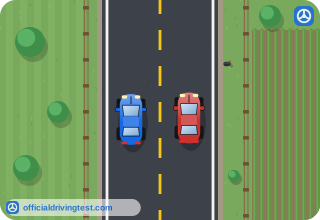
- The passed vehicle slow down to a stop
- The next intersection ahead
- A solid white line on the road
- The passed vehicles in your rear view mirror
Show answer
Correct answer: The passed vehicles in your rear view mirror
You wait until the passed vehicles show in your rear view mirror, then do a head check before returning to the lane.
Source: Utah Driver Handbook (2026 edition (new 2026 laws effective May 6, 2026)), page 34 · Open this page in the manual (Manual page 34)
-
What is illegal when you pass another vehicle on the right?
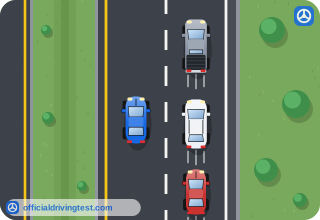
- Using your turn signal
- Leaving the roadway
- Checking your mirrors
- Moving back into your lane
Show answer
Correct answer: Leaving the roadway
The handbook says that when passing on the right it is illegal to leave the roadway.
Source: Utah Driver Handbook (2026 edition (new 2026 laws effective May 6, 2026)), page 34 · Open this page in the manual (Manual page 34)
-
What should you do if another driver is passing you?
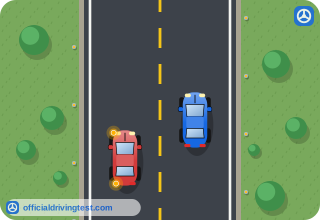
- Stay in your lane and keep your speed steady
- Slow down sharply and move onto the shoulder
- Speed up to stay even with the passing driver
- Move into the left lane to give more room
Show answer
Correct answer: Stay in your lane and keep your speed steady
You stay in your lane and keep a steady speed so the other driver can pass.
Source: Utah Driver Handbook (2026 edition (new 2026 laws effective May 6, 2026)), page 34 · Open this page in the manual (Manual page 34)
-
In which situation must you never pass another vehicle?
- In the left lane of a multi-lane road when it is clear
- On a road where a dashed line is on your side of the center line
- On a straight road after you have checked mirrors and signaled
- Before a railroad crossing or bridge
Show answer
Correct answer: Before a railroad crossing or bridge
The handbook lists the approach to a railroad crossing or bridge among the places where you must never pass.
Source: Utah Driver Handbook (2026 edition (new 2026 laws effective May 6, 2026)), page 34 · Open this page in the manual (Manual page 34)
-
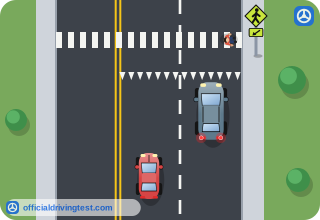
You see a car stopped at a crosswalk. What does the handbook say about passing it?
- Pass it only on the right
- Pass it if you slow down
- Never pass it
- Pass it if the crosswalk looks empty
Show answer
Correct answer: Never pass it
The handbook says never to pass another car that is stopped at a crosswalk.
Source: Utah Driver Handbook (2026 edition (new 2026 laws effective May 6, 2026)), page 34 · Open this page in the manual (Manual page 34)
-
If a curve or hill blocks your view of the road ahead, what does the handbook say about passing?
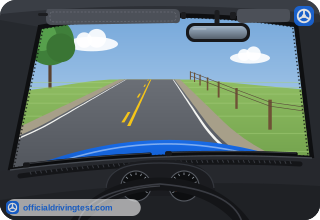
- Never pass
- Pass only if you sound your horn
- Pass only in the left lane at a slower speed
- Pass only if you signal early enough
Show answer
Correct answer: Never pass
A curve or hill that blocks your view is one of the situations where you must never pass.
Source: Utah Driver Handbook (2026 edition (new 2026 laws effective May 6, 2026)), page 34 · Open this page in the manual (Manual page 34)
-
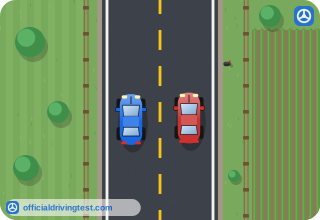
How long should you stay alongside the other vehicle while passing?
- Until the other driver sees you
- No longer than you have to
- Long enough to check the other driver's speed
- Until the next intersection
Show answer
Correct answer: No longer than you have to
The handbook tells you not to stay alongside the vehicle you are passing any longer than necessary.
Source: Utah Driver Handbook (2026 edition (new 2026 laws effective May 6, 2026)), page 34 · Open this page in the manual (Manual page 34)
-
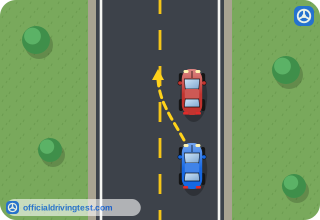
Before you pass, how should you check for vehicles following or passing you?
- Check only your rearview mirror
- Sound your horn and wait for a reply
- Look at your left side mirror only
- Check your mirrors and do a head check
Show answer
Correct answer: Check your mirrors and do a head check
The steps for passing include checking mirrors and doing a head check for vehicles following or passing you.
Source: Utah Driver Handbook (2026 edition (new 2026 laws effective May 6, 2026)), page 34 · Open this page in the manual (Manual page 34)
-
On the freeway, what is the least following distance you should always keep behind the vehicle ahead of you?
- At least four seconds
- At least six seconds
- At least two seconds
- At least one second
Show answer
Correct answer: At least two seconds
The handbook says to keep at least two seconds of following distance, more under adverse conditions.
Source: Utah Driver Handbook (2026 edition (new 2026 laws effective May 6, 2026)), page 39 · Open this page in the manual (Manual page 39)
-
Which statement about speed when getting off the freeway is true?
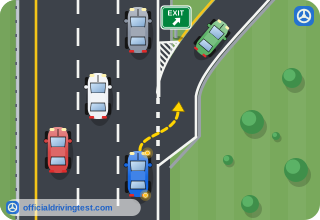
- You may not legally drive faster than the posted speed limit
- You may exceed the limit until you reach the end of the exit ramp
- The posted limit no longer applies once you signal to exit
- The limit rises by 5 miles per hour on exit lanes
Show answer
Correct answer: You may not legally drive faster than the posted speed limit
The rule against driving faster than the posted limit also applies to getting off the freeway.
Source: Utah Driver Handbook (2026 edition (new 2026 laws effective May 6, 2026)), page 39 · Open this page in the manual (Manual page 39)
-
As you approach an intersection, how should you brake?
- Quickly and firmly
- Lightly, then hard
- Only at the stop line
- Smoothly and evenly
Show answer
Correct answer: Smoothly and evenly
Approaching an intersection, brake smoothly and evenly and maintain lane position.
Source: Utah Driver Handbook (2026 edition (new 2026 laws effective May 6, 2026)), page 42 · Open this page in the manual (Manual page 42)
-
Under Utah’s basic speed law, you may never drive faster than what?
- The average speed of the vehicles around you
- The maximum speed set for your vehicle’s class
- The speed of the fastest vehicle in your lane
- A speed that is reasonable and prudent
Show answer
Correct answer: A speed that is reasonable and prudent
The basic speed law forbids driving faster than is reasonable and prudent under the existing conditions.
Source: Utah Driver Handbook (2026 edition (new 2026 laws effective May 6, 2026)), page 44 · Open this page in the manual (Manual page 44)
-
With no sign and no special hazards, what speed is permitted when passing a school building or grounds during school recess?
- 15 miles per hour
- 20 miles per hour
- 25 miles per hour
- 30 miles per hour
Show answer
Correct answer: 20 miles per hour
The permitted speed passing a school during recess is 20 miles per hour.
Source: Utah Driver Handbook (2026 edition (new 2026 laws effective May 6, 2026)), page 44 · Open this page in the manual (Manual page 44)