Utah: Sharing the road — Vulnerable Users and Drivers Near Bicycles Practice Test
Questions in this part include: “Where should you scan and check traffic?” · “Where should you be especially cautious about bicyclists when backing?”
Independent educational site · not affiliated with any government agency or DMV
Ready? Test yourself
- Instant feedback with an explanation
- Every answer cites its source in the manual
- Your best score is saved on this device
- Keyboard: press 1 to 4 to answer and Enter for the next question
Questions are original and based on the official manual "Utah Driver Handbook" (2026 edition (new 2026 laws effective May 6, 2026)), Utah Department of Public Safety, Driver License Division.
All 21 questions in this practice test
Take the test above first, then use this list to study. Tap “Show answer” to see the correct answer and explanation.
Show the questions and answersHide the questions
-
Where should you scan and check traffic?
- Only at intersections that are controlled by traffic signals
- Only on roads where the posted speed limit is higher than 45 mph
- Only in places where a crossing guard is present at the time
- In high-volume areas and areas where pedestrians are expected to be present
Show answer
Correct answer: In high-volume areas and areas where pedestrians are expected to be present
Scanning applies to high-volume areas and places where pedestrians are expected.
Source: Utah Driver Handbook (2026 edition (new 2026 laws effective May 6, 2026)), page 31 · Open this page in the manual (Manual page 31)
-
What should you do when passing bicyclists?
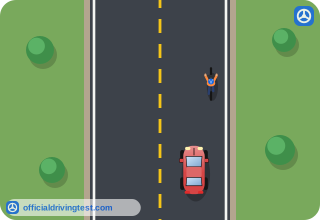
- Sound your horn to warn them before you pass
- Keep your speed the same so you do not confuse them
- Slow down to give them as much space as possible
- Stay close behind them until they turn
Show answer
Correct answer: Slow down to give them as much space as possible
The handbook says to slow down when passing bicyclists so they have as much space as possible.
Source: Utah Driver Handbook (2026 edition (new 2026 laws effective May 6, 2026)), page 34 · Open this page in the manual (Manual page 34)
-
Under Utah law, which of these people is a vulnerable user of the highway?
- A person riding an animal
- The driver of a passenger car
- The driver of a pickup truck
- The driver of a minivan
Show answer
Correct answer: A person riding an animal
Utah law counts pedestrians, people riding animals and users of bicycles, scooters, wheelchairs and similar devices as vulnerable users, not drivers of enclosed cars.
Source: Utah Driver Handbook (2026 edition (new 2026 laws effective May 6, 2026)), page 74 · Open this page in the manual (Manual page 74)
-
What must a driver always be ready to do around people walking, jogging, or riding bicycles on the roadway?
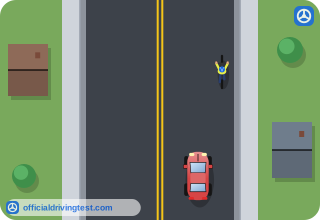
- Stop completely whenever any of them is in sight
- React to any sudden action of others using the roadway
- Sound the horn so that they move off the roadway
- Drive in the center of the road to give them room
Show answer
Correct answer: React to any sudden action of others using the roadway
Because these road users are hard to see and sometimes do the unexpected, a driver must keep the car under control and be ready to react.
Source: Utah Driver Handbook (2026 edition (new 2026 laws effective May 6, 2026)), page 74 · Open this page in the manual (Manual page 74)
-
Which rules of the road must bicyclists follow when on roadways?
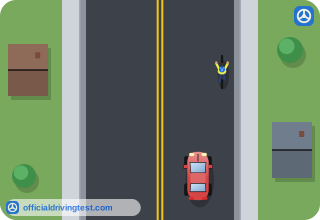
- Only the rules that apply to pedestrians
- Only the rules posted on bicycle route signs
- Special rules that never match the rules for motorists
- The same rules as motorized vehicles
Show answer
Correct answer: The same rules as motorized vehicles
Bicycles are considered vehicles on roadways, so bicyclists follow the same rules as motorists.
Source: Utah Driver Handbook (2026 edition (new 2026 laws effective May 6, 2026)), page 74 · Open this page in the manual (Manual page 74)
-
In which situation may a driver drive on a designated bicycle path or lane?
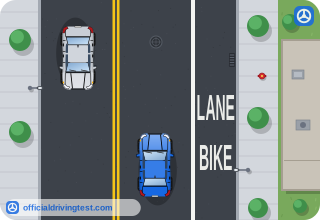
- When passing slower traffic
- When entering or leaving an alley or driveway
- When the lane is empty
- When traffic ahead is stopped at a signal
Show answer
Correct answer: When entering or leaving an alley or driveway
Driving on a bike path or lane is allowed only to enter or leave an alley or driveway, for official duties directed by a police officer, or in an emergency.
Source: Utah Driver Handbook (2026 edition (new 2026 laws effective May 6, 2026)), page 74 · Open this page in the manual (Manual page 74)
-
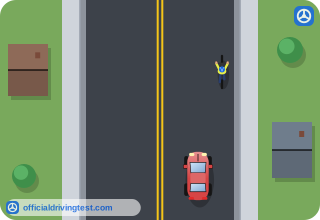
Why should a driver avoid slowing down or stopping quickly when near bicyclists?
- A bicycle’s brakes are more powerful than a motor vehicle’s
- Bicyclists cannot see brake lights of cars at all
- A motor vehicle’s brakes are more powerful than a bicycle’s
- Sudden stops damage the pavement of bicycle lanes
Show answer
Correct answer: A motor vehicle’s brakes are more powerful than a bicycle’s
Cars stop faster than bicycles, so a sudden stop in front of a bicyclist could cause a crash.
Source: Utah Driver Handbook (2026 edition (new 2026 laws effective May 6, 2026)), page 74 · Open this page in the manual (Manual page 74)
-
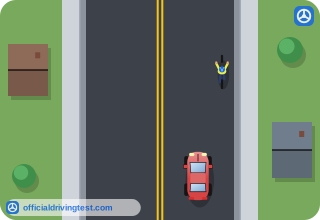
When should a driver sound the horn close to bicyclists?
- Whenever passing, to let them know you are there
- Only when there is a chance of a crash
- Whenever a bicyclist rides in your lane
- Before every turn near a bicyclist
Show answer
Correct answer: Only when there is a chance of a crash
A horn may startle bicyclists and make them steer into your path, so use it only when a crash is possible.
Source: Utah Driver Handbook (2026 edition (new 2026 laws effective May 6, 2026)), page 74 · Open this page in the manual (Manual page 74)
-
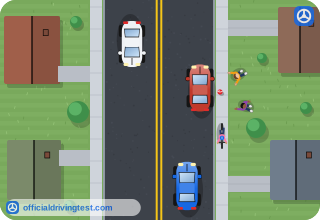
Why should a driver be especially careful when seeing children riding bikes on the sidewalk?
- Children on sidewalks must always stop before reaching the road
- Children ride faster than adult bicyclists do on the road
- Children are required to yield to cars at every driveway
- They may come onto the road and may not see you before pulling out
Show answer
Correct answer: They may come onto the road and may not see you before pulling out
Children may come onto the road, may not see you even if they glance toward you, and have trouble judging speed and distance.
Source: Utah Driver Handbook (2026 edition (new 2026 laws effective May 6, 2026)), page 75 · Open this page in the manual (Manual page 75)
-
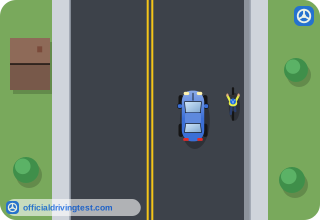
What minimum distance does Utah law require when passing a bicyclist or vulnerable user of the highway?
- Three feet
- Two feet
- Five feet
- Six feet
Show answer
Correct answer: Three feet
Utah law requires at least three feet of distance when passing a bicyclist or other vulnerable user.
Source: Utah Driver Handbook (2026 edition (new 2026 laws effective May 6, 2026)), page 75 · Open this page in the manual (Manual page 75)
-
If a bicyclist travels at less than a reasonable speed, where may you drive?
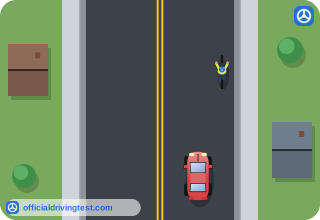
- On the shoulder of the road beside the bicyclist
- In the bicycle lane beside the bicyclist
- In a center lane (a two-way left turn lane)
- On the sidewalk beside the bicyclist
Show answer
Correct answer: In a center lane (a two-way left turn lane)
You may use the two-way left turn lane (center lane) to get around a bicyclist who is traveling at less than a reasonable speed.
Source: Utah Driver Handbook (2026 edition (new 2026 laws effective May 6, 2026)), page 75 · Open this page in the manual (Manual page 75)
-
At night, within what distance should you dim your headlights when approaching or overtaking bicyclists?
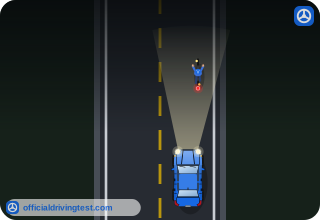
- 100 feet
- 500 feet
- 200 feet
- 300 feet
Show answer
Correct answer: 500 feet
The handbook says to dim headlights within 500 feet of bicyclists at night.
Source: Utah Driver Handbook (2026 edition (new 2026 laws effective May 6, 2026)), page 75 · Open this page in the manual (Manual page 75)
-
Which road conditions affect bicycles much more than vehicles?
- Dry, smooth pavement in clear weather
- A straight, level road with light traffic
- Bright sunshine on a dry, smooth road
- A wet roadway or one covered with sand or gravel
Show answer
Correct answer: A wet roadway or one covered with sand or gravel
Wet roads, sand and gravel affect bicycles much more than vehicles, so drivers should take extra care near bicyclists.
Source: Utah Driver Handbook (2026 edition (new 2026 laws effective May 6, 2026)), page 75 · Open this page in the manual (Manual page 75)
-
Before opening your vehicle door after parking on the street, what should you check for?
- Bicyclists to the sides and rear
- Vehicles parked ahead of you, not behind you
- Traffic signals ahead, not the sides or rear
- The sidewalk by the door, not the road behind
Show answer
Correct answer: Bicyclists to the sides and rear
Drivers should check to the sides and rear for bicyclists before opening a door.
Source: Utah Driver Handbook (2026 edition (new 2026 laws effective May 6, 2026)), page 75 · Open this page in the manual (Manual page 75)
-
Where should you be especially cautious about bicyclists when backing?
- On freeways and freeway ramps
- Near railroad crossings and bridges
- Near schools or residential areas
- On mountain roads with no shoulder
Show answer
Correct answer: Near schools or residential areas
You should always check for bicyclists before backing, particularly near schools or residential areas.
Source: Utah Driver Handbook (2026 edition (new 2026 laws effective May 6, 2026)), page 75 · Open this page in the manual (Manual page 75)
-
What are bicyclists required to use when turning and stopping?
- A bell or horn
- Hand signals
- A flashing headlight
- A turn-signal light on the helmet
Show answer
Correct answer: Hand signals
Bicyclists must use hand signals when turning and stopping, although they may be unable to signal when conditions require both hands on the handlebars.
Source: Utah Driver Handbook (2026 edition (new 2026 laws effective May 6, 2026)), page 75 · Open this page in the manual (Manual page 75)
-
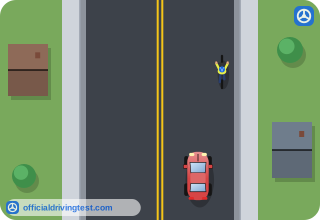
Which clue can show what a bicyclist who cannot give a hand signal intends to do?
- Pedaling faster than before the change
- Riding closer to the curb than before
- Slowing the pedaling to a stop in the lane
- Turning the head or looking over the shoulder
Show answer
Correct answer: Turning the head or looking over the shoulder
A bicyclist who keeps both hands on the handlebars may show intent by turning the head or looking over the shoulder.
Source: Utah Driver Handbook (2026 edition (new 2026 laws effective May 6, 2026)), page 75 · Open this page in the manual (Manual page 75)
-
Under which condition may a driver not pass a bicycle?
- On a straight, level road with a clear view
- When no traffic is coming from either direction
- When approaching a curve where the view is obstructed
- When the bicyclist is at the right edge of the road
Show answer
Correct answer: When approaching a curve where the view is obstructed
A driver may not pass a bicycle if the pass cannot be made safely, including at the crest of a grade or a curve where the view is obstructed.
Source: Utah Driver Handbook (2026 edition (new 2026 laws effective May 6, 2026)), page 75 · Open this page in the manual (Manual page 75)
-
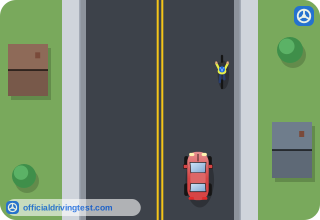
Within how many feet of an intersection or railroad grade crossing may a driver not pass a bicycle, unless a traffic control device indicates otherwise?
- 50 feet
- 100 feet
- 200 feet
- 300 feet
Show answer
Correct answer: 100 feet
A driver may not pass a bicycle when approaching within 100 feet of, or crossing, an intersection or railroad crossing.
Source: Utah Driver Handbook (2026 edition (new 2026 laws effective May 6, 2026)), page 75 · Open this page in the manual (Manual page 75)
-
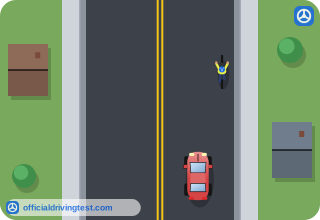
A driver may not pass a bicycle when the view is obstructed within 100 feet of what?
- Any school crossing
- Any shopping center entrance
- Any traffic light
- Any bridge, viaduct, or tunnel
Show answer
Correct answer: Any bridge, viaduct, or tunnel
Passing a bicycle is not allowed when the view is obstructed within 100 feet of a bridge, viaduct, or tunnel.
Source: Utah Driver Handbook (2026 edition (new 2026 laws effective May 6, 2026)), page 75 · Open this page in the manual (Manual page 75)
-
What does a skillful bicyclist do?
- Rides predictably and holds a steady line
- Swerves to show other road users where to go
- Rides without a light at night
- Ignores traffic signals on quiet streets
Show answer
Correct answer: Rides predictably and holds a steady line
A skillful bicyclist is predictable and holds a steady line, while an unskillful one may swerve, ignore signs and signals, or ride without a light.
Source: Utah Driver Handbook (2026 edition (new 2026 laws effective May 6, 2026)), page 74 · Open this page in the manual (Manual page 74)