South Dakota: Vehicle checks and basic control — Horn, Signaling, and Night Driving Practice Test
Questions in this part include: “After accelerating smoothly out of a turn, what should you make sure of?” · “After you make a turn or lane change, what should you check?”
Independent educational site · not affiliated with any government agency or DMV
Ready? Test yourself
- Instant feedback with an explanation
- Every answer cites its source in the manual
- Your best score is saved on this device
- Keyboard: press 1 to 4 to answer and Enter for the next question
Questions are original and based on the official manual "South Dakota Driver License Manual" (Revised 11/2024), South Dakota Department of Public Safety.
All 24 questions in this practice test
Take the test above first, then use this list to study. Tap “Show answer” to see the correct answer and explanation.
Show the questions and answersHide the questions
-
After accelerating smoothly out of a turn, what should you make sure of?
- That your hazard lights are on
- That your turn signal is cancelled
- That your high beams are on
- That your parking brake is set
Show answer
Correct answer: That your turn signal is cancelled
The manual says to accelerate smoothly, make sure the turn signal is cancelled, and check traffic to the rear.
Source: South Dakota Driver License Manual (Revised 11/2024), page 38
-
If there is no immediate danger, how should you use the horn?
- A light tap
- A long steady blast
- A sharp blast
- Several taps in a row
Show answer
Correct answer: A light tap
A light tap should be all that is needed unless there is danger.
Source: South Dakota Driver License Manual (Revised 11/2024), page 55
-
Which of these is a time to give the horn a light tap?
- When you want another driver to hurry up and move
- When another driver makes an error
- When you want someone to drive faster
- Where you cannot see what is ahead, such as a sharp curve
Show answer
Correct answer: Where you cannot see what is ahead, such as a sharp curve
The manual lists a steep hill, a sharp curve or exiting a narrow alley as times for a light tap.
Source: South Dakota Driver License Manual (Revised 11/2024), page 55
-
When should you give the horn a sharp blast?
- When you greet a friend
- When another vehicle is in danger of hitting you
- When a driver slows for no reason
- When a pedestrian is crossing at an intersection
Show answer
Correct answer: When another vehicle is in danger of hitting you
If there is danger, do not be afraid to sound a sharp blast on the horn.
Source: South Dakota Driver License Manual (Revised 11/2024), page 55
-
In which situation should you not use the horn?
- When passing a driver who starts to turn into your lane
- When you cannot see what is ahead on a sharp curve
- Around blind pedestrians
- When another vehicle is in danger of hitting you
Show answer
Correct answer: Around blind pedestrians
Using the horn inappropriately could scare or anger another road user.
Source: South Dakota Driver License Manual (Revised 11/2024), page 55
-
When should you signal?
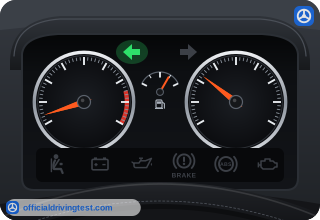
- Only when other vehicles are close by on the roadway
- Every time you change direction, even if no one else is around
- Only at intersections with traffic signals
- Only when a vehicle is behind you
Show answer
Correct answer: Every time you change direction, even if no one else is around
It is easy to miss someone who needs to know what you are doing.
Source: South Dakota Driver License Manual (Revised 11/2024), page 56
-
If there are driveways between you and where you want to turn, when should you signal?
- Before you reach them
- After you have passed them
- As soon as you see your turn
- Only after you have started the turn
Show answer
Correct answer: After you have passed them
If you signal earlier, another driver may think you plan to turn there and pull into your path.
Source: South Dakota Driver License Manual (Revised 11/2024), page 56
-
After you make a turn or lane change, what should you check?
- That the headlights are on
- That the hazard lights are on
- That the mirrors are adjusted
- That the turn signal shuts off
Show answer
Correct answer: That the turn signal shuts off
If it stays on, others might think you plan to turn again.
Source: South Dakota Driver License Manual (Revised 11/2024), page 56
-
How can you warn drivers behind you that you are about to slow down where they may not expect it?
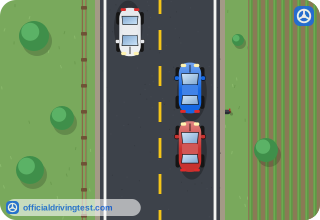
- Quickly tap the brake pedal 3 or 4 times
- Press the brake pedal firmly once
- Flash the high beams
- Sound the horn three times in a row
Show answer
Correct answer: Quickly tap the brake pedal 3 or 4 times
Tapping the brake pedal quickly lets those behind you know you are about to slow down.
Source: South Dakota Driver License Manual (Revised 11/2024), page 56
-
Why should you signal when you park or turn just before an intersection?
- The intersection may be closed to all traffic that day
- Traffic ahead may be turning
- Following traffic may expect you to continue to the intersection
- The signal light may be red
Show answer
Correct answer: Following traffic may expect you to continue to the intersection
Drivers behind may expect you to go on, so you signal that you will slow down.
Source: South Dakota Driver License Manual (Revised 11/2024), page 56
-
When may hand and arm signals be used in addition to turn signals?
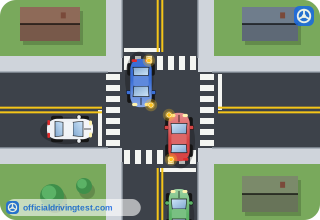
- When the road is dry and traffic is moving very slowly
- When driving in a school zone
- When driving below 25 mph
- When bright sunlight makes flashing turn signals hard to see
Show answer
Correct answer: When bright sunlight makes flashing turn signals hard to see
Hand and arm signals can also be used for an antique vehicle that may not have turn signals.
Source: South Dakota Driver License Manual (Revised 11/2024), page 56
-
An antique vehicle that may lack turn signals is defined as one manufactured before when?
- July 1, 1948
- July 1, 1958
- July 1, 1968
- January 1, 1958
Show answer
Correct answer: July 1, 1958
The manual gives July 1, 1958 as the date for an antique vehicle.
Source: South Dakota Driver License Manual (Revised 11/2024), page 56
-
In the standard hand signals, how do you signal a left turn?
- Hand pointing up
- Hand pointing down
- Hand pointing straight out
- Hand pointing straight ahead
Show answer
Correct answer: Hand pointing straight out
The left turn hand signal is a hand pointing straight out.
Source: South Dakota Driver License Manual (Revised 11/2024), page 56
-
In the standard hand signals, how do you signal a right turn?
- Hand pointing up
- Hand pointing straight out
- Hand pointing down
- Hand pointing back
Show answer
Correct answer: Hand pointing up
The right turn hand signal is a hand pointing up.
Source: South Dakota Driver License Manual (Revised 11/2024), page 56
-
In the standard hand signals, how do you signal to stop or slow down?
- Hand pointing down
- Hand pointing straight out
- Hand pointing up
- Hand waving back and forth
Show answer
Correct answer: Hand pointing down
The stop or slow down hand signal is a hand pointing down.
Source: South Dakota Driver License Manual (Revised 11/2024), page 56
-
A vehicle is coming toward you at night with its high beams on. Where should you look to keep from being blinded?
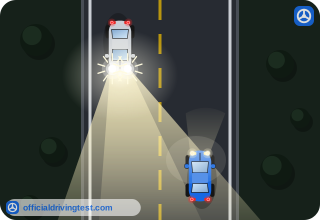
- Straight into the oncoming headlights
- Toward the right side of the road
- Toward the left side of the road
- Down at the dashboard
Show answer
Correct answer: Toward the right side of the road
Looking toward the right side of the road keeps you from being distracted or momentarily blinded by the bright lights.
Source: South Dakota Driver License Manual (Revised 11/2024), page 66
-
What kind of headlight beam should you use when you are following close behind another vehicle at night?
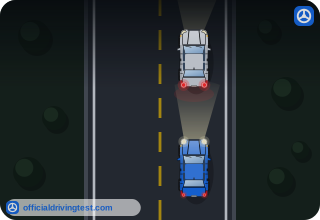
- High beams
- Parking lights only
- Fog lights only
- Low beams
Show answer
Correct answer: Low beams
Use low beams, not high beams, when you are following close behind another vehicle.
Source: South Dakota Driver License Manual (Revised 11/2024), page 66
-
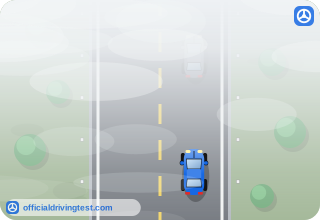
Why should you use low beams in fog, rain, or snow?
- Low beams are brighter and show more of the road ahead of you
- State law requires high beams to be turned off in all bad weather
- Light from high beams may cause glare and make it harder to see ahead
- High beams use more fuel and wear out the bulbs much faster
Show answer
Correct answer: Light from high beams may cause glare and make it harder to see ahead
Bright light from high beams bounces back in fog, rain, or snow and causes glare, which makes the road harder to see.
Source: South Dakota Driver License Manual (Revised 11/2024), page 66
-
What should you avoid doing when oncoming headlights are shining at you at night?
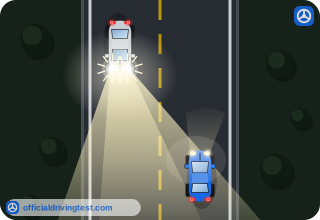
- Looking directly into the oncoming headlights
- Keeping your eyes searching the road in front of you
- Looking toward the right side of the road
- Using your low beams
Show answer
Correct answer: Looking directly into the oncoming headlights
Looking straight into oncoming headlights can blind you, so you keep your eyes searching the road in front of the vehicle.
Source: South Dakota Driver License Manual (Revised 11/2024), page 66
-
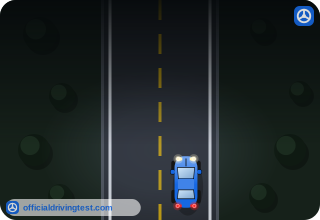
When driving at night, what should you try to find by searching well ahead of your headlight beams?
- Reflective mile markers
- The painted edge line
- Other drivers' turn signals
- Dark shapes on the roadway
Show answer
Correct answer: Dark shapes on the roadway
Searching beyond the reach of the headlights lets you spot dark shapes on the road in time to react.
Source: South Dakota Driver License Manual (Revised 11/2024), page 66
-
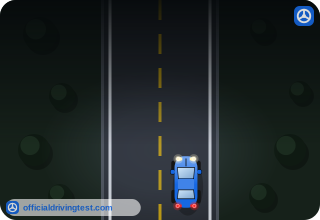
Why should you glance occasionally to the right and left when driving at night?
- To check whether other drivers behind you are using their high beams
- To find the edge of the pavement and hazards that may come from the sides
- To read the road signs that are farther away from the road ahead
- To rest your eyes from the glare of the oncoming headlights at night
Show answer
Correct answer: To find the edge of the pavement and hazards that may come from the sides
Glancing to both sides helps you locate the pavement edge and notice hazards that may enter from the sides.
Source: South Dakota Driver License Manual (Revised 11/2024), page 66
-
Why should you not wear sunglasses or colored lenses when driving at night or on an overcast day?
- They make oncoming headlights look dimmer than they are
- They are against South Dakota law at night
- They make it harder to judge your own speed
- They reduce how well you can see
Show answer
Correct answer: They reduce how well you can see
Tinted or colored lenses cut down how well you see, which is a problem in low light.
Source: South Dakota Driver License Manual (Revised 11/2024), page 66
-
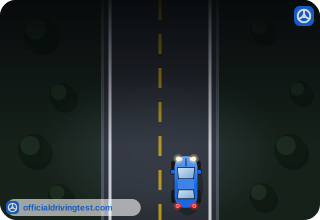
What limits how far ahead you can see when driving at night?
- The width of the road
- The speed of the traffic around you
- The light provided by your headlights
- The color of the pavement
Show answer
Correct answer: The light provided by your headlights
At night the distance you can see to the front is limited by the light your headlights provide.
Source: South Dakota Driver License Manual (Revised 11/2024), page 66
-
During a night storm, what should you avoid using to prevent glare?
- Low beams
- Windshield wipers
- Your headlights
- High beams
Show answer
Correct answer: High beams
High beams cause glare in a storm, so you should avoid them.
Source: South Dakota Driver License Manual (Revised 11/2024), page 67