South Dakota: Pavement markings Practice Test
Yellow and white center and lane lines, when passing is allowed, and stop lines and crosswalks.
Independent educational site · not affiliated with any government agency or DMV
Ready? Test yourself
- Instant feedback with an explanation
- Every answer cites its source in the manual
- Your best score is saved on this device
- Keyboard: press 1 to 4 to answer and Enter for the next question
Questions are original and based on the official manual "South Dakota Driver License Manual" (Revised 11/2024), South Dakota Department of Public Safety.
All 9 questions in this practice test
Take the test above first, then use this list to study. Tap “Show answer” to see the correct answer and explanation.
Show the questions and answersHide the questions
-
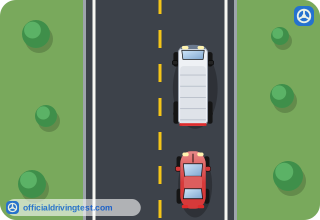
Passing is permitted where you are driving. When may you pass?
- Whenever the vehicle ahead is traveling slowly
- Whenever you have signaled first
- Only if it is safe
- Whenever you are in a hurry
Show answer
Correct answer: Only if it is safe
Even where passing is permitted, you may pass only if it is safe.
Source: South Dakota Driver License Manual (Revised 11/2024), page 35
-
What are pavement markings?
- Signs mounted on poles above the roadway
- Lines, arrows, words, or symbols on the road
- Lights that flash at the edge of the road
- Barriers placed on the road in work zones
Show answer
Correct answer: Lines, arrows, words, or symbols on the road
Pavement markings are painted on the road to give directions or warnings.
Source: South Dakota Driver License Manual (Revised 11/2024), page 36
-
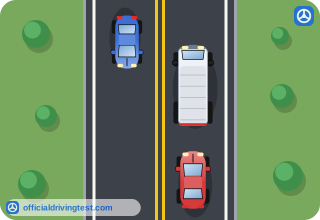
A two-direction roadway has a double yellow line. What does it mean?
- Passing is permitted in both directions
- Passing is permitted only for motorcycles
- Passing is permitted only on the right
- Passing is prohibited in both directions
Show answer
Correct answer: Passing is prohibited in both directions
A double yellow line on a two-direction road means passing is prohibited in both directions.
Source: South Dakota Driver License Manual (Revised 11/2024), page 36
-
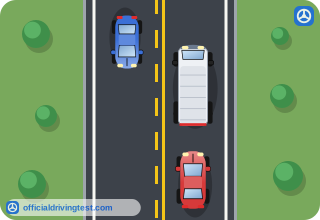
On a two-direction roadway, a dashed yellow line is next to a solid yellow line. When may you pass?
- When the solid yellow line is on your side
- Never, because passing is prohibited in both directions
- Only when the dashed line is on the other driver's side
- When the dashed yellow line is on your side
Show answer
Correct answer: When the dashed yellow line is on your side
Passing is permitted only for the driver on whose side the yellow line is dashed.
Source: South Dakota Driver License Manual (Revised 11/2024), page 36
-
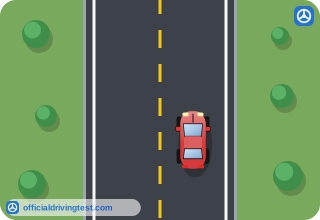
What does a single dashed yellow center line on a two-direction roadway mean?
- Passing is prohibited in both directions
- Passing is permitted
- Passing is prohibited for large trucks
- Passing is permitted only from the right
Show answer
Correct answer: Passing is permitted
A two-direction roadway with a dashed yellow line allows passing.
Source: South Dakota Driver License Manual (Revised 11/2024), page 36
-
On a one-direction roadway, which line shows that passing is permitted?
- A solid white line
- A double yellow line
- A white dashed line
- A solid yellow line
Show answer
Correct answer: A white dashed line
A white dashed line on a one-direction roadway means passing is permitted.
Source: South Dakota Driver License Manual (Revised 11/2024), page 36
-
What are shared center lanes reserved for?
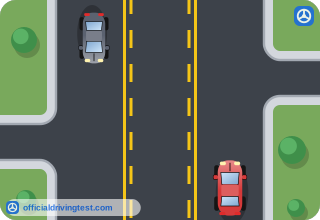
- Passing slower vehicles traveling in either direction
- Left turns by vehicles traveling in one direction only
- Buses traveling in either direction
- Left turns by vehicles traveling in either direction
Show answer
Correct answer: Left turns by vehicles traveling in either direction
A shared center lane is for left turns (or U-turns when permitted) by vehicles going either way.
Source: South Dakota Driver License Manual (Revised 11/2024), page 37
-
How is a shared center lane marked on each side?
- Double solid yellow lines
- A solid yellow line and a dashed yellow line
- Two solid white lines
- A solid white line and a dashed white line
Show answer
Correct answer: A solid yellow line and a dashed yellow line
Shared center lanes have a solid yellow and a dashed yellow line on each side.
Source: South Dakota Driver License Manual (Revised 11/2024), page 37
-
What do the pavement arrows in a shared center lane show?
- Arrows for one direction alternate with the other
- All of the arrows point in the same direction
- Arrows point straight ahead for through traffic
- Arrows point right for traffic leaving the road
Show answer
Correct answer: Arrows for one direction alternate with the other
In a shared center lane, left-turn arrows for traffic in one direction alternate with arrows for traffic from the other direction.
Source: South Dakota Driver License Manual (Revised 11/2024), page 37