South Dakota: Vehicle checks and basic control — Vehicle Maintenance, Seat, and Mirrors Practice Test
Questions in this part include: “According to the manual, whose duty is it to make certain a vehicle is safe to operate?” · “Which mirror is the primary mirror for the view to the rear of the vehicle?”
Independent educational site · not affiliated with any government agency or DMV
Ready? Test yourself
- Instant feedback with an explanation
- Every answer cites its source in the manual
- Your best score is saved on this device
- Keyboard: press 1 to 4 to answer and Enter for the next question
Questions are original and based on the official manual "South Dakota Driver License Manual" (Revised 11/2024), South Dakota Department of Public Safety.
All 17 questions in this practice test
Take the test above first, then use this list to study. Tap “Show answer” to see the correct answer and explanation.
Show the questions and answersHide the questions
-
According to the manual, whose duty is it to make certain a vehicle is safe to operate?
- The vehicle manufacturer’s
- The exam station’s
- The insurance company’s
- The driver’s
Show answer
Correct answer: The driver’s
The manual states that it is the duty of drivers to make certain the vehicles they drive are safe to operate.
Source: South Dakota Driver License Manual (Revised 11/2024), page 23
-
Compared with a well-maintained vehicle, a vehicle in bad shape costs
- less to run
- about the same to run
- less to insure
- more to run
Show answer
Correct answer: more to run
A vehicle in bad shape is unsafe and costs more to run than one that is maintained.
Source: South Dakota Driver License Manual (Revised 11/2024), page 23
-
What should you follow for routine maintenance of your vehicle?
- The advice of other drivers
- Your vehicle owner’s manual
- A set schedule of once a year
- The posted speed limit
Show answer
Correct answer: Your vehicle owner’s manual
The manual says to follow your vehicle owner’s manual for routine maintenance.
Source: South Dakota Driver License Manual (Revised 11/2024), page 23
-
How should you be seated when you drive?
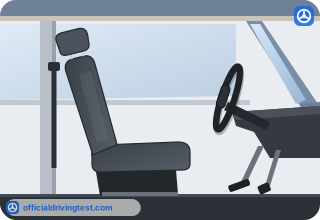
- Reclined slightly, with your feet resting on the pedals
- Leaning forward with your arms bent
- Upright, with your back against the seat and feet on the floor
- Slouched so your back stays relaxed
Show answer
Correct answer: Upright, with your back against the seat and feet on the floor
The manual says to sit upright with your back against the seat and your feet on the floor.
Source: South Dakota Driver License Manual (Revised 11/2024), page 25
-
What can improper seating positions, such as slouching, result in?
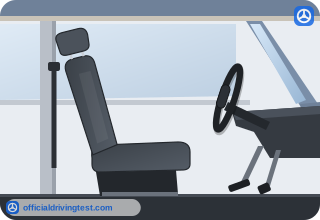
- Reduced effectiveness of the vehicle’s restraint system
- Faster tire wear
- Slower stopping because of worn brake components
- Poorer fuel economy
Show answer
Correct answer: Reduced effectiveness of the vehicle’s restraint system
Slouching and other improper seating positions can make the vehicle’s restraint system work less well.
Source: South Dakota Driver License Manual (Revised 11/2024), page 25
-
When you adjust your seat, what should your foot be able to do?
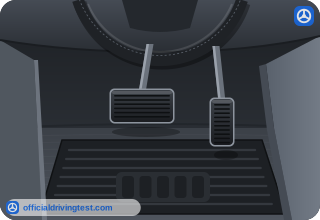
- Pivot from brake to accelerator while your heel stays on the floor
- Reach both pedals while your heel is lifted off the floor
- Rest on the brake while the other foot is on the floor
- Press the pedals without bending your knee
Show answer
Correct answer: Pivot from brake to accelerator while your heel stays on the floor
The seat should let your foot pivot smoothly from the brake to the accelerator with your heel on the floor.
Source: South Dakota Driver License Manual (Revised 11/2024), page 25
-
How high should the top of the steering wheel be?
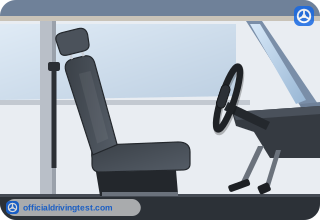
- No higher than the top of your head and above your chin
- Level with your belt buckle
- No higher than the top of your shoulders and below chin level
- Level with your elbows
Show answer
Correct answer: No higher than the top of your shoulders and below chin level
The top of the steering wheel should be no higher than the top of your shoulders and below chin level.
Source: South Dakota Driver License Manual (Revised 11/2024), page 25
-
How much space should there be between your chest and the steering wheel?
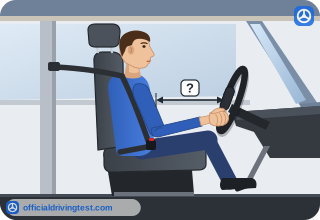
- 4 inches
- 10 inches
- 6 inches
- 15 inches
Show answer
Correct answer: 10 inches
The manual says there should be 10 inches between your chest and the steering wheel.
Source: South Dakota Driver License Manual (Revised 11/2024), page 25
-
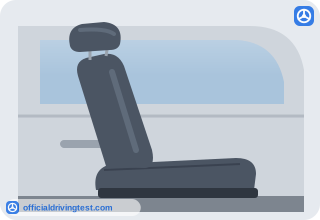
What are head restraints designed to prevent?
- Glare from headlights
- Slouching
- Seatbelt slack
- Whiplash
Show answer
Correct answer: Whiplash
Head restraints are designed to prevent whiplash.
Source: South Dakota Driver License Manual (Revised 11/2024), page 25
-
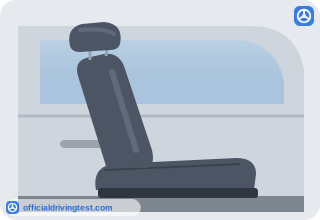
How should a head restraint be adjusted?
- It sits at the level of your shoulders
- It rests against your neck only
- It sits a few inches behind your head, below your ears
- It contacts the back of your head and is not below ear level
Show answer
Correct answer: It contacts the back of your head and is not below ear level
The head restraint should touch the back of your head and not sit below the level of your ears.
Source: South Dakota Driver License Manual (Revised 11/2024), page 25
-
Which mirror is the primary mirror for the view to the rear of the vehicle?
- The left outside mirror
- The inside mirror
- The right outside mirror
- A mirror mounted on the dashboard
Show answer
Correct answer: The inside mirror
The manual calls the inside mirror the primary mirror for the view to the rear.
Source: South Dakota Driver License Manual (Revised 11/2024), page 25
-
How should you adjust the rearview mirror?
- So that it shows only the road surface
- So that it shows mostly the back seat
- So that it frames the rear window
- So that it shows the left lane only
Show answer
Correct answer: So that it frames the rear window
The rearview mirror is adjusted so that it frames the rear window.
Source: South Dakota Driver License Manual (Revised 11/2024), page 25
-
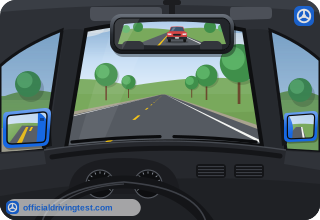
If your vehicle has a day/night mirror, how should it be set?
- For the time of day you are driving
- To night, so the mirror always dims glare
- To day at all times
- Facing the rear seat
Show answer
Correct answer: For the time of day you are driving
The day/night mirror should always be set for the time of day you are driving.
Source: South Dakota Driver License Manual (Revised 11/2024), page 25
-
What should outside mirrors be adjusted to do?
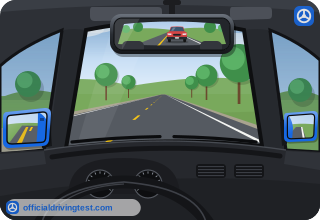
- Reduce blind spots and give maximum visibility to the sides and rear
- Show as much of the sides of your own vehicle as possible
- Show only the lane directly behind you, never the adjacent lanes
- Replace the need to check blind spots
Show answer
Correct answer: Reduce blind spots and give maximum visibility to the sides and rear
Outside mirrors are adjusted to reduce blind spots and to give maximum visibility to the sides and rear.
Source: South Dakota Driver License Manual (Revised 11/2024), page 25
-
To set the left side mirror using the method the manual encourages, what should the driver do?
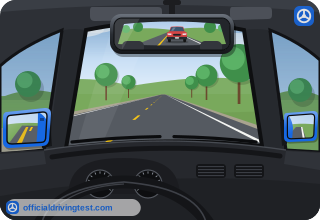
- Sit upright with your head centered and set the mirror to show the whole side of the vehicle
- Lean toward the center console and aim the mirror at the rear tire
- Rest the head against the closed window and set the mirror to barely show the edge of the vehicle
- Sit normally and aim the mirror at the lane beside you
Show answer
Correct answer: Rest the head against the closed window and set the mirror to barely show the edge of the vehicle
For the left mirror, the driver rests his or her head against the window and sets it to barely show the vehicle’s edge.
Source: South Dakota Driver License Manual (Revised 11/2024), page 25
-
To set the right-side mirror using the method the manual encourages, where should the driver’s head be?
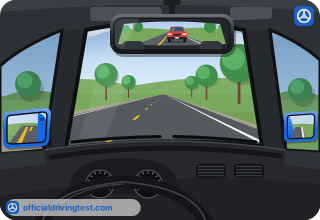
- Resting against the closed right window, as on the left side
- Directly below the rearview mirror or above the center console
- Against the driver’s head restraint
- Level with the left side mirror
Show answer
Correct answer: Directly below the rearview mirror or above the center console
For the right mirror, the driver leans right so the head is below the rearview mirror or above the center console.
Source: South Dakota Driver License Manual (Revised 11/2024), page 25
-
How much additional viewing area to each side does the manual’s outside mirror adjustment add?
- 2 to 4 degrees
- 5 to 8 degrees
- 20 to 24 degrees
- 12 to 16 degrees
Show answer
Correct answer: 12 to 16 degrees
The manual says this outside mirror setting adds 12 to 16 degrees of additional viewing area to each side.
Source: South Dakota Driver License Manual (Revised 11/2024), page 25