Pennsylvania: Speed & following distance — Part 2 Practice Test
Questions in this part include: “Even on dry pavement, about how much distance does it take to stop a vehicle moving at 55 mph?” · “If you must drive below 40 mph on a limited access highway, what should you do to warn drivers behind you?”
Independent educational site · not affiliated with any government agency or DMV
Ready? Test yourself
- Instant feedback with an explanation
- Every answer cites its source in the manual
- Your best score is saved on this device
Questions are original and based on the official manual "Pennsylvania Driver's Manual" (Pub 95), Pennsylvania Department of Transportation (PennDOT), Bureau of Driver Licensing.
All 17 questions in this practice test
Take the test above first, then use this list to study. Tap “Show answer” to see the correct answer and explanation.
Show the questions and answersHide the questions
-
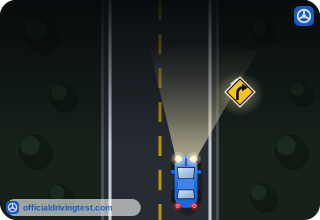
About how far ahead does a low beam headlight shine at night?
- 100 feet
- 500 feet
- 1,000 feet
- 250 feet
Show answer
Correct answer: 250 feet
Low beam headlights shine only about 250 feet ahead.
Source: Pennsylvania Driver's Manual (Pub 95), page 40 · Open this page in the manual (Manual page 40)
-
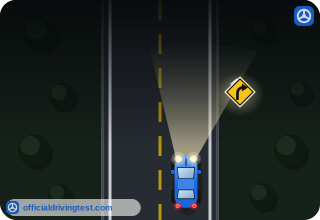
To avoid "overdriving your headlights" on a dark road at night, you should not drive faster than:
- 45 mph
- 35 mph
- 55 mph
- 65 mph
Show answer
Correct answer: 45 mph
To avoid overdriving your headlights on a dark road at night, you should not drive faster than 45 mph.
Source: Pennsylvania Driver's Manual (Pub 95), page 40 · Open this page in the manual (Manual page 40)
-
Even on dry pavement, about how much distance does it take to stop a vehicle moving at 55 mph?
- Less than 100 feet
- More than 250 feet
- About 150 feet
- Exactly 500 feet
Show answer
Correct answer: More than 250 feet
Even on dry pavement, it takes more than 250 feet to stop if you are moving at 55 mph.
Source: Pennsylvania Driver's Manual (Pub 95), page 40 · Open this page in the manual (Manual page 40)
-
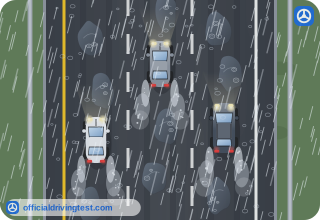
Pavements can become especially slippery during which part of a rain storm?
- After it has rained for an hour
- Only during the last few minutes of a storm
- The first 10 to 15 minutes of a rain storm
- Slipperiness does not change during rain
Show answer
Correct answer: The first 10 to 15 minutes of a rain storm
Pavements can become very slippery in the first 10 to 15 minutes of a rain storm, as oil rises to the surface.
Source: Pennsylvania Driver's Manual (Pub 95), page 40 · Open this page in the manual (Manual page 40)
-
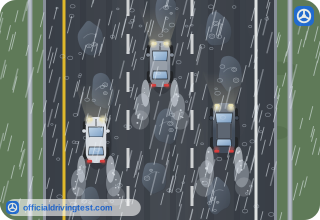
According to the manual, you can begin to hydroplane at speeds as low as:
- 25 mph
- 45 mph
- 55 mph
- 35 mph
Show answer
Correct answer: 35 mph
You can hydroplane at speeds as low as 35 mph, when water is only 1/10 of an inch deep.
Source: Pennsylvania Driver's Manual (Pub 95), page 41 · Open this page in the manual (Manual page 41)
-
Hydroplaning can occur when standing water on the road is only how deep?
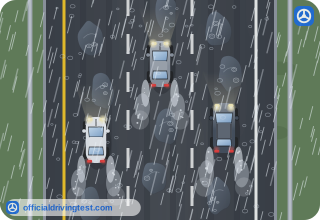
- 1/10 of an inch
- 1/2 inch
- 1 inch
- 2 inches
Show answer
Correct answer: 1/10 of an inch
You can hydroplane at speeds as low as 35 mph when water is only 1/10 of an inch deep.
Source: Pennsylvania Driver's Manual (Pub 95), page 41 · Open this page in the manual (Manual page 41)
-
"Black ice" is most likely present when:
- The road is covered in visible white frost
- The temperature is above 50°F
- It is actively snowing heavily
- The road looks wet but other cars throw no spray
Show answer
Correct answer: The road looks wet but other cars throw no spray
When the road looks wet but no spray is coming from the tires of other vehicles, "black ice" may be present.
Source: Pennsylvania Driver's Manual (Pub 95), page 41 · Open this page in the manual (Manual page 41)
-
Why is it especially dangerous to drive near 32°F when precipitation is falling?

- Water on top of ice is more slippery than ice alone
- Tires lose air pressure faster in cold weather
- Headlights are less effective at that temperature
- Engines stall more often at that temperature
Show answer
Correct answer: Water on top of ice is more slippery than ice alone
It is extremely dangerous near 32°F, when precipitation turns to rain or sleet — a thin layer of water on top of ice is more slippery than ice alone.
Source: Pennsylvania Driver's Manual (Pub 95), page 41 · Open this page in the manual (Manual page 41)
-
On wet roads, the manual recommends reducing your speed by 5 to 10 mph and increasing your following distance to:
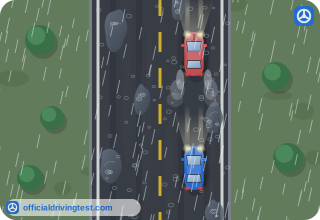
- 2 to 3 seconds
- 8 to 9 seconds
- 5 to 6 seconds
- 10 to 12 seconds
Show answer
Correct answer: 5 to 6 seconds
Reduce your speed by 5 to 10 mph on wet roads and increase your following distance to 5 to 6 seconds.
Source: Pennsylvania Driver's Manual (Pub 95), page 41 · Open this page in the manual (Manual page 41)
-
On packed snow, about how much should you decrease your normal driving speed?
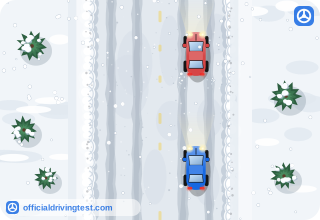
- By 10 percent
- By one-quarter
- By three-quarters
- By half
Show answer
Correct answer: By half
On packed snow, decrease your speed by half; on ice, slow to a crawl.
Source: Pennsylvania Driver's Manual (Pub 95), page 41 · Open this page in the manual (Manual page 41)
-
On ice-covered roads, roughly how much more space should you leave between you and the vehicle ahead compared to normal?
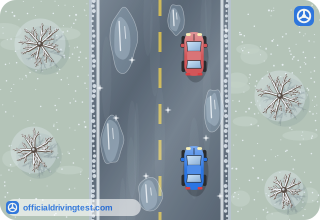
- About 10 times more
- About 2 times more
- About 5 times more
- About 20 times more
Show answer
Correct answer: About 10 times more
On ice, leave about 10 times more space than normal between you and the vehicle ahead.
Source: Pennsylvania Driver's Manual (Pub 95), page 41 · Open this page in the manual (Manual page 41)
-
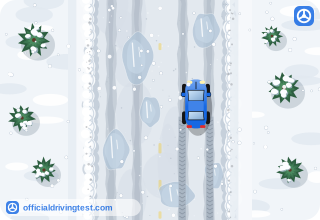
Why shouldn't you use cruise control when driving on slippery roads?
- It uses more fuel
- It keeps applying power, so your wheels keep spinning
- It disables your headlights
- It is only illegal in Pennsylvania, not dangerous
Show answer
Correct answer: It keeps applying power, so your wheels keep spinning
The only way to stop wheel spin and regain control is to reduce power, but cruise control will continue to apply power.
Source: Pennsylvania Driver's Manual (Pub 95), page 41 · Open this page in the manual (Manual page 41)
-
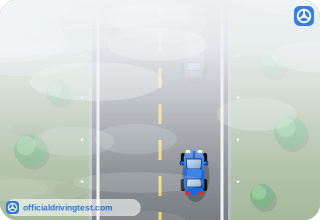
When you must drive in foggy conditions, the manual says to slow down enough to stop safely within the distance you can see, and also to:
- Turn on your hazard lights only
- Turn off your headlights to reduce glare
- Turn on your low beams and any fog lights
- Turn on your high beam headlights
Show answer
Correct answer: Turn on your low beams and any fog lights
In fog, slow down and turn on your low beam headlights (and fog lights, if your vehicle has them) so others can see you.
Source: Pennsylvania Driver's Manual (Pub 95), page 42 · Open this page in the manual (Manual page 42)
-
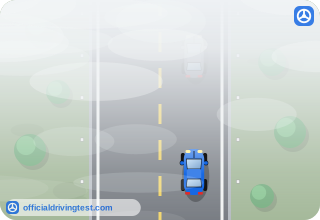
Why should you avoid using high beam headlights in fog?
- High beams use too much battery power
- High beams are illegal in all weather conditions
- High beams overheat in fog
- High beams reflect off the fog and create glare
Show answer
Correct answer: High beams reflect off the fog and create glare
High beams direct their light up into the fog, which bounces the light back into your eyes, creating glare.
Source: Pennsylvania Driver's Manual (Pub 95), page 42 · Open this page in the manual (Manual page 42)
-
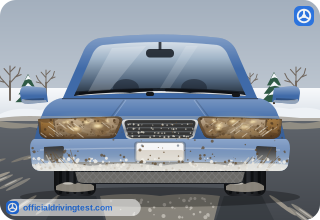
A dirty headlight can reduce light output by more than:
- 10 percent
- 50 percent
- 25 percent
- 90 percent
Show answer
Correct answer: 50 percent
A dirty headlight reduces light output by more than 50 percent.
Source: Pennsylvania Driver's Manual (Pub 95), page 42 · Open this page in the manual (Manual page 42)
-
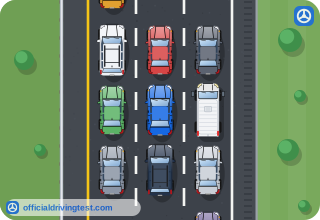
If you find yourself traveling in a pack of vehicles on a highway with no space cushion for emergencies, what does the manual suggest?
- Speed up to get ahead of the pack
- Reduce your speed by 2 or 3 mph so traffic clears out
- Change lanes immediately without signaling
- Tailgate the vehicle ahead until it moves over
Show answer
Correct answer: Reduce your speed by 2 or 3 mph so traffic clears out
Reducing your speed by just 2 or 3 mph will encourage traffic around you to clear out, so you are no longer closed in.
Source: Pennsylvania Driver's Manual (Pub 95), page 43 · Open this page in the manual (Manual page 43)
-
If you must drive below 40 mph on a limited access highway, what should you do to warn drivers behind you?
- Use your parking lights
- Sound your horn continuously
- Turn on your interior dome light
- Use your hazard (four-way) flashers
Show answer
Correct answer: Use your hazard (four-way) flashers
If you must drive below 40 mph on a limited access highway, use your hazard flashers to warn the drivers behind you.
Source: Pennsylvania Driver's Manual (Pub 95), page 44 · Open this page in the manual (Manual page 44)