Pennsylvania: Right of way & turning
Intersections, four-way stops, roundabouts, turns, and passing. Split into 4 shorter tests so you're not stuck in one long quiz.
Independent educational site · not affiliated with any government agency or DMV
Choose a part
Right of way & turning — Part 1
Questions in this part include: “According to the manual's 'left-right-left' rule for approaching an intersection, why should you look to the left first?”
Right of way & turning — Part 2
Questions in this part include: “Why is passing at night considered especially dangerous?”
Right of way & turning — Part 3
Questions in this part include: “In a roundabout, which direction does traffic move, and what does this make every turn into or out of the circle?”
Right of way & turning — Part 4
Questions in this part include: “According to the manual, what is the most frequent cause of crashes at roundabouts?”
Questions are original and based on the official manual "Pennsylvania Driver's Manual" (Pub 95), Pennsylvania Department of Transportation (PennDOT), Bureau of Driver Licensing.
All 65 Right of way & turning questions with answers
Choose a part above to take a practice test, or study every question and answer here.
Show the questions and answersHide the questions
1Part 117 questions
-
At a four-way stop intersection, which vehicle should move forward first?
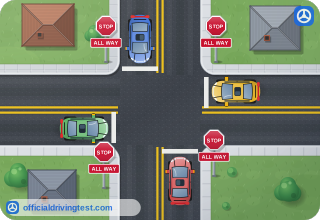
- The vehicle turning left, regardless of arrival order
- The first vehicle to reach the intersection
- The vehicle on the right, regardless of arrival order
- Whichever vehicle is largest
Show answer
Correct answer: The first vehicle to reach the intersection
At a four-way stop, the first vehicle to reach the intersection should move forward first.
Source: Pennsylvania Driver's Manual (Pub 95), page 10 · Open this page in the manual (Manual page 10)
-
At a four-way stop, if two vehicles reach the intersection at the same time, who has the right-of-way?
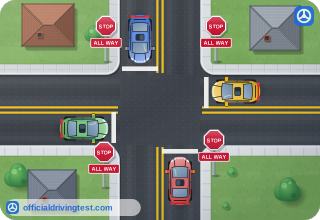
- Neither driver may proceed until a third vehicle arrives
- The driver going straight always yields to a turning driver
- The driver on the left yields to the driver on the right
- The driver on the right yields to the driver on the left
Show answer
Correct answer: The driver on the left yields to the driver on the right
If two vehicles reach a four-way stop at the same time, the driver on the left yields to the driver on the right.
Source: Pennsylvania Driver's Manual (Pub 95), page 10 · Open this page in the manual (Manual page 10)
-
A sign used together with a YIELD sign at a one-lane bridge or underpass tells you that:
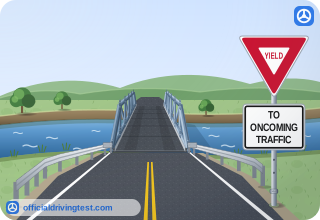
- you always have the right-of-way over opposing traffic
- you must yield the right-of-way to opposing traffic
- trucks are prohibited from the bridge
- the bridge is closed to all traffic
Show answer
Correct answer: you must yield the right-of-way to opposing traffic
At a one-lane bridge or underpass, a sign used with a YIELD sign alerts motorists that the one-lane roadway requires them to yield the right-of-way to opposing traffic.
Source: Pennsylvania Driver's Manual (Pub 95), page 10 · Open this page in the manual (Manual page 10)
-
A MERGING TRAFFIC sign warns that traffic may be entering your lane from another roadway or ramp. Who must yield?
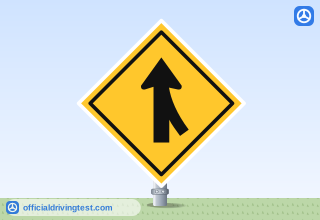
- The traffic already on the major roadway must yield to entering traffic
- The entering traffic must yield to traffic already on the major roadway
- Neither driver must yield; it is first-come, first-served
- Only trucks must yield in this situation
Show answer
Correct answer: The entering traffic must yield to traffic already on the major roadway
Entering traffic must yield to traffic already on the major roadway.
Source: Pennsylvania Driver's Manual (Pub 95), page 14 · Open this page in the manual (Manual page 14)
-
According to the manual's 'left-right-left' rule for approaching an intersection, why should you look to the left first?
- Because pedestrians only cross from the left
- Because traffic signals face left first
- Because vehicles from the left are closer to you
- Because it is required only at four-way stops
Show answer
Correct answer: Because vehicles from the left are closer to you
Look to the left first, because vehicles coming from the left are closer to you, then look right, then look left again before you pull out.
Source: Pennsylvania Driver's Manual (Pub 95), page 38 · Open this page in the manual (Manual page 38)
-
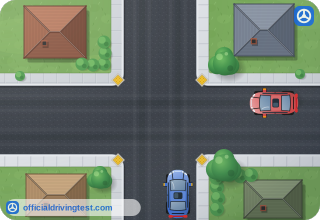
According to the manual, if your view of the cross street at an intersection is blocked by buildings, shrubs, or parked vehicles, what should you do?
- Sound your horn and proceed
- Stop and wait for another driver to wave you through
- Turn on your hazard lights and proceed at normal speed
- Move forward slowly until you can see clearly
Show answer
Correct answer: Move forward slowly until you can see clearly
If your view of the cross street is blocked by buildings, shrubs or parked vehicles, move forward slowly until you can see clearly.
Source: Pennsylvania Driver's Manual (Pub 95), page 38 · Open this page in the manual (Manual page 38)
-
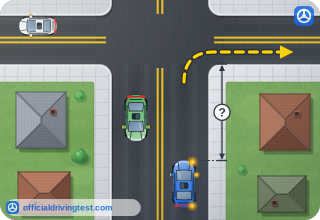
About how many seconds before your turn should you signal, according to the manual's guidelines for completing a turn safely?
- 1 to 2 seconds
- 5 to 6 seconds
- 3 to 4 seconds
- 8 to 10 seconds
Show answer
Correct answer: 3 to 4 seconds
The first step to completing a turn safely is to signal 3 to 4 seconds before your turn.
Source: Pennsylvania Driver's Manual (Pub 95), page 45 · Open this page in the manual (Manual page 45)
-
On a two-lane, two-way street, where should you position your vehicle to make a left turn?
- As close to the right edge of the roadway as possible
- In the center of your lane
- Straddling the centerline
- As close to the centerline as possible
Show answer
Correct answer: As close to the centerline as possible
On two-lane, two-way streets or highways, make left turns from as close to the centerline as possible.
Source: Pennsylvania Driver's Manual (Pub 95), page 45 · Open this page in the manual (Manual page 45)
-
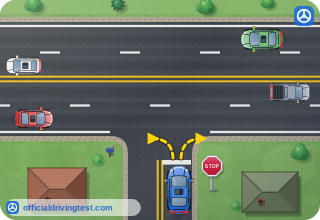
When turning onto a highway that has more than one lane in your direction of travel, you should turn into:
- The closest lane going in that direction
- Whichever lane has less traffic
- Always the far-left lane, regardless of your turn
- Always the far-right lane, regardless of your turn
Show answer
Correct answer: The closest lane going in that direction
Turn into the closest lane going in that direction — the left lane for a left turn, the right lane for a right turn.
Source: Pennsylvania Driver's Manual (Pub 95), page 45 · Open this page in the manual (Manual page 45)
-
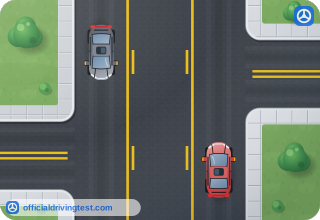
A center lane marked on both sides by one solid outer line and one broken inner line is meant to be used for:
- High-speed passing only
- Left turns only
- Parking
- Through traffic during rush hour
Show answer
Correct answer: Left turns only
A lane marked with a solid outer line and a broken inner line may only be used for left turns.
Source: Pennsylvania Driver's Manual (Pub 95), page 45 · Open this page in the manual (Manual page 45)
-
How long before entering a center turn lane should you put on your left turn signal?
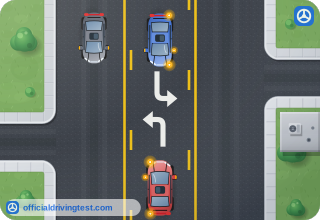
- 1 to 2 seconds
- 5 to 6 seconds
- 3 to 4 seconds
- 8 to 10 seconds
Show answer
Correct answer: 3 to 4 seconds
Put on your left turn signal at least 3 to 4 seconds before entering the left-turn lane.
Source: Pennsylvania Driver's Manual (Pub 95), page 45 · Open this page in the manual (Manual page 45)
-
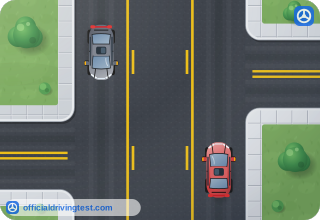
Why does the manual warn against getting into a center turn lane too soon?
- It is illegal to enter a center turn lane early
- It will trigger a nearby traffic signal to change
- Other drivers will assume you are parking
- You are more likely to meet an oncoming driver head-on
Show answer
Correct answer: You are more likely to meet an oncoming driver head-on
Do not get into the center turn lane too soon — the longer you drive in it, the more likely you are to meet someone head-on.
Source: Pennsylvania Driver's Manual (Pub 95), page 45 · Open this page in the manual (Manual page 45)
-
When choosing a place to make a U-turn, drivers coming from all directions should be at least how far away and able to see you clearly?
- 500 feet
- 100 feet
- 250 feet
- 1,000 feet
Show answer
Correct answer: 500 feet
Make sure drivers coming from all directions are at least 500 feet away from you and can see you clearly.
Source: Pennsylvania Driver's Manual (Pub 95), page 46 · Open this page in the manual (Manual page 46)
-
Where are U-turns not allowed, according to the manual?
- On any street with a posted speed limit under 35 mph
- On curves or when approaching or nearing the crest of a hill
- On any street with more than one lane
- Anywhere within a business district
Show answer
Correct answer: On curves or when approaching or nearing the crest of a hill
U-turns are not allowed on curves or when you are approaching or nearing the crest of a hill.
Source: Pennsylvania Driver's Manual (Pub 95), page 46 · Open this page in the manual (Manual page 46)
-
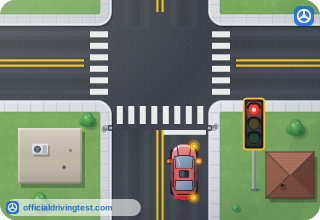
Before making a legal right turn at a red light, what must you always do first?
- Sound your horn to alert other drivers
- Flash your headlights to warn cross traffic
- Stop and yield to pedestrians and cross traffic
- Activate your hazard lights
Show answer
Correct answer: Stop and yield to pedestrians and cross traffic
Before making the right turn, you must always stop first and yield to pedestrians and cross traffic.
Source: Pennsylvania Driver's Manual (Pub 95), page 46 · Open this page in the manual (Manual page 46)
-
When may you turn left on a red signal after stopping?
- Never — left turns on red are always illegal in Pennsylvania
- Only at night
- Only if a police officer directs you to do so
- From one one-way street onto another, if clear and no sign forbids it
Show answer
Correct answer: From one one-way street onto another, if clear and no sign forbids it
If you are turning from a one-way street onto another one-way street, you may turn left on red after stopping, if traffic is clear and there is no NO TURN ON RED sign.
Source: Pennsylvania Driver's Manual (Pub 95), page 46 · Open this page in the manual (Manual page 46)
-
Stopping halfway across a street while crossing or turning is safe only when:
- A median turn lane can hold your entire vehicle
- There is heavy traffic in both directions
- You have your hazard lights on
- You are driving a large vehicle
Show answer
Correct answer: A median turn lane can hold your entire vehicle
Stopping halfway across a street is safe only when there is a turning lane in the center median large enough to hold your entire vehicle.
Source: Pennsylvania Driver's Manual (Pub 95), page 46 · Open this page in the manual (Manual page 46)
2Part 216 questions
-
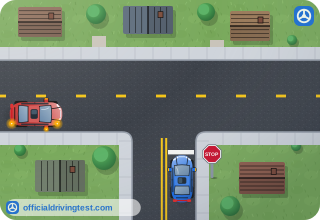
If an oncoming vehicle has its turn signal on as you prepare to cross or enter a street, what should you do?
- Proceed immediately since the driver has signaled their intention
- Wait until the other driver actually starts to turn before you go
- Speed up to cross before they turn
- Assume the signal is a mistake and ignore it
Show answer
Correct answer: Wait until the other driver actually starts to turn before you go
The driver may have changed their mind or forgotten to turn off the signal — wait until they actually start to turn before you go.
Source: Pennsylvania Driver's Manual (Pub 95), page 46 · Open this page in the manual (Manual page 46)
-
What is illegal to do in a highway entrance/acceleration lane?
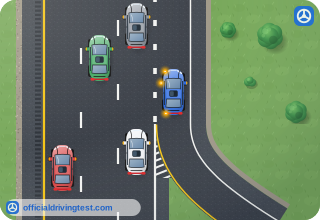
- Signaling before merging
- Looking for an opening in traffic
- Passing a vehicle ahead of you
- Accelerating to the speed of traffic
Show answer
Correct answer: Passing a vehicle ahead of you
It is illegal to pass a vehicle ahead of you in an acceleration lane.
Source: Pennsylvania Driver's Manual (Pub 95), page 46 · Open this page in the manual (Manual page 46)
-
What is the correct order of steps for merging with traffic from an acceleration lane?
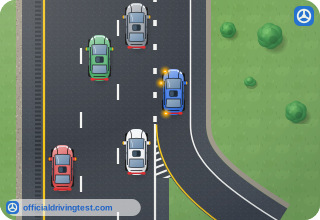
- Merge first, then accelerate, then signal
- Accelerate immediately, then signal, then look for an opening
- Stop at the end of the lane, then merge
- Signal and look for an opening, accelerate to traffic speed, then merge
Show answer
Correct answer: Signal and look for an opening, accelerate to traffic speed, then merge
Put your turn signal on and look for an opening, accelerate up to the speed of traffic, then merge into the opening.
Source: Pennsylvania Driver's Manual (Pub 95), page 46 · Open this page in the manual (Manual page 46)
-
Before moving back into your lane after passing a vehicle, you should make sure you can see what in your rearview mirror?
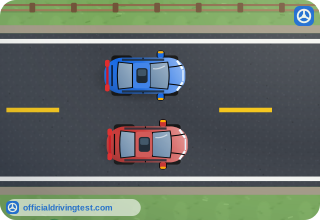
- Both of the vehicle's headlights
- Only the vehicle's front bumper
- The vehicle's license plate
- The vehicle's turn signal
Show answer
Correct answer: Both of the vehicle's headlights
Before you move back into the lane, make sure you can see both headlights of the vehicle you passed in your rearview mirror.
Source: Pennsylvania Driver's Manual (Pub 95), page 47 · Open this page in the manual (Manual page 47)
-
On a two-lane road at 45 mph, about how much clear roadway do you need to safely pass a slower vehicle?
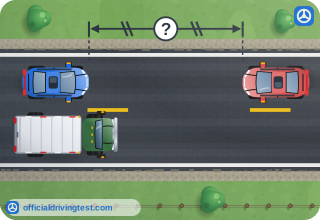
- 1/8 mile
- 1/4 mile
- 1/2 mile
- A full mile
Show answer
Correct answer: 1/4 mile
At 45 mph, passing on a two-lane road translates into 1/4 mile of clear roadway you need to safely pass a slower vehicle.
Source: Pennsylvania Driver's Manual (Pub 95), page 47 · Open this page in the manual (Manual page 47)
-
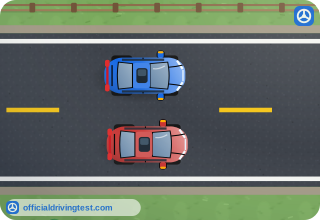
When passing on a two-lane road, about how much faster should you be going than the vehicle you are passing?
- About 5 mph faster
- About 20 mph faster
- About 10 mph faster
- About 30 mph faster
Show answer
Correct answer: About 10 mph faster
You need to be going about 10 mph faster than the vehicle(s) you are passing.
Source: Pennsylvania Driver's Manual (Pub 95), page 47 · Open this page in the manual (Manual page 47)
-
Why is passing at night considered especially dangerous?
- There is more traffic at night
- Headlights are not permitted while passing at night
- Speed limits are lower at night
- You cannot see as far ahead or judge distances as well
Show answer
Correct answer: You cannot see as far ahead or judge distances as well
It is most dangerous to pass at night because you cannot see as far ahead and it is harder to accurately judge distances.
Source: Pennsylvania Driver's Manual (Pub 95), page 47 · Open this page in the manual (Manual page 47)
-
When passing on the right is permitted because the driver ahead is making or signaling a left turn, where must the passing driver stay?
- On the berm or shoulder
- In the oncoming lane
- In the center turn lane
- Directly behind the turning vehicle
Show answer
Correct answer: On the berm or shoulder
When the driver you are passing is making or signaling a left turn, the driver of the passing vehicle must stay on the berm or shoulder.
Source: Pennsylvania Driver's Manual (Pub 95), page 47 · Open this page in the manual (Manual page 47)
-
In which of these situations may you pass another vehicle on the right?
- The vehicle ahead is going more than 10 mph under the limit
- You are on a road with two or more marked lanes in each direction
- There is no other traffic on the road
- You are within 100 feet of an intersection
Show answer
Correct answer: You are on a road with two or more marked lanes in each direction
You may pass on the right when driving on a roadway with two or more marked traffic lanes in each direction.
Source: Pennsylvania Driver's Manual (Pub 95), page 47 · Open this page in the manual (Manual page 47)
-
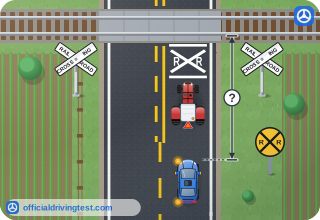
You may NOT pass another vehicle when you are within how many feet of, or are crossing, an intersection or railroad grade crossing (unless a traffic control device says you may)?
- 50 feet
- 500 feet
- 100 feet
- 200 feet
Show answer
Correct answer: 100 feet
You may not pass if you are within 100 feet of or are crossing any intersection or railroad grade crossing.
Source: Pennsylvania Driver's Manual (Pub 95), page 47 · Open this page in the manual (Manual page 47)
-
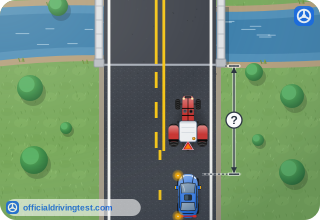
You may NOT pass when you are within how many feet of any bridge, elevated structure, or tunnel?
- 50 feet
- 250 feet
- 500 feet
- 100 feet
Show answer
Correct answer: 100 feet
You may not pass if you are within 100 feet of any bridge, elevated structure or tunnel.
Source: Pennsylvania Driver's Manual (Pub 95), page 47 · Open this page in the manual (Manual page 47)
-
According to the manual, in which of these places is passing prohibited?
- On the shoulder of a multi-lane highway
- On any road posted 55 mph or higher
- Within 500 feet of a gas station
- On any road with a broken yellow centerline
Show answer
Correct answer: On the shoulder of a multi-lane highway
You may not pass while on the shoulder of a multi-lane highway.
Source: Pennsylvania Driver's Manual (Pub 95), page 47 · Open this page in the manual (Manual page 47)
-
According to the manual, what does the law actually establish at intersections?
- Which vehicle has absolute priority
- Who must yield — the law does not grant anyone the right-of-way
- That the fastest vehicle always goes first
- That right-of-way belongs to whichever driver arrives first, no exceptions
Show answer
Correct answer: Who must yield — the law does not grant anyone the right-of-way
The law does not give anyone the right-of-way at intersections; it only says who must yield.
Source: Pennsylvania Driver's Manual (Pub 95), page 48 · Open this page in the manual (Manual page 48)
-
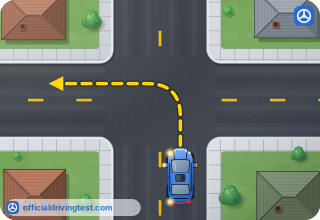
When turning left, a driver must yield to:
- Pedestrians only, not other vehicles
- Vehicles behind them
- No one, since they signaled first
- Oncoming vehicles going straight ahead
Show answer
Correct answer: Oncoming vehicles going straight ahead
Drivers turning left must yield to oncoming vehicles going straight ahead.
Source: Pennsylvania Driver's Manual (Pub 95), page 48 · Open this page in the manual (Manual page 48)
-
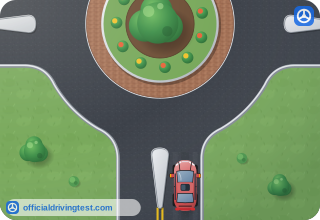
A driver entering a circular intersection (or roundabout) must yield the right-of-way to:
- Drivers already in the circle
- Vehicles waiting to enter behind them
- Pedestrians only
- No one, since they have already entered
Show answer
Correct answer: Drivers already in the circle
Drivers entering a circular intersection must yield the right-of-way to drivers already in the circle.
Source: Pennsylvania Driver's Manual (Pub 95), page 48 · Open this page in the manual (Manual page 48)
-
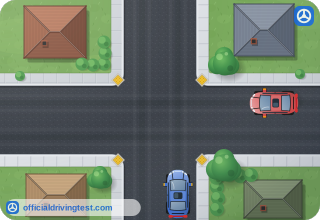
When two vehicles approach or enter an intersection from different roadways at or about the same time, who must yield?
- The vehicle coming from the right yields to the vehicle coming from the left
- The vehicle coming from the left yields to the vehicle coming from the right
- Whichever vehicle is moving slower yields
- Neither vehicle needs to yield
Show answer
Correct answer: The vehicle coming from the left yields to the vehicle coming from the right
Drivers coming from the left must yield to vehicles coming from the right.
Source: Pennsylvania Driver's Manual (Pub 95), page 48 · Open this page in the manual (Manual page 48)
3Part 316 questions
-
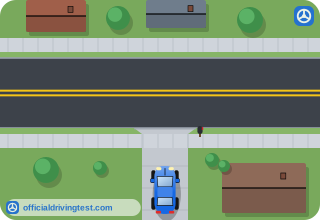
A vehicle entering a public highway from an alley, private road, or driveway must:
- Sound its horn before entering
- Always yield to pedestrians only
- Wait until the main road is clear
- Proceed if traveling under 15 mph
Show answer
Correct answer: Wait until the main road is clear
A vehicle entering a public highway from an alley, private road or driveway must wait until the main road is clear.
Source: Pennsylvania Driver's Manual (Pub 95), page 48 · Open this page in the manual (Manual page 48)
-
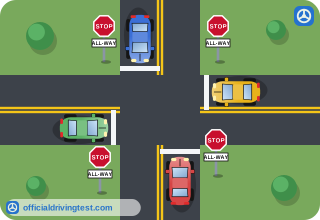
At a four-way stop where all vehicles have stopped, who should move forward first?
- The largest vehicle
- The vehicle turning right
- The vehicle on the left, always
- The first vehicle to arrive
Show answer
Correct answer: The first vehicle to arrive
At a four-way stop, the first vehicle to reach the intersection should move forward first.
Source: Pennsylvania Driver's Manual (Pub 95), page 48 · Open this page in the manual (Manual page 48)
-
At a four-way stop, if two vehicles reach the intersection at the same time, who yields?
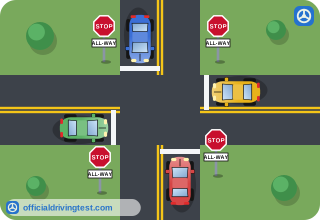
- The driver on the left yields to the driver on the right
- The driver on the right yields to the driver on the left
- Both must wait for a police officer
- Whoever arrived from the north
Show answer
Correct answer: The driver on the left yields to the driver on the right
If two vehicles reach a four-way stop at the same time, the driver on the left yields to the driver on the right.
Source: Pennsylvania Driver's Manual (Pub 95), page 48 · Open this page in the manual (Manual page 48)
-
At a four-way stop, if two vehicles are facing one another, what should they do?
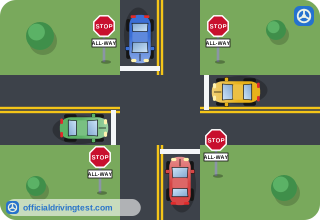
- Wait for a third vehicle to arrive
- Both can proceed with caution, watching for possible turns
- Only the heavier vehicle may proceed
- The vehicle turning must always wait a full minute
Show answer
Correct answer: Both can proceed with caution, watching for possible turns
If facing one another, both drivers can proceed with caution, watching for possible turns.
Source: Pennsylvania Driver's Manual (Pub 95), page 48 · Open this page in the manual (Manual page 48)
-
If you end up in a lane marked for turns only but wanted to go straight through the intersection, what must you do?
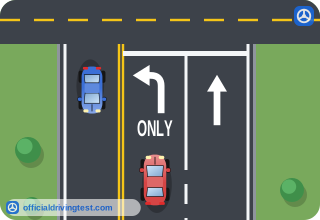
- Reverse and change lanes immediately
- Proceed straight anyway
- Make the turn
- Stop and wait for the light to cycle
Show answer
Correct answer: Make the turn
If you end up in a lane marked for turns only when you want to go straight through, you must make the turn.
Source: Pennsylvania Driver's Manual (Pub 95), page 48 · Open this page in the manual (Manual page 48)
-
If you end up in a lane marked for through traffic only but wanted to turn, what must you do?
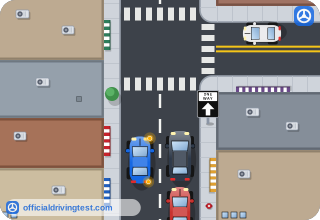
- Turn anyway, using extra caution
- Stop in the lane and wait
- Cross into the turn lane at the last moment
- Continue straight through the intersection
Show answer
Correct answer: Continue straight through the intersection
If you want to turn but end up in a lane marked for through traffic, you must continue straight through the intersection.
Source: Pennsylvania Driver's Manual (Pub 95), page 48 · Open this page in the manual (Manual page 48)
-
At an intersection with dual (two) left turn lanes, what must you avoid doing while turning?
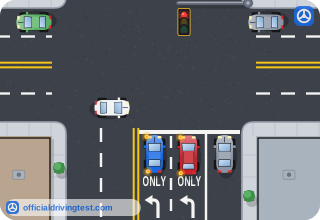
- Changing lanes during the turn
- Using your turn signal
- Turning into the lane closest to the centerline
- Watching for the driver turning next to you
Show answer
Correct answer: Changing lanes during the turn
Do not change lanes during the turn, as this will cause you to crash into the driver turning next to you.
Source: Pennsylvania Driver's Manual (Pub 95), page 48 · Open this page in the manual (Manual page 48)
-
Making a right turn onto a divided highway is:
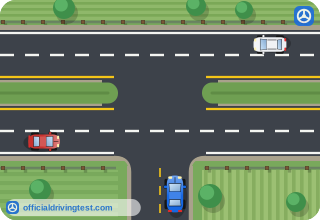
- Illegal without a special permit
- No different from a right turn at any other intersection
- Only allowed at signalized intersections
- Prohibited unless a police officer directs traffic
Show answer
Correct answer: No different from a right turn at any other intersection
Making a right turn onto a divided highway is no different from making a right turn at any other intersection.
Source: Pennsylvania Driver's Manual (Pub 95), page 49 · Open this page in the manual (Manual page 49)
-
What is the correct way to turn left onto a divided highway?
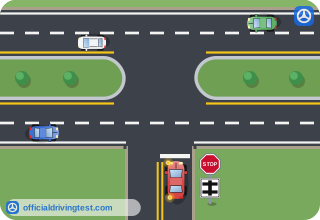
- Turn left immediately after crossing the first roadway, before reaching the barrier
- Always wait for a traffic signal, even if none exists
- Cross the first roadway when there is a safe gap, then turn left on the other side of the barrier
- Turn left only from the right lane
Show answer
Correct answer: Cross the first roadway when there is a safe gap, then turn left on the other side of the barrier
Cross the "first" roadway when there is a safe gap from the left, then turn left on the other side of the barrier when there is a safe gap from the right on the "second" roadway.
Source: Pennsylvania Driver's Manual (Pub 95), page 49 · Open this page in the manual (Manual page 49)
-
At a two-way stop sign, to cross a 30 mph street, about how large a gap do you need in both directions?
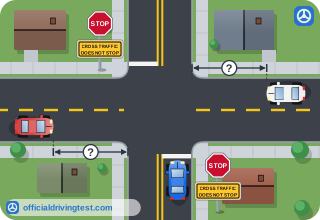
- About 3 seconds
- About 12 seconds
- About 20 seconds
- About 6 seconds
Show answer
Correct answer: About 6 seconds
You need about a 6-second gap in both directions to cross a 30 mph street.
Source: Pennsylvania Driver's Manual (Pub 95), page 49 · Open this page in the manual (Manual page 49)
-
When turning right at an intersection with a two-way stop, the manual recommends allowing a gap of about how many seconds between you and any vehicle approaching from the left?
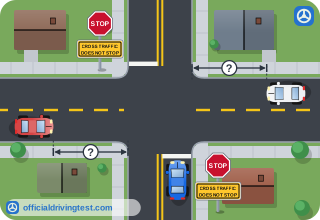
- 4 seconds
- 6 seconds
- 8 seconds
- 12 seconds
Show answer
Correct answer: 8 seconds
Allow a gap of about 8 seconds between you and any vehicle approaching from the left when turning right.
Source: Pennsylvania Driver's Manual (Pub 95), page 49 · Open this page in the manual (Manual page 49)
-
When turning left from a minor street onto a major street, the manual recommends allowing a gap of about how many seconds from any vehicle approaching from the right?
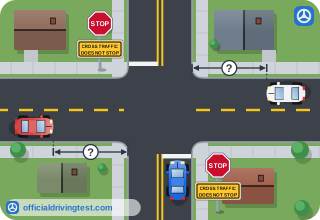
- 5 seconds
- 9 seconds
- 7 seconds
- 12 seconds
Show answer
Correct answer: 9 seconds
If turning from a minor onto a major street, allow a 9-second gap between you and any vehicle approaching from the right.
Source: Pennsylvania Driver's Manual (Pub 95), page 49 · Open this page in the manual (Manual page 49)
-
To avoid a "tangle turn" with an oncoming left-turning driver, you should turn:
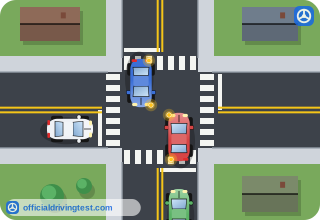
- After you reach the center "X" of the intersection
- Only after the other driver has completed their turn
- Before you reach the center "X" of the intersection
- Into the lane farthest from the centerline
Show answer
Correct answer: Before you reach the center "X" of the intersection
By turning before you reach the "X" at the center of the intersection, you avoid a "tangle turn" with the other left-turning driver.
Source: Pennsylvania Driver's Manual (Pub 95), page 49 · Open this page in the manual (Manual page 49)
-
What is the most important rule when starting a left turn, according to the manual?
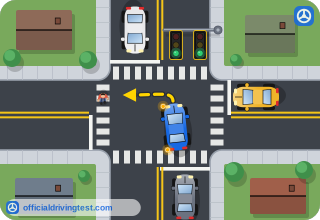
- Complete the turn as quickly as possible
- Always turn before oncoming traffic arrives
- Turn only when a passenger confirms it is safe
- Never start until all lanes you must cross are clear
Show answer
Correct answer: Never start until all lanes you must cross are clear
Most important: never start a left turn until you can see all the lanes you need to cross are clear.
Source: Pennsylvania Driver's Manual (Pub 95), page 49 · Open this page in the manual (Manual page 49)
-
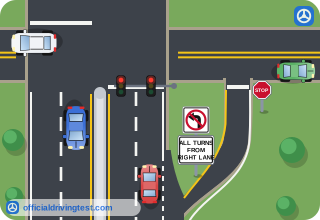
On a road designed with a jughandle where signs say NO LEFT TURN and ALL TURNS FROM RIGHT LANE, how do you make a left turn?
- Use a right turn lane that curves back, then turn left
- Cross oncoming traffic directly, as on any other road
- Perform a U-turn instead
- Wait for a police officer to stop traffic
Show answer
Correct answer: Use a right turn lane that curves back, then turn left
With a jughandle, you use a right turn lane curving back to intersect the major road at a traffic light, then turn left.
Source: Pennsylvania Driver's Manual (Pub 95), page 50 · Open this page in the manual (Manual page 50)
-
In a roundabout, which direction does traffic move, and what does this make every turn into or out of the circle?
- Clockwise; every turn is a left turn
- Counterclockwise; every turn is a right turn
- Clockwise; every turn is a right turn
- Counterclockwise; every turn is a left turn
Show answer
Correct answer: Counterclockwise; every turn is a right turn
Traffic in a roundabout moves counterclockwise, so that all turns into and out of the circle are right turns.
Source: Pennsylvania Driver's Manual (Pub 95), page 50 · Open this page in the manual (Manual page 50)
4Part 416 questions
-
According to the manual, what is the most frequent cause of crashes at roundabouts?
- Vehicles exiting too slowly
- Pedestrians crossing without looking
- Drivers who fail to yield before they enter
- Vehicles stopping inside the circle
Show answer
Correct answer: Drivers who fail to yield before they enter
The most frequent cause of crashes at roundabouts is drivers who fail to yield before they enter.
Source: Pennsylvania Driver's Manual (Pub 95), page 50 · Open this page in the manual (Manual page 50)
-
At each entry point of a roundabout, you will find:
- A stop sign and stop line
- A traffic signal
- No signage at all
- A YIELD sign and a yield line
Show answer
Correct answer: A YIELD sign and a yield line
Roundabouts have YIELD signs at each entry point and yield lines painted on the pavement.
Source: Pennsylvania Driver's Manual (Pub 95), page 50 · Open this page in the manual (Manual page 50)
-
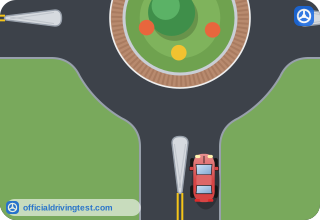
As you approach a roundabout's yield line, who has the right-of-way?
- Circulating traffic in the roundabout
- The vehicle entering the roundabout
- Whichever vehicle arrives first
- Pedestrians only
Show answer
Correct answer: Circulating traffic in the roundabout
Pull up to the yield line and check for approaching traffic — circulating traffic has the right-of-way.
Source: Pennsylvania Driver's Manual (Pub 95), page 50 · Open this page in the manual (Manual page 50)
-
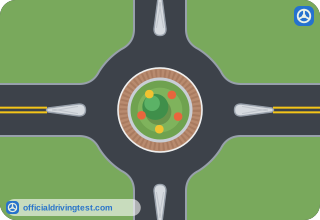
Once you have entered a roundabout and are proceeding to your exit, who now has the right-of-way?
- Vehicles waiting to enter the roundabout
- You — the vehicle already circulating
- Pedestrians in the roadway only
- No one; roundabouts have no right-of-way rules once inside
Show answer
Correct answer: You — the vehicle already circulating
Once you have entered the roundabout, you now have the right-of-way as you proceed counterclockwise to your exit.
Source: Pennsylvania Driver's Manual (Pub 95), page 50 · Open this page in the manual (Manual page 50)
-
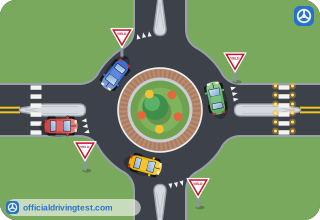
As you approach your exit in a roundabout, what should you do?
- Use your left turn signal
- Turn off all signals
- Use your right turn signal
- Sound your horn
Show answer
Correct answer: Use your right turn signal
As you approach your exit, use your right turn signal.
Source: Pennsylvania Driver's Manual (Pub 95), page 50 · Open this page in the manual (Manual page 50)
-
What is a key difference between traffic circles and roundabouts, according to the manual?
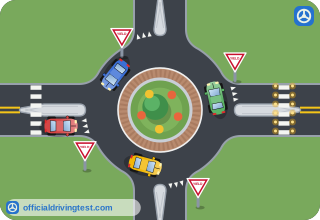
- Traffic circles are always smaller
- Traffic circles only exist on interstate ramps
- Roundabouts have special rules and a special design
- Roundabouts do not have yield signs
Show answer
Correct answer: Roundabouts have special rules and a special design
Roundabouts have special rules and a special design making them different from traffic circles.
Source: Pennsylvania Driver's Manual (Pub 95), page 50 · Open this page in the manual (Manual page 50)
-
According to a "Teen Crash Fact" in the manual, improper or careless turning was a contributing factor in how many crashes involving 17-year-old drivers in Pennsylvania in 2017?
- 159
- 259
- 359
- 459
Show answer
Correct answer: 459
In 2017, improper or careless turning was a factor contributing to 459 crashes involving drivers age 17 in Pennsylvania.
Source: Pennsylvania Driver's Manual (Pub 95), page 45 · Open this page in the manual (Manual page 45)
-
According to a "Teen Crash Fact," from 2013 to 2017, how many crashes involving driving on the wrong side of the road (resulting in 15 deaths) involved 16- and 17-year-old drivers in Pennsylvania?
- 384
- 284
- 484
- 584
Show answer
Correct answer: 384
From 2013 to 2017, there were 384 crashes and 15 people killed involving driving on the wrong side of the road among 16- and 17-year-old drivers.
Source: Pennsylvania Driver's Manual (Pub 95), page 47 · Open this page in the manual (Manual page 47)
-
If you see a funeral procession on the road, what must you do?
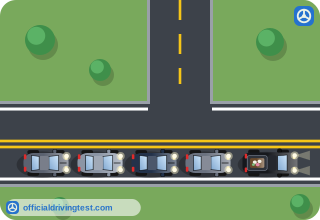
- Yield to the vehicles in the procession
- Pass through the procession quickly
- Honk your horn to signal the procession to hurry
- Ignore the procession and proceed as normal
Show answer
Correct answer: Yield to the vehicles in the procession
If you see a funeral procession on the road, yield to vehicles in the procession.
Source: Pennsylvania Driver's Manual (Pub 95), page 64 · Open this page in the manual (Manual page 64)
-
Once the lead vehicle of a funeral procession has cleared an intersection, what happens?
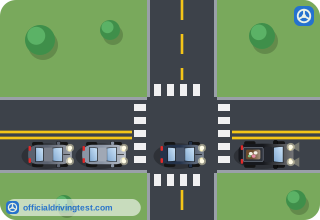
- The procession must stop and wait for a new signal
- The rest may proceed through, and other traffic must yield
- Other traffic gets priority immediately
- Only marked funeral escort vehicles may continue
Show answer
Correct answer: The rest may proceed through, and other traffic must yield
Once the lead vehicle has cleared an intersection, the rest of the procession may proceed through, and other traffic must yield.
Source: Pennsylvania Driver's Manual (Pub 95), page 64 · Open this page in the manual (Manual page 64)
-
As a driver encountering a funeral procession, when may you cut in and out of the procession?
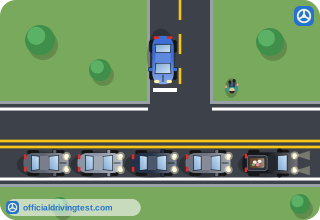
- Whenever there is a safe gap in the procession
- Never, under any circumstances
- Only if directed by police or the funeral director's staff
- Only at intersections controlled by traffic signals
Show answer
Correct answer: Only if directed by police or the funeral director's staff
Allow the procession to pass and do not cut in and out of it, unless directed otherwise by a police officer or an agent or employee of the funeral director.
Source: Pennsylvania Driver's Manual (Pub 95), page 64 · Open this page in the manual (Manual page 64)
-
What must vehicles in a funeral procession have turned on, and what must they bear?
- Hazard flashers only, with no other identification required
- Only their headlights, with no flag or insignia required
- High beams only
- Headlights and emergency flashers, plus a flag or insignia
Show answer
Correct answer: Headlights and emergency flashers, plus a flag or insignia
All vehicles in a funeral procession must have their headlights and emergency flashers turned on and bear a flag or other insignia designating them as part of the procession.
Source: Pennsylvania Driver's Manual (Pub 95), page 64 · Open this page in the manual (Manual page 64)
-
What color of flashing or revolving light may vehicles in a funeral procession display?
- Purple
- Blue
- Amber
- Green
Show answer
Correct answer: Purple
Vehicles in a funeral procession may also have a flashing or revolving purple light displayed during the procession.
Source: Pennsylvania Driver's Manual (Pub 95), page 64 · Open this page in the manual (Manual page 64)
-
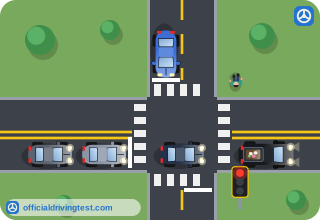
Under what condition may drivers in a funeral procession proceed through a red light?
- Any time, regardless of when the lead vehicle entered
- If the lead vehicle started through while the light was green
- Only if a police escort is present
- Never; a red light always requires a full stop
Show answer
Correct answer: If the lead vehicle started through while the light was green
Drivers in funeral processions may proceed through a red light if the lead vehicle starts through the intersection while the light was green.
Source: Pennsylvania Driver's Manual (Pub 95), page 64 · Open this page in the manual (Manual page 64)
-
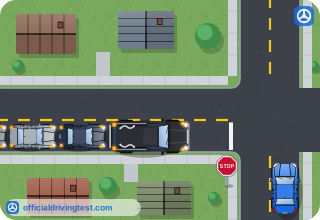
At a stop sign, what must the lead vehicle of a funeral procession do before the rest of the procession may proceed through?
- Slow down without stopping
- Sound its horn twice
- Come to a complete stop first
- Wait for a police escort to arrive
Show answer
Correct answer: Come to a complete stop first
In the case of a stop sign, the lead vehicle of a funeral procession must first come to a complete stop before proceeding through the intersection.
Source: Pennsylvania Driver's Manual (Pub 95), page 64 · Open this page in the manual (Manual page 64)
-
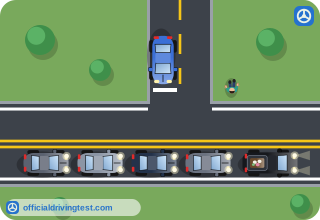
What must a funeral procession yield to, even while proceeding as a group through intersections?
- Other funeral processions only
- Vehicles signaling a turn
- Nothing; a funeral procession always has the right-of-way
- Emergency vehicles
Show answer
Correct answer: Emergency vehicles
Funeral processions must yield to emergency vehicles.
Source: Pennsylvania Driver's Manual (Pub 95), page 64 · Open this page in the manual (Manual page 64)