Pennsylvania: Railroad crossings Practice Test
Crossing signals, gates, and what to do if you get stuck on the tracks.
Independent educational site · not affiliated with any government agency or DMV
Ready? Test yourself
Answer to start, or tap Start below:
How are most railroad crossings protected, according to the manual?
- Instant feedback with an explanation
- Every answer cites its source in the manual
- Your best score is saved on this device
- Keyboard: press 1 to 4 to answer and Enter for the next question
Questions are original and based on the official manual "Pennsylvania Driver's Manual" (Pub 95), Pennsylvania Department of Transportation (PennDOT), Bureau of Driver Licensing.
All 17 questions in this practice test
Take the test above first, then use this list to study. Tap “Show answer” to see the correct answer and explanation.
Show the questions and answersHide the questions
-
Which of the following are signals that indicate an approaching train at a railroad crossing, requiring you to stop?
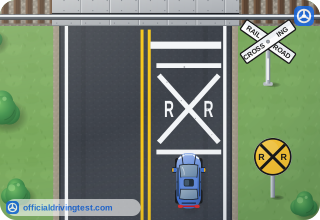
- Only a lowered crossing gate
- Flashing red lights, a lowered crossing gate, a flagger signaling, or the train's audible warning signal
- Only flashing red lights
- Only the train's audible signal
Show answer
Correct answer: Flashing red lights, a lowered crossing gate, a flagger signaling, or the train's audible warning signal
You are required to stop when there is any signal of an approaching train: flashing red lights, a lowered gate, a flagger signaling, or the train's audible signal.
Source: Pennsylvania Driver's Manual (Pub 95), page 9 · Open this page in the manual (Manual page 9)
-
If a railroad crossing has no signals at all, what should you do?
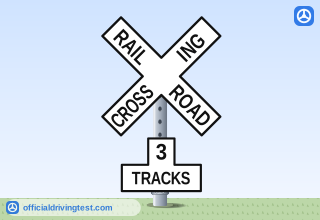
- Cross at normal speed since no signal means no train is near
- Sound your horn and proceed without slowing
- Slow down and prepare to stop if you see or hear an approaching train
- Stop only if you can see the tracks are wet
Show answer
Correct answer: Slow down and prepare to stop if you see or hear an approaching train
If there are no signals at the railroad crossing, you should slow down and prepare to stop if you see or hear a train approaching.
Source: Pennsylvania Driver's Manual (Pub 95), page 9 · Open this page in the manual (Manual page 9)
-
At a railroad crossing, you should stop if a train:
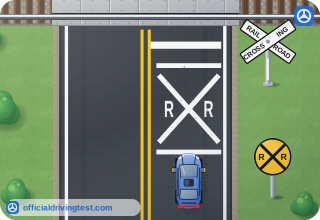
- is more than a mile away, regardless of visibility or any warning signal
- is parked on a side track away from the crossing, with no signals active
- is on a track that has a crossing gate, and the gate is still raised
- has sounded its audible signal or is plainly visible and in hazardous proximity
Show answer
Correct answer: has sounded its audible signal or is plainly visible and in hazardous proximity
You should stop if a train is approaching and has sounded its audible signal, or is plainly visible and in hazardous proximity to the crossing.
Source: Pennsylvania Driver's Manual (Pub 95), page 9 · Open this page in the manual (Manual page 9)
-
If traffic is backed up at a railroad crossing because of a traffic signal or stop sign ahead, what should you do?
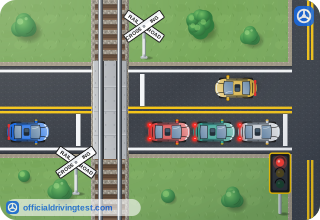
- Make sure your vehicle stops in a location entirely clear of the railroad tracks
- Stop with your vehicle straddling the tracks if that is where the line ends
- Proceed past the stopped traffic to clear the tracks first
- Reverse until the tracks are clear, even into oncoming traffic
Show answer
Correct answer: Make sure your vehicle stops in a location entirely clear of the railroad tracks
Never stop on a railroad track; if traffic is backed up, make sure you stop your vehicle in a location entirely clear of the tracks.
Source: Pennsylvania Driver's Manual (Pub 95), page 9 · Open this page in the manual (Manual page 9)
-
How should you treat a railroad crossbuck sign (the X-shaped sign at a railroad crossing)?
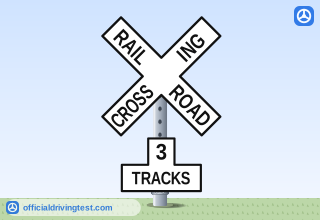
- As a STOP sign, requiring a complete stop every time, train or not
- As a warning sign with no legal requirement to slow down
- As a YIELD sign — slow down and prepare to stop if a train is approaching
- As a guide sign providing only directional information
Show answer
Correct answer: As a YIELD sign — slow down and prepare to stop if a train is approaching
You should treat the railroad crossbuck sign as a YIELD sign: slow down and prepare to stop if you see or hear a train approaching.
Source: Pennsylvania Driver's Manual (Pub 95), page 10 · Open this page in the manual (Manual page 10)
-
A RAILROAD CROSSING AHEAD sign (an advance warning sign, not the crossbuck at the tracks) is placed:
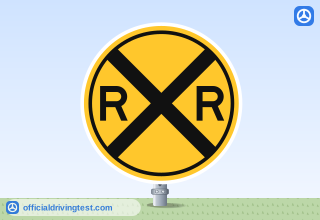
- far enough ahead to let you stop before the tracks
- directly at the tracks, beside the crossbuck
- only on rural roads
- only where crossing gates are absent
Show answer
Correct answer: far enough ahead to let you stop before the tracks
This sign is placed far enough in advance to allow you to stop before you reach the tracks, if necessary.
Source: Pennsylvania Driver's Manual (Pub 95), page 16 · Open this page in the manual (Manual page 16)
-
An ADVANCED INTERSECTION/RAILROAD CROSSING sign warns that:
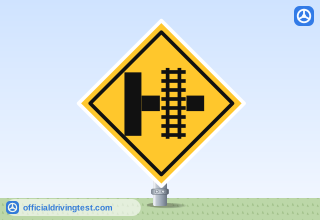
- the main road you are on crosses railroad tracks just ahead
- the intersecting road has a railroad crossing near the intersection
- all railroad crossings ahead have been removed
- you must stop at the intersection regardless of a train
Show answer
Correct answer: the intersecting road has a railroad crossing near the intersection
The intersecting road has a railroad crossing within a very short distance from the intersection; if turning onto it, be prepared to stop for an approaching train.
Source: Pennsylvania Driver's Manual (Pub 95), page 17 · Open this page in the manual (Manual page 17)
-
The letters 'R X R' painted on the pavement warn that you are approaching:
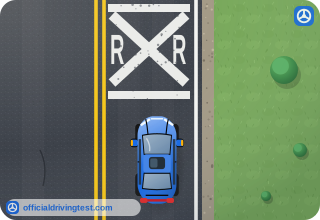
- A railroad crossing
- A restricted parking zone
- A rest area exit
- A reduced speed zone
Show answer
Correct answer: A railroad crossing
R X R is painted on the pavement before a railroad crossing.
Source: Pennsylvania Driver's Manual (Pub 95), page 22 · Open this page in the manual (Manual page 22)
-
How are most railroad crossings protected, according to the manual?
- By automatic gates only
- By a police officer stationed at the crossing
- By an advance warning sign and a crossbuck
- By a traffic signal only
Show answer
Correct answer: By an advance warning sign and a crossbuck
Most railroad crossings are protected only by an advance warning sign and a crossbuck; most crossings do not have gates.
Source: Pennsylvania Driver's Manual (Pub 95), page 55 · Open this page in the manual (Manual page 55)
-
Why can familiar railroad crossings with little train traffic be especially dangerous?
- They have no crossbucks
- Drivers may think trains never pass
- They usually have broken gates
- They are always unmarked
Show answer
Correct answer: Drivers may think trains never pass
If you often use a crossing and rarely see a train, you may start to believe trains never go by, which the manual warns can be dangerous.
Source: Pennsylvania Driver's Manual (Pub 95), page 55 · Open this page in the manual (Manual page 55)
-
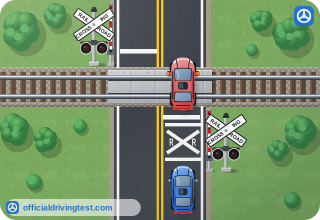
As you approach a railroad crossing, what should you do even if the signals are not flashing?
- Honk your horn once
- Look left, right, and then left again
- Speed up to cross quickly
- Assume the crossing is safe and proceed
Show answer
Correct answer: Look left, right, and then left again
The manual instructs drivers to always look left, right, and then left again as they approach a crossing, even if signals appear inactive, since they may not be working.
Source: Pennsylvania Driver's Manual (Pub 95), page 55 · Open this page in the manual (Manual page 55)
-
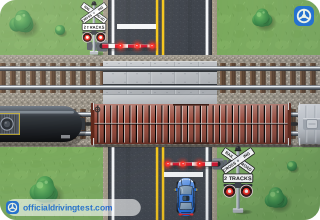
If you are stopped at a crossing with more than one track and a train just passed, what should you do?
- Back away from the crossing entirely
- Wait for a clear view down both tracks
- Start across immediately
- Honk your horn and proceed
Show answer
Correct answer: Wait for a clear view down both tracks
At a multi-track crossing, wait until you have a clear view down both tracks before starting across.
Source: Pennsylvania Driver's Manual (Pub 95), page 55 · Open this page in the manual (Manual page 55)
-
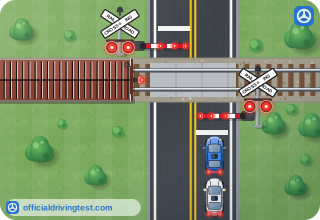
Even with only one track, what should you do immediately after a train passes?
- Wait exactly 60 seconds before crossing
- Cross immediately since the track is now clear
- Wait for a police officer to signal you
- Check again for another approaching train
Show answer
Correct answer: Check again for another approaching train
Even with one track, do not start across immediately after a train passes — check again for another approaching train.
Source: Pennsylvania Driver's Manual (Pub 95), page 55 · Open this page in the manual (Manual page 55)
-
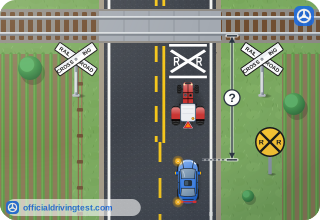
What do the manual's points to remember at railroad crossings say about passing another vehicle as you approach or enter a railroad crossing?
- It is allowed if there is no train in sight
- Never try to pass as you approach or enter it
- It is allowed only in daylight
- It is allowed if your lane is clear
Show answer
Correct answer: Never try to pass as you approach or enter it
The manual says to never try to pass someone as you approach or enter a railroad crossing.
Source: Pennsylvania Driver's Manual (Pub 95), page 55 · Open this page in the manual (Manual page 55)
-
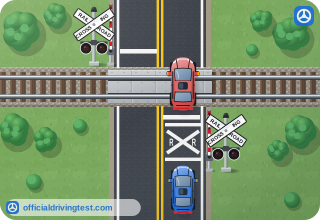
If you are following another vehicle across railroad tracks, what should you make sure of before driving onto the tracks?
- That your headlights are on
- That your windows are down
- That your hazard lights are flashing as you cross
- That you have enough room to get all the way across
Show answer
Correct answer: That you have enough room to get all the way across
Do not blindly follow the lead vehicle; make sure you have enough room to get all the way across before driving onto the tracks.
Source: Pennsylvania Driver's Manual (Pub 95), page 55 · Open this page in the manual (Manual page 55)
-
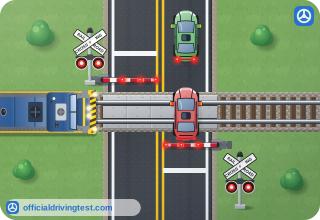
What should you do if you become trapped on a railroad crossing with a train approaching?
- Stay in the vehicle, keep your seat belt on and brace for impact
- Quickly leave the vehicle and move far away from the track
- Try to drive around the crossing gate to get off the tracks
- Rev the engine and try to push through the crossing gate
Show answer
Correct answer: Quickly leave the vehicle and move far away from the track
If you get trapped on a crossing with a train approaching, quickly leave the vehicle and move as far away from the track as you can.
Source: Pennsylvania Driver's Manual (Pub 95), page 55 · Open this page in the manual (Manual page 55)
-
According to the manual, how much more likely are you to die in a crash involving a train than in a crash with another vehicle?
- About 100 times more likely
- About 10 times more likely
- About 40 times more likely
- About 2 times more likely
Show answer
Correct answer: About 40 times more likely
The manual's Did You Know box states you are 40 times more likely to die in a crash involving a train than in a crash with another vehicle.
Source: Pennsylvania Driver's Manual (Pub 95), page 55 · Open this page in the manual (Manual page 55)