Pennsylvania: Right of way & turning — Part 2 Practice Test
Questions in this part include: “Why is passing at night considered especially dangerous?” · “According to the manual, in which of these places is passing prohibited?”
Independent educational site · not affiliated with any government agency or DMV
Ready? Test yourself
Answer to start, or tap Start below:
Why is passing at night considered especially dangerous?
- Instant feedback with an explanation
- Every answer cites its source in the manual
- Your best score is saved on this device
- Keyboard: press 1 to 4 to answer and Enter for the next question
Questions are original and based on the official manual "Pennsylvania Driver's Manual" (Pub 95), Pennsylvania Department of Transportation (PennDOT), Bureau of Driver Licensing.
All 16 questions in this practice test
Take the test above first, then use this list to study. Tap “Show answer” to see the correct answer and explanation.
Show the questions and answersHide the questions
-
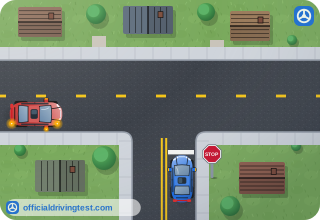
If an oncoming vehicle has its turn signal on as you prepare to cross or enter a street, what should you do?
- Proceed immediately since the driver has signaled their intention
- Wait until the other driver actually starts to turn before you go
- Speed up to cross before they turn
- Assume the signal is a mistake and ignore it
Show answer
Correct answer: Wait until the other driver actually starts to turn before you go
The driver may have changed their mind or forgotten to turn off the signal — wait until they actually start to turn before you go.
Source: Pennsylvania Driver's Manual (Pub 95), page 46 · Open this page in the manual (Manual page 46)
-
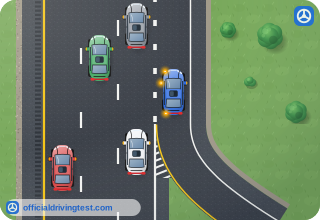
What is illegal to do in a highway entrance/acceleration lane?
- Signaling before merging
- Looking for an opening in traffic
- Passing a vehicle ahead of you
- Accelerating to the speed of traffic
Show answer
Correct answer: Passing a vehicle ahead of you
It is illegal to pass a vehicle ahead of you in an acceleration lane.
Source: Pennsylvania Driver's Manual (Pub 95), page 46 · Open this page in the manual (Manual page 46)
-
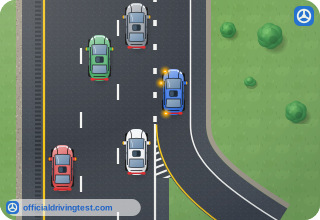
What is the correct order of steps for merging with traffic from an acceleration lane?
- Merge first, then accelerate, then signal
- Accelerate immediately, then signal, then look for an opening
- Stop at the end of the lane, then merge
- Signal and look for an opening, accelerate to traffic speed, then merge
Show answer
Correct answer: Signal and look for an opening, accelerate to traffic speed, then merge
Put your turn signal on and look for an opening, accelerate up to the speed of traffic, then merge into the opening.
Source: Pennsylvania Driver's Manual (Pub 95), page 46 · Open this page in the manual (Manual page 46)
-
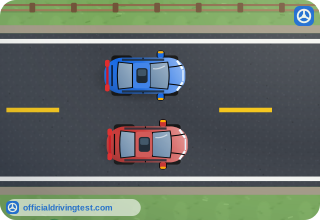
Before moving back into your lane after passing a vehicle, you should make sure you can see what in your rearview mirror?
- Both of the vehicle's headlights
- Only the vehicle's front bumper
- The vehicle's license plate
- The vehicle's turn signal
Show answer
Correct answer: Both of the vehicle's headlights
Before you move back into the lane, make sure you can see both headlights of the vehicle you passed in your rearview mirror.
Source: Pennsylvania Driver's Manual (Pub 95), page 47 · Open this page in the manual (Manual page 47)
-
On a two-lane road at 45 mph, about how much clear roadway do you need to safely pass a slower vehicle?
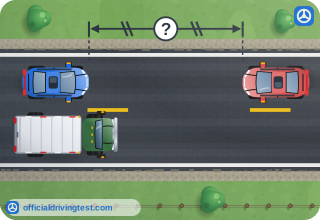
- 1/8 mile
- 1/4 mile
- 1/2 mile
- A full mile
Show answer
Correct answer: 1/4 mile
At 45 mph, passing on a two-lane road translates into 1/4 mile of clear roadway you need to safely pass a slower vehicle.
Source: Pennsylvania Driver's Manual (Pub 95), page 47 · Open this page in the manual (Manual page 47)
-
When passing on a two-lane road, about how much faster should you be going than the vehicle you are passing?
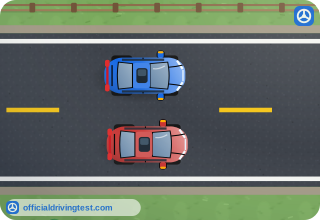
- About 5 mph faster
- About 20 mph faster
- About 10 mph faster
- About 30 mph faster
Show answer
Correct answer: About 10 mph faster
You need to be going about 10 mph faster than the vehicle(s) you are passing.
Source: Pennsylvania Driver's Manual (Pub 95), page 47 · Open this page in the manual (Manual page 47)
-
Why is passing at night considered especially dangerous?
- There is more traffic at night
- Headlights are not permitted while passing at night
- Speed limits are lower at night
- You cannot see as far ahead or judge distances as well
Show answer
Correct answer: You cannot see as far ahead or judge distances as well
It is most dangerous to pass at night because you cannot see as far ahead and it is harder to accurately judge distances.
Source: Pennsylvania Driver's Manual (Pub 95), page 47 · Open this page in the manual (Manual page 47)
-
When passing on the right is permitted because the driver ahead is making or signaling a left turn, where must the passing driver stay?
- On the berm or shoulder
- In the oncoming lane
- In the center turn lane
- Directly behind the turning vehicle
Show answer
Correct answer: On the berm or shoulder
When the driver you are passing is making or signaling a left turn, the driver of the passing vehicle must stay on the berm or shoulder.
Source: Pennsylvania Driver's Manual (Pub 95), page 47 · Open this page in the manual (Manual page 47)
-
In which of these situations may you pass another vehicle on the right?
- The vehicle ahead is going more than 10 mph under the limit
- You are on a road with two or more marked lanes in each direction
- There is no other traffic on the road
- You are within 100 feet of an intersection
Show answer
Correct answer: You are on a road with two or more marked lanes in each direction
You may pass on the right when driving on a roadway with two or more marked traffic lanes in each direction.
Source: Pennsylvania Driver's Manual (Pub 95), page 47 · Open this page in the manual (Manual page 47)
-
You may NOT pass another vehicle when you are within how many feet of, or are crossing, an intersection or railroad grade crossing (unless a traffic control device says you may)?
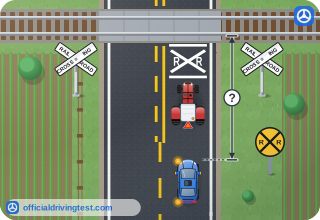
- 50 feet
- 500 feet
- 100 feet
- 200 feet
Show answer
Correct answer: 100 feet
You may not pass if you are within 100 feet of or are crossing any intersection or railroad grade crossing.
Source: Pennsylvania Driver's Manual (Pub 95), page 47 · Open this page in the manual (Manual page 47)
-
You may NOT pass when you are within how many feet of any bridge, elevated structure, or tunnel?
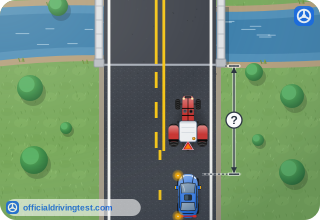
- 50 feet
- 250 feet
- 500 feet
- 100 feet
Show answer
Correct answer: 100 feet
You may not pass if you are within 100 feet of any bridge, elevated structure or tunnel.
Source: Pennsylvania Driver's Manual (Pub 95), page 47 · Open this page in the manual (Manual page 47)
-
According to the manual, in which of these places is passing prohibited?
- On the shoulder of a multi-lane highway
- On any road posted 55 mph or higher
- Within 500 feet of a gas station
- On any road with a broken yellow centerline
Show answer
Correct answer: On the shoulder of a multi-lane highway
You may not pass while on the shoulder of a multi-lane highway.
Source: Pennsylvania Driver's Manual (Pub 95), page 47 · Open this page in the manual (Manual page 47)
-
According to the manual, what does the law actually establish at intersections?
- Which vehicle has absolute priority
- Who must yield — the law does not grant anyone the right-of-way
- That the fastest vehicle always goes first
- That right-of-way belongs to whichever driver arrives first, no exceptions
Show answer
Correct answer: Who must yield — the law does not grant anyone the right-of-way
The law does not give anyone the right-of-way at intersections; it only says who must yield.
Source: Pennsylvania Driver's Manual (Pub 95), page 48 · Open this page in the manual (Manual page 48)
-
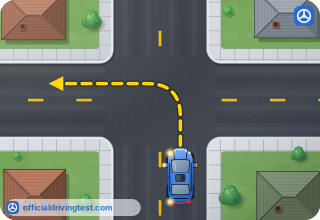
When turning left, a driver must yield to:
- Pedestrians only, not other vehicles
- Vehicles behind them
- No one, since they signaled first
- Oncoming vehicles going straight ahead
Show answer
Correct answer: Oncoming vehicles going straight ahead
Drivers turning left must yield to oncoming vehicles going straight ahead.
Source: Pennsylvania Driver's Manual (Pub 95), page 48 · Open this page in the manual (Manual page 48)
-
A driver entering a circular intersection (or roundabout) must yield the right-of-way to:
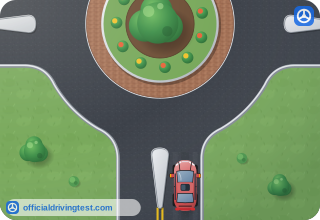
- Drivers already in the circle
- Vehicles waiting to enter behind them
- Pedestrians only
- No one, since they have already entered
Show answer
Correct answer: Drivers already in the circle
Drivers entering a circular intersection must yield the right-of-way to drivers already in the circle.
Source: Pennsylvania Driver's Manual (Pub 95), page 48 · Open this page in the manual (Manual page 48)
-
When two vehicles approach or enter an intersection from different roadways at or about the same time, who must yield?
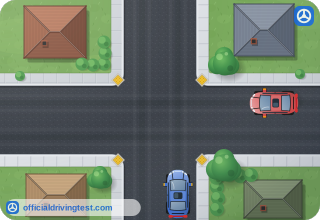
- The vehicle coming from the right yields to the vehicle coming from the left
- The vehicle coming from the left yields to the vehicle coming from the right
- Whichever vehicle is moving slower yields
- Neither vehicle needs to yield
Show answer
Correct answer: The vehicle coming from the left yields to the vehicle coming from the right
Drivers coming from the left must yield to vehicles coming from the right.
Source: Pennsylvania Driver's Manual (Pub 95), page 48 · Open this page in the manual (Manual page 48)