Pennsylvania: Right of way & turning — Part 3 Practice Test
Questions in this part include: “In a roundabout, which direction does traffic move, and what does this make every turn into or out of the circle?”
Independent educational site · not affiliated with any government agency or DMV
Ready? Test yourself
- Instant feedback with an explanation
- Every answer cites its source in the manual
- Your best score is saved on this device
Questions are original and based on the official manual "Pennsylvania Driver's Manual" (Pub 95), Pennsylvania Department of Transportation (PennDOT), Bureau of Driver Licensing.
All 16 questions in this practice test
Take the test above first, then use this list to study. Tap “Show answer” to see the correct answer and explanation.
Show the questions and answersHide the questions
-
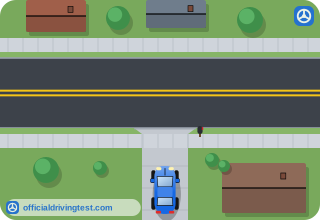
A vehicle entering a public highway from an alley, private road, or driveway must:
- Sound its horn before entering
- Always yield to pedestrians only
- Wait until the main road is clear
- Proceed if traveling under 15 mph
Show answer
Correct answer: Wait until the main road is clear
A vehicle entering a public highway from an alley, private road or driveway must wait until the main road is clear.
Source: Pennsylvania Driver's Manual (Pub 95), page 48 · Open this page in the manual (Manual page 48)
-
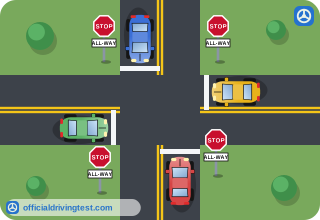
At a four-way stop where all vehicles have stopped, who should move forward first?
- The largest vehicle
- The vehicle turning right
- The vehicle on the left, always
- The first vehicle to arrive
Show answer
Correct answer: The first vehicle to arrive
At a four-way stop, the first vehicle to reach the intersection should move forward first.
Source: Pennsylvania Driver's Manual (Pub 95), page 48 · Open this page in the manual (Manual page 48)
-
At a four-way stop, if two vehicles reach the intersection at the same time, who yields?
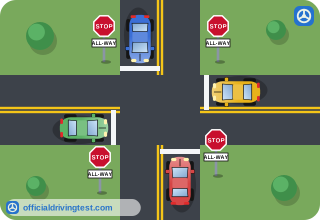
- The driver on the left yields to the driver on the right
- The driver on the right yields to the driver on the left
- Both must wait for a police officer
- Whoever arrived from the north
Show answer
Correct answer: The driver on the left yields to the driver on the right
If two vehicles reach a four-way stop at the same time, the driver on the left yields to the driver on the right.
Source: Pennsylvania Driver's Manual (Pub 95), page 48 · Open this page in the manual (Manual page 48)
-
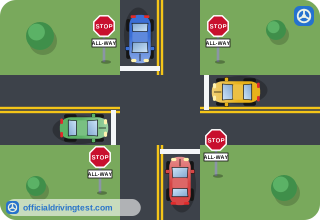
At a four-way stop, if two vehicles are facing one another, what should they do?
- Wait for a third vehicle to arrive
- Both can proceed with caution, watching for possible turns
- Only the heavier vehicle may proceed
- The vehicle turning must always wait a full minute
Show answer
Correct answer: Both can proceed with caution, watching for possible turns
If facing one another, both drivers can proceed with caution, watching for possible turns.
Source: Pennsylvania Driver's Manual (Pub 95), page 48 · Open this page in the manual (Manual page 48)
-
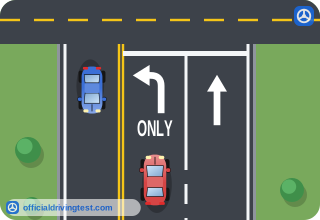
If you end up in a lane marked for turns only but wanted to go straight through the intersection, what must you do?
- Reverse and change lanes immediately
- Proceed straight anyway
- Make the turn
- Stop and wait for the light to cycle
Show answer
Correct answer: Make the turn
If you end up in a lane marked for turns only when you want to go straight through, you must make the turn.
Source: Pennsylvania Driver's Manual (Pub 95), page 48 · Open this page in the manual (Manual page 48)
-
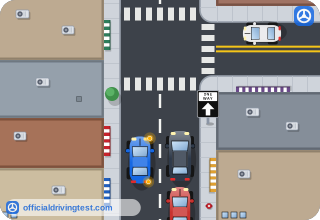
If you end up in a lane marked for through traffic only but wanted to turn, what must you do?
- Turn anyway, using extra caution
- Stop in the lane and wait
- Cross into the turn lane at the last moment
- Continue straight through the intersection
Show answer
Correct answer: Continue straight through the intersection
If you want to turn but end up in a lane marked for through traffic, you must continue straight through the intersection.
Source: Pennsylvania Driver's Manual (Pub 95), page 48 · Open this page in the manual (Manual page 48)
-
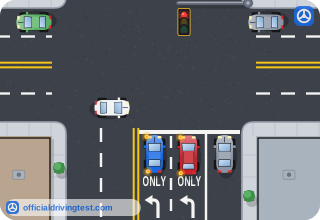
At an intersection with dual (two) left turn lanes, what must you avoid doing while turning?
- Changing lanes during the turn
- Using your turn signal
- Turning into the lane closest to the centerline
- Watching for the driver turning next to you
Show answer
Correct answer: Changing lanes during the turn
Do not change lanes during the turn, as this will cause you to crash into the driver turning next to you.
Source: Pennsylvania Driver's Manual (Pub 95), page 48 · Open this page in the manual (Manual page 48)
-
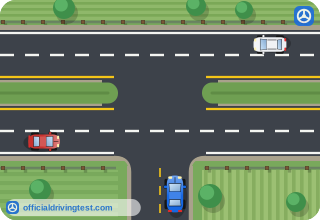
Making a right turn onto a divided highway is:
- Illegal without a special permit
- No different from a right turn at any other intersection
- Only allowed at signalized intersections
- Prohibited unless a police officer directs traffic
Show answer
Correct answer: No different from a right turn at any other intersection
Making a right turn onto a divided highway is no different from making a right turn at any other intersection.
Source: Pennsylvania Driver's Manual (Pub 95), page 49 · Open this page in the manual (Manual page 49)
-
What is the correct way to turn left onto a divided highway?
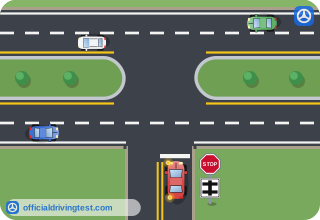
- Turn left immediately after crossing the first roadway, before reaching the barrier
- Always wait for a traffic signal, even if none exists
- Cross the first roadway when there is a safe gap, then turn left on the other side of the barrier
- Turn left only from the right lane
Show answer
Correct answer: Cross the first roadway when there is a safe gap, then turn left on the other side of the barrier
Cross the "first" roadway when there is a safe gap from the left, then turn left on the other side of the barrier when there is a safe gap from the right on the "second" roadway.
Source: Pennsylvania Driver's Manual (Pub 95), page 49 · Open this page in the manual (Manual page 49)
-
At a two-way stop sign, to cross a 30 mph street, about how large a gap do you need in both directions?
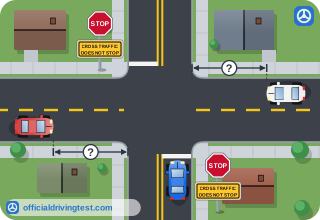
- About 3 seconds
- About 12 seconds
- About 20 seconds
- About 6 seconds
Show answer
Correct answer: About 6 seconds
You need about a 6-second gap in both directions to cross a 30 mph street.
Source: Pennsylvania Driver's Manual (Pub 95), page 49 · Open this page in the manual (Manual page 49)
-
When turning right at an intersection with a two-way stop, the manual recommends allowing a gap of about how many seconds between you and any vehicle approaching from the left?
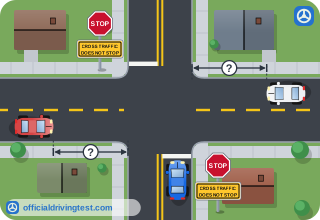
- 4 seconds
- 6 seconds
- 8 seconds
- 12 seconds
Show answer
Correct answer: 8 seconds
Allow a gap of about 8 seconds between you and any vehicle approaching from the left when turning right.
Source: Pennsylvania Driver's Manual (Pub 95), page 49 · Open this page in the manual (Manual page 49)
-
When turning left from a minor street onto a major street, the manual recommends allowing a gap of about how many seconds from any vehicle approaching from the right?
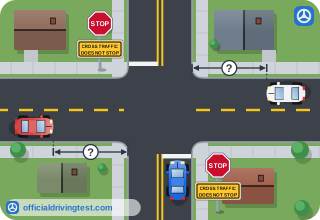
- 5 seconds
- 9 seconds
- 7 seconds
- 12 seconds
Show answer
Correct answer: 9 seconds
If turning from a minor onto a major street, allow a 9-second gap between you and any vehicle approaching from the right.
Source: Pennsylvania Driver's Manual (Pub 95), page 49 · Open this page in the manual (Manual page 49)
-
To avoid a "tangle turn" with an oncoming left-turning driver, you should turn:
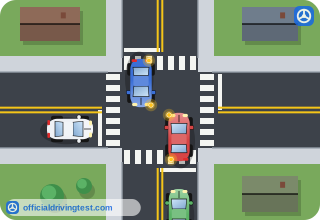
- After you reach the center "X" of the intersection
- Only after the other driver has completed their turn
- Before you reach the center "X" of the intersection
- Into the lane farthest from the centerline
Show answer
Correct answer: Before you reach the center "X" of the intersection
By turning before you reach the "X" at the center of the intersection, you avoid a "tangle turn" with the other left-turning driver.
Source: Pennsylvania Driver's Manual (Pub 95), page 49 · Open this page in the manual (Manual page 49)
-
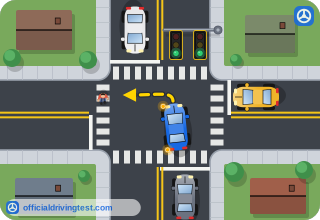
What is the most important rule when starting a left turn, according to the manual?
- Complete the turn as quickly as possible
- Always turn before oncoming traffic arrives
- Turn only when a passenger confirms it is safe
- Never start until all lanes you must cross are clear
Show answer
Correct answer: Never start until all lanes you must cross are clear
Most important: never start a left turn until you can see all the lanes you need to cross are clear.
Source: Pennsylvania Driver's Manual (Pub 95), page 49 · Open this page in the manual (Manual page 49)
-
On a road designed with a jughandle where signs say NO LEFT TURN and ALL TURNS FROM RIGHT LANE, how do you make a left turn?
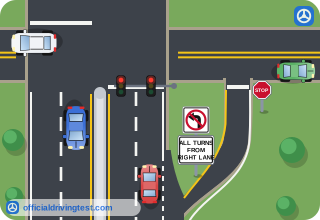
- Use a right turn lane that curves back, then turn left
- Cross oncoming traffic directly, as on any other road
- Perform a U-turn instead
- Wait for a police officer to stop traffic
Show answer
Correct answer: Use a right turn lane that curves back, then turn left
With a jughandle, you use a right turn lane curving back to intersect the major road at a traffic light, then turn left.
Source: Pennsylvania Driver's Manual (Pub 95), page 50 · Open this page in the manual (Manual page 50)
-
In a roundabout, which direction does traffic move, and what does this make every turn into or out of the circle?
- Clockwise; every turn is a left turn
- Counterclockwise; every turn is a right turn
- Clockwise; every turn is a right turn
- Counterclockwise; every turn is a left turn
Show answer
Correct answer: Counterclockwise; every turn is a right turn
Traffic in a roundabout moves counterclockwise, so that all turns into and out of the circle are right turns.
Source: Pennsylvania Driver's Manual (Pub 95), page 50 · Open this page in the manual (Manual page 50)