Pennsylvania: Right of way & turning — Part 1 Practice Test
Questions in this part include: “According to the manual's 'left-right-left' rule for approaching an intersection, why should you look to the left first?” · “Where are U-turns not allowed, according to the manual?”
Independent educational site · not affiliated with any government agency or DMV
Ready? Test yourself
Answer to start, or tap Start below:
According to the manual's 'left-right-left' rule for approaching an intersection, why should you look to the left first?
- Instant feedback with an explanation
- Every answer cites its source in the manual
- Your best score is saved on this device
- Keyboard: press 1 to 4 to answer and Enter for the next question
Questions are original and based on the official manual "Pennsylvania Driver's Manual" (Pub 95), Pennsylvania Department of Transportation (PennDOT), Bureau of Driver Licensing.
All 17 questions in this practice test
Take the test above first, then use this list to study. Tap “Show answer” to see the correct answer and explanation.
Show the questions and answersHide the questions
-
At a four-way stop intersection, which vehicle should move forward first?
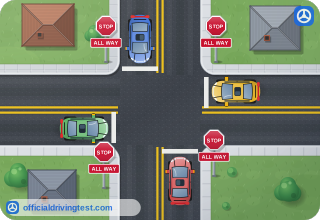
- The vehicle turning left, regardless of arrival order
- The first vehicle to reach the intersection
- The vehicle on the right, regardless of arrival order
- Whichever vehicle is largest
Show answer
Correct answer: The first vehicle to reach the intersection
At a four-way stop, the first vehicle to reach the intersection should move forward first.
Source: Pennsylvania Driver's Manual (Pub 95), page 10 · Open this page in the manual (Manual page 10)
-
At a four-way stop, if two vehicles reach the intersection at the same time, who has the right-of-way?
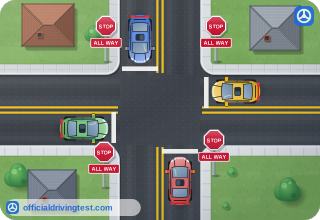
- Neither driver may proceed until a third vehicle arrives
- The driver going straight always yields to a turning driver
- The driver on the left yields to the driver on the right
- The driver on the right yields to the driver on the left
Show answer
Correct answer: The driver on the left yields to the driver on the right
If two vehicles reach a four-way stop at the same time, the driver on the left yields to the driver on the right.
Source: Pennsylvania Driver's Manual (Pub 95), page 10 · Open this page in the manual (Manual page 10)
-
A sign used together with a YIELD sign at a one-lane bridge or underpass tells you that:
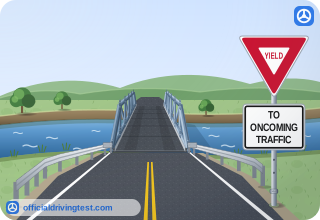
- you always have the right-of-way over opposing traffic
- you must yield the right-of-way to opposing traffic
- trucks are prohibited from the bridge
- the bridge is closed to all traffic
Show answer
Correct answer: you must yield the right-of-way to opposing traffic
At a one-lane bridge or underpass, a sign used with a YIELD sign alerts motorists that the one-lane roadway requires them to yield the right-of-way to opposing traffic.
Source: Pennsylvania Driver's Manual (Pub 95), page 10 · Open this page in the manual (Manual page 10)
-
A MERGING TRAFFIC sign warns that traffic may be entering your lane from another roadway or ramp. Who must yield?
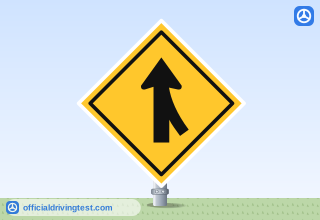
- The traffic already on the major roadway must yield to entering traffic
- The entering traffic must yield to traffic already on the major roadway
- Neither driver must yield; it is first-come, first-served
- Only trucks must yield in this situation
Show answer
Correct answer: The entering traffic must yield to traffic already on the major roadway
Entering traffic must yield to traffic already on the major roadway.
Source: Pennsylvania Driver's Manual (Pub 95), page 14 · Open this page in the manual (Manual page 14)
-
According to the manual's 'left-right-left' rule for approaching an intersection, why should you look to the left first?
- Because pedestrians only cross from the left
- Because traffic signals face left first
- Because vehicles from the left are closer to you
- Because it is required only at four-way stops
Show answer
Correct answer: Because vehicles from the left are closer to you
Look to the left first, because vehicles coming from the left are closer to you, then look right, then look left again before you pull out.
Source: Pennsylvania Driver's Manual (Pub 95), page 38 · Open this page in the manual (Manual page 38)
-
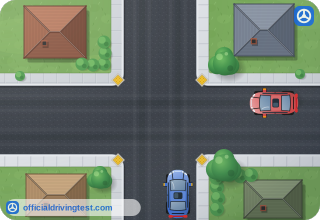
According to the manual, if your view of the cross street at an intersection is blocked by buildings, shrubs, or parked vehicles, what should you do?
- Sound your horn and proceed
- Stop and wait for another driver to wave you through
- Turn on your hazard lights and proceed at normal speed
- Move forward slowly until you can see clearly
Show answer
Correct answer: Move forward slowly until you can see clearly
If your view of the cross street is blocked by buildings, shrubs or parked vehicles, move forward slowly until you can see clearly.
Source: Pennsylvania Driver's Manual (Pub 95), page 38 · Open this page in the manual (Manual page 38)
-
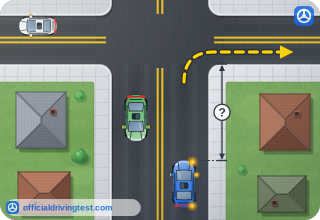
About how many seconds before your turn should you signal, according to the manual's guidelines for completing a turn safely?
- 1 to 2 seconds
- 5 to 6 seconds
- 3 to 4 seconds
- 8 to 10 seconds
Show answer
Correct answer: 3 to 4 seconds
The first step to completing a turn safely is to signal 3 to 4 seconds before your turn.
Source: Pennsylvania Driver's Manual (Pub 95), page 45 · Open this page in the manual (Manual page 45)
-
On a two-lane, two-way street, where should you position your vehicle to make a left turn?
- As close to the right edge of the roadway as possible
- In the center of your lane
- Straddling the centerline
- As close to the centerline as possible
Show answer
Correct answer: As close to the centerline as possible
On two-lane, two-way streets or highways, make left turns from as close to the centerline as possible.
Source: Pennsylvania Driver's Manual (Pub 95), page 45 · Open this page in the manual (Manual page 45)
-
When turning onto a highway that has more than one lane in your direction of travel, you should turn into:
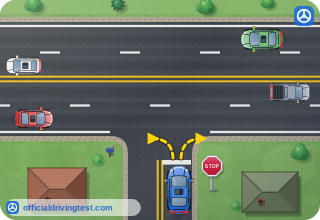
- The closest lane going in that direction
- Whichever lane has less traffic
- Always the far-left lane, regardless of your turn
- Always the far-right lane, regardless of your turn
Show answer
Correct answer: The closest lane going in that direction
Turn into the closest lane going in that direction — the left lane for a left turn, the right lane for a right turn.
Source: Pennsylvania Driver's Manual (Pub 95), page 45 · Open this page in the manual (Manual page 45)
-
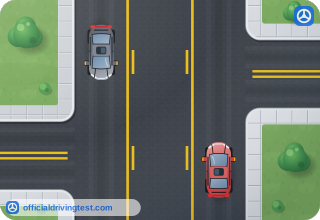
A center lane marked on both sides by one solid outer line and one broken inner line is meant to be used for:
- High-speed passing only
- Left turns only
- Parking
- Through traffic during rush hour
Show answer
Correct answer: Left turns only
A lane marked with a solid outer line and a broken inner line may only be used for left turns.
Source: Pennsylvania Driver's Manual (Pub 95), page 45 · Open this page in the manual (Manual page 45)
-
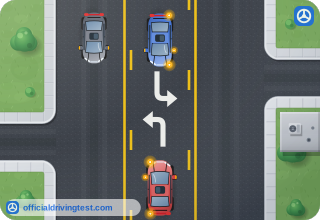
How long before entering a center turn lane should you put on your left turn signal?
- 1 to 2 seconds
- 5 to 6 seconds
- 3 to 4 seconds
- 8 to 10 seconds
Show answer
Correct answer: 3 to 4 seconds
Put on your left turn signal at least 3 to 4 seconds before entering the left-turn lane.
Source: Pennsylvania Driver's Manual (Pub 95), page 45 · Open this page in the manual (Manual page 45)
-
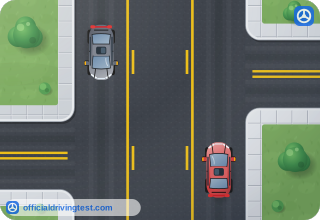
Why does the manual warn against getting into a center turn lane too soon?
- It is illegal to enter a center turn lane early
- It will trigger a nearby traffic signal to change
- Other drivers will assume you are parking
- You are more likely to meet an oncoming driver head-on
Show answer
Correct answer: You are more likely to meet an oncoming driver head-on
Do not get into the center turn lane too soon — the longer you drive in it, the more likely you are to meet someone head-on.
Source: Pennsylvania Driver's Manual (Pub 95), page 45 · Open this page in the manual (Manual page 45)
-
When choosing a place to make a U-turn, drivers coming from all directions should be at least how far away and able to see you clearly?
- 500 feet
- 100 feet
- 250 feet
- 1,000 feet
Show answer
Correct answer: 500 feet
Make sure drivers coming from all directions are at least 500 feet away from you and can see you clearly.
Source: Pennsylvania Driver's Manual (Pub 95), page 46 · Open this page in the manual (Manual page 46)
-
Where are U-turns not allowed, according to the manual?
- On any street with a posted speed limit under 35 mph
- On curves or when approaching or nearing the crest of a hill
- On any street with more than one lane
- Anywhere within a business district
Show answer
Correct answer: On curves or when approaching or nearing the crest of a hill
U-turns are not allowed on curves or when you are approaching or nearing the crest of a hill.
Source: Pennsylvania Driver's Manual (Pub 95), page 46 · Open this page in the manual (Manual page 46)
-
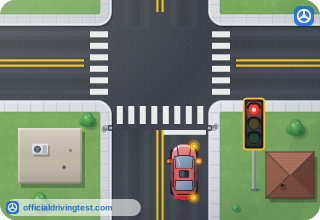
Before making a legal right turn at a red light, what must you always do first?
- Sound your horn to alert other drivers
- Flash your headlights to warn cross traffic
- Stop and yield to pedestrians and cross traffic
- Activate your hazard lights
Show answer
Correct answer: Stop and yield to pedestrians and cross traffic
Before making the right turn, you must always stop first and yield to pedestrians and cross traffic.
Source: Pennsylvania Driver's Manual (Pub 95), page 46 · Open this page in the manual (Manual page 46)
-
When may you turn left on a red signal after stopping?
- Never — left turns on red are always illegal in Pennsylvania
- Only at night
- Only if a police officer directs you to do so
- From one one-way street onto another, if clear and no sign forbids it
Show answer
Correct answer: From one one-way street onto another, if clear and no sign forbids it
If you are turning from a one-way street onto another one-way street, you may turn left on red after stopping, if traffic is clear and there is no NO TURN ON RED sign.
Source: Pennsylvania Driver's Manual (Pub 95), page 46 · Open this page in the manual (Manual page 46)
-
Stopping halfway across a street while crossing or turning is safe only when:
- A median turn lane can hold your entire vehicle
- There is heavy traffic in both directions
- You have your hazard lights on
- You are driving a large vehicle
Show answer
Correct answer: A median turn lane can hold your entire vehicle
Stopping halfway across a street is safe only when there is a turning lane in the center median large enough to hold your entire vehicle.
Source: Pennsylvania Driver's Manual (Pub 95), page 46 · Open this page in the manual (Manual page 46)