Pennsylvania: Right of way & turning — Part 4 Practice Test
Questions in this part include: “According to the manual, what is the most frequent cause of crashes at roundabouts?” · “What must vehicles in a funeral procession have turned on, and what must they bear?”
Independent educational site · not affiliated with any government agency or DMV
Ready? Test yourself
- Instant feedback with an explanation
- Every answer cites its source in the manual
- Your best score is saved on this device
Questions are original and based on the official manual "Pennsylvania Driver's Manual" (Pub 95), Pennsylvania Department of Transportation (PennDOT), Bureau of Driver Licensing.
All 16 questions in this practice test
Take the test above first, then use this list to study. Tap “Show answer” to see the correct answer and explanation.
Show the questions and answersHide the questions
-
According to the manual, what is the most frequent cause of crashes at roundabouts?
- Vehicles exiting too slowly
- Pedestrians crossing without looking
- Drivers who fail to yield before they enter
- Vehicles stopping inside the circle
Show answer
Correct answer: Drivers who fail to yield before they enter
The most frequent cause of crashes at roundabouts is drivers who fail to yield before they enter.
Source: Pennsylvania Driver's Manual (Pub 95), page 50 · Open this page in the manual (Manual page 50)
-
At each entry point of a roundabout, you will find:
- A stop sign and stop line
- A traffic signal
- No signage at all
- A YIELD sign and a yield line
Show answer
Correct answer: A YIELD sign and a yield line
Roundabouts have YIELD signs at each entry point and yield lines painted on the pavement.
Source: Pennsylvania Driver's Manual (Pub 95), page 50 · Open this page in the manual (Manual page 50)
-
As you approach a roundabout's yield line, who has the right-of-way?
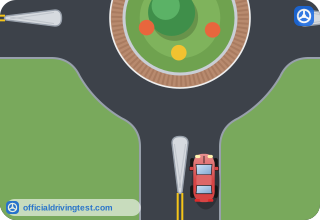
- Circulating traffic in the roundabout
- The vehicle entering the roundabout
- Whichever vehicle arrives first
- Pedestrians only
Show answer
Correct answer: Circulating traffic in the roundabout
Pull up to the yield line and check for approaching traffic — circulating traffic has the right-of-way.
Source: Pennsylvania Driver's Manual (Pub 95), page 50 · Open this page in the manual (Manual page 50)
-
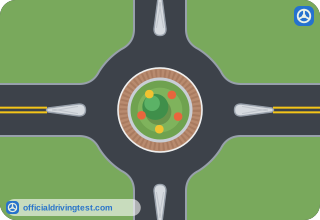
Once you have entered a roundabout and are proceeding to your exit, who now has the right-of-way?
- Vehicles waiting to enter the roundabout
- You — the vehicle already circulating
- Pedestrians in the roadway only
- No one; roundabouts have no right-of-way rules once inside
Show answer
Correct answer: You — the vehicle already circulating
Once you have entered the roundabout, you now have the right-of-way as you proceed counterclockwise to your exit.
Source: Pennsylvania Driver's Manual (Pub 95), page 50 · Open this page in the manual (Manual page 50)
-
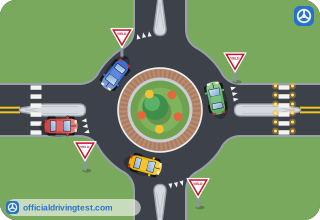
As you approach your exit in a roundabout, what should you do?
- Use your left turn signal
- Turn off all signals
- Use your right turn signal
- Sound your horn
Show answer
Correct answer: Use your right turn signal
As you approach your exit, use your right turn signal.
Source: Pennsylvania Driver's Manual (Pub 95), page 50 · Open this page in the manual (Manual page 50)
-
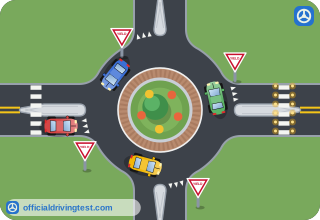
What is a key difference between traffic circles and roundabouts, according to the manual?
- Traffic circles are always smaller
- Traffic circles only exist on interstate ramps
- Roundabouts have special rules and a special design
- Roundabouts do not have yield signs
Show answer
Correct answer: Roundabouts have special rules and a special design
Roundabouts have special rules and a special design making them different from traffic circles.
Source: Pennsylvania Driver's Manual (Pub 95), page 50 · Open this page in the manual (Manual page 50)
-
According to a "Teen Crash Fact" in the manual, improper or careless turning was a contributing factor in how many crashes involving 17-year-old drivers in Pennsylvania in 2017?
- 159
- 259
- 359
- 459
Show answer
Correct answer: 459
In 2017, improper or careless turning was a factor contributing to 459 crashes involving drivers age 17 in Pennsylvania.
Source: Pennsylvania Driver's Manual (Pub 95), page 45 · Open this page in the manual (Manual page 45)
-
According to a "Teen Crash Fact," from 2013 to 2017, how many crashes involving driving on the wrong side of the road (resulting in 15 deaths) involved 16- and 17-year-old drivers in Pennsylvania?
- 384
- 284
- 484
- 584
Show answer
Correct answer: 384
From 2013 to 2017, there were 384 crashes and 15 people killed involving driving on the wrong side of the road among 16- and 17-year-old drivers.
Source: Pennsylvania Driver's Manual (Pub 95), page 47 · Open this page in the manual (Manual page 47)
-
If you see a funeral procession on the road, what must you do?
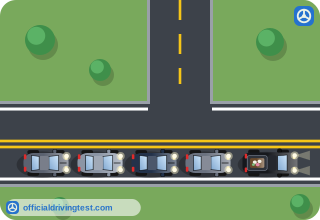
- Yield to the vehicles in the procession
- Pass through the procession quickly
- Honk your horn to signal the procession to hurry
- Ignore the procession and proceed as normal
Show answer
Correct answer: Yield to the vehicles in the procession
If you see a funeral procession on the road, yield to vehicles in the procession.
Source: Pennsylvania Driver's Manual (Pub 95), page 64 · Open this page in the manual (Manual page 64)
-
Once the lead vehicle of a funeral procession has cleared an intersection, what happens?
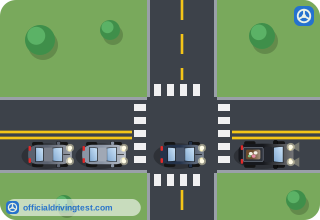
- The procession must stop and wait for a new signal
- The rest may proceed through, and other traffic must yield
- Other traffic gets priority immediately
- Only marked funeral escort vehicles may continue
Show answer
Correct answer: The rest may proceed through, and other traffic must yield
Once the lead vehicle has cleared an intersection, the rest of the procession may proceed through, and other traffic must yield.
Source: Pennsylvania Driver's Manual (Pub 95), page 64 · Open this page in the manual (Manual page 64)
-
As a driver encountering a funeral procession, when may you cut in and out of the procession?
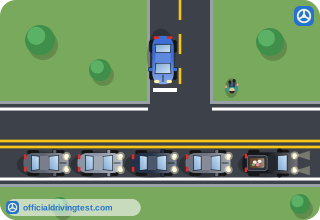
- Whenever there is a safe gap in the procession
- Never, under any circumstances
- Only if directed by police or the funeral director's staff
- Only at intersections controlled by traffic signals
Show answer
Correct answer: Only if directed by police or the funeral director's staff
Allow the procession to pass and do not cut in and out of it, unless directed otherwise by a police officer or an agent or employee of the funeral director.
Source: Pennsylvania Driver's Manual (Pub 95), page 64 · Open this page in the manual (Manual page 64)
-
What must vehicles in a funeral procession have turned on, and what must they bear?
- Hazard flashers only, with no other identification required
- Only their headlights, with no flag or insignia required
- High beams only
- Headlights and emergency flashers, plus a flag or insignia
Show answer
Correct answer: Headlights and emergency flashers, plus a flag or insignia
All vehicles in a funeral procession must have their headlights and emergency flashers turned on and bear a flag or other insignia designating them as part of the procession.
Source: Pennsylvania Driver's Manual (Pub 95), page 64 · Open this page in the manual (Manual page 64)
-
What color of flashing or revolving light may vehicles in a funeral procession display?
- Purple
- Blue
- Amber
- Green
Show answer
Correct answer: Purple
Vehicles in a funeral procession may also have a flashing or revolving purple light displayed during the procession.
Source: Pennsylvania Driver's Manual (Pub 95), page 64 · Open this page in the manual (Manual page 64)
-
Under what condition may drivers in a funeral procession proceed through a red light?
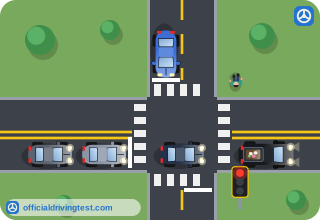
- Any time, regardless of when the lead vehicle entered
- If the lead vehicle started through while the light was green
- Only if a police escort is present
- Never; a red light always requires a full stop
Show answer
Correct answer: If the lead vehicle started through while the light was green
Drivers in funeral processions may proceed through a red light if the lead vehicle starts through the intersection while the light was green.
Source: Pennsylvania Driver's Manual (Pub 95), page 64 · Open this page in the manual (Manual page 64)
-
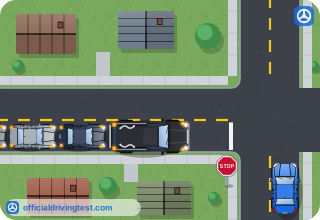
At a stop sign, what must the lead vehicle of a funeral procession do before the rest of the procession may proceed through?
- Slow down without stopping
- Sound its horn twice
- Come to a complete stop first
- Wait for a police escort to arrive
Show answer
Correct answer: Come to a complete stop first
In the case of a stop sign, the lead vehicle of a funeral procession must first come to a complete stop before proceeding through the intersection.
Source: Pennsylvania Driver's Manual (Pub 95), page 64 · Open this page in the manual (Manual page 64)
-
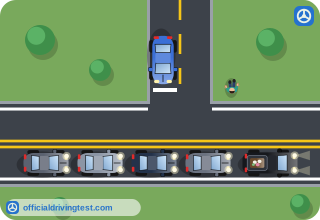
What must a funeral procession yield to, even while proceeding as a group through intersections?
- Other funeral processions only
- Vehicles signaling a turn
- Nothing; a funeral procession always has the right-of-way
- Emergency vehicles
Show answer
Correct answer: Emergency vehicles
Funeral processions must yield to emergency vehicles.
Source: Pennsylvania Driver's Manual (Pub 95), page 64 · Open this page in the manual (Manual page 64)