North Carolina: Sharing the road
Bicyclists, motorcycles and mopeds, trucks, farm equipment and other road users. Split into 5 shorter tests so you're not stuck in one long quiz.
Independent educational site · not affiliated with any government agency or DMV
Choose a part
Sharing the road — Part 1
Questions in this part include: “When and where do most crashes involving farm equipment occur, according to the manual?”
StartSharing the road — Part 2
Questions in this part include: “Because bicycles are vehicles, which laws must bicyclists obey?”
StartSharing the road — Part 3
Questions in this part include: “Which part of its lane should a moped travel in?”
StartSharing the road — Part 4
Questions in this part include: “About what share of motorcycle crashes in North Carolina involve a car?”
StartSharing the road — Part 5
Questions in this part include: “Which laws that apply to drivers of other motor vehicles also apply to moped operators?”
StartAll 82 Sharing the road questions with answers
Choose a part above to take a practice test, or study every question and answer here.
Show the questions and answersHide the questions
-
What happens to a vehicle driver who does not properly signal vehicle movements to a motorcycle operator and causes the motorcycle to change lanes or leave the roadway?
- The driver receives only a verbal warning from an officer
- The driver will be charged and fined as the law provides
- The motorcyclist is charged instead of the driver
- Nothing happens unless there is also a crash with injuries
Show answer
Correct answer: The driver will be charged and fined as the law provides
The manual says the vehicle driver will be charged and fined as the law provides in that situation.
Source: North Carolina Driver Handbook (Revised May 2025), page 47 · Open this page in the manual (Manual page 47)
-
When and where do most crashes involving farm equipment occur, according to the manual?
- At night when it is raining, on wet gravel or dirt roads
- During heavy rain on hilly roads with a lot of curves
- In fog before sunrise on narrow dirt roads with no shoulder
- On a clear day, during daylight hours, on a dry paved surface
Show answer
Correct answer: On a clear day, during daylight hours, on a dry paved surface
The manual says most crashes involving farm equipment occur on a clear day, during daylight hours, and/or on a dry surface that is paved.
Source: North Carolina Driver Handbook (Revised May 2025), page 51 · Open this page in the manual (Manual page 51)
-
What are typical crashes with farm equipment, according to the manual?
- Sideswipes and angle crashes
- Head-on and rollover crashes
- Rear-end and chain-reaction crashes
- Backing and parking crashes
Show answer
Correct answer: Sideswipes and angle crashes
The manual says typical crashes with farm equipment include sideswipes and angle crashes.
Source: North Carolina Driver Handbook (Revised May 2025), page 51 · Open this page in the manual (Manual page 51)
-
Why do drivers sometimes crash into farm equipment that is turning left?
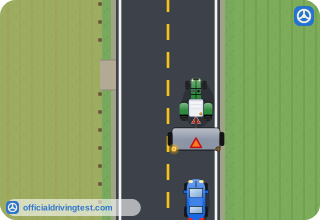
- They stop too far behind the equipment to see its signals
- They follow the equipment too slowly and lose patience quickly
- They mistake the equipment's left-hand signal as a sign to pass
- They mistake the equipment for a parked vehicle at night
Show answer
Correct answer: They mistake the equipment's left-hand signal as a sign to pass
The manual says a machinery operator may use a left-hand signal, drivers may mistake it as a sign to pass, and the following vehicle crashes when it tries to pass as the machinery slows to turn.
Source: North Carolina Driver Handbook (Revised May 2025), page 51 · Open this page in the manual (Manual page 51)
-
What does the manual say about passing farm equipment in a no passing zone?
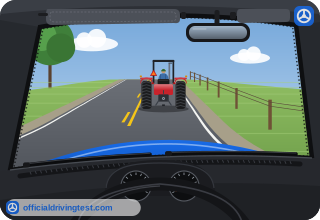
- It is legal if the equipment is moving slowly
- It is illegal and very dangerous
- It is legal if no vehicles are approaching
- It is legal on a clear day
Show answer
Correct answer: It is illegal and very dangerous
The manual says it is illegal and very dangerous to pass farm equipment in a no passing zone.
Source: North Carolina Driver Handbook (Revised May 2025), page 51 · Open this page in the manual (Manual page 51)
-
Why should you be careful when passing farm equipment?
- It always travels much faster than it appears to when seen from behind
- It never has any brakes or working lights on the front or the rear
- It can only be passed safely on the right side of the roadway ahead
- It may be wider than what is visible from behind and need space in both lanes
Show answer
Correct answer: It may be wider than what is visible from behind and need space in both lanes
The manual says farm equipment may be wider than what is visible from behind and may require ample space in both lanes.
Source: North Carolina Driver Handbook (Revised May 2025), page 51 · Open this page in the manual (Manual page 51)
-
According to the manual, what is the key to safety when sharing the road with farm equipment?
- Being patient
- Speeding up to pass quickly
- Following as closely as possible
- Sounding your horn repeatedly
Show answer
Correct answer: Being patient
The manual says the key to safety when sharing the road with farm equipment is to be patient.
Source: North Carolina Driver Handbook (Revised May 2025), page 51 · Open this page in the manual (Manual page 51)
-
If farm equipment is causing a delay in traffic, when does the manual say it is advisable to pass it on public roads?
- Any time that the road ahead looks clear for several hundred yards
- Whenever the operator turns on a hazard light on the machine ahead
- When the operator moves off the road at a practical spot and lets traffic pass
- Only when the equipment is moving slowly up a long, steep hill
Show answer
Correct answer: When the operator moves off the road at a practical spot and lets traffic pass
The manual says the operator should move off the road at the nearest practical location and allow traffic to pass, which is the only advisable time to pass farm equipment.
Source: North Carolina Driver Handbook (Revised May 2025), page 51 · Open this page in the manual (Manual page 51)
-
How far must the rear red light on farm equipment be visible?
- Up to 100 feet
- Up to 500 feet
- Up to 250 feet
- Up to 1,000 feet
Show answer
Correct answer: Up to 500 feet
The manual says farm equipment must have one front white light and a rear red light visible for up to 500 feet.
Source: North Carolina Driver Handbook (Revised May 2025), page 51 · Open this page in the manual (Manual page 51)
-
What can replace the rear red light on farm equipment?
- One white reflector at least four inches wide
- Two red reflectors at least one inch in diameter
- One amber flashing light
- Two red reflectors at least four inches in diameter
Show answer
Correct answer: Two red reflectors at least four inches in diameter
The manual says two red reflectors that are at least four inches in diameter can replace the rear red light.
Source: North Carolina Driver Handbook (Revised May 2025), page 51 · Open this page in the manual (Manual page 51)
-
Why must you approach farm equipment with care?
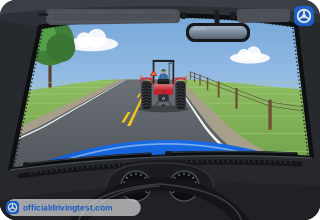
- Closure time is much quicker because of its slow speed
- Farm equipment is always wider than the lane it travels in
- Farm equipment often stops without warning on the roadway
- Farm equipment travels faster than most passenger vehicles
Show answer
Correct answer: Closure time is much quicker because of its slow speed
The manual says approaching farm equipment closes the gap much faster because the equipment moves so slowly.
Source: North Carolina Driver Handbook (Revised May 2025), page 52 · Open this page in the manual (Manual page 52)
-
On which roads in North Carolina is farm equipment NOT legally entitled to travel?
- Two-lane rural roads
- Secondary roads
- Interstates
- Roads inside city limits
Show answer
Correct answer: Interstates
Farm equipment may legally travel on most North Carolina roads except interstates.
Source: North Carolina Driver Handbook (Revised May 2025), page 52 · Open this page in the manual (Manual page 52)
-
What may larger trucks and buses need to do in a roundabout?
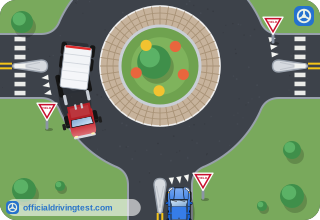
- Stop in the center island
- Straddle the lane
- Drive against the direction of traffic
- Use the shoulder
Show answer
Correct answer: Straddle the lane
The manual says to give larger trucks and buses extra room because they may need to straddle the lane.
Source: North Carolina Driver Handbook (Revised May 2025), page 59 · Open this page in the manual (Manual page 59)
-
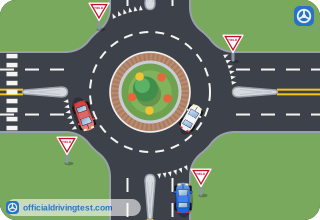
How should bicyclists position themselves in a multi-lane roundabout?
- Ride along the shoulder of the roundabout and stay to the right
- Ride against traffic on the outer edge of the roundabout
- Pick a lane and change lanes freely inside the roundabout
- Pick the appropriate lane before entering and stay in the middle of it
Show answer
Correct answer: Pick the appropriate lane before entering and stay in the middle of it
Bicyclists should pick the appropriate lane before entering a multi-lane roundabout and stay in the middle of their chosen lane, not along the shoulder.
Source: North Carolina Driver Handbook (Revised May 2025), page 59 · Open this page in the manual (Manual page 59)
-
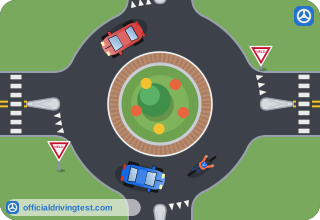
What should drivers not do to a bicyclist inside a roundabout?
- Yield to the bicyclist
- Pass the bicyclist
- Follow behind the bicyclist
- Give the bicyclist room
Show answer
Correct answer: Pass the bicyclist
Drivers should not pass a bicyclist while inside the roundabout.
Source: North Carolina Driver Handbook (Revised May 2025), page 59 · Open this page in the manual (Manual page 59)
-
When a bicycle lane or bike path travels on or adjacent to the roadway, what should you pay special attention to as you approach and move through an intersection?
- Bicyclists
- Parked vehicles
- Railroad signals
- School buses
Show answer
Correct answer: Bicyclists
The manual says to pay special attention to bicyclists when a bicycle lane or bike path is on or next to the roadway.
Source: North Carolina Driver Handbook (Revised May 2025), page 62 · Open this page in the manual (Manual page 62)
-
Because bicyclists ride to the right of traffic, what crash potential exists at an intersection?
- Between a bicyclist turning left and a motorist going straight ahead
- Between a bicyclist stopped at a signal and a motorist turning left
- Between a bicyclist moving straight ahead and a motorist turning right
- Between a bicyclist riding on the sidewalk and a motorist parking
Show answer
Correct answer: Between a bicyclist moving straight ahead and a motorist turning right
A crash can occur between a bicyclist moving straight ahead through the intersection and a motorist who is turning right.
Source: North Carolina Driver Handbook (Revised May 2025), page 63 · Open this page in the manual (Manual page 63)
-
Because bicycles are vehicles, which laws must bicyclists obey?
- Only the traffic laws that apply to pedestrians on the roadway
- The same traffic laws as drivers, but not the DWI laws
- Only the laws about stopping for stop signs and red lights
- The same traffic laws as other drivers, including DWI laws
Show answer
Correct answer: The same traffic laws as other drivers, including DWI laws
Bicyclists must obey the same traffic laws as other drivers, including DWI laws.
Source: North Carolina Driver Handbook (Revised May 2025), page 89 · Open this page in the manual (Manual page 89)
-
What should motorists expect and understand about bicyclists in the roadway?
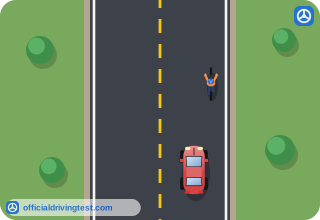
- Bicyclists may need to use the full travel lane
- Bicyclists must stay on the paved shoulder at all times
- Bicyclists may ride only in bicycle lanes when one is provided
- Bicyclists may use the travel lane only on roads without shoulders
Show answer
Correct answer: Bicyclists may need to use the full travel lane
Motorists should expect bicyclists in the roadway and understand they may need to use the full travel lane.
Source: North Carolina Driver Handbook (Revised May 2025), page 89 · Open this page in the manual (Manual page 89)
-
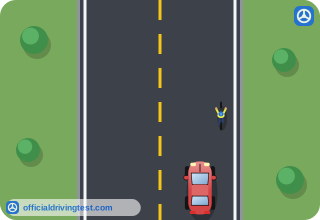
When may a driver pass a bicyclist?
- Only when the bicyclist has moved onto the shoulder
- Only after sounding your horn to warn the bicyclist
- Only with abundant clearance and no oncoming traffic
- Only when the bicyclist is riding in a marked bicycle lane
Show answer
Correct answer: Only with abundant clearance and no oncoming traffic
Drivers may pass a bicyclist only when there is abundant clearance and no oncoming traffic in the opposing lane.
Source: North Carolina Driver Handbook (Revised May 2025), page 90 · Open this page in the manual (Manual page 90)
-
What is the safest way to pass a bicyclist?
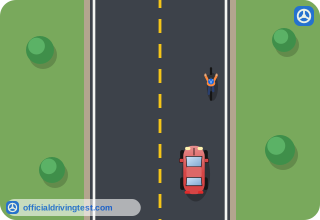
- Stay in your lane and pass slowly
- Change lanes
- Sound your horn and pass as quickly as possible
- Wait until the bicyclist moves onto the shoulder
Show answer
Correct answer: Change lanes
The manual says the safest way to pass a bicyclist is to change lanes.
Source: North Carolina Driver Handbook (Revised May 2025), page 90 · Open this page in the manual (Manual page 90)
-
In which direction should bicyclists ride relative to traffic?
- Facing traffic, so drivers can see them
- Facing traffic when they ride on the shoulder
- In either direction, if they stay near the edge
- With the flow of traffic, not facing it
Show answer
Correct answer: With the flow of traffic, not facing it
Bicyclists should ride right, with the traffic, and not facing traffic.
Source: North Carolina Driver Handbook (Revised May 2025), page 90 · Open this page in the manual (Manual page 90)
-
At night, the law requires a bicycle to have a light on the front visible for what distance?
- At least 300 feet
- At least 100 feet
- At least 200 feet
- At least 500 feet
Show answer
Correct answer: At least 300 feet
The law requires a front light visible for a distance of at least 300 feet at night.
Source: North Carolina Driver Handbook (Revised May 2025), page 90 · Open this page in the manual (Manual page 90)
-
At night, the law requires a red light or reflector on the rear of a bicycle visible for what distance?
- At least 100 feet
- At least 300 feet
- At least 200 feet
- At least 500 feet
Show answer
Correct answer: At least 200 feet
The law requires a red rear light or reflector visible for a distance of at least 200 feet.
Source: North Carolina Driver Handbook (Revised May 2025), page 90 · Open this page in the manual (Manual page 90)
-
Who must wear an approved protective bicycle helmet?
- All bicycle riders and passengers under age 18
- All bicycle riders and passengers under age 16
- Only bicycle riders under age 12
- Only bicycle passengers under age 16
Show answer
Correct answer: All bicycle riders and passengers under age 16
All bicycle riders and passengers under age 16 must wear an approved protective bicycle helmet.
Source: North Carolina Driver Handbook (Revised May 2025), page 90 · Open this page in the manual (Manual page 90)
-
When must a bicycle passenger be seated in a bicycle restraining seat?
- When the passenger weighs less than 60 pounds or is less than 48 inches tall
- When the passenger weighs less than 30 pounds or is less than 36 inches tall
- When the passenger weighs less than 50 pounds or is less than 44 inches tall
- When the passenger weighs less than 40 pounds or is less than 40 inches tall
Show answer
Correct answer: When the passenger weighs less than 40 pounds or is less than 40 inches tall
A passenger under 40 pounds or under 40 inches in height must use a bicycle restraining seat.
Source: North Carolina Driver Handbook (Revised May 2025), page 90 · Open this page in the manual (Manual page 90)
-
How do heavy trucks compare with cars in gaining speed?
- They gain speed faster, especially uphill
- They cannot gain speed as quickly, especially uphill
- They gain speed at the same rate, but stop more slowly
- They gain speed faster, especially downhill
Show answer
Correct answer: They cannot gain speed as quickly, especially uphill
Heavy trucks cannot gain speed as quickly as cars, especially while traveling uphill.
Source: North Carolina Driver Handbook (Revised May 2025), page 91 · Open this page in the manual (Manual page 91)
-
Because of its large size, how does a tractor-trailer often appear to be traveling?
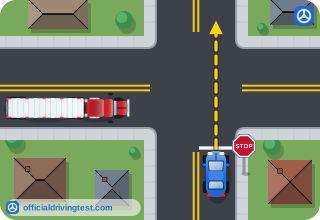
- At a faster speed than it really is
- At the same speed as nearby cars
- Farther away than it really is
- At a slower speed than it really is
Show answer
Correct answer: At a slower speed than it really is
A tractor-trailer often appears to be traveling more slowly than it actually is.
Source: North Carolina Driver Handbook (Revised May 2025), page 91 · Open this page in the manual (Manual page 91)
-
Why do large trucks require additional turning room?
- Their rear wheels do not follow the path of their front wheels
- Their front wheels turn more slowly than the wheels of a car
- Their drivers sit twice as high as the driver of a car
- Their brakes create heat when they travel in city traffic
Show answer
Correct answer: Their rear wheels do not follow the path of their front wheels
The rear wheels of a large truck do not follow the path of its front wheels, so it needs extra turning room.
Source: North Carolina Driver Handbook (Revised May 2025), page 91 · Open this page in the manual (Manual page 91)
-
When following a tractor-trailer that appears to be starting a left turn, what should you check before you try to pass?
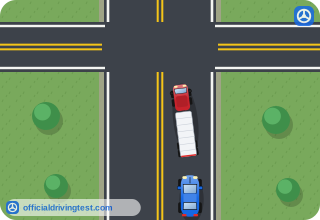
- Whether the truck’s brake lights are on
- Whether the truck is in the right-hand lane
- Which way the driver is signaling
- How fast the truck is traveling
Show answer
Correct answer: Which way the driver is signaling
Before passing a truck that seems to be starting a left turn, check which way the driver is signaling.
Source: North Carolina Driver Handbook (Revised May 2025), page 91 · Open this page in the manual (Manual page 91)
-
Why do trucks need additional stopping distance when traveling downhill?
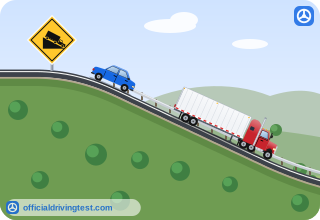
- Their tires lose traction on downgrades
- Their brakes create heat when going downhill
- Their engines cannot slow the vehicle
- Their drivers cannot see the road ahead
Show answer
Correct answer: Their brakes create heat when going downhill
Truck brakes create heat on downhill travel, which requires additional stopping distance.
Source: North Carolina Driver Handbook (Revised May 2025), page 91 · Open this page in the manual (Manual page 91)
-
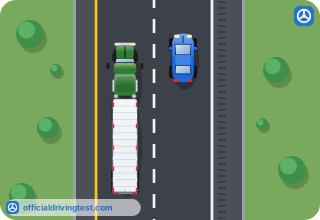
What may affect your steering when you drive beside large trucks or any large vehicle?
- Heat from the truck’s engine
- Exhaust fumes from the truck
- The shadow of the truck on the road
- Wind currents from the larger vehicle
Show answer
Correct answer: Wind currents from the larger vehicle
Wind currents created by a larger vehicle may affect your steering, so give the truck plenty of room.
Source: North Carolina Driver Handbook (Revised May 2025), page 91 · Open this page in the manual (Manual page 91)
-
What may happen when you follow large trucks?
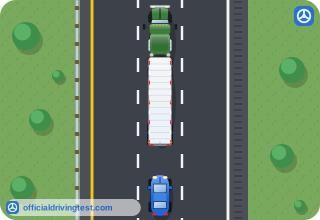
- Your vision may be blocked
- Your headlights may not work
- Your vehicle may lose traction
- Your speedometer may read incorrectly
Show answer
Correct answer: Your vision may be blocked
When following large trucks your vision may be blocked, so use caution when passing.
Source: North Carolina Driver Handbook (Revised May 2025), page 91 · Open this page in the manual (Manual page 91)
-
How high above the driver of a car do truck drivers sit, according to the manual?
- Three times as high
- One and a half times as high
- Twice as high
- Four times as high
Show answer
Correct answer: Twice as high
Truckers sit twice as high as the driver of a car, but they still have serious blind spots.
Source: North Carolina Driver Handbook (Revised May 2025), page 91 · Open this page in the manual (Manual page 91)
-
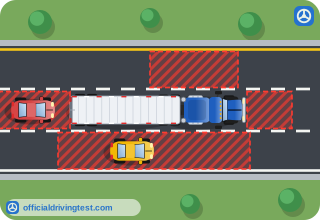
How far in front of the cab does the NO-ZONE of a tractor-trailer extend?
- Up to 10 feet
- Up to 20 feet
- Up to 50 feet
- Up to 100 feet
Show answer
Correct answer: Up to 20 feet
A tractor-trailer has NO-ZONES up to 20 feet in front of the cab, alongside it and up to 200 feet in the rear.
Source: North Carolina Driver Handbook (Revised May 2025), page 92 · Open this page in the manual (Manual page 92)
-
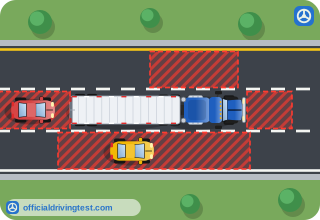
How far behind a tractor-trailer does the NO-ZONE in the rear extend?
- Up to 50 feet
- Up to 100 feet
- Up to 400 feet
- Up to 200 feet
Show answer
Correct answer: Up to 200 feet
The rear NO-ZONE of a tractor-trailer extends up to 200 feet.
Source: North Carolina Driver Handbook (Revised May 2025), page 92 · Open this page in the manual (Manual page 92)
-
What does the manual give as a general rule for sharing the road with a tractor-trailer?
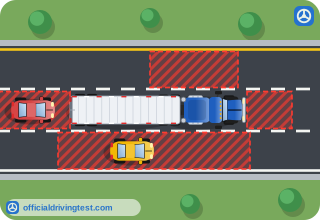
- If you can’t see the truck driver in their side-view mirror, they can’t see you
- If you can see the truck’s headlights, the driver can see you
- If the truck driver sits higher than you, you are always visible
- If you stay within 20 feet behind the truck, the driver can see you
Show answer
Correct answer: If you can’t see the truck driver in their side-view mirror, they can’t see you
If you cannot see the truck driver in the side-view mirror, the driver cannot see you.
Source: North Carolina Driver Handbook (Revised May 2025), page 92 · Open this page in the manual (Manual page 92)
-
What do motorists who linger in the NO-ZONES hamper?
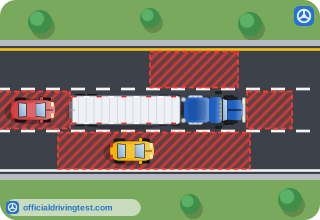
- The trucker’s ability to shift gears
- The trucker’s ability to see traffic signals
- The trucker’s ability to take evasive action
- The trucker’s ability to use turn signals
Show answer
Correct answer: The trucker’s ability to take evasive action
Motorists lingering in NO-ZONES hamper the trucker’s ability to take evasive action.
Source: North Carolina Driver Handbook (Revised May 2025), page 92 · Open this page in the manual (Manual page 92)
-
How do recreational vehicles and trailers compare with cars?
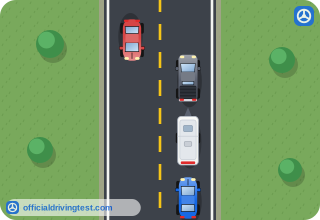
- They accelerate more slowly than cars but stop more quickly
- They accelerate and stop more slowly and need more turning room
- They stop more slowly than cars but need less room for turning
- They accelerate and stop as quickly as cars but are taller
Show answer
Correct answer: They accelerate and stop more slowly and need more turning room
Recreational vehicles and trailers accelerate and stop more slowly than cars and need more room to turn.
Source: North Carolina Driver Handbook (Revised May 2025), page 92 · Open this page in the manual (Manual page 92)
-
What happens to your field of vision as you approach a recreational vehicle more closely?
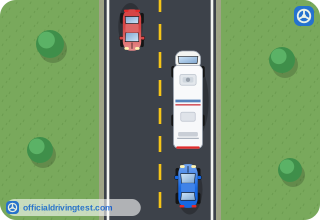
- It improves, because you can see past the sides
- It stays the same at any distance
- It widens as you get closer to the rear
- The recreational vehicle blocks more of it
Show answer
Correct answer: The recreational vehicle blocks more of it
The closer you are to a recreational vehicle, the more it blocks your field of vision.
Source: North Carolina Driver Handbook (Revised May 2025), page 92 · Open this page in the manual (Manual page 92)
-
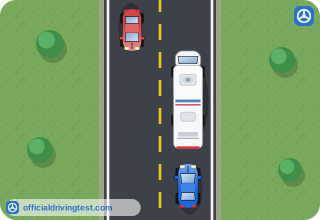
Why can drivers of recreational vehicles lose sight of you?
- Their blind spots are much larger than a car’s
- Their mirrors are always folded in
- Their windows are usually tinted
- They sit lower than the driver of a car
Show answer
Correct answer: Their blind spots are much larger than a car’s
Recreational vehicle drivers can lose sight of you because their blind spots are much larger than those of cars.
Source: North Carolina Driver Handbook (Revised May 2025), page 92 · Open this page in the manual (Manual page 92)
-
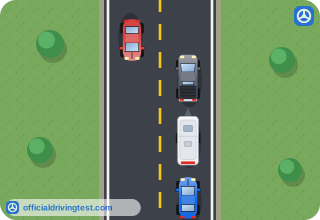
What might sudden braking cause a trailer to do?
- Come loose from the hitch
- Lose its lights
- Jackknife
- Roll onto its side at once
Show answer
Correct answer: Jackknife
Sudden braking might cause a trailer to jackknife.
Source: North Carolina Driver Handbook (Revised May 2025), page 92 · Open this page in the manual (Manual page 92)
-
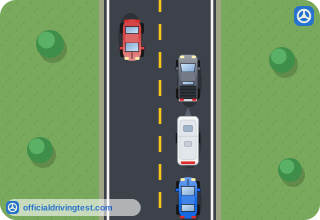
How much clear roadway may it take to pass a trailer and the towing vehicle safely?
- A quarter mile
- A half mile
- One mile
- Two miles
Show answer
Correct answer: A half mile
It may take a half mile of clear roadway to safely pass a trailer and its towing vehicle.
Source: North Carolina Driver Handbook (Revised May 2025), page 92 · Open this page in the manual (Manual page 92)
-
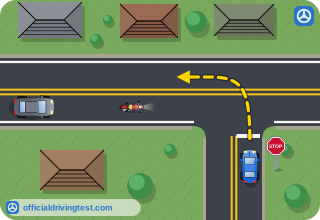
What right of way consideration should you give a motorcyclist or moped rider?
- Less than for larger vehicles, because they are smaller
- More than for other vehicles, because they cannot stop quickly
- None, because they may share the lane with you
- The same as for the driver of any other vehicle
Show answer
Correct answer: The same as for the driver of any other vehicle
Give motorcyclists and moped riders the same right of way consideration as any other driver.
Source: North Carolina Driver Handbook (Revised May 2025), page 92 · Open this page in the manual (Manual page 92)
-
How much of their lane are motorcycles entitled to?
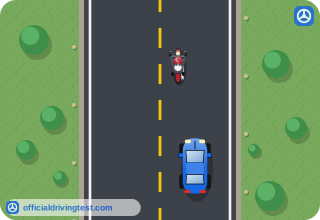
- The full width
- Half the width
- The right two-thirds
- Only the center
Show answer
Correct answer: The full width
Motorcycles are entitled to the full width of their lane.
Source: North Carolina Driver Handbook (Revised May 2025), page 92 · Open this page in the manual (Manual page 92)
-
How must you pass a motorcycle?
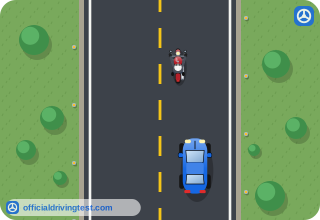
- Stay in the same lane and leave a safe gap
- Pass on the shoulder of the road
- Change lanes, as you would for a larger vehicle
- Share the lane and pass slowly
Show answer
Correct answer: Change lanes, as you would for a larger vehicle
To pass a motorcycle you must change lanes, just as you would to pass a larger motor vehicle.
Source: North Carolina Driver Handbook (Revised May 2025), page 92 · Open this page in the manual (Manual page 92)
-
Which part of its lane should a moped travel in?
- The left side
- The right side
- The center
- Any part of it
Show answer
Correct answer: The right side
A moped should travel using the right side of the lane.
Source: North Carolina Driver Handbook (Revised May 2025), page 92 · Open this page in the manual (Manual page 92)
-
How far to the left must you stay when you pass a moped?
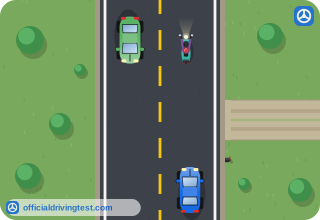
- At least one foot
- At least four feet
- At least six feet
- At least two feet
Show answer
Correct answer: At least two feet
To pass a moped you must stay at least two feet to the left.
Source: North Carolina Driver Handbook (Revised May 2025), page 92 · Open this page in the manual (Manual page 92)
-
How much room must you leave a cyclist when you pass?
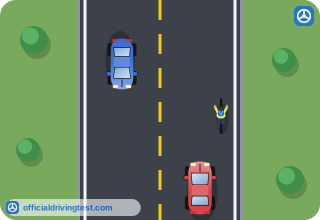
- Enough that your windstream cannot make the rider lose control
- Enough that you do not have to slow down while passing
- Enough that your right tires stay off the shoulder of the road
- Enough that the rider can see your turn signals at all times
Show answer
Correct answer: Enough that your windstream cannot make the rider lose control
You must leave enough room so your vehicle’s windstream cannot cause the rider to lose control.
Source: North Carolina Driver Handbook (Revised May 2025), page 92 · Open this page in the manual (Manual page 92)
-
When should you be especially watchful for motorcycles and mopeds?
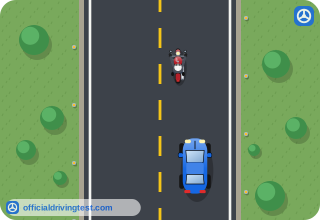
- Only when driving on freeways at high speeds
- Only when driving in heavy rain or fog
- When turning or entering the road from a driveway
- Only when a motorcycle has its headlight off
Show answer
Correct answer: When turning or entering the road from a driveway
Be especially watchful for motorcycles and mopeds while turning, changing lanes at intersections or entering the road from a driveway.
Source: North Carolina Driver Handbook (Revised May 2025), page 92 · Open this page in the manual (Manual page 92)
-
About what share of motorcycle crashes in North Carolina involve a car?
- About one-third
- About two-thirds
- About one-half
- About one-tenth
Show answer
Correct answer: About two-thirds
About two-thirds of motorcycle crashes in North Carolina involve a car.
Source: North Carolina Driver Handbook (Revised May 2025), page 93 · Open this page in the manual (Manual page 93)
-
In most motorcycle crashes that involve a car, who is usually at fault?
- The motorcyclist
- Whoever was traveling faster
- Whoever has more driving experience
- The driver of the car
Show answer
Correct answer: The driver of the car
In most of these crashes the driver of the car is at fault, and usually claims not to have seen the motorcycle.
Source: North Carolina Driver Handbook (Revised May 2025), page 93 · Open this page in the manual (Manual page 93)
-
What kind of helmet must moped riders and all passengers wear?
- A helmet with a secured retention strap that meets FMVSS 218
- A helmet with a face shield and a light-colored outer shell
- Any helmet that covers the ears, when riding on public roads
- A bicycle helmet approved for riders under age 16
Show answer
Correct answer: A helmet with a secured retention strap that meets FMVSS 218
Moped riders and all passengers must wear a helmet with a properly secured retention strap that complies with FMVSS 218.
Source: North Carolina Driver Handbook (Revised May 2025), page 93 · Open this page in the manual (Manual page 93)
-
What is true of many small motorcycles?
- They accelerate more rapidly than most passenger cars do
- They can always keep up with the speed of highway traffic
- They may not maintain speed going uphill or against a headwind
- They hold their speed on hills even against a headwind
Show answer
Correct answer: They may not maintain speed going uphill or against a headwind
Many small motorcycles do not accelerate rapidly and may not maintain speed going uphill or against a headwind.
Source: North Carolina Driver Handbook (Revised May 2025), page 93 · Open this page in the manual (Manual page 93)
-
When do motorcycles stop more slowly than cars?
- When the rider is not wearing a helmet or protective gear
- When there is a second rider or on poor road surfaces
- When traveling below 30 miles per hour on smooth pavement
- When traveling on dry pavement in daylight
Show answer
Correct answer: When there is a second rider or on poor road surfaces
Most motorcycles stop more quickly than cars, but they stop more slowly with a second rider or on poor road surfaces.
Source: North Carolina Driver Handbook (Revised May 2025), page 93 · Open this page in the manual (Manual page 93)
-
Which materials on the pavement can cause a cyclist ahead of you to lose control?
- Speed bumps and dry concrete
- Fresh asphalt and painted crosswalks
- Wide shoulders and smooth concrete
- Sand, gravel, wet leaves or water
Show answer
Correct answer: Sand, gravel, wet leaves or water
A cyclist could lose control when sand, gravel, wet leaves or water are on the pavement.
Source: North Carolina Driver Handbook (Revised May 2025), page 93 · Open this page in the manual (Manual page 93)
-
Which behavior is a sign of a beginning cyclist?
- Wobbling or jerking while starting to move
- Riding at the far right of the lane
- Riding with a passenger on the rear seat
- Wearing light or brightly colored clothing
Show answer
Correct answer: Wobbling or jerking while starting to move
Wobbling or jerking when starting, or hesitating over traffic decisions, are signs of a beginning cyclist.
Source: North Carolina Driver Handbook (Revised May 2025), page 93 · Open this page in the manual (Manual page 93)
-
Why should you never crowd a motorcycle or moped?
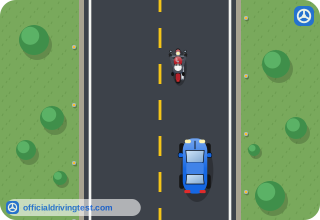
- Your headlights may blind the rider through the mirrors
- Your horn may startle the rider and cause a fall
- You would not have enough reaction time in an emergency
- Your engine noise may make the rider lose control
Show answer
Correct answer: You would not have enough reaction time in an emergency
Following too closely does not allow enough reaction time in an emergency.
Source: North Carolina Driver Handbook (Revised May 2025), page 93 · Open this page in the manual (Manual page 93)
-
What following distance should you allow behind a motorcycle or moped when road surfaces are slippery?
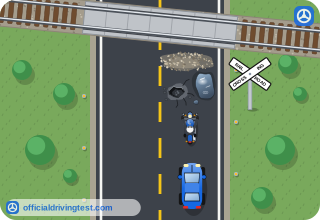
- The same distance as on dry roads
- A greater following distance
- A shorter following distance, since they are lighter
- No extra distance if their headlight is on
Show answer
Correct answer: A greater following distance
You should allow a greater following distance when road surfaces are slippery.
Source: North Carolina Driver Handbook (Revised May 2025), page 93 · Open this page in the manual (Manual page 93)
-
Why should you give a cyclist extra room at a rough or angled railroad crossing?
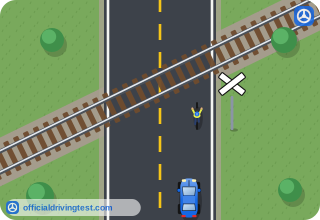
- The rider must stop and dismount to cross
- The rider must speed up to cross safely
- The rider is required to use the opposing lane
- The rider might need to slow down to cross
Show answer
Correct answer: The rider might need to slow down to cross
If the crossing is rough or at an angle, the rider might need to slow down to cross.
Source: North Carolina Driver Handbook (Revised May 2025), page 93 · Open this page in the manual (Manual page 93)
-
Which surfaces are hazardous for cyclists?
- Steel bridge expansion joints and metal grating on bridges
- Concrete bridge decks that are dry and clean
- Wide asphalt shoulders and concrete bridge decks
- Painted crosswalks and dry concrete pavement sections
Show answer
Correct answer: Steel bridge expansion joints and metal grating on bridges
Steel bridge expansion joints, metal grating on bridges and other metal surfaces are hazardous for cyclists.
Source: North Carolina Driver Handbook (Revised May 2025), page 93 · Open this page in the manual (Manual page 93)
-
How does North Carolina law define a moped?
- Two wheels only, a motor of no more than 100 cc, and no external shifting device
- Two or three wheels, a motor of no more than 50 cc, and an external shifting device
- Two or three wheels, a motor of no more than 50 cc, and no external shifting device
- Two or three wheels, a motor of no more than 150 cc, and a top speed of 45 mph
Show answer
Correct answer: Two or three wheels, a motor of no more than 50 cc, and no external shifting device
The law defines a moped as a vehicle with two or three wheels, a motor of no more than 50 cubic centimeters, and no external shifting device.
Source: North Carolina Driver Handbook (Revised May 2025), page 93 · Open this page in the manual (Manual page 93)
-
Legally, what is the top speed of a moped?
- 20 miles per hour
- 30 miles per hour
- 35 miles per hour
- 45 miles per hour
Show answer
Correct answer: 30 miles per hour
A moped’s top speed legally cannot exceed 30 miles per hour.
Source: North Carolina Driver Handbook (Revised May 2025), page 93 · Open this page in the manual (Manual page 93)
-
What is true of mopeds on the market that have top speeds higher than 30 mph?
- They may be used with a motorcycle license
- They may be used only on secondary roads
- They may be used only during daylight hours
- They are illegal for use in North Carolina
Show answer
Correct answer: They are illegal for use in North Carolina
Mopeds with top speeds higher than 30 mph are illegal for use in North Carolina.
Source: North Carolina Driver Handbook (Revised May 2025), page 93 · Open this page in the manual (Manual page 93)
-
How old must you be to operate a moped on a public roadway or public vehicular area?
- At least 16
- At least 14
- At least 15
- At least 18
Show answer
Correct answer: At least 16
You must be at least 16 years old to operate a moped on a public roadway or public vehicular area.
Source: North Carolina Driver Handbook (Revised May 2025), page 93 · Open this page in the manual (Manual page 93)
-
What must a moped operator have besides being at least 16 years old?
- A motorcycle endorsement only
- A moped safety course certificate
- A valid N.C. driver license or N.C. ID card
- A motorcycle license and a helmet permit
Show answer
Correct answer: A valid N.C. driver license or N.C. ID card
Moped operators must be 16 or older and have a valid N.C. driver license or N.C. ID card.
Source: North Carolina Driver Handbook (Revised May 2025), page 93 · Open this page in the manual (Manual page 93)
-
Which laws that apply to drivers of other motor vehicles also apply to moped operators?
- Commercial driver license laws
- Driving while impaired laws
- Emissions inspection laws
- Learner permit restriction laws
Show answer
Correct answer: Driving while impaired laws
Driving while impaired laws that apply to drivers of other motor vehicles also apply to moped operators.
Source: North Carolina Driver Handbook (Revised May 2025), page 93 · Open this page in the manual (Manual page 93)
-
Which rule for riding a moped concerns other vehicles?
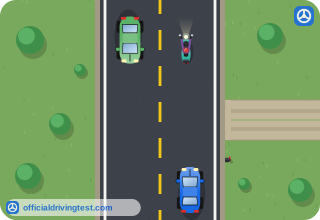
- Stay in the center of the lane to be seen
- Pass slower vehicles on the right side
- Ride close behind larger vehicles
- Do not share lanes with other vehicles
Show answer
Correct answer: Do not share lanes with other vehicles
The manual lists “Do not share lanes with other vehicles” among the rules for riding a moped.
Source: North Carolina Driver Handbook (Revised May 2025), page 94 · Open this page in the manual (Manual page 94)
-
What should a moped rider never do at an intersection?
- Squeeze between parked cars and traffic
- Ride to the right of the lane
- Look over the shoulder before moving
- Slow down before crossing traffic
Show answer
Correct answer: Squeeze between parked cars and traffic
At an intersection a moped rider should never squeeze between parked cars and moving traffic.
Source: North Carolina Driver Handbook (Revised May 2025), page 94 · Open this page in the manual (Manual page 94)
-
What kind of clothing should a moped rider wear so other drivers can see them?
- Dark clothing that matches the pavement
- Clothing with long sleeves only
- Light or brightly colored clothing
- Reflective clothing only at night
Show answer
Correct answer: Light or brightly colored clothing
A moped rider should wear light or brightly colored clothing so other drivers can see them.
Source: North Carolina Driver Handbook (Revised May 2025), page 94 · Open this page in the manual (Manual page 94)
-
What should a moped rider use if the moped has no electric turn signals?
- Horn signals when turning or stopping
- Hand signals when turning or stopping
- Flashing of the headlight when turning
- No signals, since the moped is slower than traffic
Show answer
Correct answer: Hand signals when turning or stopping
Without electric turn signals, a moped rider should use hand signals when turning or stopping.
Source: North Carolina Driver Handbook (Revised May 2025), page 94 · Open this page in the manual (Manual page 94)
-
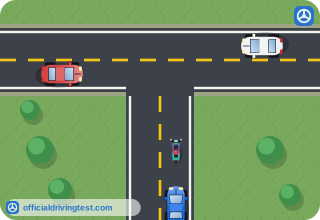
What should a moped rider do anytime the moped crosses the path of traffic?
- Speed up to clear the lane quickly
- Slow down and sound the horn without stopping
- Continue at the same speed if the road appears clear
- Slow down, stop and look carefully before proceeding
Show answer
Correct answer: Slow down, stop and look carefully before proceeding
Anytime you cross the path of traffic, slow down, stop and look carefully before you proceed.
Source: North Carolina Driver Handbook (Revised May 2025), page 94 · Open this page in the manual (Manual page 94)
-
What should a moped rider do before moving into traffic?
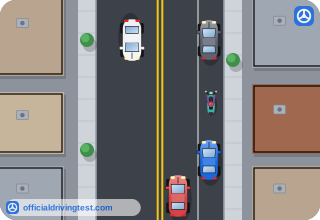
- Look over the shoulder
- Sound the horn twice
- Flash the headlight
- Wait for a gap of one full minute
Show answer
Correct answer: Look over the shoulder
A moped rider should look over the shoulder before moving into traffic and be careful around parked cars.
Source: North Carolina Driver Handbook (Revised May 2025), page 94 · Open this page in the manual (Manual page 94)
-
What should a moped rider wear to protect the body?
- A helmet and gloves, but shoes are optional in hot weather
- A jacket only, since the moped body protects the legs
- Protective clothing that covers the body, and shoes at all times
- Shorts and a T-shirt, since a moped is lightweight
Show answer
Correct answer: Protective clothing that covers the body, and shoes at all times
A moped rider should wear protective clothing that covers the body and always wear shoes.
Source: North Carolina Driver Handbook (Revised May 2025), page 94 · Open this page in the manual (Manual page 94)
-
Where must a moped’s license plate be displayed?
- On the front of the moped
- On the rear of the moped, at all times
- On the rider’s helmet
- Only while riding on state highways
Show answer
Correct answer: On the rear of the moped, at all times
The license plate must be displayed on the rear of the moped at all times.
Source: North Carolina Driver Handbook (Revised May 2025), page 94 · Open this page in the manual (Manual page 94)
-
What does the North Carolina Division of Motor Vehicles require all moped operators to do?
- Have the moped inspected every year and display a sticker
- Register the moped only if it is ridden on state highways
- Register the moped only if it was bought new
- Register the moped and obtain a registration card and license plate
Show answer
Correct answer: Register the moped and obtain a registration card and license plate
All moped operators must register their moped with the DMV and obtain a registration card and license plate.
Source: North Carolina Driver Handbook (Revised May 2025), page 94 · Open this page in the manual (Manual page 94)
-
Besides a valid N.C. driver license or ID card, what must a moped operator bring to register the moped?
- The manufacturer’s certificate of origin (MCO)
- A signed safety inspection form for the moped
- A title issued by another state’s agency
- A receipt showing that a helmet was purchased
Show answer
Correct answer: The manufacturer’s certificate of origin (MCO)
Registration requires a valid N.C. driver license or ID card along with the moped manufacturer’s certificate of origin (MCO).
Source: North Carolina Driver Handbook (Revised May 2025), page 94 · Open this page in the manual (Manual page 94)
-
What can a moped operator without an MCO fill out to serve as proof of ownership?
- A Title Application for a Moped signed by the seller
- A Certificate of Insurance issued by the operator’s insurer
- An Affidavit of Facts for the Registration of a Moped (MVR-58)
- A Statement of Ownership signed by a local law enforcement officer
Show answer
Correct answer: An Affidavit of Facts for the Registration of a Moped (MVR-58)
An operator without an MCO can fill out an Affidavit of Facts for the Registration of a Moped form (MVR-58).
Source: North Carolina Driver Handbook (Revised May 2025), page 94 · Open this page in the manual (Manual page 94)
-
Who is held responsible when litter is thrown or blown from a vehicle?
- Only the passenger who threw the litter
- The driver of the vehicle
- The owner of the vehicle, if not driving
- No one, if the litter blew out accidentally
Show answer
Correct answer: The driver of the vehicle
The driver of the vehicle is held responsible when litter is thrown or blown from it.
Source: North Carolina Driver Handbook (Revised May 2025), page 95 · Open this page in the manual (Manual page 95)
-
What are the minimum and maximum fines for a littering conviction?
- $100 minimum and $500 maximum
- $500 minimum and $2,000 maximum
- $50 minimum and $250 maximum
- $250 minimum and $1,000 maximum
Show answer
Correct answer: $250 minimum and $1,000 maximum
If convicted, the minimum fine is $250 and the maximum fine is $1,000.
Source: North Carolina Driver Handbook (Revised May 2025), page 95 · Open this page in the manual (Manual page 95)
-
What is the fine for a second or subsequent littering offense within three years of a prior offense?
- Not less than $500 nor more than $2,000
- Not less than $250 nor more than $1,000
- Not less than $100 nor more than $1,000
- Not less than $1,000 nor more than $5,000
Show answer
Correct answer: Not less than $500 nor more than $2,000
A second or later offense within three years is punishable by a fine of not less than $500 nor more than $2,000.
Source: North Carolina Driver Handbook (Revised May 2025), page 95 · Open this page in the manual (Manual page 95)
-
Why can litter on roadsides increase the risk of a collision?
- It can cover pavement markings
- It can hide roadway signs
- It can attract wildlife to road edges
- It can make road surfaces slippery
Show answer
Correct answer: It can attract wildlife to road edges
Roadside litter can attract wildlife to road edges, increasing the risk of a wildlife-vehicle collision.
Source: North Carolina Driver Handbook (Revised May 2025), page 95 · Open this page in the manual (Manual page 95)