North Carolina: Sharing the road — Part 3 Practice Test
Questions in this part include: “Which part of its lane should a moped travel in?”
Independent educational site · not affiliated with any government agency or DMV
Ready? Test yourself
- Instant feedback with an explanation
- Every answer cites its source in the manual
- Your best score is saved on this device
Questions are original and based on the official manual "North Carolina Driver Handbook" (Revised May 2025), North Carolina Division of Motor Vehicles (NCDMV).
All 16 questions in this practice test
Take the test above first, then use this list to study. Tap “Show answer” to see the correct answer and explanation.
Show the questions and answersHide the questions
-
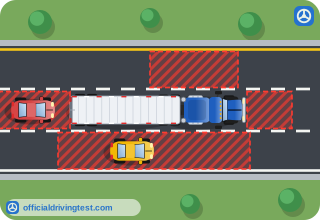
How far in front of the cab does the NO-ZONE of a tractor-trailer extend?
- Up to 10 feet
- Up to 20 feet
- Up to 50 feet
- Up to 100 feet
Show answer
Correct answer: Up to 20 feet
A tractor-trailer has NO-ZONES up to 20 feet in front of the cab, alongside it and up to 200 feet in the rear.
Source: North Carolina Driver Handbook (Revised May 2025), page 92 · Open this page in the manual (Manual page 92)
-
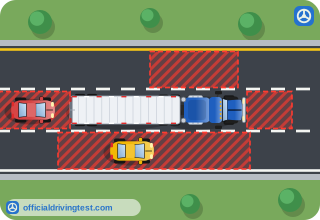
How far behind a tractor-trailer does the NO-ZONE in the rear extend?
- Up to 50 feet
- Up to 100 feet
- Up to 400 feet
- Up to 200 feet
Show answer
Correct answer: Up to 200 feet
The rear NO-ZONE of a tractor-trailer extends up to 200 feet.
Source: North Carolina Driver Handbook (Revised May 2025), page 92 · Open this page in the manual (Manual page 92)
-
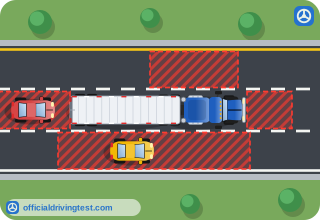
What does the manual give as a general rule for sharing the road with a tractor-trailer?
- If you can’t see the truck driver in their side-view mirror, they can’t see you
- If you can see the truck’s headlights, the driver can see you
- If the truck driver sits higher than you, you are always visible
- If you stay within 20 feet behind the truck, the driver can see you
Show answer
Correct answer: If you can’t see the truck driver in their side-view mirror, they can’t see you
If you cannot see the truck driver in the side-view mirror, the driver cannot see you.
Source: North Carolina Driver Handbook (Revised May 2025), page 92 · Open this page in the manual (Manual page 92)
-
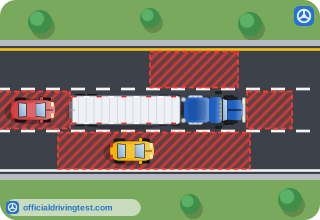
What do motorists who linger in the NO-ZONES hamper?
- The trucker’s ability to shift gears
- The trucker’s ability to see traffic signals
- The trucker’s ability to take evasive action
- The trucker’s ability to use turn signals
Show answer
Correct answer: The trucker’s ability to take evasive action
Motorists lingering in NO-ZONES hamper the trucker’s ability to take evasive action.
Source: North Carolina Driver Handbook (Revised May 2025), page 92 · Open this page in the manual (Manual page 92)
-
How do recreational vehicles and trailers compare with cars?
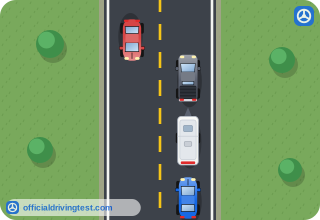
- They accelerate more slowly than cars but stop more quickly
- They accelerate and stop more slowly and need more turning room
- They stop more slowly than cars but need less room for turning
- They accelerate and stop as quickly as cars but are taller
Show answer
Correct answer: They accelerate and stop more slowly and need more turning room
Recreational vehicles and trailers accelerate and stop more slowly than cars and need more room to turn.
Source: North Carolina Driver Handbook (Revised May 2025), page 92 · Open this page in the manual (Manual page 92)
-
What happens to your field of vision as you approach a recreational vehicle more closely?
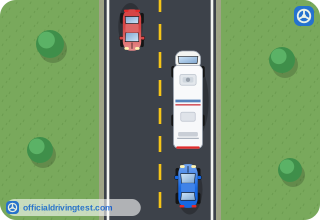
- It improves, because you can see past the sides
- It stays the same at any distance
- It widens as you get closer to the rear
- The recreational vehicle blocks more of it
Show answer
Correct answer: The recreational vehicle blocks more of it
The closer you are to a recreational vehicle, the more it blocks your field of vision.
Source: North Carolina Driver Handbook (Revised May 2025), page 92 · Open this page in the manual (Manual page 92)
-
Why can drivers of recreational vehicles lose sight of you?
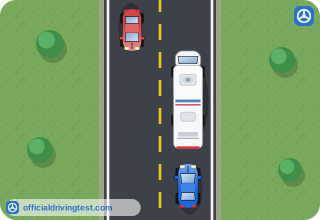
- Their blind spots are much larger than a car’s
- Their mirrors are always folded in
- Their windows are usually tinted
- They sit lower than the driver of a car
Show answer
Correct answer: Their blind spots are much larger than a car’s
Recreational vehicle drivers can lose sight of you because their blind spots are much larger than those of cars.
Source: North Carolina Driver Handbook (Revised May 2025), page 92 · Open this page in the manual (Manual page 92)
-
What might sudden braking cause a trailer to do?
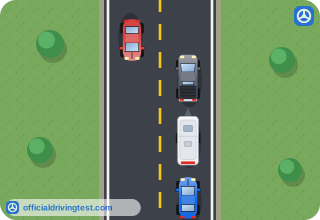
- Come loose from the hitch
- Lose its lights
- Jackknife
- Roll onto its side at once
Show answer
Correct answer: Jackknife
Sudden braking might cause a trailer to jackknife.
Source: North Carolina Driver Handbook (Revised May 2025), page 92 · Open this page in the manual (Manual page 92)
-
How much clear roadway may it take to pass a trailer and the towing vehicle safely?
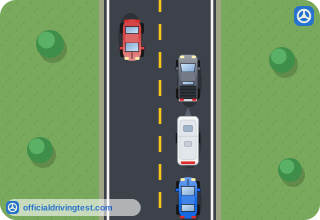
- A quarter mile
- A half mile
- One mile
- Two miles
Show answer
Correct answer: A half mile
It may take a half mile of clear roadway to safely pass a trailer and its towing vehicle.
Source: North Carolina Driver Handbook (Revised May 2025), page 92 · Open this page in the manual (Manual page 92)
-
What right of way consideration should you give a motorcyclist or moped rider?
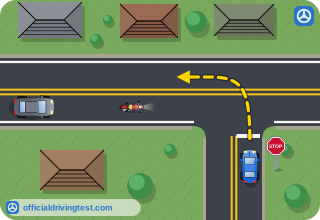
- Less than for larger vehicles, because they are smaller
- More than for other vehicles, because they cannot stop quickly
- None, because they may share the lane with you
- The same as for the driver of any other vehicle
Show answer
Correct answer: The same as for the driver of any other vehicle
Give motorcyclists and moped riders the same right of way consideration as any other driver.
Source: North Carolina Driver Handbook (Revised May 2025), page 92 · Open this page in the manual (Manual page 92)
-
How much of their lane are motorcycles entitled to?
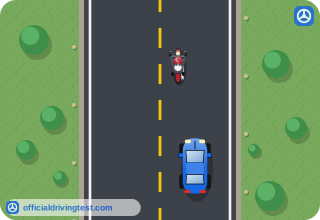
- The full width
- Half the width
- The right two-thirds
- Only the center
Show answer
Correct answer: The full width
Motorcycles are entitled to the full width of their lane.
Source: North Carolina Driver Handbook (Revised May 2025), page 92 · Open this page in the manual (Manual page 92)
-
How must you pass a motorcycle?
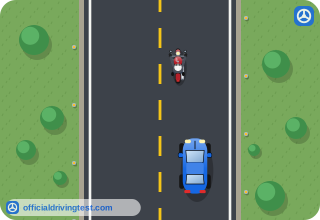
- Stay in the same lane and leave a safe gap
- Pass on the shoulder of the road
- Change lanes, as you would for a larger vehicle
- Share the lane and pass slowly
Show answer
Correct answer: Change lanes, as you would for a larger vehicle
To pass a motorcycle you must change lanes, just as you would to pass a larger motor vehicle.
Source: North Carolina Driver Handbook (Revised May 2025), page 92 · Open this page in the manual (Manual page 92)
-
Which part of its lane should a moped travel in?
- The left side
- The right side
- The center
- Any part of it
Show answer
Correct answer: The right side
A moped should travel using the right side of the lane.
Source: North Carolina Driver Handbook (Revised May 2025), page 92 · Open this page in the manual (Manual page 92)
-
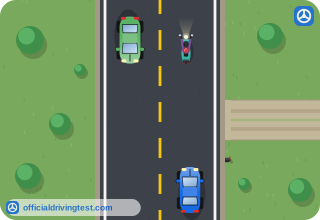
How far to the left must you stay when you pass a moped?
- At least one foot
- At least four feet
- At least six feet
- At least two feet
Show answer
Correct answer: At least two feet
To pass a moped you must stay at least two feet to the left.
Source: North Carolina Driver Handbook (Revised May 2025), page 92 · Open this page in the manual (Manual page 92)
-
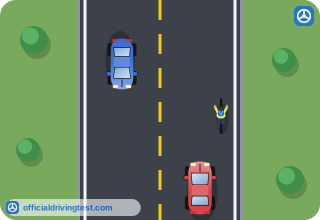
How much room must you leave a cyclist when you pass?
- Enough that your windstream cannot make the rider lose control
- Enough that you do not have to slow down while passing
- Enough that your right tires stay off the shoulder of the road
- Enough that the rider can see your turn signals at all times
Show answer
Correct answer: Enough that your windstream cannot make the rider lose control
You must leave enough room so your vehicle’s windstream cannot cause the rider to lose control.
Source: North Carolina Driver Handbook (Revised May 2025), page 92 · Open this page in the manual (Manual page 92)
-
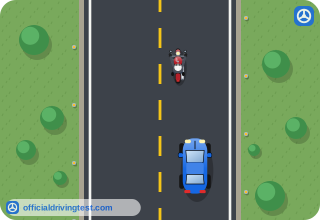
When should you be especially watchful for motorcycles and mopeds?
- Only when driving on freeways at high speeds
- Only when driving in heavy rain or fog
- When turning or entering the road from a driveway
- Only when a motorcycle has its headlight off
Show answer
Correct answer: When turning or entering the road from a driveway
Be especially watchful for motorcycles and mopeds while turning, changing lanes at intersections or entering the road from a driveway.
Source: North Carolina Driver Handbook (Revised May 2025), page 92 · Open this page in the manual (Manual page 92)