North Carolina: Sharing the road — Part 4 Practice Test
Questions in this part include: “About what share of motorcycle crashes in North Carolina involve a car?” · “Which behavior is a sign of a beginning cyclist?”
Independent educational site · not affiliated with any government agency or DMV
Ready? Test yourself
- Instant feedback with an explanation
- Every answer cites its source in the manual
- Your best score is saved on this device
Questions are original and based on the official manual "North Carolina Driver Handbook" (Revised May 2025), North Carolina Division of Motor Vehicles (NCDMV).
All 16 questions in this practice test
Take the test above first, then use this list to study. Tap “Show answer” to see the correct answer and explanation.
Show the questions and answersHide the questions
-
About what share of motorcycle crashes in North Carolina involve a car?
- About one-third
- About two-thirds
- About one-half
- About one-tenth
Show answer
Correct answer: About two-thirds
About two-thirds of motorcycle crashes in North Carolina involve a car.
Source: North Carolina Driver Handbook (Revised May 2025), page 93 · Open this page in the manual (Manual page 93)
-
In most motorcycle crashes that involve a car, who is usually at fault?
- The motorcyclist
- Whoever was traveling faster
- Whoever has more driving experience
- The driver of the car
Show answer
Correct answer: The driver of the car
In most of these crashes the driver of the car is at fault, and usually claims not to have seen the motorcycle.
Source: North Carolina Driver Handbook (Revised May 2025), page 93 · Open this page in the manual (Manual page 93)
-
What kind of helmet must moped riders and all passengers wear?
- A helmet with a secured retention strap that meets FMVSS 218
- A helmet with a face shield and a light-colored outer shell
- Any helmet that covers the ears, when riding on public roads
- A bicycle helmet approved for riders under age 16
Show answer
Correct answer: A helmet with a secured retention strap that meets FMVSS 218
Moped riders and all passengers must wear a helmet with a properly secured retention strap that complies with FMVSS 218.
Source: North Carolina Driver Handbook (Revised May 2025), page 93 · Open this page in the manual (Manual page 93)
-
What is true of many small motorcycles?
- They accelerate more rapidly than most passenger cars do
- They can always keep up with the speed of highway traffic
- They may not maintain speed going uphill or against a headwind
- They hold their speed on hills even against a headwind
Show answer
Correct answer: They may not maintain speed going uphill or against a headwind
Many small motorcycles do not accelerate rapidly and may not maintain speed going uphill or against a headwind.
Source: North Carolina Driver Handbook (Revised May 2025), page 93 · Open this page in the manual (Manual page 93)
-
When do motorcycles stop more slowly than cars?
- When the rider is not wearing a helmet or protective gear
- When there is a second rider or on poor road surfaces
- When traveling below 30 miles per hour on smooth pavement
- When traveling on dry pavement in daylight
Show answer
Correct answer: When there is a second rider or on poor road surfaces
Most motorcycles stop more quickly than cars, but they stop more slowly with a second rider or on poor road surfaces.
Source: North Carolina Driver Handbook (Revised May 2025), page 93 · Open this page in the manual (Manual page 93)
-
Which materials on the pavement can cause a cyclist ahead of you to lose control?
- Speed bumps and dry concrete
- Fresh asphalt and painted crosswalks
- Wide shoulders and smooth concrete
- Sand, gravel, wet leaves or water
Show answer
Correct answer: Sand, gravel, wet leaves or water
A cyclist could lose control when sand, gravel, wet leaves or water are on the pavement.
Source: North Carolina Driver Handbook (Revised May 2025), page 93 · Open this page in the manual (Manual page 93)
-
Which behavior is a sign of a beginning cyclist?
- Wobbling or jerking while starting to move
- Riding at the far right of the lane
- Riding with a passenger on the rear seat
- Wearing light or brightly colored clothing
Show answer
Correct answer: Wobbling or jerking while starting to move
Wobbling or jerking when starting, or hesitating over traffic decisions, are signs of a beginning cyclist.
Source: North Carolina Driver Handbook (Revised May 2025), page 93 · Open this page in the manual (Manual page 93)
-
Why should you never crowd a motorcycle or moped?
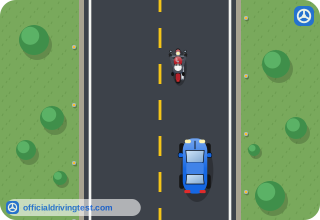
- Your headlights may blind the rider through the mirrors
- Your horn may startle the rider and cause a fall
- You would not have enough reaction time in an emergency
- Your engine noise may make the rider lose control
Show answer
Correct answer: You would not have enough reaction time in an emergency
Following too closely does not allow enough reaction time in an emergency.
Source: North Carolina Driver Handbook (Revised May 2025), page 93 · Open this page in the manual (Manual page 93)
-
What following distance should you allow behind a motorcycle or moped when road surfaces are slippery?
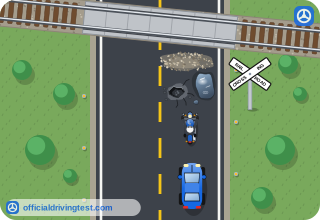
- The same distance as on dry roads
- A greater following distance
- A shorter following distance, since they are lighter
- No extra distance if their headlight is on
Show answer
Correct answer: A greater following distance
You should allow a greater following distance when road surfaces are slippery.
Source: North Carolina Driver Handbook (Revised May 2025), page 93 · Open this page in the manual (Manual page 93)
-
Why should you give a cyclist extra room at a rough or angled railroad crossing?
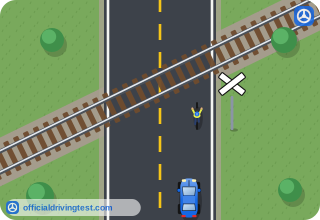
- The rider must stop and dismount to cross
- The rider must speed up to cross safely
- The rider is required to use the opposing lane
- The rider might need to slow down to cross
Show answer
Correct answer: The rider might need to slow down to cross
If the crossing is rough or at an angle, the rider might need to slow down to cross.
Source: North Carolina Driver Handbook (Revised May 2025), page 93 · Open this page in the manual (Manual page 93)
-
Which surfaces are hazardous for cyclists?
- Steel bridge expansion joints and metal grating on bridges
- Concrete bridge decks that are dry and clean
- Wide asphalt shoulders and concrete bridge decks
- Painted crosswalks and dry concrete pavement sections
Show answer
Correct answer: Steel bridge expansion joints and metal grating on bridges
Steel bridge expansion joints, metal grating on bridges and other metal surfaces are hazardous for cyclists.
Source: North Carolina Driver Handbook (Revised May 2025), page 93 · Open this page in the manual (Manual page 93)
-
How does North Carolina law define a moped?
- Two wheels only, a motor of no more than 100 cc, and no external shifting device
- Two or three wheels, a motor of no more than 50 cc, and an external shifting device
- Two or three wheels, a motor of no more than 50 cc, and no external shifting device
- Two or three wheels, a motor of no more than 150 cc, and a top speed of 45 mph
Show answer
Correct answer: Two or three wheels, a motor of no more than 50 cc, and no external shifting device
The law defines a moped as a vehicle with two or three wheels, a motor of no more than 50 cubic centimeters, and no external shifting device.
Source: North Carolina Driver Handbook (Revised May 2025), page 93 · Open this page in the manual (Manual page 93)
-
Legally, what is the top speed of a moped?
- 20 miles per hour
- 30 miles per hour
- 35 miles per hour
- 45 miles per hour
Show answer
Correct answer: 30 miles per hour
A moped’s top speed legally cannot exceed 30 miles per hour.
Source: North Carolina Driver Handbook (Revised May 2025), page 93 · Open this page in the manual (Manual page 93)
-
What is true of mopeds on the market that have top speeds higher than 30 mph?
- They may be used with a motorcycle license
- They may be used only on secondary roads
- They may be used only during daylight hours
- They are illegal for use in North Carolina
Show answer
Correct answer: They are illegal for use in North Carolina
Mopeds with top speeds higher than 30 mph are illegal for use in North Carolina.
Source: North Carolina Driver Handbook (Revised May 2025), page 93 · Open this page in the manual (Manual page 93)
-
How old must you be to operate a moped on a public roadway or public vehicular area?
- At least 16
- At least 14
- At least 15
- At least 18
Show answer
Correct answer: At least 16
You must be at least 16 years old to operate a moped on a public roadway or public vehicular area.
Source: North Carolina Driver Handbook (Revised May 2025), page 93 · Open this page in the manual (Manual page 93)
-
What must a moped operator have besides being at least 16 years old?
- A motorcycle endorsement only
- A moped safety course certificate
- A valid N.C. driver license or N.C. ID card
- A motorcycle license and a helmet permit
Show answer
Correct answer: A valid N.C. driver license or N.C. ID card
Moped operators must be 16 or older and have a valid N.C. driver license or N.C. ID card.
Source: North Carolina Driver Handbook (Revised May 2025), page 93 · Open this page in the manual (Manual page 93)