North Carolina: Sharing the road — Part 2 Practice Test
Questions in this part include: “Because bicycles are vehicles, which laws must bicyclists obey?” · “Who must wear an approved protective bicycle helmet?”
Independent educational site · not affiliated with any government agency or DMV
Ready? Test yourself
- Instant feedback with an explanation
- Every answer cites its source in the manual
- Your best score is saved on this device
Questions are original and based on the official manual "North Carolina Driver Handbook" (Revised May 2025), North Carolina Division of Motor Vehicles (NCDMV).
All 17 questions in this practice test
Take the test above first, then use this list to study. Tap “Show answer” to see the correct answer and explanation.
Show the questions and answersHide the questions
-
Because bicycles are vehicles, which laws must bicyclists obey?
- Only the traffic laws that apply to pedestrians on the roadway
- The same traffic laws as drivers, but not the DWI laws
- Only the laws about stopping for stop signs and red lights
- The same traffic laws as other drivers, including DWI laws
Show answer
Correct answer: The same traffic laws as other drivers, including DWI laws
Bicyclists must obey the same traffic laws as other drivers, including DWI laws.
Source: North Carolina Driver Handbook (Revised May 2025), page 89 · Open this page in the manual (Manual page 89)
-
What should motorists expect and understand about bicyclists in the roadway?
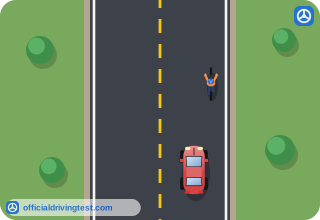
- Bicyclists may need to use the full travel lane
- Bicyclists must stay on the paved shoulder at all times
- Bicyclists may ride only in bicycle lanes when one is provided
- Bicyclists may use the travel lane only on roads without shoulders
Show answer
Correct answer: Bicyclists may need to use the full travel lane
Motorists should expect bicyclists in the roadway and understand they may need to use the full travel lane.
Source: North Carolina Driver Handbook (Revised May 2025), page 89 · Open this page in the manual (Manual page 89)
-
When may a driver pass a bicyclist?
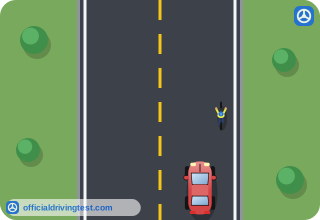
- Only when the bicyclist has moved onto the shoulder
- Only after sounding your horn to warn the bicyclist
- Only with abundant clearance and no oncoming traffic
- Only when the bicyclist is riding in a marked bicycle lane
Show answer
Correct answer: Only with abundant clearance and no oncoming traffic
Drivers may pass a bicyclist only when there is abundant clearance and no oncoming traffic in the opposing lane.
Source: North Carolina Driver Handbook (Revised May 2025), page 90 · Open this page in the manual (Manual page 90)
-
What is the safest way to pass a bicyclist?
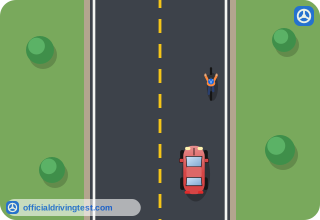
- Stay in your lane and pass slowly
- Change lanes
- Sound your horn and pass as quickly as possible
- Wait until the bicyclist moves onto the shoulder
Show answer
Correct answer: Change lanes
The manual says the safest way to pass a bicyclist is to change lanes.
Source: North Carolina Driver Handbook (Revised May 2025), page 90 · Open this page in the manual (Manual page 90)
-
In which direction should bicyclists ride relative to traffic?
- Facing traffic, so drivers can see them
- Facing traffic when they ride on the shoulder
- In either direction, if they stay near the edge
- With the flow of traffic, not facing it
Show answer
Correct answer: With the flow of traffic, not facing it
Bicyclists should ride right, with the traffic, and not facing traffic.
Source: North Carolina Driver Handbook (Revised May 2025), page 90 · Open this page in the manual (Manual page 90)
-
At night, the law requires a bicycle to have a light on the front visible for what distance?
- At least 300 feet
- At least 100 feet
- At least 200 feet
- At least 500 feet
Show answer
Correct answer: At least 300 feet
The law requires a front light visible for a distance of at least 300 feet at night.
Source: North Carolina Driver Handbook (Revised May 2025), page 90 · Open this page in the manual (Manual page 90)
-
At night, the law requires a red light or reflector on the rear of a bicycle visible for what distance?
- At least 100 feet
- At least 300 feet
- At least 200 feet
- At least 500 feet
Show answer
Correct answer: At least 200 feet
The law requires a red rear light or reflector visible for a distance of at least 200 feet.
Source: North Carolina Driver Handbook (Revised May 2025), page 90 · Open this page in the manual (Manual page 90)
-
Who must wear an approved protective bicycle helmet?
- All bicycle riders and passengers under age 18
- All bicycle riders and passengers under age 16
- Only bicycle riders under age 12
- Only bicycle passengers under age 16
Show answer
Correct answer: All bicycle riders and passengers under age 16
All bicycle riders and passengers under age 16 must wear an approved protective bicycle helmet.
Source: North Carolina Driver Handbook (Revised May 2025), page 90 · Open this page in the manual (Manual page 90)
-
When must a bicycle passenger be seated in a bicycle restraining seat?
- When the passenger weighs less than 60 pounds or is less than 48 inches tall
- When the passenger weighs less than 30 pounds or is less than 36 inches tall
- When the passenger weighs less than 50 pounds or is less than 44 inches tall
- When the passenger weighs less than 40 pounds or is less than 40 inches tall
Show answer
Correct answer: When the passenger weighs less than 40 pounds or is less than 40 inches tall
A passenger under 40 pounds or under 40 inches in height must use a bicycle restraining seat.
Source: North Carolina Driver Handbook (Revised May 2025), page 90 · Open this page in the manual (Manual page 90)
-
How do heavy trucks compare with cars in gaining speed?
- They gain speed faster, especially uphill
- They cannot gain speed as quickly, especially uphill
- They gain speed at the same rate, but stop more slowly
- They gain speed faster, especially downhill
Show answer
Correct answer: They cannot gain speed as quickly, especially uphill
Heavy trucks cannot gain speed as quickly as cars, especially while traveling uphill.
Source: North Carolina Driver Handbook (Revised May 2025), page 91 · Open this page in the manual (Manual page 91)
-
Because of its large size, how does a tractor-trailer often appear to be traveling?
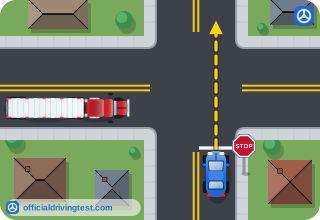
- At a faster speed than it really is
- At the same speed as nearby cars
- Farther away than it really is
- At a slower speed than it really is
Show answer
Correct answer: At a slower speed than it really is
A tractor-trailer often appears to be traveling more slowly than it actually is.
Source: North Carolina Driver Handbook (Revised May 2025), page 91 · Open this page in the manual (Manual page 91)
-
Why do large trucks require additional turning room?
- Their rear wheels do not follow the path of their front wheels
- Their front wheels turn more slowly than the wheels of a car
- Their drivers sit twice as high as the driver of a car
- Their brakes create heat when they travel in city traffic
Show answer
Correct answer: Their rear wheels do not follow the path of their front wheels
The rear wheels of a large truck do not follow the path of its front wheels, so it needs extra turning room.
Source: North Carolina Driver Handbook (Revised May 2025), page 91 · Open this page in the manual (Manual page 91)
-
When following a tractor-trailer that appears to be starting a left turn, what should you check before you try to pass?
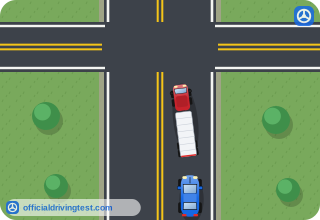
- Whether the truck’s brake lights are on
- Whether the truck is in the right-hand lane
- Which way the driver is signaling
- How fast the truck is traveling
Show answer
Correct answer: Which way the driver is signaling
Before passing a truck that seems to be starting a left turn, check which way the driver is signaling.
Source: North Carolina Driver Handbook (Revised May 2025), page 91 · Open this page in the manual (Manual page 91)
-
Why do trucks need additional stopping distance when traveling downhill?
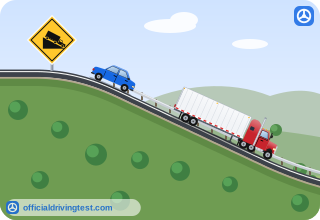
- Their tires lose traction on downgrades
- Their brakes create heat when going downhill
- Their engines cannot slow the vehicle
- Their drivers cannot see the road ahead
Show answer
Correct answer: Their brakes create heat when going downhill
Truck brakes create heat on downhill travel, which requires additional stopping distance.
Source: North Carolina Driver Handbook (Revised May 2025), page 91 · Open this page in the manual (Manual page 91)
-
What may affect your steering when you drive beside large trucks or any large vehicle?
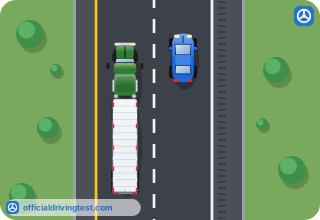
- Heat from the truck’s engine
- Exhaust fumes from the truck
- The shadow of the truck on the road
- Wind currents from the larger vehicle
Show answer
Correct answer: Wind currents from the larger vehicle
Wind currents created by a larger vehicle may affect your steering, so give the truck plenty of room.
Source: North Carolina Driver Handbook (Revised May 2025), page 91 · Open this page in the manual (Manual page 91)
-
What may happen when you follow large trucks?
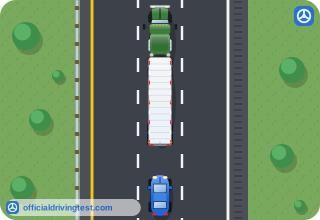
- Your vision may be blocked
- Your headlights may not work
- Your vehicle may lose traction
- Your speedometer may read incorrectly
Show answer
Correct answer: Your vision may be blocked
When following large trucks your vision may be blocked, so use caution when passing.
Source: North Carolina Driver Handbook (Revised May 2025), page 91 · Open this page in the manual (Manual page 91)
-
How high above the driver of a car do truck drivers sit, according to the manual?
- Three times as high
- One and a half times as high
- Twice as high
- Four times as high
Show answer
Correct answer: Twice as high
Truckers sit twice as high as the driver of a car, but they still have serious blind spots.
Source: North Carolina Driver Handbook (Revised May 2025), page 91 · Open this page in the manual (Manual page 91)