North Carolina: Sharing the road — Part 5 Practice Test
Questions in this part include: “Which laws that apply to drivers of other motor vehicles also apply to moped operators?” · “What does the North Carolina Division of Motor Vehicles require all moped operators to do?”
Independent educational site · not affiliated with any government agency or DMV
Ready? Test yourself
- Instant feedback with an explanation
- Every answer cites its source in the manual
- Your best score is saved on this device
Questions are original and based on the official manual "North Carolina Driver Handbook" (Revised May 2025), North Carolina Division of Motor Vehicles (NCDMV).
All 16 questions in this practice test
Take the test above first, then use this list to study. Tap “Show answer” to see the correct answer and explanation.
Show the questions and answersHide the questions
-
Which laws that apply to drivers of other motor vehicles also apply to moped operators?
- Commercial driver license laws
- Driving while impaired laws
- Emissions inspection laws
- Learner permit restriction laws
Show answer
Correct answer: Driving while impaired laws
Driving while impaired laws that apply to drivers of other motor vehicles also apply to moped operators.
Source: North Carolina Driver Handbook (Revised May 2025), page 93 · Open this page in the manual (Manual page 93)
-
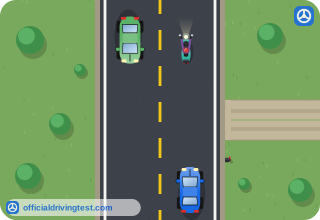
Which rule for riding a moped concerns other vehicles?
- Stay in the center of the lane to be seen
- Pass slower vehicles on the right side
- Ride close behind larger vehicles
- Do not share lanes with other vehicles
Show answer
Correct answer: Do not share lanes with other vehicles
The manual lists “Do not share lanes with other vehicles” among the rules for riding a moped.
Source: North Carolina Driver Handbook (Revised May 2025), page 94 · Open this page in the manual (Manual page 94)
-
What should a moped rider never do at an intersection?
- Squeeze between parked cars and traffic
- Ride to the right of the lane
- Look over the shoulder before moving
- Slow down before crossing traffic
Show answer
Correct answer: Squeeze between parked cars and traffic
At an intersection a moped rider should never squeeze between parked cars and moving traffic.
Source: North Carolina Driver Handbook (Revised May 2025), page 94 · Open this page in the manual (Manual page 94)
-
What kind of clothing should a moped rider wear so other drivers can see them?
- Dark clothing that matches the pavement
- Clothing with long sleeves only
- Light or brightly colored clothing
- Reflective clothing only at night
Show answer
Correct answer: Light or brightly colored clothing
A moped rider should wear light or brightly colored clothing so other drivers can see them.
Source: North Carolina Driver Handbook (Revised May 2025), page 94 · Open this page in the manual (Manual page 94)
-
What should a moped rider use if the moped has no electric turn signals?
- Horn signals when turning or stopping
- Hand signals when turning or stopping
- Flashing of the headlight when turning
- No signals, since the moped is slower than traffic
Show answer
Correct answer: Hand signals when turning or stopping
Without electric turn signals, a moped rider should use hand signals when turning or stopping.
Source: North Carolina Driver Handbook (Revised May 2025), page 94 · Open this page in the manual (Manual page 94)
-
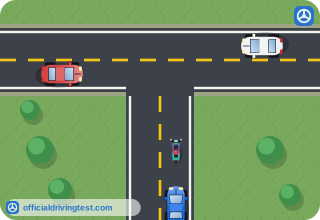
What should a moped rider do anytime the moped crosses the path of traffic?
- Speed up to clear the lane quickly
- Slow down and sound the horn without stopping
- Continue at the same speed if the road appears clear
- Slow down, stop and look carefully before proceeding
Show answer
Correct answer: Slow down, stop and look carefully before proceeding
Anytime you cross the path of traffic, slow down, stop and look carefully before you proceed.
Source: North Carolina Driver Handbook (Revised May 2025), page 94 · Open this page in the manual (Manual page 94)
-
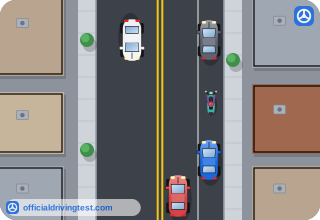
What should a moped rider do before moving into traffic?
- Look over the shoulder
- Sound the horn twice
- Flash the headlight
- Wait for a gap of one full minute
Show answer
Correct answer: Look over the shoulder
A moped rider should look over the shoulder before moving into traffic and be careful around parked cars.
Source: North Carolina Driver Handbook (Revised May 2025), page 94 · Open this page in the manual (Manual page 94)
-
What should a moped rider wear to protect the body?
- A helmet and gloves, but shoes are optional in hot weather
- A jacket only, since the moped body protects the legs
- Protective clothing that covers the body, and shoes at all times
- Shorts and a T-shirt, since a moped is lightweight
Show answer
Correct answer: Protective clothing that covers the body, and shoes at all times
A moped rider should wear protective clothing that covers the body and always wear shoes.
Source: North Carolina Driver Handbook (Revised May 2025), page 94 · Open this page in the manual (Manual page 94)
-
Where must a moped’s license plate be displayed?
- On the front of the moped
- On the rear of the moped, at all times
- On the rider’s helmet
- Only while riding on state highways
Show answer
Correct answer: On the rear of the moped, at all times
The license plate must be displayed on the rear of the moped at all times.
Source: North Carolina Driver Handbook (Revised May 2025), page 94 · Open this page in the manual (Manual page 94)
-
What does the North Carolina Division of Motor Vehicles require all moped operators to do?
- Have the moped inspected every year and display a sticker
- Register the moped only if it is ridden on state highways
- Register the moped only if it was bought new
- Register the moped and obtain a registration card and license plate
Show answer
Correct answer: Register the moped and obtain a registration card and license plate
All moped operators must register their moped with the DMV and obtain a registration card and license plate.
Source: North Carolina Driver Handbook (Revised May 2025), page 94 · Open this page in the manual (Manual page 94)
-
Besides a valid N.C. driver license or ID card, what must a moped operator bring to register the moped?
- The manufacturer’s certificate of origin (MCO)
- A signed safety inspection form for the moped
- A title issued by another state’s agency
- A receipt showing that a helmet was purchased
Show answer
Correct answer: The manufacturer’s certificate of origin (MCO)
Registration requires a valid N.C. driver license or ID card along with the moped manufacturer’s certificate of origin (MCO).
Source: North Carolina Driver Handbook (Revised May 2025), page 94 · Open this page in the manual (Manual page 94)
-
What can a moped operator without an MCO fill out to serve as proof of ownership?
- A Title Application for a Moped signed by the seller
- A Certificate of Insurance issued by the operator’s insurer
- An Affidavit of Facts for the Registration of a Moped (MVR-58)
- A Statement of Ownership signed by a local law enforcement officer
Show answer
Correct answer: An Affidavit of Facts for the Registration of a Moped (MVR-58)
An operator without an MCO can fill out an Affidavit of Facts for the Registration of a Moped form (MVR-58).
Source: North Carolina Driver Handbook (Revised May 2025), page 94 · Open this page in the manual (Manual page 94)
-
Who is held responsible when litter is thrown or blown from a vehicle?
- Only the passenger who threw the litter
- The driver of the vehicle
- The owner of the vehicle, if not driving
- No one, if the litter blew out accidentally
Show answer
Correct answer: The driver of the vehicle
The driver of the vehicle is held responsible when litter is thrown or blown from it.
Source: North Carolina Driver Handbook (Revised May 2025), page 95 · Open this page in the manual (Manual page 95)
-
What are the minimum and maximum fines for a littering conviction?
- $100 minimum and $500 maximum
- $500 minimum and $2,000 maximum
- $50 minimum and $250 maximum
- $250 minimum and $1,000 maximum
Show answer
Correct answer: $250 minimum and $1,000 maximum
If convicted, the minimum fine is $250 and the maximum fine is $1,000.
Source: North Carolina Driver Handbook (Revised May 2025), page 95 · Open this page in the manual (Manual page 95)
-
What is the fine for a second or subsequent littering offense within three years of a prior offense?
- Not less than $500 nor more than $2,000
- Not less than $250 nor more than $1,000
- Not less than $100 nor more than $1,000
- Not less than $1,000 nor more than $5,000
Show answer
Correct answer: Not less than $500 nor more than $2,000
A second or later offense within three years is punishable by a fine of not less than $500 nor more than $2,000.
Source: North Carolina Driver Handbook (Revised May 2025), page 95 · Open this page in the manual (Manual page 95)
-
Why can litter on roadsides increase the risk of a collision?
- It can cover pavement markings
- It can hide roadway signs
- It can attract wildlife to road edges
- It can make road surfaces slippery
Show answer
Correct answer: It can attract wildlife to road edges
Roadside litter can attract wildlife to road edges, increasing the risk of a wildlife-vehicle collision.
Source: North Carolina Driver Handbook (Revised May 2025), page 95 · Open this page in the manual (Manual page 95)