North Carolina: Sharing the road — Part 1 Practice Test
Questions in this part include: “When and where do most crashes involving farm equipment occur, according to the manual?” · “If farm equipment is causing a delay in traffic, when does the manual say it is advisable to pass it on public roads?”
Independent educational site · not affiliated with any government agency or DMV
Ready? Test yourself
- Instant feedback with an explanation
- Every answer cites its source in the manual
- Your best score is saved on this device
Questions are original and based on the official manual "North Carolina Driver Handbook" (Revised May 2025), North Carolina Division of Motor Vehicles (NCDMV).
All 17 questions in this practice test
Take the test above first, then use this list to study. Tap “Show answer” to see the correct answer and explanation.
Show the questions and answersHide the questions
-
What happens to a vehicle driver who does not properly signal vehicle movements to a motorcycle operator and causes the motorcycle to change lanes or leave the roadway?
- The driver receives only a verbal warning from an officer
- The driver will be charged and fined as the law provides
- The motorcyclist is charged instead of the driver
- Nothing happens unless there is also a crash with injuries
Show answer
Correct answer: The driver will be charged and fined as the law provides
The manual says the vehicle driver will be charged and fined as the law provides in that situation.
Source: North Carolina Driver Handbook (Revised May 2025), page 47 · Open this page in the manual (Manual page 47)
-
When and where do most crashes involving farm equipment occur, according to the manual?
- At night when it is raining, on wet gravel or dirt roads
- During heavy rain on hilly roads with a lot of curves
- In fog before sunrise on narrow dirt roads with no shoulder
- On a clear day, during daylight hours, on a dry paved surface
Show answer
Correct answer: On a clear day, during daylight hours, on a dry paved surface
The manual says most crashes involving farm equipment occur on a clear day, during daylight hours, and/or on a dry surface that is paved.
Source: North Carolina Driver Handbook (Revised May 2025), page 51 · Open this page in the manual (Manual page 51)
-
What are typical crashes with farm equipment, according to the manual?
- Sideswipes and angle crashes
- Head-on and rollover crashes
- Rear-end and chain-reaction crashes
- Backing and parking crashes
Show answer
Correct answer: Sideswipes and angle crashes
The manual says typical crashes with farm equipment include sideswipes and angle crashes.
Source: North Carolina Driver Handbook (Revised May 2025), page 51 · Open this page in the manual (Manual page 51)
-
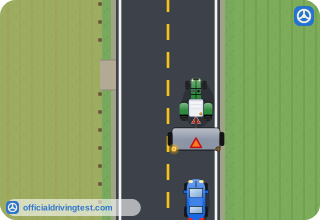
Why do drivers sometimes crash into farm equipment that is turning left?
- They stop too far behind the equipment to see its signals
- They follow the equipment too slowly and lose patience quickly
- They mistake the equipment's left-hand signal as a sign to pass
- They mistake the equipment for a parked vehicle at night
Show answer
Correct answer: They mistake the equipment's left-hand signal as a sign to pass
The manual says a machinery operator may use a left-hand signal, drivers may mistake it as a sign to pass, and the following vehicle crashes when it tries to pass as the machinery slows to turn.
Source: North Carolina Driver Handbook (Revised May 2025), page 51 · Open this page in the manual (Manual page 51)
-
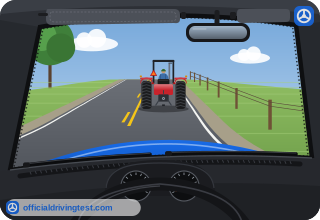
What does the manual say about passing farm equipment in a no passing zone?
- It is legal if the equipment is moving slowly
- It is illegal and very dangerous
- It is legal if no vehicles are approaching
- It is legal on a clear day
Show answer
Correct answer: It is illegal and very dangerous
The manual says it is illegal and very dangerous to pass farm equipment in a no passing zone.
Source: North Carolina Driver Handbook (Revised May 2025), page 51 · Open this page in the manual (Manual page 51)
-
Why should you be careful when passing farm equipment?
- It always travels much faster than it appears to when seen from behind
- It never has any brakes or working lights on the front or the rear
- It can only be passed safely on the right side of the roadway ahead
- It may be wider than what is visible from behind and need space in both lanes
Show answer
Correct answer: It may be wider than what is visible from behind and need space in both lanes
The manual says farm equipment may be wider than what is visible from behind and may require ample space in both lanes.
Source: North Carolina Driver Handbook (Revised May 2025), page 51 · Open this page in the manual (Manual page 51)
-
According to the manual, what is the key to safety when sharing the road with farm equipment?
- Being patient
- Speeding up to pass quickly
- Following as closely as possible
- Sounding your horn repeatedly
Show answer
Correct answer: Being patient
The manual says the key to safety when sharing the road with farm equipment is to be patient.
Source: North Carolina Driver Handbook (Revised May 2025), page 51 · Open this page in the manual (Manual page 51)
-
If farm equipment is causing a delay in traffic, when does the manual say it is advisable to pass it on public roads?
- Any time that the road ahead looks clear for several hundred yards
- Whenever the operator turns on a hazard light on the machine ahead
- When the operator moves off the road at a practical spot and lets traffic pass
- Only when the equipment is moving slowly up a long, steep hill
Show answer
Correct answer: When the operator moves off the road at a practical spot and lets traffic pass
The manual says the operator should move off the road at the nearest practical location and allow traffic to pass, which is the only advisable time to pass farm equipment.
Source: North Carolina Driver Handbook (Revised May 2025), page 51 · Open this page in the manual (Manual page 51)
-
How far must the rear red light on farm equipment be visible?
- Up to 100 feet
- Up to 500 feet
- Up to 250 feet
- Up to 1,000 feet
Show answer
Correct answer: Up to 500 feet
The manual says farm equipment must have one front white light and a rear red light visible for up to 500 feet.
Source: North Carolina Driver Handbook (Revised May 2025), page 51 · Open this page in the manual (Manual page 51)
-
What can replace the rear red light on farm equipment?
- One white reflector at least four inches wide
- Two red reflectors at least one inch in diameter
- One amber flashing light
- Two red reflectors at least four inches in diameter
Show answer
Correct answer: Two red reflectors at least four inches in diameter
The manual says two red reflectors that are at least four inches in diameter can replace the rear red light.
Source: North Carolina Driver Handbook (Revised May 2025), page 51 · Open this page in the manual (Manual page 51)
-
Why must you approach farm equipment with care?
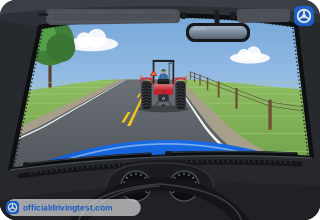
- Closure time is much quicker because of its slow speed
- Farm equipment is always wider than the lane it travels in
- Farm equipment often stops without warning on the roadway
- Farm equipment travels faster than most passenger vehicles
Show answer
Correct answer: Closure time is much quicker because of its slow speed
The manual says approaching farm equipment closes the gap much faster because the equipment moves so slowly.
Source: North Carolina Driver Handbook (Revised May 2025), page 52 · Open this page in the manual (Manual page 52)
-
On which roads in North Carolina is farm equipment NOT legally entitled to travel?
- Two-lane rural roads
- Secondary roads
- Interstates
- Roads inside city limits
Show answer
Correct answer: Interstates
Farm equipment may legally travel on most North Carolina roads except interstates.
Source: North Carolina Driver Handbook (Revised May 2025), page 52 · Open this page in the manual (Manual page 52)
-
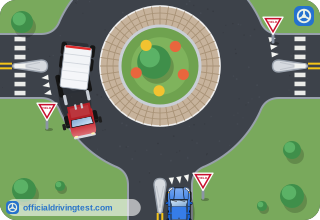
What may larger trucks and buses need to do in a roundabout?
- Stop in the center island
- Straddle the lane
- Drive against the direction of traffic
- Use the shoulder
Show answer
Correct answer: Straddle the lane
The manual says to give larger trucks and buses extra room because they may need to straddle the lane.
Source: North Carolina Driver Handbook (Revised May 2025), page 59 · Open this page in the manual (Manual page 59)
-
How should bicyclists position themselves in a multi-lane roundabout?
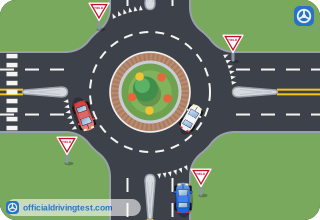
- Ride along the shoulder of the roundabout and stay to the right
- Ride against traffic on the outer edge of the roundabout
- Pick a lane and change lanes freely inside the roundabout
- Pick the appropriate lane before entering and stay in the middle of it
Show answer
Correct answer: Pick the appropriate lane before entering and stay in the middle of it
Bicyclists should pick the appropriate lane before entering a multi-lane roundabout and stay in the middle of their chosen lane, not along the shoulder.
Source: North Carolina Driver Handbook (Revised May 2025), page 59 · Open this page in the manual (Manual page 59)
-
What should drivers not do to a bicyclist inside a roundabout?
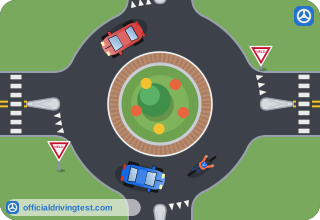
- Yield to the bicyclist
- Pass the bicyclist
- Follow behind the bicyclist
- Give the bicyclist room
Show answer
Correct answer: Pass the bicyclist
Drivers should not pass a bicyclist while inside the roundabout.
Source: North Carolina Driver Handbook (Revised May 2025), page 59 · Open this page in the manual (Manual page 59)
-
When a bicycle lane or bike path travels on or adjacent to the roadway, what should you pay special attention to as you approach and move through an intersection?
- Bicyclists
- Parked vehicles
- Railroad signals
- School buses
Show answer
Correct answer: Bicyclists
The manual says to pay special attention to bicyclists when a bicycle lane or bike path is on or next to the roadway.
Source: North Carolina Driver Handbook (Revised May 2025), page 62 · Open this page in the manual (Manual page 62)
-
Because bicyclists ride to the right of traffic, what crash potential exists at an intersection?
- Between a bicyclist turning left and a motorist going straight ahead
- Between a bicyclist stopped at a signal and a motorist turning left
- Between a bicyclist moving straight ahead and a motorist turning right
- Between a bicyclist riding on the sidewalk and a motorist parking
Show answer
Correct answer: Between a bicyclist moving straight ahead and a motorist turning right
A crash can occur between a bicyclist moving straight ahead through the intersection and a motorist who is turning right.
Source: North Carolina Driver Handbook (Revised May 2025), page 63 · Open this page in the manual (Manual page 63)