New Mexico: Sharing the road — Part 5 Practice Test
Questions in this part include: “What does the manual say about lane sharing by cars and motorcycles?” · “At night, what should decide a motorcyclist's lane position?”
Independent educational site · not affiliated with any government agency or DMV
Ready? Test yourself
- Instant feedback with an explanation
- Every answer cites its source in the manual
- Your best score is saved on this device
- Keyboard: press 1 to 4 to answer and Enter for the next question
Questions are original and based on the official manual "New Mexico Driver Manual" (Version 11.19.19), New Mexico Motor Vehicle Division (MVD).
All 16 questions in this practice test
Take the test above first, then use this list to study. Tap “Show answer” to see the correct answer and explanation.
Show the questions and answersHide the questions
-
What does the manual say about lane sharing by cars and motorcycles?
- A full lane is needed, so lane sharing is usually prohibited
- Lane sharing is encouraged in heavy, bumper-to-bumper traffic
- Lane sharing is allowed whenever the motorcycle signals first
- Each of them needs only half of a lane to operate safely
Show answer
Correct answer: A full lane is needed, so lane sharing is usually prohibited
Cars and motorcycles need a full lane to operate safely, and lane sharing is usually prohibited.
Source: New Mexico Driver Manual (Version 11.19.19), page 36
-
How can a motorcyclist discourage lane sharing by other drivers?
- Ride on the left lane line
- Ride on the right edge of the lane
- Keep a center of the lane position
- Sound the horn continuously
Show answer
Correct answer: Keep a center of the lane position
The manual says to keep a center of the lane position whenever drivers might be tempted to squeeze by.
Source: New Mexico Driver Manual (Version 11.19.19), page 36
-
What does the manual say about the best lane position for motorcycle riders?
- The left portion is always the best position
- No single best position; no portion of the lane need be avoided
- The right portion is best because it leaves an escape route
- The center must always be avoided because it is oily
Show answer
Correct answer: No single best position; no portion of the lane need be avoided
In general there is no single best position, and no portion of the lane need be avoided, including the center.
Source: New Mexico Driver Manual (Version 11.19.19), page 36
-
If hazardous conditions exist on both sides of a motorcyclist, which lane position is usually the best choice?
- The left edge of the lane
- The right edge of the lane
- On the line between lanes
- The center of the lane
Show answer
Correct answer: The center of the lane
If hazardous conditions exist on both sides of the rider, the center of the lane is usually the best choice.
Source: New Mexico Driver Manual (Version 11.19.19), page 36
-
How wide is the oily strip in the center of a lane, usually?
- No more than two feet wide
- No more than six inches wide
- About four feet wide
- As wide as the whole lane
Show answer
Correct answer: No more than two feet wide
The oily center strip is usually no more than two feet wide, so a rider can ride to the left or right of it and still be in the lane.
Source: New Mexico Driver Manual (Version 11.19.19), page 36
-
Where are the big build-ups of oil and grease that a motorcyclist should avoid usually found?
- On long downhill mountain grades
- On freeway on-ramps and exits
- At busy intersections or toll booths
- In school zones near schools
Show answer
Correct answer: At busy intersections or toll booths
Big build-ups of oil and grease are usually found at very busy intersections or toll booths, and riders should avoid riding on them.
Source: New Mexico Driver Manual (Version 11.19.19), page 37
-
At night, what should decide a motorcyclist's lane position?
- The right edge of the lane, to stay away from oncoming lights
- The center of the lane, with no changes at all
- Whatever portion best helps the rider see and be seen
- The left edge of the lane, to stay next to the line
Show answer
Correct answer: Whatever portion best helps the rider see and be seen
At night a rider should be flexible and change to whatever portion of the lane best helps see, be seen and keep an adequate space cushion.
Source: New Mexico Driver Manual (Version 11.19.19), page 38
-
What is the best way for a group of motorcyclists to keep ranks close yet maintain an adequate space cushion?
- A side-by-side formation
- A staggered formation
- A bumper-to-bumper line
- A V-shaped formation
Show answer
Correct answer: A staggered formation
The manual calls the staggered formation the best way to keep ranks close yet maintain an adequate space cushion.
Source: New Mexico Driver Manual (Version 11.19.19), page 38
-
How should riders in a staggered formation pass another vehicle?
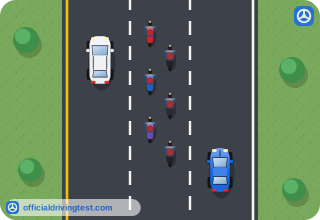
- All together, side by side
- One at a time
- In pairs, left and right
- Only the last rider may pass
Show answer
Correct answer: One at a time
Riders in a staggered formation should pass one at a time.
Source: New Mexico Driver Manual (Version 11.19.19), page 38
-
After a lead rider in a staggered formation passes a vehicle, what should the leader do?
- Move to the right side and slow to the speed of the group
- Slow at once and wait beside the passed vehicle for the group
- Move to the right side so the second rider can pass more quickly
- Return to the left position and keep riding at passing speed
Show answer
Correct answer: Return to the left position and keep riding at passing speed
The leader returns to the left position and keeps riding at passing speed to open room for the next rider; moving to the right side is not a good idea.
Source: New Mexico Driver Manual (Version 11.19.19), page 38
-
When is it best for a group of motorcyclists to move into a single-file formation?
- When riding curves, turning, entering or leaving a highway
- When riding in light traffic on straight roads in daylight
- When stopped at a traffic light with the group behind
- When riding on a wide road in good daylight
Show answer
Correct answer: When riding curves, turning, entering or leaving a highway
It is best to move into a single-file formation when riding curves, turning, entering or leaving a highway.
Source: New Mexico Driver Manual (Version 11.19.19), page 38
-
When a motorcyclist is being passed from behind or by an oncoming vehicle, where should the rider stay in the lane?
- In the portion closest to the passing vehicle
- In the center portion of the lane
- In the portion farthest from the passing vehicle
- On the line between the lanes
Show answer
Correct answer: In the center portion of the lane
When being passed from behind or by an oncoming vehicle, stay in the center portion of your lane.
Source: New Mexico Driver Manual (Version 11.19.19), page 39
-
What do some drivers forget about their mirrors when passing a motorcyclist?
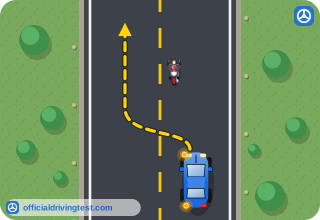
- That their mirrors must be folded in when passing
- That their mirrors cannot show the motorcycle at all
- That their mirrors can be adjusted while driving
- That their mirrors hang out farther than their fenders
Show answer
Correct answer: That their mirrors hang out farther than their fenders
Some drivers forget that their mirrors hang out farther than their fenders, which is a danger when being passed.
Source: New Mexico Driver Manual (Version 11.19.19), page 39
-
Why might objects be thrown from a passing vehicle onto a motorcyclist or the road ahead?
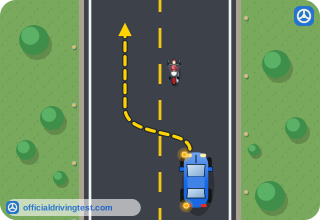
- A passenger may not see the rider, even if the driver does
- The driver wants to make the rider slow down or leave the lane
- Passengers cannot see anything on the road
- The driver cannot see out of the passenger window
Show answer
Correct answer: A passenger may not see the rider, even if the driver does
Even if the driver knows the rider is there, a passenger may not see the rider and might toss something onto the rider or the road ahead.
Source: New Mexico Driver Manual (Version 11.19.19), page 39
-
Why is the middle portion of the lane best when a motorcyclist is hit by a blast of wind from a larger vehicle?
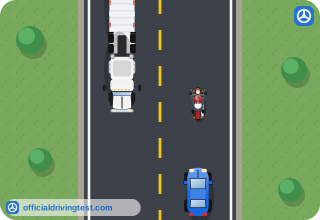
- The wind is weaker in the middle of the lane
- The wind always pushes a rider toward the lane line
- There is more room for error than on either side of the lane
- The larger vehicle will slow down in the middle
Show answer
Correct answer: There is more room for error than on either side of the lane
A rider has more room for error in the middle portion of the lane than on either side when hit by a blast of wind from a larger vehicle.
Source: New Mexico Driver Manual (Version 11.19.19), page 39
-
Why should a rider not move into the portion of the lane farthest from a passing vehicle?
- It leaves the rider much too close to the passing vehicle's mirrors
- It might invite the other driver to cut back into the lane too early
- It puts the rider in the oily strip in the center of the lane
- It blocks the view of drivers coming up in the next lane
Show answer
Correct answer: It might invite the other driver to cut back into the lane too early
Moving to the portion of the lane farthest from the passing vehicle might invite the other driver to cut back into the lane too early.
Source: New Mexico Driver Manual (Version 11.19.19), page 39