New Mexico: Sharing the road — Part 3 Practice Test
Questions in this part include: “According to the manual, what is the safest way for a bicyclist to ride?” · “What do sharrows encourage bicyclists to do?”
Independent educational site · not affiliated with any government agency or DMV
Ready? Test yourself
- Instant feedback with an explanation
- Every answer cites its source in the manual
- Your best score is saved on this device
- Keyboard: press 1 to 4 to answer and Enter for the next question
Questions are original and based on the official manual "New Mexico Driver Manual" (Version 11.19.19), New Mexico Motor Vehicle Division (MVD).
All 17 questions in this practice test
Take the test above first, then use this list to study. Tap “Show answer” to see the correct answer and explanation.
Show the questions and answersHide the questions
-
According to the manual, what is the safest way for a bicyclist to ride?
- As part of the traffic, going with the flow of the normal traffic pattern
- Away from traffic, on sidewalks and crosswalks whenever possible
- Against the flow of traffic so drivers can see the rider's face
- At the far right edge, as close to parked cars as possible
Show answer
Correct answer: As part of the traffic, going with the flow of the normal traffic pattern
The manual says the safest way to ride is as part of the traffic, going with the flow of the normal traffic pattern.
Source: New Mexico Driver Manual (Version 11.19.19), page 26
-
What does the manual say "sharrows" are?
- Parking spaces shared by bicycles
- Posts that mark a bicycle route
- Shared lane pavement markings
- Signs that close a lane to bicycles
Show answer
Correct answer: Shared lane pavement markings
Sharrows are "shared lane pavement markings."
Source: New Mexico Driver Manual (Version 11.19.19), page 26
-
When are sharrows painted on the pavement?
- When a road is wide enough to give bicyclists a lane of their own
- When a road is too narrow for side-by-side road sharing with slower vehicles
- When a school zone or crosswalk is just ahead on the road
- When bicycles are not allowed to use that road at all
Show answer
Correct answer: When a road is too narrow for side-by-side road sharing with slower vehicles
Sharrows are painted on the pavement when a road is too narrow for side-by-side road sharing with slower vehicles.
Source: New Mexico Driver Manual (Version 11.19.19), page 26
-
What do sharrows encourage bicyclists to do?
- Ride only on the road shoulder
- Ride in the door zone of parked cars
- Pass slower vehicles on the right
- Take the whole travel lane
Show answer
Correct answer: Take the whole travel lane
Sharrows indicate that bicyclists are encouraged to take the whole travel lane and that motorists shall yield to the bicyclist as needed.
Source: New Mexico Driver Manual (Version 11.19.19), page 26
-
As a motorist, what should you do in the presence of sharrows?
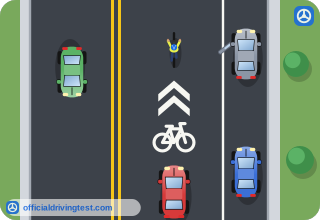
- Slow down and yield to bicyclists in the roadway
- Speed up to pass the bicyclist before the lane narrows
- Honk to tell bicyclists to move onto the sidewalk
- Stay in your lane and wait for bicyclists to yield
Show answer
Correct answer: Slow down and yield to bicyclists in the roadway
In the presence of sharrows, motorists should slow down and yield to bicyclists in the roadway.
Source: New Mexico Driver Manual (Version 11.19.19), page 26
-
Where there are sharrows, when should a motorist pass a bicyclist?
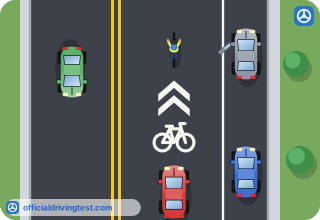
- Only after the bicyclist signals that the driver may go by
- Whenever the driver sounds the horn first
- Only when the roadway width allows the bicyclist to move to the right
- Never, because sharrows prohibit all passing
Show answer
Correct answer: Only when the roadway width allows the bicyclist to move to the right
Motorists should pass bicyclists only when the roadway width allows bicyclists to move to the right.
Source: New Mexico Driver Manual (Version 11.19.19), page 26
-
As a bicyclist, where may you ride when there are sharrows?
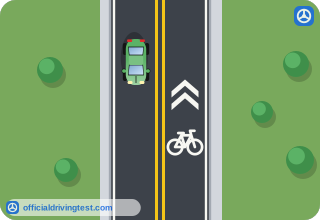
- Only on the sidewalk next to the sharrow
- On the center of the sharrow
- Only on the far right edge of the road
- Against traffic, to the left of the sharrow
Show answer
Correct answer: On the center of the sharrow
Where there are sharrows, a bicyclist may ride on the center of the sharrow.
Source: New Mexico Driver Manual (Version 11.19.19), page 26
-
As a bicyclist in the presence of sharrows, what should you keep a safe distance from?
- The center line of the road
- The curb on the right side
- The wheels of passing trucks
- The door zone of parked cars
Show answer
Correct answer: The door zone of parked cars
Bicyclists should keep a safe distance from the "door zone" of parked cars.
Source: New Mexico Driver Manual (Version 11.19.19), page 26
-
As a bicyclist on a road with sharrows, what should you do to let vehicles pass when it is safe?
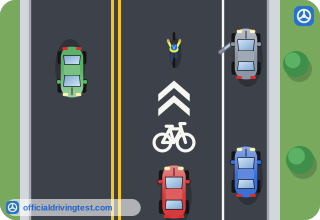
- Move right
- Move left
- Stop and dismount
- Ride faster
Show answer
Correct answer: Move right
Bicyclists should move right to let vehicles pass when it is safe to do so.
Source: New Mexico Driver Manual (Version 11.19.19), page 26
-
Compared with a car going the same speed, how do large trucks and RVs stop?
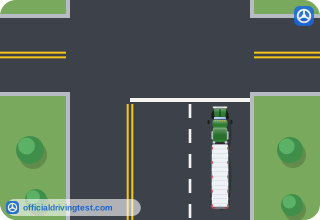
- In a shorter distance than the car
- They take longer to stop
- In the same distance as the car
- Faster, because they have air brakes
Show answer
Correct answer: They take longer to stop
Large trucks and RVs take longer to stop than a car going the same speed, so do not pull in front of a big rig and suddenly slow down or stop.
Source: New Mexico Driver Manual (Version 11.19.19), page 27
-
Why should you not pull in front of a big rig and suddenly slow down or stop?
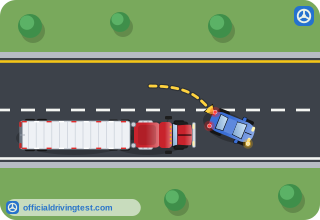
- The truck driver cannot see anything that is in front of the truck
- The driver may not be able to stop quickly enough to avoid crashing into you
- Large trucks are not allowed to follow other vehicles closely
- A large truck always stops faster than a car going the same speed
Show answer
Correct answer: The driver may not be able to stop quickly enough to avoid crashing into you
Large trucks take longer to stop, so the driver may not be able to stop quickly enough to avoid crashing into you.
Source: New Mexico Driver Manual (Version 11.19.19), page 27
-
Which turn do big trucks and RVs often swing wide to make?
- A left turn
- A U-turn
- A turn into a driveway
- A right turn
Show answer
Correct answer: A right turn
Big trucks and RVs need more room to turn and often swing wide to make a right turn.
Source: New Mexico Driver Manual (Version 11.19.19), page 27
-
You are following a big rig and think it is turning left. What should you do before you start to pass?
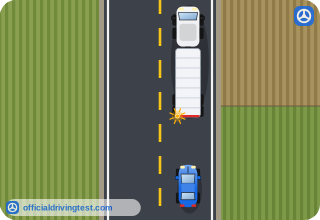
- Wait a second and check its turn signals again
- Start to pass on the right at once
- Pass quickly on the left before it turns
- Move beside it so the driver can see you
Show answer
Correct answer: Wait a second and check its turn signals again
The driver may really be turning right, so wait a second and check the turn signals again.
Source: New Mexico Driver Manual (Version 11.19.19), page 27
-
What are the large areas around a truck that the trucker cannot see called?
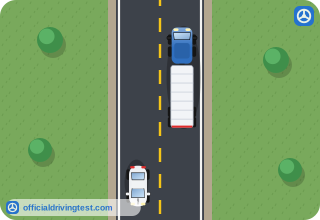
- The safety cushion
- The swing area
- The NO ZONE
- The escape lane
Show answer
Correct answer: The NO ZONE
The large areas a trucker cannot see are called blind spots or the NO ZONE.
Source: New Mexico Driver Manual (Version 11.19.19), page 27
-
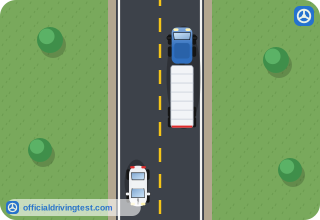
In general, what does it mean if you cannot see a truck driver in the side mirror?
- The driver is not paying attention
- The driver cannot see you
- The truck is about to turn right
- The truck is moving too slowly
Show answer
Correct answer: The driver cannot see you
In general, if you cannot see the driver in the side mirror, the driver cannot see you.
Source: New Mexico Driver Manual (Version 11.19.19), page 27
-
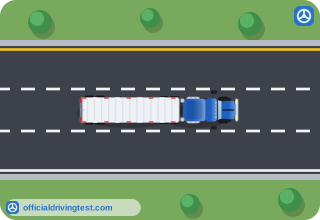
Which is a common mistake when driving around large trucks and RVs?
- Passing a large truck or RV on the left side
- Checking a truck's turn signals before you pass
- Moving ahead of a truck or RV after you pass it
- Cutting in front of a truck to reach your exit
Show answer
Correct answer: Cutting in front of a truck to reach your exit
The manual lists cutting in front of a truck or RV to reach your exit or turn as a mistake, because cutting into the open space in front of a truck is dangerous.
Source: New Mexico Driver Manual (Version 11.19.19), page 27
-
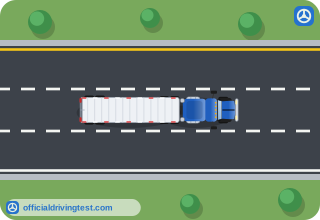
Why should you not drive beside a large truck or RV?
- It may be unable to swerve around a hazard
- Its tires may throw rocks at your windshield
- Trucks are not allowed to change lanes
- The truck's brakes can fail when a car is close
Show answer
Correct answer: It may be unable to swerve around a hazard
If you drive beside a truck or RV, it may not be able to swerve to miss a hazard in the road.
Source: New Mexico Driver Manual (Version 11.19.19), page 27