New Mexico: Sharing the road
Bicycles and sharrows, large trucks and RVs and their No-Zone, slow vehicles, and how motorcyclists ride, pass and stay visible. Split into 5 shorter tests so you're not stuck in one long quiz.
Independent educational site · not affiliated with any government agency or DMV
Choose a part
Sharing the road — Part 1
Questions in this part include: “Which road users does the manual say are harder to see than cars and trucks?”
StartSharing the road — Part 2
Questions in this part include: “Why should you be ready to slow down to let deer cross on slick surfaces?”
StartSharing the road — Part 3
Questions in this part include: “According to the manual, what is the safest way for a bicyclist to ride?”
StartSharing the road — Part 4
Questions in this part include: “What should a motorcyclist who is ready to pass do before moving into the left lane?”
StartSharing the road — Part 5
Questions in this part include: “What does the manual say about lane sharing by cars and motorcycles?”
StartAll 83 Sharing the road questions with answers
Choose a part above to take a practice test, or study every question and answer here.
Show the questions and answersHide the questions
-
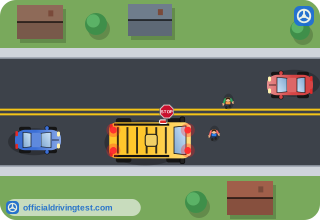
When must you stop for a school bus that is stopped with its red lights flashing?
- Only when it is on your side of the road
- On your side, the opposite side, or at an intersection
- Only when children are visible outside the bus
- Only when it is at an intersection
Show answer
Correct answer: On your side, the opposite side, or at an intersection
You must stop for a stopped school bus with flashing red lights whether it is on your side of the road, the opposite side or at an intersection you are approaching.
Source: New Mexico Driver Manual (Version 11.19.19), page 12
-
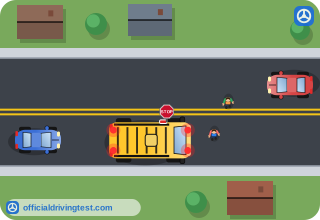
When are you not required to stop for a stopped school bus with its red lights flashing?
- The bus is on the opposite side of the road
- The bus is stopped at an intersection you are approaching
- A median or physical barrier separates you from an oncoming bus
- No children are visible near the bus
Show answer
Correct answer: A median or physical barrier separates you from an oncoming bus
You are not required to stop if the bus is traveling toward you and a median or other physical barrier separates the roadway.
Source: New Mexico Driver Manual (Version 11.19.19), page 12
-
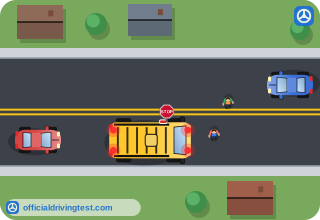
After a school bus's red lights stop flashing, when may you proceed?
- Right away, as soon as the red lights have stopped flashing
- As soon as the school bus begins to move again
- As soon as the bus doors have closed behind the children
- When the children have completely left the roadway and it is safe
Show answer
Correct answer: When the children have completely left the roadway and it is safe
After the red lights stop flashing, you must watch for children and not proceed until they have completely left the roadway and it is safe.
Source: New Mexico Driver Manual (Version 11.19.19), page 12
-
Which road users does the manual say are harder to see than cars and trucks?
- School buses, ambulances and fire trucks
- Motorcycles, bicycles and pedestrians
- Large trucks, buses and tractors
- Taxis, vans and delivery vehicles
Show answer
Correct answer: Motorcycles, bicycles and pedestrians
The manual says motorcycles, bicycles and pedestrians are harder to see than cars and trucks.
Source: New Mexico Driver Manual (Version 11.19.19), page 17
-
When should you be especially alert for motorcycles, bicycles and pedestrians?
- When you drive on an empty freeway
- When you are parked with the engine off
- When you drive at a steady speed on a flat road
- When you enter the roadway from the curb or driveway
Show answer
Correct answer: When you enter the roadway from the curb or driveway
The manual says to be especially alert for these harder-to-see road users when entering the roadway from the curb or driveway.
Source: New Mexico Driver Manual (Version 11.19.19), page 17
-
When you go down hills or mountains, which vehicles should you be alert for because they may be going too fast?
- Small cars and motorcycles
- Slow-moving farm equipment
- Large trucks and buses
- Delivery vans and taxis
Show answer
Correct answer: Large trucks and buses
The manual says to be alert for large trucks and buses that may be going too fast when you drive down a steep grade.
Source: New Mexico Driver Manual (Version 11.19.19), page 17
-
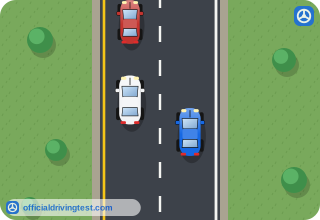
Which position puts you in another vehicle’s blind spot?
- Well ahead of it in the next lane
- Several car lengths behind it in its own lane
- On either side and slightly to the rear of it
- Directly in front of it, one car length ahead
Show answer
Correct answer: On either side and slightly to the rear of it
The manual says that driving on either side and slightly to the rear of another vehicle puts you in that driver’s blind spot.
Source: New Mexico Driver Manual (Version 11.19.19), page 19
-
If you find yourself in another vehicle’s blind spot, what should you do?
- Stay where you are and watch its mirrors
- Either speed up or drop back
- Sound your horn continuously
- Flash your high beams until it moves
Show answer
Correct answer: Either speed up or drop back
The manual says to either speed up or drop back so the other driver can see your vehicle more easily.
Source: New Mexico Driver Manual (Version 11.19.19), page 19
-
When passing another vehicle, how should you get through the other driver’s blind spot?
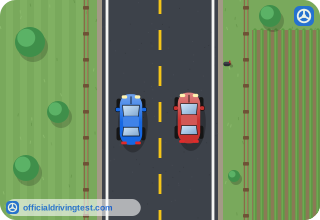
- As slowly as is safe
- At the same speed as the other vehicle
- While sounding your horn
- As quickly as you can
Show answer
Correct answer: As quickly as you can
The manual says the longer you stay in the blind spot, the longer you are in danger of the other driver turning into you.
Source: New Mexico Driver Manual (Version 11.19.19), page 19
-
Why should you never stay alongside a large vehicle such as a truck or bus?
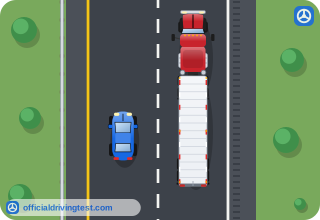
- It must stay in the right lane at all times
- Its exhaust can make it hard for you to see
- It has large blind spots and its driver may not see you
- It always changes lanes without signaling to other drivers
Show answer
Correct answer: It has large blind spots and its driver may not see you
The manual says large vehicles have large blind spots and it is hard for their drivers to see you.
Source: New Mexico Driver Manual (Version 11.19.19), page 19
-
Which of these is named in the manual as a large game animal to watch for on New Mexico roads?
- Moose
- Bison
- Pronghorn antelope
- Wild boar
Show answer
Correct answer: Pronghorn antelope
The manual lists deer, elk, pronghorn antelope, black bears and cougars as the large game animals to watch out for.
Source: New Mexico Driver Manual (Version 11.19.19), page 21
-
Where does the manual say to watch for elk?
- In the western three-quarters of the state
- Only in the eastern part of the state
- Only on the open plains of the east
- Only along the southern border of the state
Show answer
Correct answer: In the western three-quarters of the state
The manual says to watch for elk in the western three-quarters of the state.
Source: New Mexico Driver Manual (Version 11.19.19), page 21
-
Where does the manual say to watch for antelope?
- In the western three-quarters of the state
- Only in the mountains and forests of the western part
- Only in river valleys
- In the eastern part of the state or in open plains
Show answer
Correct answer: In the eastern part of the state or in open plains
The manual says to watch for antelope in the eastern part of the state or in open plains.
Source: New Mexico Driver Manual (Version 11.19.19), page 21
-
Where does the manual say to keep an eye out for black bears and cougars?
- On open plains
- In the mountains
- In the eastern part of the state
- Along city streets
Show answer
Correct answer: In the mountains
The manual says to keep an eye out for black bears and cougars in the mountains.
Source: New Mexico Driver Manual (Version 11.19.19), page 21
-
What do animal crossing signs warn you about?
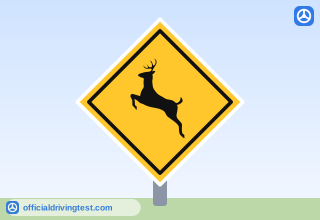
- That a game preserve begins within the next mile
- That vehicles have hit wildlife in this area before
- That hunting is allowed in this area during the day
- That fences keep animals off the road ahead
Show answer
Correct answer: That vehicles have hit wildlife in this area before
The manual says animal crossing signs warn that vehicles have hit wildlife in the area before.
Source: New Mexico Driver Manual (Version 11.19.19), page 21
-
What should you do if you see animals that have been hit along the road?
- Stop and pull the animals off the road yourself right away
- Speed up to get out of the area quickly
- Keep your speed because the danger is gone
- Slow down, since you may be in an animal crossing area
Show answer
Correct answer: Slow down, since you may be in an animal crossing area
The manual says that if you see animals that have been hit you should slow down, because you may be in an animal crossing area.
Source: New Mexico Driver Manual (Version 11.19.19), page 21
-
When should you be especially watchful for wildlife?
- At dawn, dusk and the first few hours after dark
- In the middle of the day when it is hottest
- Only during the first two hours of bright sunshine
- Only on cloudy days when visibility is low
Show answer
Correct answer: At dawn, dusk and the first few hours after dark
The manual says many animals are most active at dawn, dusk and in the first few hours after darkness falls.
Source: New Mexico Driver Manual (Version 11.19.19), page 21
-
What should you assume about animals on the road?
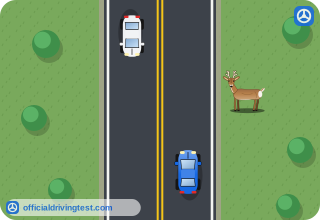
- That they will move away as you approach
- That they will wait for you to pass
- That they will not get out of your way
- That they will run from your headlights
Show answer
Correct answer: That they will not get out of your way
The manual says to assume that animals will not get out of your way.
Source: New Mexico Driver Manual (Version 11.19.19), page 21
-
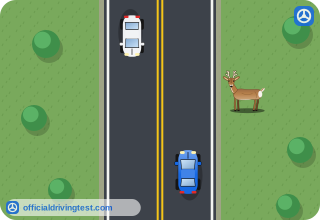
When one animal is crossing the road, what should you remember?
- The rest have already crossed
- Other animals will wait on the shoulder
- No other animals will cross at that spot
- There may be more animals crossing
Show answer
Correct answer: There may be more animals crossing
The manual says to remember that where one animal is crossing, there may be more.
Source: New Mexico Driver Manual (Version 11.19.19), page 21
-
Why should you be ready to slow down to let deer cross on slick surfaces?
- Animals with hooves often speed up on slick surfaces
- Animals with hooves often slow down on slick surfaces
- Animals with hooves cannot see vehicles well in the rain
- Animals with hooves always run toward headlights
Show answer
Correct answer: Animals with hooves often slow down on slick surfaces
The manual says animals with hooves, such as deer, often slow down on slick surfaces, so you should be ready to slow down to let them cross.
Source: New Mexico Driver Manual (Version 11.19.19), page 21
-
What does a slow-moving vehicle decal on the back of a vehicle look like?
- A red diamond
- A yellow circle
- A white square
- An orange triangle
Show answer
Correct answer: An orange triangle
The manual says slow-moving vehicles such as farm tractors should have a slow-moving vehicle decal, an orange triangle, on the back.
Source: New Mexico Driver Manual (Version 11.19.19), page 22
-
To whom should you give extra space at the side of your vehicle, especially if they are children?
- Large trucks and buses
- Vehicles stopped at a red light
- Pedestrians or bicycles
- Vehicles ahead of you in your own lane
Show answer
Correct answer: Pedestrians or bicycles
The manual says to give extra space to pedestrians or bicycles, especially children.
Source: New Mexico Driver Manual (Version 11.19.19), page 24
-
What rights and responsibilities do bicycle drivers on roads have, compared with drivers of cars?
- The same rights and responsibilities as drivers of cars
- Fewer rights than drivers of cars, because bicycles are slower
- Only the rights that pedestrians have on the roadway
- More rights than drivers of cars, because bicycles are smaller
Show answer
Correct answer: The same rights and responsibilities as drivers of cars
The manual says bicycle drivers on roads have the same rights and responsibilities as drivers of cars.
Source: New Mexico Driver Manual (Version 11.19.19), page 25
-
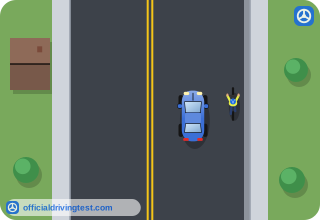
When passing a bicyclist, motor vehicle drivers are required to keep a safe distance and try for at least how much space?
- At least two feet
- At least three feet
- At least five feet
- At least ten feet
Show answer
Correct answer: At least five feet
Drivers must keep a safe distance when passing a bicyclist, trying for at least five feet, and pass only when it is safe and legal.
Source: New Mexico Driver Manual (Version 11.19.19), page 25
-
What must a motor vehicle driver give a bicyclist who needs to merge or use a turn lane?
- The right of way, even when the bicyclist is turning left
- Extra time and space, as for any other vehicle
- A horn signal to warn the bicyclist before every merge
- Only the space that is left after the driver has passed
Show answer
Correct answer: Extra time and space, as for any other vehicle
Motor vehicle drivers must provide the bicyclist with extra time and space to merge and use turn lanes like other vehicles.
Source: New Mexico Driver Manual (Version 11.19.19), page 25
-
How does the manual say a driver should treat a bicycle on the road?
- As a pedestrian who happens to be riding on the roadway
- As an obstacle that must always give way to motor vehicles
- As a toy that is not allowed to use the travel lanes
- As a legal, slow-moving vehicle, such as a backhoe
Show answer
Correct answer: As a legal, slow-moving vehicle, such as a backhoe
Drivers are required to treat the bicycle as a legal, slow-moving vehicle such as a backhoe.
Source: New Mexico Driver Manual (Version 11.19.19), page 25
-
Bicycles should usually stay on the right side of the roadway. What are they legally allowed to do when necessary?
- Take the whole lane by riding in its center
- Ride on the left shoulder, facing oncoming traffic
- Ride on the sidewalk, ahead of any pedestrians
- Ride against the flow of traffic in the left lane
Show answer
Correct answer: Take the whole lane by riding in its center
Bicycles are legally allowed to take the whole lane by riding in the center of the traffic lane when necessary.
Source: New Mexico Driver Manual (Version 11.19.19), page 25
-
Which is a reason a bicyclist will typically take the whole lane?
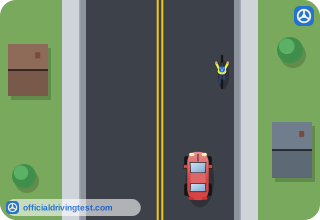
- To get ahead of slower cars
- To make room for drivers behind
- To prepare for a left turn
- To race cars in the next lane
Show answer
Correct answer: To prepare for a left turn
Bicyclists typically take the whole lane to prepare for a left turn, to avoid being squeezed on a narrow street, or to avoid hazards, grates and debris.
Source: New Mexico Driver Manual (Version 11.19.19), page 26
-
You have just passed a bicyclist on your right and want to turn right. What should you do?
- Turn right immediately, since you are already ahead of the bicyclist
- Slow down and merge behind the bicyclist before turning
- Sound your horn and turn right ahead of the bicyclist
- Speed up so that the bicyclist can turn behind your car
Show answer
Correct answer: Slow down and merge behind the bicyclist before turning
Drivers should not make a sudden right turn after passing a bicyclist; they should slow down and merge behind the bicyclist before turning.
Source: New Mexico Driver Manual (Version 11.19.19), page 26
-
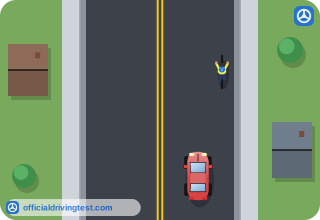
Which bicyclists does the manual single out as likely to behave unexpectedly?
- Adults riding alone
- Riders on narrow roads
- Riders wearing helmets
- Young children
Show answer
Correct answer: Young children
The manual says some bicyclists, especially young children, will behave unexpectedly, so drivers should stay watchful for sudden movements and lane changes.
Source: New Mexico Driver Manual (Version 11.19.19), page 26
-
What are bicycle drivers required to use at night?
- A bright headlight and a good rear reflector
- A bright taillight and a good front reflector
- A flashing light on each wheel and a horn
- Reflective clothing and a handlebar bell
Show answer
Correct answer: A bright headlight and a good rear reflector
Bicycle drivers must obey traffic laws, including night-time use of a bright headlight and a good rear reflector.
Source: New Mexico Driver Manual (Version 11.19.19), page 26
-
In which direction must bicycle drivers travel on the road?
- Facing oncoming traffic on the left side
- In either direction, if they stay near the curb
- In the same direction as traffic
- Against traffic whenever the road is narrow
Show answer
Correct answer: In the same direction as traffic
Bicycle drivers must travel in the same direction as traffic and make left and right turns the same way cars do.
Source: New Mexico Driver Manual (Version 11.19.19), page 26
-
Who must wear a well-fitting helmet when bicycling, according to the manual?
- Adults must; minors should
- Minors must; adults should
- Only riders on roads with sharrows
- Nobody; it is only a suggestion
Show answer
Correct answer: Minors must; adults should
The manual says adults should, and minors must, wear a well-fitting helmet.
Source: New Mexico Driver Manual (Version 11.19.19), page 26
-
Bicycles may be difficult for motorists to see. What does the manual advise bicyclists to do?
- Ride close to parked cars, wear dark colors, and avoid lane changes
- Ride mostly at night, use a horn, and travel in large groups
- Stay on sidewalks, wear helmet colors that match the road
- Wear bright colors, use proper lighting, and be predictable
Show answer
Correct answer: Wear bright colors, use proper lighting, and be predictable
Because bicycles are hard to see, bicyclists should wear bright colors, use proper lighting, and be predictable.
Source: New Mexico Driver Manual (Version 11.19.19), page 26
-
According to the manual, what is the safest way for a bicyclist to ride?
- As part of the traffic, going with the flow of the normal traffic pattern
- Away from traffic, on sidewalks and crosswalks whenever possible
- Against the flow of traffic so drivers can see the rider's face
- At the far right edge, as close to parked cars as possible
Show answer
Correct answer: As part of the traffic, going with the flow of the normal traffic pattern
The manual says the safest way to ride is as part of the traffic, going with the flow of the normal traffic pattern.
Source: New Mexico Driver Manual (Version 11.19.19), page 26
-
What does the manual say "sharrows" are?
- Parking spaces shared by bicycles
- Posts that mark a bicycle route
- Shared lane pavement markings
- Signs that close a lane to bicycles
Show answer
Correct answer: Shared lane pavement markings
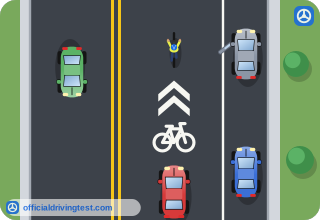
Sharrows are "shared lane pavement markings."
Source: New Mexico Driver Manual (Version 11.19.19), page 26
-
When are sharrows painted on the pavement?
- When a road is wide enough to give bicyclists a lane of their own
- When a road is too narrow for side-by-side road sharing with slower vehicles
- When a school zone or crosswalk is just ahead on the road
- When bicycles are not allowed to use that road at all
Show answer
Correct answer: When a road is too narrow for side-by-side road sharing with slower vehicles
Sharrows are painted on the pavement when a road is too narrow for side-by-side road sharing with slower vehicles.
Source: New Mexico Driver Manual (Version 11.19.19), page 26
-
What do sharrows encourage bicyclists to do?
- Ride only on the road shoulder
- Ride in the door zone of parked cars
- Pass slower vehicles on the right
- Take the whole travel lane
Show answer
Correct answer: Take the whole travel lane
Sharrows indicate that bicyclists are encouraged to take the whole travel lane and that motorists shall yield to the bicyclist as needed.
Source: New Mexico Driver Manual (Version 11.19.19), page 26
-
As a motorist, what should you do in the presence of sharrows?
- Slow down and yield to bicyclists in the roadway
- Speed up to pass the bicyclist before the lane narrows
- Honk to tell bicyclists to move onto the sidewalk
- Stay in your lane and wait for bicyclists to yield
Show answer
Correct answer: Slow down and yield to bicyclists in the roadway
In the presence of sharrows, motorists should slow down and yield to bicyclists in the roadway.
Source: New Mexico Driver Manual (Version 11.19.19), page 26
-
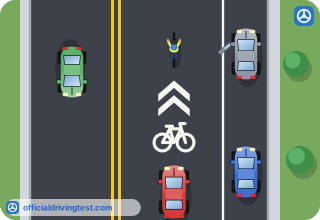
Where there are sharrows, when should a motorist pass a bicyclist?
- Only after the bicyclist signals that the driver may go by
- Whenever the driver sounds the horn first
- Only when the roadway width allows the bicyclist to move to the right
- Never, because sharrows prohibit all passing
Show answer
Correct answer: Only when the roadway width allows the bicyclist to move to the right
Motorists should pass bicyclists only when the roadway width allows bicyclists to move to the right.
Source: New Mexico Driver Manual (Version 11.19.19), page 26
-
As a bicyclist, where may you ride when there are sharrows?
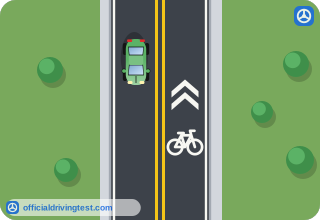
- Only on the sidewalk next to the sharrow
- On the center of the sharrow
- Only on the far right edge of the road
- Against traffic, to the left of the sharrow
Show answer
Correct answer: On the center of the sharrow
Where there are sharrows, a bicyclist may ride on the center of the sharrow.
Source: New Mexico Driver Manual (Version 11.19.19), page 26
-
As a bicyclist in the presence of sharrows, what should you keep a safe distance from?
- The center line of the road
- The curb on the right side
- The wheels of passing trucks
- The door zone of parked cars
Show answer
Correct answer: The door zone of parked cars
Bicyclists should keep a safe distance from the "door zone" of parked cars.
Source: New Mexico Driver Manual (Version 11.19.19), page 26
-
As a bicyclist on a road with sharrows, what should you do to let vehicles pass when it is safe?
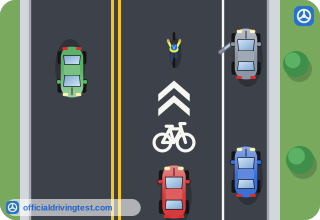
- Move right
- Move left
- Stop and dismount
- Ride faster
Show answer
Correct answer: Move right
Bicyclists should move right to let vehicles pass when it is safe to do so.
Source: New Mexico Driver Manual (Version 11.19.19), page 26
-
Compared with a car going the same speed, how do large trucks and RVs stop?
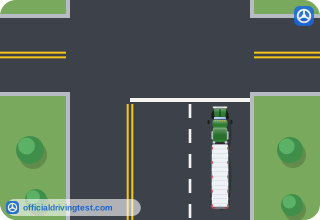
- In a shorter distance than the car
- They take longer to stop
- In the same distance as the car
- Faster, because they have air brakes
Show answer
Correct answer: They take longer to stop
Large trucks and RVs take longer to stop than a car going the same speed, so do not pull in front of a big rig and suddenly slow down or stop.
Source: New Mexico Driver Manual (Version 11.19.19), page 27
-
Why should you not pull in front of a big rig and suddenly slow down or stop?
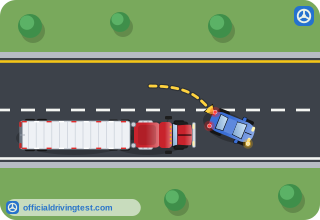
- The truck driver cannot see anything that is in front of the truck
- The driver may not be able to stop quickly enough to avoid crashing into you
- Large trucks are not allowed to follow other vehicles closely
- A large truck always stops faster than a car going the same speed
Show answer
Correct answer: The driver may not be able to stop quickly enough to avoid crashing into you
Large trucks take longer to stop, so the driver may not be able to stop quickly enough to avoid crashing into you.
Source: New Mexico Driver Manual (Version 11.19.19), page 27
-
Which turn do big trucks and RVs often swing wide to make?
- A left turn
- A U-turn
- A turn into a driveway
- A right turn
Show answer
Correct answer: A right turn
Big trucks and RVs need more room to turn and often swing wide to make a right turn.
Source: New Mexico Driver Manual (Version 11.19.19), page 27
-
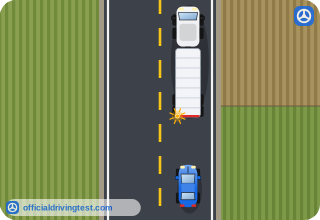
You are following a big rig and think it is turning left. What should you do before you start to pass?
- Wait a second and check its turn signals again
- Start to pass on the right at once
- Pass quickly on the left before it turns
- Move beside it so the driver can see you
Show answer
Correct answer: Wait a second and check its turn signals again
The driver may really be turning right, so wait a second and check the turn signals again.
Source: New Mexico Driver Manual (Version 11.19.19), page 27
-
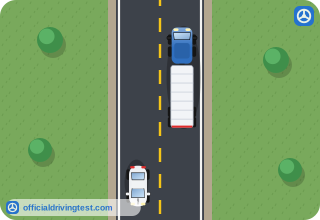
What are the large areas around a truck that the trucker cannot see called?
- The safety cushion
- The swing area
- The NO ZONE
- The escape lane
Show answer
Correct answer: The NO ZONE
The large areas a trucker cannot see are called blind spots or the NO ZONE.
Source: New Mexico Driver Manual (Version 11.19.19), page 27
-
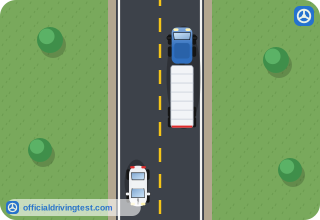
In general, what does it mean if you cannot see a truck driver in the side mirror?
- The driver is not paying attention
- The driver cannot see you
- The truck is about to turn right
- The truck is moving too slowly
Show answer
Correct answer: The driver cannot see you
In general, if you cannot see the driver in the side mirror, the driver cannot see you.
Source: New Mexico Driver Manual (Version 11.19.19), page 27
-
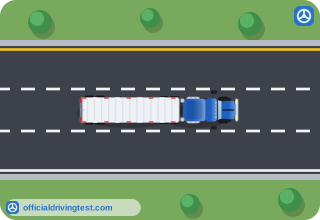
Which is a common mistake when driving around large trucks and RVs?
- Passing a large truck or RV on the left side
- Checking a truck's turn signals before you pass
- Moving ahead of a truck or RV after you pass it
- Cutting in front of a truck to reach your exit
Show answer
Correct answer: Cutting in front of a truck to reach your exit
The manual lists cutting in front of a truck or RV to reach your exit or turn as a mistake, because cutting into the open space in front of a truck is dangerous.
Source: New Mexico Driver Manual (Version 11.19.19), page 27
-
Why should you not drive beside a large truck or RV?
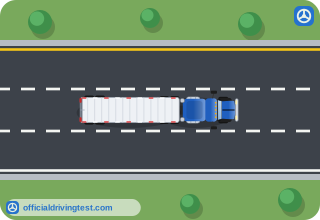
- It may be unable to swerve around a hazard
- Its tires may throw rocks at your windshield
- Trucks are not allowed to change lanes
- The truck's brakes can fail when a car is close
Show answer
Correct answer: It may be unable to swerve around a hazard
If you drive beside a truck or RV, it may not be able to swerve to miss a hazard in the road.
Source: New Mexico Driver Manual (Version 11.19.19), page 27
-
On which side should you always pass a large truck or RV?
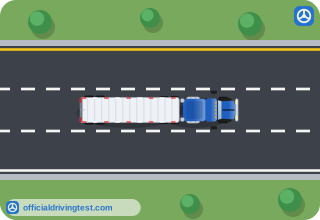
- The right side
- Whichever side has more room
- The left side
- The side the driver signals
Show answer
Correct answer: The left side
The manual says to always pass a large truck or RV on the left side.
Source: New Mexico Driver Manual (Version 11.19.19), page 27
-
After you pass a large truck or RV, what should you do?
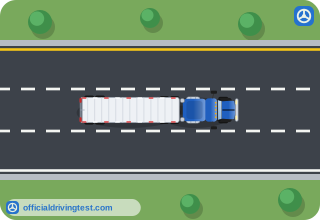
- Stay beside it so the driver can watch you
- Move ahead of it, out of the blind spot
- Slow down at once so it can pass you again
- Move into the lane beside it and match its speed
Show answer
Correct answer: Move ahead of it, out of the blind spot
After passing, move ahead of the truck or RV and do not stay in the driver's blind spot.
Source: New Mexico Driver Manual (Version 11.19.19), page 27
-
What may happen if you drive too close behind a truck?
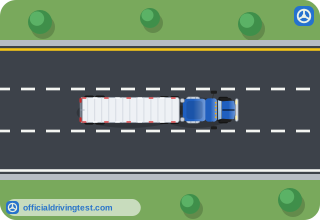
- The truck may slow down to let you pass
- The trucker may use the horn to warn you
- The truck may leave its lane to avoid you
- The trucker may not know you are there
Show answer
Correct answer: The trucker may not know you are there
If you drive too close behind a truck, the trucker may not know you are there.
Source: New Mexico Driver Manual (Version 11.19.19), page 27
-
How may a big truck or RV look compared with how fast it is really going?
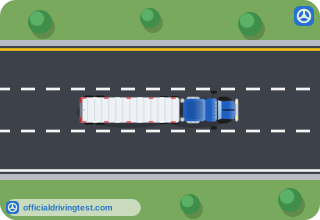
- As if it is going more slowly than it is
- As if it is going faster than it is
- Exactly as fast as a car at that speed
- Slower than it is only when it is turning
Show answer
Correct answer: As if it is going more slowly than it is
A big truck or RV may look like it is going more slowly than it is.
Source: New Mexico Driver Manual (Version 11.19.19), page 27
-
Which advantage do truck drivers have over car drivers, according to the manual?
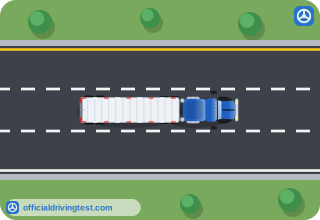
- They can see better behind and to both sides of the truck
- They have no blind spots because they sit up higher
- They can see better in front of them and have bigger mirrors
- They can see the whole road at night with their lights
Show answer
Correct answer: They can see better in front of them and have bigger mirrors
Truckers can see better in front of them and have bigger mirrors, but there are still large areas they cannot see.
Source: New Mexico Driver Manual (Version 11.19.19), page 27
-
Before passing, where should a motorcyclist ride at a safe following distance to increase the line of sight and be more visible?
- In the right portion of the lane
- In the left portion of the lane
- On the line between the lanes
- On the shoulder of the road
Show answer
Correct answer: In the left portion of the lane
The manual says to ride in the left portion of the lane at a safe following distance to increase your line of sight and make you more visible.
Source: New Mexico Driver Manual (Version 11.19.19), page 35
-
What should a motorcyclist who is ready to pass do before moving into the left lane?
- Sound the horn and move over to the left lane right away
- Slow down and stay in the right portion of the lane until the way is clear
- Turn on the high beam and accelerate past the vehicle ahead
- Signal, check oncoming traffic, and look behind with mirrors and a head turn
Show answer
Correct answer: Signal, check oncoming traffic, and look behind with mirrors and a head turn
To pass, a motorcyclist signals, checks for oncoming traffic, and uses the mirrors and a head turn to look for traffic behind.
Source: New Mexico Driver Manual (Version 11.19.19), page 35
-
What should a motorcyclist do before returning to the original lane after passing?
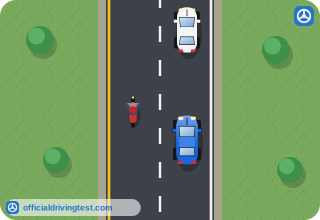
- Sound the horn and move back at once
- Cancel the signal and return as soon as the vehicle is behind
- Signal again and complete mirror and head checks
- Slow down sharply while still beside the vehicle
Show answer
Correct answer: Signal again and complete mirror and head checks
Before returning to the original lane, the rider signals again and completes mirror and head checks.
Source: New Mexico Driver Manual (Version 11.19.19), page 35
-
Within what limits must a motorcyclist complete a pass?
- The speed of the vehicle being passed, in any lane
- Posted speed limits, and only where passing is permitted
- Any speed, if the road is clear of traffic
- Posted limits, but only on a freeway
Show answer
Correct answer: Posted speed limits, and only where passing is permitted
Passing must be completed within posted speed limits and only where permitted.
Source: New Mexico Driver Manual (Version 11.19.19), page 35
-
Why should a motorcyclist not ride next to cars or trucks in other lanes if it can be avoided?
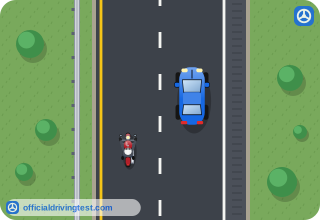
- Cars in the next lane always speed up when a motorcycle is beside them
- Motorcycles are not allowed to travel beside other vehicles
- The wind from the car makes the motorcycle's brakes lock
- It could be in the blind spot of a car that may switch lanes without warning
Show answer
Correct answer: It could be in the blind spot of a car that may switch lanes without warning
A motorcyclist might be in the blind spot of a car in the next lane, which could switch into the rider's lane without warning.
Source: New Mexico Driver Manual (Version 11.19.19), page 35
-
How does a motorcyclist find a place that is clear of traffic on both sides?
- Speed up or drop back
- Stay beside the nearest car
- Ride along the lane line
- Slow down beside a truck
Show answer
Correct answer: Speed up or drop back
The manual says to speed up or drop back to find a place clear of traffic on both sides.
Source: New Mexico Driver Manual (Version 11.19.19), page 35
-
When passing parked cars, where should a motorcyclist stay in the lane?
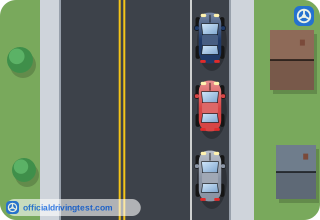
- Toward the right of the lane, close to the parked cars
- Close to the parked cars, so there is room on the left
- Toward the right of the lane, away from oncoming traffic
- Toward the left of the lane
Show answer
Correct answer: Toward the left of the lane
Staying toward the left of the lane avoids problems caused by doors opening, drivers getting out of cars, or people stepping from between cars.
Source: New Mexico Driver Manual (Version 11.19.19), page 36
-
When a motorcyclist passes parked cars and oncoming traffic is present, what is usually best?
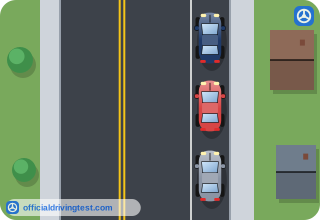
- To remain in the center lane position
- To move to the far left of the lane
- To move to the right, next to the parked cars
- To speed up to get past the parked cars quickly
Show answer
Correct answer: To remain in the center lane position
If oncoming traffic is present, it is usually best to remain in the center lane position to maximize your space cushion.
Source: New Mexico Driver Manual (Version 11.19.19), page 36
-
A driver may pull away from the curb without checking for traffic behind and cut into a motorcyclist's path. What should the rider do?
- Speed up to pass the car before it moves
- Stay close to the curb so the driver sees the rider
- Slow down or change lanes to make room
- Flash the headlight and keep the same speed
Show answer
Correct answer: Slow down or change lanes to make room
The rider should slow down or change lanes to make room for someone cutting in.
Source: New Mexico Driver Manual (Version 11.19.19), page 36
-
Which cars does the manual call the most dangerous to a motorcyclist passing parked cars?
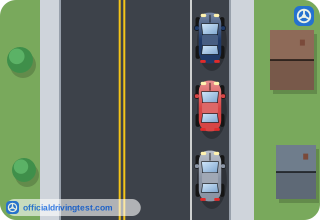
- Cars that are parked with a door open
- Cars making a sudden U-turn
- Cars pulling away slowly from the curb
- Cars waiting at a stop sign
Show answer
Correct answer: Cars making a sudden U-turn
Cars making a sudden U-turn are the most dangerous, because they may cut the rider off entirely and block the whole road.
Source: New Mexico Driver Manual (Version 11.19.19), page 36
-
How can a motorcyclist get the attention of a driver who may make a sudden U-turn?
- Flash the brake light and stop in the lane
- Swerve toward the center line
- Speed up and pass on the right
- Sound the horn and continue with caution
Show answer
Correct answer: Sound the horn and continue with caution
Since a rider cannot tell what the driver will do, the manual says to get the driver's attention by sounding the horn and continuing with caution.
Source: New Mexico Driver Manual (Version 11.19.19), page 36
-
What does the manual say about lane sharing by cars and motorcycles?
- A full lane is needed, so lane sharing is usually prohibited
- Lane sharing is encouraged in heavy, bumper-to-bumper traffic
- Lane sharing is allowed whenever the motorcycle signals first
- Each of them needs only half of a lane to operate safely
Show answer
Correct answer: A full lane is needed, so lane sharing is usually prohibited
Cars and motorcycles need a full lane to operate safely, and lane sharing is usually prohibited.
Source: New Mexico Driver Manual (Version 11.19.19), page 36
-
How can a motorcyclist discourage lane sharing by other drivers?
- Ride on the left lane line
- Ride on the right edge of the lane
- Keep a center of the lane position
- Sound the horn continuously
Show answer
Correct answer: Keep a center of the lane position
The manual says to keep a center of the lane position whenever drivers might be tempted to squeeze by.
Source: New Mexico Driver Manual (Version 11.19.19), page 36
-
What does the manual say about the best lane position for motorcycle riders?
- The left portion is always the best position
- No single best position; no portion of the lane need be avoided
- The right portion is best because it leaves an escape route
- The center must always be avoided because it is oily
Show answer
Correct answer: No single best position; no portion of the lane need be avoided
In general there is no single best position, and no portion of the lane need be avoided, including the center.
Source: New Mexico Driver Manual (Version 11.19.19), page 36
-
If hazardous conditions exist on both sides of a motorcyclist, which lane position is usually the best choice?
- The left edge of the lane
- The right edge of the lane
- On the line between lanes
- The center of the lane
Show answer
Correct answer: The center of the lane
If hazardous conditions exist on both sides of the rider, the center of the lane is usually the best choice.
Source: New Mexico Driver Manual (Version 11.19.19), page 36
-
How wide is the oily strip in the center of a lane, usually?
- No more than two feet wide
- No more than six inches wide
- About four feet wide
- As wide as the whole lane
Show answer
Correct answer: No more than two feet wide
The oily center strip is usually no more than two feet wide, so a rider can ride to the left or right of it and still be in the lane.
Source: New Mexico Driver Manual (Version 11.19.19), page 36
-
Where are the big build-ups of oil and grease that a motorcyclist should avoid usually found?
- On long downhill mountain grades
- On freeway on-ramps and exits
- At busy intersections or toll booths
- In school zones near schools
Show answer
Correct answer: At busy intersections or toll booths
Big build-ups of oil and grease are usually found at very busy intersections or toll booths, and riders should avoid riding on them.
Source: New Mexico Driver Manual (Version 11.19.19), page 37
-
At night, what should decide a motorcyclist's lane position?
- The right edge of the lane, to stay away from oncoming lights
- The center of the lane, with no changes at all
- Whatever portion best helps the rider see and be seen
- The left edge of the lane, to stay next to the line
Show answer
Correct answer: Whatever portion best helps the rider see and be seen
At night a rider should be flexible and change to whatever portion of the lane best helps see, be seen and keep an adequate space cushion.
Source: New Mexico Driver Manual (Version 11.19.19), page 38
-
What is the best way for a group of motorcyclists to keep ranks close yet maintain an adequate space cushion?
- A side-by-side formation
- A staggered formation
- A bumper-to-bumper line
- A V-shaped formation
Show answer
Correct answer: A staggered formation
The manual calls the staggered formation the best way to keep ranks close yet maintain an adequate space cushion.
Source: New Mexico Driver Manual (Version 11.19.19), page 38
-
How should riders in a staggered formation pass another vehicle?
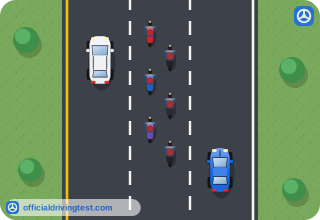
- All together, side by side
- One at a time
- In pairs, left and right
- Only the last rider may pass
Show answer
Correct answer: One at a time
Riders in a staggered formation should pass one at a time.
Source: New Mexico Driver Manual (Version 11.19.19), page 38
-
After a lead rider in a staggered formation passes a vehicle, what should the leader do?
- Move to the right side and slow to the speed of the group
- Slow at once and wait beside the passed vehicle for the group
- Move to the right side so the second rider can pass more quickly
- Return to the left position and keep riding at passing speed
Show answer
Correct answer: Return to the left position and keep riding at passing speed
The leader returns to the left position and keeps riding at passing speed to open room for the next rider; moving to the right side is not a good idea.
Source: New Mexico Driver Manual (Version 11.19.19), page 38
-
When is it best for a group of motorcyclists to move into a single-file formation?
- When riding curves, turning, entering or leaving a highway
- When riding in light traffic on straight roads in daylight
- When stopped at a traffic light with the group behind
- When riding on a wide road in good daylight
Show answer
Correct answer: When riding curves, turning, entering or leaving a highway
It is best to move into a single-file formation when riding curves, turning, entering or leaving a highway.
Source: New Mexico Driver Manual (Version 11.19.19), page 38
-
When a motorcyclist is being passed from behind or by an oncoming vehicle, where should the rider stay in the lane?
- In the portion closest to the passing vehicle
- In the center portion of the lane
- In the portion farthest from the passing vehicle
- On the line between the lanes
Show answer
Correct answer: In the center portion of the lane
When being passed from behind or by an oncoming vehicle, stay in the center portion of your lane.
Source: New Mexico Driver Manual (Version 11.19.19), page 39
-
What do some drivers forget about their mirrors when passing a motorcyclist?
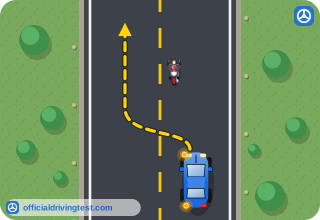
- That their mirrors must be folded in when passing
- That their mirrors cannot show the motorcycle at all
- That their mirrors can be adjusted while driving
- That their mirrors hang out farther than their fenders
Show answer
Correct answer: That their mirrors hang out farther than their fenders
Some drivers forget that their mirrors hang out farther than their fenders, which is a danger when being passed.
Source: New Mexico Driver Manual (Version 11.19.19), page 39
-
Why might objects be thrown from a passing vehicle onto a motorcyclist or the road ahead?
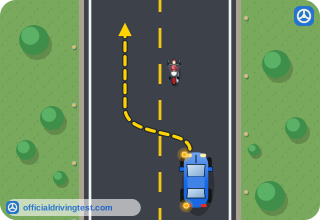
- A passenger may not see the rider, even if the driver does
- The driver wants to make the rider slow down or leave the lane
- Passengers cannot see anything on the road
- The driver cannot see out of the passenger window
Show answer
Correct answer: A passenger may not see the rider, even if the driver does
Even if the driver knows the rider is there, a passenger may not see the rider and might toss something onto the rider or the road ahead.
Source: New Mexico Driver Manual (Version 11.19.19), page 39
-
Why is the middle portion of the lane best when a motorcyclist is hit by a blast of wind from a larger vehicle?
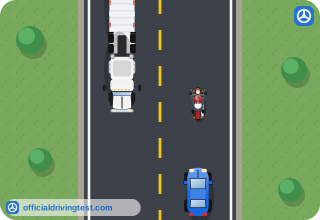
- The wind is weaker in the middle of the lane
- The wind always pushes a rider toward the lane line
- There is more room for error than on either side of the lane
- The larger vehicle will slow down in the middle
Show answer
Correct answer: There is more room for error than on either side of the lane
A rider has more room for error in the middle portion of the lane than on either side when hit by a blast of wind from a larger vehicle.
Source: New Mexico Driver Manual (Version 11.19.19), page 39
-
Why should a rider not move into the portion of the lane farthest from a passing vehicle?
- It leaves the rider much too close to the passing vehicle's mirrors
- It might invite the other driver to cut back into the lane too early
- It puts the rider in the oily strip in the center of the lane
- It blocks the view of drivers coming up in the next lane
Show answer
Correct answer: It might invite the other driver to cut back into the lane too early
Moving to the portion of the lane farthest from the passing vehicle might invite the other driver to cut back into the lane too early.
Source: New Mexico Driver Manual (Version 11.19.19), page 39