New Mexico: Sharing the road — Part 2 Practice Test
Questions in this part include: “Why should you be ready to slow down to let deer cross on slick surfaces?” · “You have just passed a bicyclist on your right and want to turn right. What should you do?”
Independent educational site · not affiliated with any government agency or DMV
Ready? Test yourself
- Instant feedback with an explanation
- Every answer cites its source in the manual
- Your best score is saved on this device
- Keyboard: press 1 to 4 to answer and Enter for the next question
Questions are original and based on the official manual "New Mexico Driver Manual" (Version 11.19.19), New Mexico Motor Vehicle Division (MVD).
All 17 questions in this practice test
Take the test above first, then use this list to study. Tap “Show answer” to see the correct answer and explanation.
Show the questions and answersHide the questions
-
What should you assume about animals on the road?
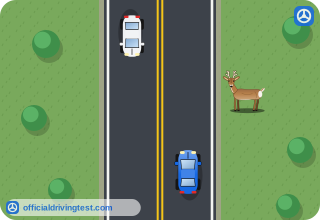
- That they will move away as you approach
- That they will wait for you to pass
- That they will not get out of your way
- That they will run from your headlights
Show answer
Correct answer: That they will not get out of your way
The manual says to assume that animals will not get out of your way.
Source: New Mexico Driver Manual (Version 11.19.19), page 21
-
When one animal is crossing the road, what should you remember?
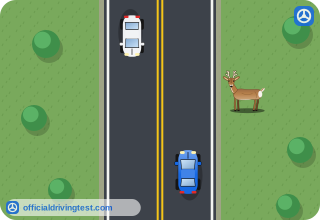
- The rest have already crossed
- Other animals will wait on the shoulder
- No other animals will cross at that spot
- There may be more animals crossing
Show answer
Correct answer: There may be more animals crossing
The manual says to remember that where one animal is crossing, there may be more.
Source: New Mexico Driver Manual (Version 11.19.19), page 21
-
Why should you be ready to slow down to let deer cross on slick surfaces?
- Animals with hooves often speed up on slick surfaces
- Animals with hooves often slow down on slick surfaces
- Animals with hooves cannot see vehicles well in the rain
- Animals with hooves always run toward headlights
Show answer
Correct answer: Animals with hooves often slow down on slick surfaces
The manual says animals with hooves, such as deer, often slow down on slick surfaces, so you should be ready to slow down to let them cross.
Source: New Mexico Driver Manual (Version 11.19.19), page 21
-
What does a slow-moving vehicle decal on the back of a vehicle look like?
- A red diamond
- A yellow circle
- A white square
- An orange triangle
Show answer
Correct answer: An orange triangle
The manual says slow-moving vehicles such as farm tractors should have a slow-moving vehicle decal, an orange triangle, on the back.
Source: New Mexico Driver Manual (Version 11.19.19), page 22
-
To whom should you give extra space at the side of your vehicle, especially if they are children?
- Large trucks and buses
- Vehicles stopped at a red light
- Pedestrians or bicycles
- Vehicles ahead of you in your own lane
Show answer
Correct answer: Pedestrians or bicycles
The manual says to give extra space to pedestrians or bicycles, especially children.
Source: New Mexico Driver Manual (Version 11.19.19), page 24
-
What rights and responsibilities do bicycle drivers on roads have, compared with drivers of cars?
- The same rights and responsibilities as drivers of cars
- Fewer rights than drivers of cars, because bicycles are slower
- Only the rights that pedestrians have on the roadway
- More rights than drivers of cars, because bicycles are smaller
Show answer
Correct answer: The same rights and responsibilities as drivers of cars
The manual says bicycle drivers on roads have the same rights and responsibilities as drivers of cars.
Source: New Mexico Driver Manual (Version 11.19.19), page 25
-
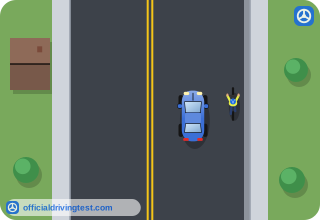
When passing a bicyclist, motor vehicle drivers are required to keep a safe distance and try for at least how much space?
- At least two feet
- At least three feet
- At least five feet
- At least ten feet
Show answer
Correct answer: At least five feet
Drivers must keep a safe distance when passing a bicyclist, trying for at least five feet, and pass only when it is safe and legal.
Source: New Mexico Driver Manual (Version 11.19.19), page 25
-
What must a motor vehicle driver give a bicyclist who needs to merge or use a turn lane?
- The right of way, even when the bicyclist is turning left
- Extra time and space, as for any other vehicle
- A horn signal to warn the bicyclist before every merge
- Only the space that is left after the driver has passed
Show answer
Correct answer: Extra time and space, as for any other vehicle
Motor vehicle drivers must provide the bicyclist with extra time and space to merge and use turn lanes like other vehicles.
Source: New Mexico Driver Manual (Version 11.19.19), page 25
-
How does the manual say a driver should treat a bicycle on the road?
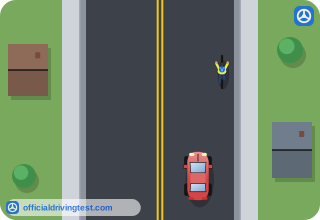
- As a pedestrian who happens to be riding on the roadway
- As an obstacle that must always give way to motor vehicles
- As a toy that is not allowed to use the travel lanes
- As a legal, slow-moving vehicle, such as a backhoe
Show answer
Correct answer: As a legal, slow-moving vehicle, such as a backhoe
Drivers are required to treat the bicycle as a legal, slow-moving vehicle such as a backhoe.
Source: New Mexico Driver Manual (Version 11.19.19), page 25
-
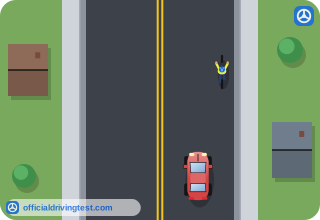
Bicycles should usually stay on the right side of the roadway. What are they legally allowed to do when necessary?
- Take the whole lane by riding in its center
- Ride on the left shoulder, facing oncoming traffic
- Ride on the sidewalk, ahead of any pedestrians
- Ride against the flow of traffic in the left lane
Show answer
Correct answer: Take the whole lane by riding in its center
Bicycles are legally allowed to take the whole lane by riding in the center of the traffic lane when necessary.
Source: New Mexico Driver Manual (Version 11.19.19), page 25
-
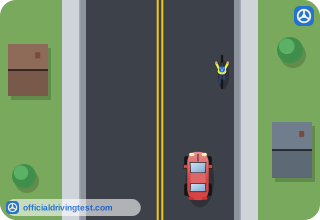
Which is a reason a bicyclist will typically take the whole lane?
- To get ahead of slower cars
- To make room for drivers behind
- To prepare for a left turn
- To race cars in the next lane
Show answer
Correct answer: To prepare for a left turn
Bicyclists typically take the whole lane to prepare for a left turn, to avoid being squeezed on a narrow street, or to avoid hazards, grates and debris.
Source: New Mexico Driver Manual (Version 11.19.19), page 26
-
You have just passed a bicyclist on your right and want to turn right. What should you do?
- Turn right immediately, since you are already ahead of the bicyclist
- Slow down and merge behind the bicyclist before turning
- Sound your horn and turn right ahead of the bicyclist
- Speed up so that the bicyclist can turn behind your car
Show answer
Correct answer: Slow down and merge behind the bicyclist before turning
Drivers should not make a sudden right turn after passing a bicyclist; they should slow down and merge behind the bicyclist before turning.
Source: New Mexico Driver Manual (Version 11.19.19), page 26
-
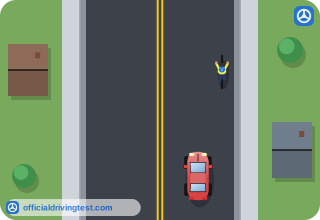
Which bicyclists does the manual single out as likely to behave unexpectedly?
- Adults riding alone
- Riders on narrow roads
- Riders wearing helmets
- Young children
Show answer
Correct answer: Young children
The manual says some bicyclists, especially young children, will behave unexpectedly, so drivers should stay watchful for sudden movements and lane changes.
Source: New Mexico Driver Manual (Version 11.19.19), page 26
-
What are bicycle drivers required to use at night?
- A bright headlight and a good rear reflector
- A bright taillight and a good front reflector
- A flashing light on each wheel and a horn
- Reflective clothing and a handlebar bell
Show answer
Correct answer: A bright headlight and a good rear reflector
Bicycle drivers must obey traffic laws, including night-time use of a bright headlight and a good rear reflector.
Source: New Mexico Driver Manual (Version 11.19.19), page 26
-
In which direction must bicycle drivers travel on the road?
- Facing oncoming traffic on the left side
- In either direction, if they stay near the curb
- In the same direction as traffic
- Against traffic whenever the road is narrow
Show answer
Correct answer: In the same direction as traffic
Bicycle drivers must travel in the same direction as traffic and make left and right turns the same way cars do.
Source: New Mexico Driver Manual (Version 11.19.19), page 26
-
Who must wear a well-fitting helmet when bicycling, according to the manual?
- Adults must; minors should
- Minors must; adults should
- Only riders on roads with sharrows
- Nobody; it is only a suggestion
Show answer
Correct answer: Minors must; adults should
The manual says adults should, and minors must, wear a well-fitting helmet.
Source: New Mexico Driver Manual (Version 11.19.19), page 26
-
Bicycles may be difficult for motorists to see. What does the manual advise bicyclists to do?
- Ride close to parked cars, wear dark colors, and avoid lane changes
- Ride mostly at night, use a horn, and travel in large groups
- Stay on sidewalks, wear helmet colors that match the road
- Wear bright colors, use proper lighting, and be predictable
Show answer
Correct answer: Wear bright colors, use proper lighting, and be predictable
Because bicycles are hard to see, bicyclists should wear bright colors, use proper lighting, and be predictable.
Source: New Mexico Driver Manual (Version 11.19.19), page 26