New Mexico: Sharing the road — Part 1 Practice Test
Questions in this part include: “Which road users does the manual say are harder to see than cars and trucks?” · “Where does the manual say to watch for elk?”
Independent educational site · not affiliated with any government agency or DMV
Ready? Test yourself
- Instant feedback with an explanation
- Every answer cites its source in the manual
- Your best score is saved on this device
- Keyboard: press 1 to 4 to answer and Enter for the next question
Questions are original and based on the official manual "New Mexico Driver Manual" (Version 11.19.19), New Mexico Motor Vehicle Division (MVD).
All 17 questions in this practice test
Take the test above first, then use this list to study. Tap “Show answer” to see the correct answer and explanation.
Show the questions and answersHide the questions
-
When must you stop for a school bus that is stopped with its red lights flashing?
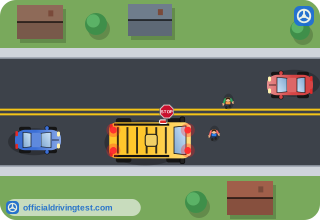
- Only when it is on your side of the road
- On your side, the opposite side, or at an intersection
- Only when children are visible outside the bus
- Only when it is at an intersection
Show answer
Correct answer: On your side, the opposite side, or at an intersection
You must stop for a stopped school bus with flashing red lights whether it is on your side of the road, the opposite side or at an intersection you are approaching.
Source: New Mexico Driver Manual (Version 11.19.19), page 12
-
When are you not required to stop for a stopped school bus with its red lights flashing?
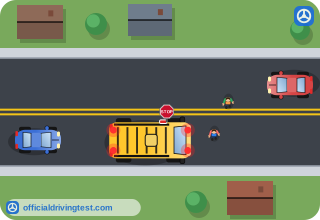
- The bus is on the opposite side of the road
- The bus is stopped at an intersection you are approaching
- A median or physical barrier separates you from an oncoming bus
- No children are visible near the bus
Show answer
Correct answer: A median or physical barrier separates you from an oncoming bus
You are not required to stop if the bus is traveling toward you and a median or other physical barrier separates the roadway.
Source: New Mexico Driver Manual (Version 11.19.19), page 12
-
After a school bus's red lights stop flashing, when may you proceed?
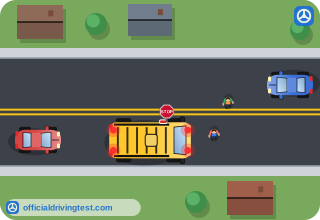
- Right away, as soon as the red lights have stopped flashing
- As soon as the school bus begins to move again
- As soon as the bus doors have closed behind the children
- When the children have completely left the roadway and it is safe
Show answer
Correct answer: When the children have completely left the roadway and it is safe
After the red lights stop flashing, you must watch for children and not proceed until they have completely left the roadway and it is safe.
Source: New Mexico Driver Manual (Version 11.19.19), page 12
-
Which road users does the manual say are harder to see than cars and trucks?
- School buses, ambulances and fire trucks
- Motorcycles, bicycles and pedestrians
- Large trucks, buses and tractors
- Taxis, vans and delivery vehicles
Show answer
Correct answer: Motorcycles, bicycles and pedestrians
The manual says motorcycles, bicycles and pedestrians are harder to see than cars and trucks.
Source: New Mexico Driver Manual (Version 11.19.19), page 17
-
When should you be especially alert for motorcycles, bicycles and pedestrians?
- When you drive on an empty freeway
- When you are parked with the engine off
- When you drive at a steady speed on a flat road
- When you enter the roadway from the curb or driveway
Show answer
Correct answer: When you enter the roadway from the curb or driveway
The manual says to be especially alert for these harder-to-see road users when entering the roadway from the curb or driveway.
Source: New Mexico Driver Manual (Version 11.19.19), page 17
-
When you go down hills or mountains, which vehicles should you be alert for because they may be going too fast?
- Small cars and motorcycles
- Slow-moving farm equipment
- Large trucks and buses
- Delivery vans and taxis
Show answer
Correct answer: Large trucks and buses
The manual says to be alert for large trucks and buses that may be going too fast when you drive down a steep grade.
Source: New Mexico Driver Manual (Version 11.19.19), page 17
-
Which position puts you in another vehicle’s blind spot?
- Well ahead of it in the next lane
- Several car lengths behind it in its own lane
- On either side and slightly to the rear of it
- Directly in front of it, one car length ahead
Show answer
Correct answer: On either side and slightly to the rear of it
The manual says that driving on either side and slightly to the rear of another vehicle puts you in that driver’s blind spot.
Source: New Mexico Driver Manual (Version 11.19.19), page 19
-
If you find yourself in another vehicle’s blind spot, what should you do?
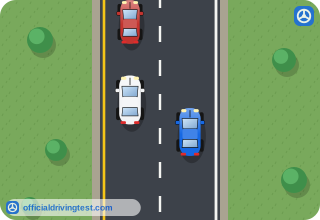
- Stay where you are and watch its mirrors
- Either speed up or drop back
- Sound your horn continuously
- Flash your high beams until it moves
Show answer
Correct answer: Either speed up or drop back
The manual says to either speed up or drop back so the other driver can see your vehicle more easily.
Source: New Mexico Driver Manual (Version 11.19.19), page 19
-
When passing another vehicle, how should you get through the other driver’s blind spot?
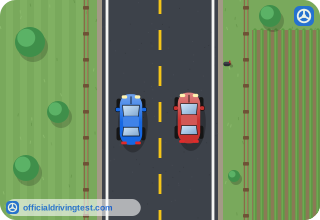
- As slowly as is safe
- At the same speed as the other vehicle
- While sounding your horn
- As quickly as you can
Show answer
Correct answer: As quickly as you can
The manual says the longer you stay in the blind spot, the longer you are in danger of the other driver turning into you.
Source: New Mexico Driver Manual (Version 11.19.19), page 19
-
Why should you never stay alongside a large vehicle such as a truck or bus?
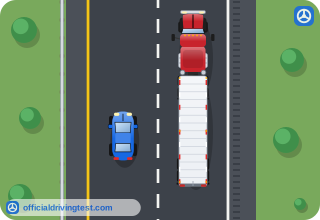
- It must stay in the right lane at all times
- Its exhaust can make it hard for you to see
- It has large blind spots and its driver may not see you
- It always changes lanes without signaling to other drivers
Show answer
Correct answer: It has large blind spots and its driver may not see you
The manual says large vehicles have large blind spots and it is hard for their drivers to see you.
Source: New Mexico Driver Manual (Version 11.19.19), page 19
-
Which of these is named in the manual as a large game animal to watch for on New Mexico roads?
- Moose
- Bison
- Pronghorn antelope
- Wild boar
Show answer
Correct answer: Pronghorn antelope
The manual lists deer, elk, pronghorn antelope, black bears and cougars as the large game animals to watch out for.
Source: New Mexico Driver Manual (Version 11.19.19), page 21
-
Where does the manual say to watch for elk?
- In the western three-quarters of the state
- Only in the eastern part of the state
- Only on the open plains of the east
- Only along the southern border of the state
Show answer
Correct answer: In the western three-quarters of the state
The manual says to watch for elk in the western three-quarters of the state.
Source: New Mexico Driver Manual (Version 11.19.19), page 21
-
Where does the manual say to watch for antelope?
- In the western three-quarters of the state
- Only in the mountains and forests of the western part
- Only in river valleys
- In the eastern part of the state or in open plains
Show answer
Correct answer: In the eastern part of the state or in open plains
The manual says to watch for antelope in the eastern part of the state or in open plains.
Source: New Mexico Driver Manual (Version 11.19.19), page 21
-
Where does the manual say to keep an eye out for black bears and cougars?
- On open plains
- In the mountains
- In the eastern part of the state
- Along city streets
Show answer
Correct answer: In the mountains
The manual says to keep an eye out for black bears and cougars in the mountains.
Source: New Mexico Driver Manual (Version 11.19.19), page 21
-
What do animal crossing signs warn you about?
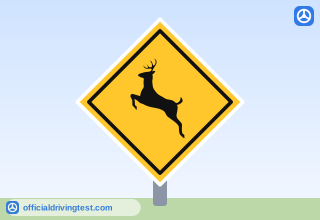
- That a game preserve begins within the next mile
- That vehicles have hit wildlife in this area before
- That hunting is allowed in this area during the day
- That fences keep animals off the road ahead
Show answer
Correct answer: That vehicles have hit wildlife in this area before
The manual says animal crossing signs warn that vehicles have hit wildlife in the area before.
Source: New Mexico Driver Manual (Version 11.19.19), page 21
-
What should you do if you see animals that have been hit along the road?
- Stop and pull the animals off the road yourself right away
- Speed up to get out of the area quickly
- Keep your speed because the danger is gone
- Slow down, since you may be in an animal crossing area
Show answer
Correct answer: Slow down, since you may be in an animal crossing area
The manual says that if you see animals that have been hit you should slow down, because you may be in an animal crossing area.
Source: New Mexico Driver Manual (Version 11.19.19), page 21
-
When should you be especially watchful for wildlife?
- At dawn, dusk and the first few hours after dark
- In the middle of the day when it is hottest
- Only during the first two hours of bright sunshine
- Only on cloudy days when visibility is low
Show answer
Correct answer: At dawn, dusk and the first few hours after dark
The manual says many animals are most active at dawn, dusk and in the first few hours after darkness falls.
Source: New Mexico Driver Manual (Version 11.19.19), page 21