New Mexico: Speed and following distance — Part 1 Practice Test
Questions in this part include: “In which conditions should you drive at the posted maximum speed limit?” · “According to the manual, speed should be adjusted for which of these?”
Independent educational site · not affiliated with any government agency or DMV
Ready? Test yourself
- Instant feedback with an explanation
- Every answer cites its source in the manual
- Your best score is saved on this device
- Keyboard: press 1 to 4 to answer and Enter for the next question
Questions are original and based on the official manual "New Mexico Driver Manual" (Version 11.19.19), New Mexico Motor Vehicle Division (MVD).
All 18 questions in this practice test
Take the test above first, then use this list to study. Tap “Show answer” to see the correct answer and explanation.
Show the questions and answersHide the questions
-
What do speed limit signs indicate?
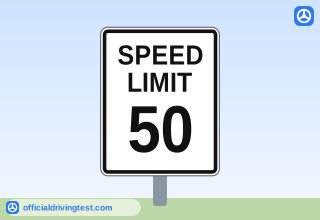
- The maximum safe speed allowed or the minimum safe speed required
- Only the average speed of all the traffic around you
- Only the maximum speed allowed, and never a minimum speed
- The speed at which most drivers feel comfortable on that road
Show answer
Correct answer: The maximum safe speed allowed or the minimum safe speed required
Speed limit signs indicate the maximum safe speed allowed or the minimum safe speed required.
Source: New Mexico Driver Manual (Version 11.19.19), page 6
-
In which conditions should you drive at the posted maximum speed limit?
- In all weather and road conditions
- Only at night on a lighted road
- Only in ideal driving conditions
- Only on highways and freeways
Show answer
Correct answer: Only in ideal driving conditions
The maximum limit should be driven only in ideal driving conditions, and you must reduce speed when conditions require it.
Source: New Mexico Driver Manual (Version 11.19.19), page 6
-
In which situation should you reduce your speed below the posted limit?
- When the roadway is dry, straight, flat and well lit
- When it is foggy and difficult to see clearly down the road
- When traffic is light and the day is clear and sunny
- When the vehicle has just been serviced at a repair shop
Show answer
Correct answer: When it is foggy and difficult to see clearly down the road
You should reduce speed when the roadway is slippery, during rain, snow or icy conditions, or when it is foggy and difficult to see down the road.
Source: New Mexico Driver Manual (Version 11.19.19), page 6
-
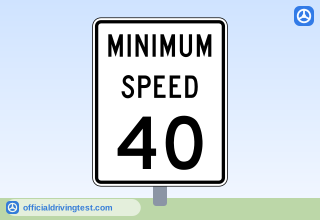
Some high-speed roads have minimum speed limits. What are you required to do on them?
- Travel exactly at the minimum speed at all times
- Travel at least 10 mph under the minimum
- Travel at the minimum only during daylight hours
- Travel at least that fast
Show answer
Correct answer: Travel at least that fast
On roads with minimum speed limits you are required to travel at least that fast so as not to be a hazard to other drivers.
Source: New Mexico Driver Manual (Version 11.19.19), page 7
-
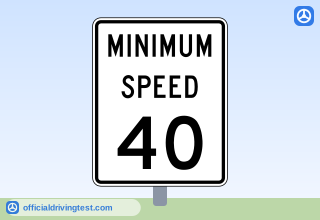
The minimum posted speed on a road is too fast for you. What should you do?
- Drive on the shoulder
- Use another road
- Drive slowly with your hazard lights on
- Follow a faster vehicle closely
Show answer
Correct answer: Use another road
If the minimum posted speed is too fast for you, you should use another road.
Source: New Mexico Driver Manual (Version 11.19.19), page 7
-
What is the maximum speed within a school zone that has a posted speed limit?
- 15 mph
- 20 mph
- 35 mph
- 40 mph
Show answer
Correct answer: 15 mph
The maximum speed within a school zone with a posted speed limit is 15 mph.
Source: New Mexico Driver Manual (Version 11.19.19), page 12
-
What is the maximum speed in business or residential areas, unless posted otherwise?
- 20 mph
- 30 mph
- 40 mph
- 50 mph
Show answer
Correct answer: 30 mph
The maximum speed in business or residential areas is 30 mph unless posted otherwise.
Source: New Mexico Driver Manual (Version 11.19.19), page 12
-
What is the maximum speed on public highways, unless posted otherwise?
- 45 mph
- 60 mph
- 65 mph
- 55 mph
Show answer
Correct answer: 55 mph
The maximum speed on public highways is 55 mph unless posted otherwise.
Source: New Mexico Driver Manual (Version 11.19.19), page 12
-
What is the maximum speed on rural interstate highways, unless posted otherwise?
- 65 mph
- 75 mph
- 70 mph
- 80 mph
Show answer
Correct answer: 75 mph
The maximum speed on rural interstate highways is 75 mph unless posted otherwise.
Source: New Mexico Driver Manual (Version 11.19.19), page 12
-
If no minimum speed is posted, how should you drive?
- At the maximum speed limit at all times, whatever other traffic does
- In the left-most lane so that faster traffic must pass you on the right
- So that you do not interfere with regular traffic flow
- At no more than half of the maximum speed limit
Show answer
Correct answer: So that you do not interfere with regular traffic flow
If no minimum speed is posted, you should drive so that you do not interfere with regular traffic flow.
Source: New Mexico Driver Manual (Version 11.19.19), page 12
-
According to the manual, speed should be adjusted for which of these?
- Adverse conditions and the type of vehicle
- The color of the vehicle and the time of day
- The number of passengers and the driver's age
- The length of the trip and the type of fuel
Show answer
Correct answer: Adverse conditions and the type of vehicle
Speed should be adjusted for adverse conditions and for the type of vehicle, and to avoid accidents.
Source: New Mexico Driver Manual (Version 11.19.19), page 13
-
When is it especially easy to be traveling much faster than you think?
- When you leave high-speed roads and drive on much slower local roads
- When you drive uphill behind a slow truck in heavy traffic
- When you drive on a crowded city street during the day
- When you first start the vehicle after it has been parked
Show answer
Correct answer: When you leave high-speed roads and drive on much slower local roads
People are not very good at judging speed, and this is especially true when leaving high-speed roads for much slower local roads.
Source: New Mexico Driver Manual (Version 11.19.19), page 15
-
What should you do about your speed, since people are not very good at judging how fast they are going?
- Compare your speed with the vehicles around you
- Estimate it by the sound of the engine
- Check the speedometer often
- Check the speedometer only when you enter a highway
Show answer
Correct answer: Check the speedometer often
The manual says to be aware of your speed and check the speedometer often.
Source: New Mexico Driver Manual (Version 11.19.19), page 15
-
How does the manual say you should treat speed limit signs?
- Follow them only when a police officer is nearby
- Follow them, because they are there for your safety
- Ignore them whenever the road is clear and dry
- Treat them as advice that only slow drivers need to follow
Show answer
Correct answer: Follow them, because they are there for your safety
The manual says to follow the speed limit signs because they are there for your safety.
Source: New Mexico Driver Manual (Version 11.19.19), page 15
-
What does stopping suddenly usually indicate?
- A driver who has a better view of the road
- A driver who is running late for an appointment
- A driver who is new to the area
- A driver who is not paying attention
Show answer
Correct answer: A driver who is not paying attention
The manual says stopping suddenly is dangerous and usually indicates a driver who is not paying attention.
Source: New Mexico Driver Manual (Version 11.19.19), page 15
-
What could happen when you brake quickly?
- You could skid and lose control of your vehicle
- It could make it easier for drivers behind you to stop
- Your brake pedal could stick to the floor
- Your headlights could turn off automatically
Show answer
Correct answer: You could skid and lose control of your vehicle
When you brake quickly you could skid and lose control, and you also make it harder for drivers behind you to stop without hitting you.
Source: New Mexico Driver Manual (Version 11.19.19), page 15
-
How can you try to avoid panic stops?
- By braking only at the last moment
- By following the vehicle ahead more closely
- By seeing events well in advance
- By driving a little faster than traffic
Show answer
Correct answer: By seeing events well in advance
The manual says to try to avoid panic stops by seeing events well in advance.
Source: New Mexico Driver Manual (Version 11.19.19), page 15
-
What may let you avoid having to stop at all?
- Speeding up and sounding your horn
- Slowing down or changing lanes
- Braking hard and then accelerating
- Moving onto the shoulder and parking
Show answer
Correct answer: Slowing down or changing lanes
By slowing down or changing lanes you may not have to stop at all, and if you do stop you can make a more gradual and safer stop.
Source: New Mexico Driver Manual (Version 11.19.19), page 15