Nevada: Speed and following distance — Part 4 Practice Test
Questions in this part include: “On what dates may studded snow tires be used?” · “Why do empty trucks actually require greater stopping distances?”
Independent educational site · not affiliated with any government agency or DMV
Ready? Test yourself
- Instant feedback with an explanation
- Every answer cites its source in the manual
- Your best score is saved on this device
- Keyboard: press 1 to 4 to answer and Enter for the next question
Questions are original and based on the official manual "Nevada Driver's Handbook" (March 2024 (DMV 700)), Nevada Department of Motor Vehicles.
All 17 questions in this practice test
Take the test above first, then use this list to study. Tap “Show answer” to see the correct answer and explanation.
Show the questions and answersHide the questions
-
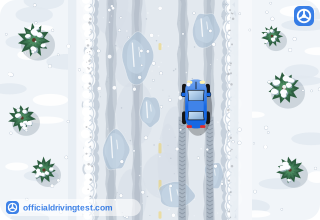
What does the handbook say about speed on snow and ice?
- Half the posted limit is always safe
- There is no such thing as a completely safe speed
- The posted limit is always safe
- Speeds under 30 mph are always completely safe
Show answer
Correct answer: There is no such thing as a completely safe speed
Each stretch of road may differ depending on sun, shade and sanding, so there is no completely safe speed on snow and ice.
Source: Nevada Driver's Handbook (March 2024 (DMV 700)), page 57 · Open this page in the manual (Manual page 57)
-
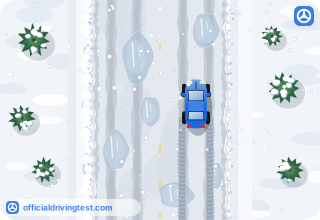
In general, what braking will let you slow down and stop safely on snow and ice?
- Sudden hard braking to stop in the shortest distance
- Quick, repeated stabs at the pedal with full force
- Locking the wheels and steering sharply
- Gentle braking with a slow, light, touch-and-release pattern
Show answer
Correct answer: Gentle braking with a slow, light, touch-and-release pattern
Gentle braking with a slow, light, touch-and-release pattern lets you slow down and stop safely on snow and ice.
Source: Nevada Driver's Handbook (March 2024 (DMV 700)), page 57 · Open this page in the manual (Manual page 57)
-
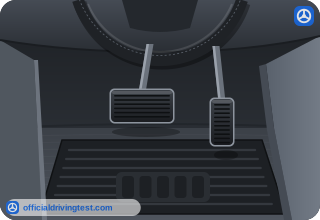
On snow and ice, how should you brake if your vehicle has an anti-lock braking system (ABS)?
- With firm, continuous pressure on the brake pedal
- With a slow, light touch-and-release pattern
- With sudden, repeated taps on the pedal
- With the emergency parking brake
Show answer
Correct answer: With firm, continuous pressure on the brake pedal
With ABS, a firm, continuous pressure on the brake pedal is needed to activate the anti-lock feature.
Source: Nevada Driver's Handbook (March 2024 (DMV 700)), page 57 · Open this page in the manual (Manual page 57)
-
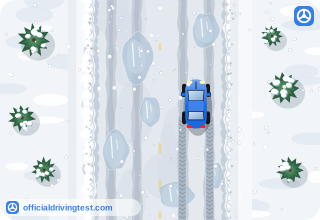
What should you avoid when driving on snow and ice?
- Using your windshield wipers
- Keeping a safe distance
- Sudden changes in speed or direction
- Leaving extra time for your trip
Show answer
Correct answer: Sudden changes in speed or direction
The handbook says to avoid sudden changes in speed or direction on snow and ice.
Source: Nevada Driver's Handbook (March 2024 (DMV 700)), page 57 · Open this page in the manual (Manual page 57)
-
On what dates may studded snow tires be used?
- November 1 through March 31
- October 1 through April 30
- September 1 through May 31
- Any time of year
Show answer
Correct answer: October 1 through April 30
Studded snow tires may only be used from October 1 through April 30.
Source: Nevada Driver's Handbook (March 2024 (DMV 700)), page 57 · Open this page in the manual (Manual page 57)
-
When may tires with retractable studs be used?
- Only from October 1 through April 30
- Only from October 1 through April 30, with studs extended
- Only when chains are not available
- Any time of year, but studs may be extended only on certain dates
Show answer
Correct answer: Any time of year, but studs may be extended only on certain dates
Tires with retractable studs are allowed any time of year, but the studs may be extended or engaged only during the dates indicated.
Source: Nevada Driver's Handbook (March 2024 (DMV 700)), page 57 · Open this page in the manual (Manual page 57)
-
What can overloading a trailer negatively affect, according to the handbook?
- Only the fuel supply and the engine oil
- Steering, braking and speed control
- Only the tire tread wear and alignment
- Only the headlight aim and wiper speed
Show answer
Correct answer: Steering, braking and speed control
The handbook says overloading can have negative effects on steering, braking and speed control.
Source: Nevada Driver's Handbook (March 2024 (DMV 700)), page 68 · Open this page in the manual (Manual page 68)
-
What are overloaded vehicles likely to do on uphill grades?
- Hold a steady speed
- Pick up speed quickly
- Need less braking
- Go very slowly
Show answer
Correct answer: Go very slowly
Overloaded vehicles are likely to go very slowly on uphill grades.
Source: Nevada Driver's Handbook (March 2024 (DMV 700)), page 68 · Open this page in the manual (Manual page 68)
-
What can happen to an overloaded vehicle on downhill grades?
- It may gain too much speed
- It may slow down by itself
- It may stop more quickly
- It may need less braking
Show answer
Correct answer: It may gain too much speed
Overloaded vehicles may gain too much speed on downhill grades.
Source: Nevada Driver's Handbook (March 2024 (DMV 700)), page 68 · Open this page in the manual (Manual page 68)
-
What happens to the stopping distance of an overloaded vehicle whose brakes are forced to work too hard?
- The distance stays the same and the brakes hold
- The distance becomes much shorter than normal
- The distance increases and the brakes can fail
- The brakes grip better as they warm
Show answer
Correct answer: The distance increases and the brakes can fail
Stopping distance increases and brakes can fail when forced to work too hard.
Source: Nevada Driver's Handbook (March 2024 (DMV 700)), page 68 · Open this page in the manual (Manual page 68)
-
Why do empty trucks actually require greater stopping distances?
- They have less traction
- They have heavier brakes
- They absorb more heat in the brakes
- They have softer springs than loaded trucks
Show answer
Correct answer: They have less traction
Empty trucks need greater stopping distances because they have less traction, and an empty truck can bounce and lock up its wheels.
Source: Nevada Driver's Handbook (March 2024 (DMV 700)), page 70 · Open this page in the manual (Manual page 70)
-
When are the brakes, tires, springs and shock absorbers on heavy vehicles designed to work best?
- When the vehicle is completely empty
- When the vehicle is parked
- When the vehicle is fully loaded
- When the vehicle is lightly loaded
Show answer
Correct answer: When the vehicle is fully loaded
Brakes, tires, springs and shock absorbers on heavy vehicles are designed to work best when the vehicle is fully loaded.
Source: Nevada Driver's Handbook (March 2024 (DMV 700)), page 70 · Open this page in the manual (Manual page 70)
-
Compared with other vehicles, what do large vehicles require when managing space?
- Less space for stopping and turning
- More space for stopping and turning
- The same space as a car
- More space only for passing
Show answer
Correct answer: More space for stopping and turning
Large vehicles take up more space and require more space for stopping and turning.
Source: Nevada Driver's Handbook (March 2024 (DMV 700)), page 70 · Open this page in the manual (Manual page 70)
-
Compared with a car, how large a gap may a large vehicle need to enter traffic?
- A much larger gap
- A smaller gap
- The same gap
- A gap only when empty
Show answer
Correct answer: A much larger gap
Because of slow acceleration and the space large vehicles require, you may need a much larger gap to enter traffic than you would in a car.
Source: Nevada Driver's Handbook (March 2024 (DMV 700)), page 72 · Open this page in the manual (Manual page 72)
-
How does a heavy load affect the room you should allow when entering traffic?
- Allow less room because the load adds speed
- Allow the same room as when empty
- Allow more room if your vehicle is heavily loaded
- Allow more room only when empty
Show answer
Correct answer: Allow more room if your vehicle is heavily loaded
Acceleration varies with the load, so you should allow more room if your vehicle is heavily loaded.
Source: Nevada Driver's Handbook (March 2024 (DMV 700)), page 72 · Open this page in the manual (Manual page 72)
-
Why do lightly loaded large combination vehicles lock up their wheels very easily?
- The soft suspension springs and weak brakes give too much grip
- The extra weight on the wheels gives too much traction
- The tires are always under-inflated when lightly loaded
- The very stiff suspension springs and strong brakes give poor traction
Show answer
Correct answer: The very stiff suspension springs and strong brakes give poor traction
When lightly loaded, the very stiff suspension springs and strong brakes give poor traction and make it very easy to lock up the wheels.
Source: Nevada Driver's Handbook (March 2024 (DMV 700)), page 74 · Open this page in the manual (Manual page 74)
-
In any combination rig, how should you plan to brake?
- Allow a lot of following distance and look far enough ahead to brake early
- Follow closely behind the vehicle ahead and brake as late as you can
- Look only at the vehicle ahead and brake hard when needed
- Rely on the engine to slow the rig down instead of the brakes
Show answer
Correct answer: Allow a lot of following distance and look far enough ahead to brake early
In any combination rig, allow a lot of following distance and look far enough ahead so you can brake early, so you are not caught by surprise and forced into a panic stop.
Source: Nevada Driver's Handbook (March 2024 (DMV 700)), page 74 · Open this page in the manual (Manual page 74)