Nevada: Seat belts and child safety Practice Test
Nevada’s seat belt law, child restraint systems and children and pets left in vehicles.
Independent educational site · not affiliated with any government agency or DMV
Ready? Test yourself
- Instant feedback with an explanation
- Every answer cites its source in the manual
- Your best score is saved on this device
- Keyboard: press 1 to 4 to answer and Enter for the next question
Questions are original and based on the official manual "Nevada Driver's Handbook" (March 2024 (DMV 700)), Nevada Department of Motor Vehicles.
All 25 questions in this practice test
Take the test above first, then use this list to study. Tap “Show answer” to see the correct answer and explanation.
Show the questions and answersHide the questions
-
A car of which model year or newer must have lap-type seat belts for passengers in the front seat?
- 1968
- 1960
- 1964
- 1972
Show answer
Correct answer: 1968
A car that is a 1968 model or newer must have lap-type seat belts for passengers in the front seat.
Source: Nevada Driver's Handbook (March 2024 (DMV 700)), page 25 · Open this page in the manual (Manual page 25)
-
A car of the 1970 model year or newer must have lap-type seat belts for each passenger. What else must it have for use in the front seat?
- Side-impact airbags
- Child safety locks
- Shoulder harnesses
- Padded head restraints
Show answer
Correct answer: Shoulder harnesses
A 1970 model or newer car must have lap-type belts for each passenger and also shoulder harnesses for use in the front seat.
Source: Nevada Driver's Handbook (March 2024 (DMV 700)), page 25 · Open this page in the manual (Manual page 25)
-
The driver and any passengers of what age or older must wear safety belts if the vehicle is equipped with them?
- Age 4
- Age 6
- Age 10
- Age 14
Show answer
Correct answer: Age 6
The driver and any passengers age six and older must wear safety belts if the vehicle has them.
Source: Nevada Driver's Handbook (March 2024 (DMV 700)), page 25 · Open this page in the manual (Manual page 25)
-
Children who measure less than how many inches tall must be in an approved child restraint system?
- 48 inches
- 52 inches
- 60 inches
- 57 inches
Show answer
Correct answer: 57 inches
Children who measure less than 57 inches tall must be in an approved child restraint system.
Source: Nevada Driver's Handbook (March 2024 (DMV 700)), page 25 · Open this page in the manual (Manual page 25)
-
Children under what age must be in an approved child restraint system?
- Age 5
- Age 9
- Age 6
- Age 10
Show answer
Correct answer: Age 6
Children under age six must be in an approved child restraint system, as must those under 57 inches tall.
Source: Nevada Driver's Handbook (March 2024 (DMV 700)), page 25 · Open this page in the manual (Manual page 25)
-
What may result from failing to restrain children under age six and those measuring less than 57 inches?
- Fines, community service, and/or suspension of your driver’s license
- Impoundment of the vehicle for up to 30 days and loss of its registration
- A required retake of the written test and a vehicle safety inspection
- A mandatory jail term and permanent loss of the driver’s license
Show answer
Correct answer: Fines, community service, and/or suspension of your driver’s license
Failure to restrain these children may result in fines, community service, and/or suspension of the driver’s license.
Source: Nevada Driver's Handbook (March 2024 (DMV 700)), page 25 · Open this page in the manual (Manual page 25)
-
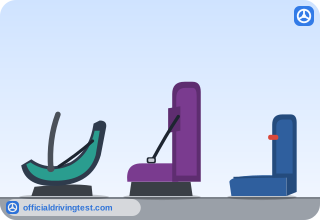
How must a child under the age of two be secured in a motor vehicle?
- In a forward-facing child restraint system in the back seat
- In a rear-facing child restraint system in the front seat
- In a booster seat in the back seat
- In a rear-facing child restraint system in the back seat
Show answer
Correct answer: In a rear-facing child restraint system in the back seat
Children under two must be secured in a rear-facing child restraint system in the back seat of the vehicle.
Source: Nevada Driver's Handbook (March 2024 (DMV 700)), page 25 · Open this page in the manual (Manual page 25)
-
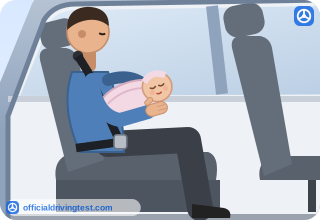
According to the handbook, when should a child be held in a lap or buckled with someone else into a single safety belt?
- On short trips
- Never
- In the back seat only
- When no child seat is available
Show answer
Correct answer: Never
A child should never be held in a lap or buckled with someone else into a single safety belt.
Source: Nevada Driver's Handbook (March 2024 (DMV 700)), page 25 · Open this page in the manual (Manual page 25)
-
Never leave a child aged what or younger unattended in a vehicle if conditions present a significant risk to the child’s health and safety (unless supervised)?
- Age 5
- Age 7
- Age 9
- Age 10
Show answer
Correct answer: Age 7
A child aged 7 or younger must not be left unattended in a vehicle if conditions present a significant risk to health and safety.
Source: Nevada Driver's Handbook (March 2024 (DMV 700)), page 25 · Open this page in the manual (Manual page 25)
-
A child aged 7 or younger left in a vehicle where conditions present a significant risk must be supervised by, and within sight of, a person at least how old?
- 10 years old
- 14 years old
- 16 years old
- 12 years old
Show answer
Correct answer: 12 years old
The child may be left only if supervised by and within sight of a person at least 12 years old.
Source: Nevada Driver's Handbook (March 2024 (DMV 700)), page 25 · Open this page in the manual (Manual page 25)
-
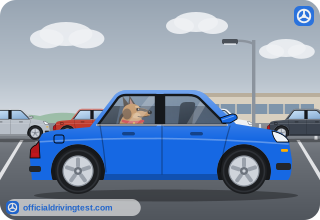
During what conditions is it illegal to leave a dog or cat unattended in a vehicle?
- Periods of extreme heat or cold
- Any time the engine is turned off
- Whenever the windows are closed
- More than 15 minutes in any weather
Show answer
Correct answer: Periods of extreme heat or cold
It is illegal to leave a dog or cat unattended in a vehicle during periods of extreme heat or cold.
Source: Nevada Driver's Handbook (March 2024 (DMV 700)), page 25 · Open this page in the manual (Manual page 25)
-
Who may use reasonable force to rescue a dog or cat left unattended in a vehicle during extreme heat or cold?
- Only a licensed veterinarian called to the scene by a bystander
- Any bystander who sees the animal and cannot reach the owner
- Law enforcement, firefighters and other officials
- Only the animal’s owner or a person the owner authorizes in writing
Show answer
Correct answer: Law enforcement, firefighters and other officials
Law enforcement, firefighters and other officials may use reasonable force to rescue the animal.
Source: Nevada Driver's Handbook (March 2024 (DMV 700)), page 25 · Open this page in the manual (Manual page 25)
-
Violations of the laws on unattended children and on unattended dogs and cats are what kind of offense?
- Felony offenses
- Civil infractions only
- Administrative violations with no penalty
- Misdemeanor offenses
Show answer
Correct answer: Misdemeanor offenses
The handbook states that violations of these laws are misdemeanor offenses.
Source: Nevada Driver's Handbook (March 2024 (DMV 700)), page 25 · Open this page in the manual (Manual page 25)
-
Which agency should have approved a child restraint system, in accordance with Federal Motor Vehicle Safety Standards?
- Nevada Department of Motor Vehicles
- U.S. Department of Transportation
- Nevada Highway Patrol
- American Automobile Association
Show answer
Correct answer: U.S. Department of Transportation
A child restraint system should be approved by the U.S. Department of Transportation in accordance with Federal Motor Vehicle Safety Standards.
Source: Nevada Driver's Handbook (March 2024 (DMV 700)), page 26 · Open this page in the manual (Manual page 26)
-
A child restraint seat should be installed safely and securely in accordance with the installation instructions provided by whom?
- The vehicle dealer
- The local police
- The manufacturer
- The DMV
Show answer
Correct answer: The manufacturer
The seat should be installed in accordance with the manufacturer’s installation instructions or in another manner approved by the National Highway Traffic Safety Administration.
Source: Nevada Driver's Handbook (March 2024 (DMV 700)), page 26 · Open this page in the manual (Manual page 26)
-
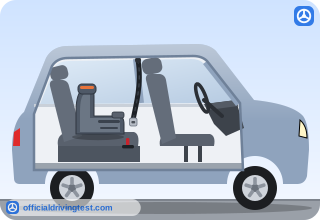
What are booster seats and belt-positioning seats designed to do?
- Elevate or position a child so a seat belt can safely secure the child
- Hold a baby facing the rear to protect the neck and spine in a crash
- Replace the vehicle seat belt for children who are under two years old
- Allow a child to sit in the front seat of a car that has an airbag
Show answer
Correct answer: Elevate or position a child so a seat belt can safely secure the child
Booster seats and belt-positioning seats elevate or position a child so the child can be safely secured with a seat belt.
Source: Nevada Driver's Handbook (March 2024 (DMV 700)), page 26 · Open this page in the manual (Manual page 26)
-
Why must children under 2 ride in a rear-facing child safety seat?
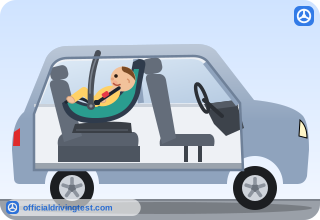
- It supports a baby’s head, protecting the neck and spine in most crashes
- It lets the baby see the road ahead and stay calm during a trip
- It lets the seat be fastened with the adult lap belt in the front
- It makes the seat easier to install without using a seat belt
Show answer
Correct answer: It supports a baby’s head, protecting the neck and spine in most crashes
The rear-facing safety seat supports a baby’s head, protecting the neck and spine from injury in most crashes.
Source: Nevada Driver's Handbook (March 2024 (DMV 700)), page 26 · Open this page in the manual (Manual page 26)
-
Which place in a car is generally the safest for children?
- The front passenger seat
- The middle of the front seat
- The back seat
- The cargo area
Show answer
Correct answer: The back seat
The back seat generally is the safest place in the car.
Source: Nevada Driver's Handbook (March 2024 (DMV 700)), page 26 · Open this page in the manual (Manual page 26)
-
When an older child must ride in the front seat, what should be done with the vehicle seat?
- It should be moved all the way forward
- It should be moved back as far as possible
- It should be left where the last passenger set it
- It should be tilted so the child leans toward the dash
Show answer
Correct answer: It should be moved back as far as possible
Older children may ride in the front if necessary, but the vehicle seat should be moved back as far as possible.
Source: Nevada Driver's Handbook (March 2024 (DMV 700)), page 26 · Open this page in the manual (Manual page 26)
-
What should be used to protect a child’s head from contact with a rapidly inflating airbag?
- A lap belt only, worn loosely so the child can lean away from the seat
- A pillow or folded blanket placed between the child and the dashboard
- A seat cushion that raises the child’s head close to the windshield
- A child restraint with a complete harness or a properly fitted shoulder/lap belt
Show answer
Correct answer: A child restraint with a complete harness or a properly fitted shoulder/lap belt
To protect the head from an inflating airbag, use a child restraint with a complete harness system or a properly fitted vehicle shoulder/lap belt.
Source: Nevada Driver's Handbook (March 2024 (DMV 700)), page 26 · Open this page in the manual (Manual page 26)
-
When should you never put an infant in the front seat?
- If the car is a 1968 model or newer
- If the infant is awake
- If the car has a passenger side airbag
- If the trip is longer than one hour
Show answer
Correct answer: If the car has a passenger side airbag
An infant must never be put in the front seat if the car has a passenger side airbag.
Source: Nevada Driver's Handbook (March 2024 (DMV 700)), page 26 · Open this page in the manual (Manual page 26)
-
At about what speed does an airbag explode from the dashboard in a crash, according to the handbook?
- 200 mph
- 50 mph
- 100 mph
- 300 mph
Show answer
Correct answer: 200 mph
The handbook says the airbag explodes from the dashboard at 200 mph, smashing through the safety seat into the back of the baby’s head.
Source: Nevada Driver's Handbook (March 2024 (DMV 700)), page 26 · Open this page in the manual (Manual page 26)
-
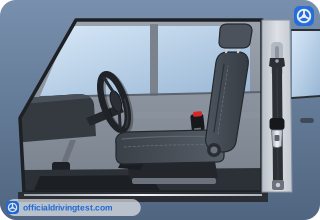
Before you start the engine, besides buckling up yourself, what should you do?
- Make sure your passengers buckle up, too
- Ask passengers to sit in the front seat
- Tell passengers to adjust the mirrors
- Let passengers hold small children
Show answer
Correct answer: Make sure your passengers buckle up, too
Before starting the engine, buckle up and make sure your passengers do, too.
Source: Nevada Driver's Handbook (March 2024 (DMV 700)), page 27 · Open this page in the manual (Manual page 27)
-
Anyone under what age may not ride in the bed of a pickup truck driven on a paved highway in Nevada?
- Under 16
- Under 18
- Under 14
- Under 21
Show answer
Correct answer: Under 18
Anyone under the age of 18 may not ride within the bed of a pickup truck driven on a paved highway.
Source: Nevada Driver's Handbook (March 2024 (DMV 700)), page 66 · Open this page in the manual (Manual page 66)
-
Which is an exception to the rule against riding in a truck bed under age 18?
- Riding while wearing a seat belt
- Riding when the truck is going under 25 miles per hour
- Riding when an adult is also in the bed
- Riding in a parade authorized by a local authority
Show answer
Correct answer: Riding in a parade authorized by a local authority
The exceptions are a parade authorized by a local authority, or a vehicle being used while farming or ranching.
Source: Nevada Driver's Handbook (March 2024 (DMV 700)), page 66 · Open this page in the manual (Manual page 66)