Nevada: Speed and following distance — Part 3 Practice Test
Questions in this part include: “About how long would you need to stop at 55 mph with perfect brakes and ideal road conditions?” · “What kind of lane position should you choose in traffic?”
Independent educational site · not affiliated with any government agency or DMV
Ready? Test yourself
- Instant feedback with an explanation
- Every answer cites its source in the manual
- Your best score is saved on this device
- Keyboard: press 1 to 4 to answer and Enter for the next question
Questions are original and based on the official manual "Nevada Driver's Handbook" (March 2024 (DMV 700)), Nevada Department of Motor Vehicles.
All 17 questions in this practice test
Take the test above first, then use this list to study. Tap “Show answer” to see the correct answer and explanation.
Show the questions and answersHide the questions
-
How many seconds of following distance do most driving instructors recommend?
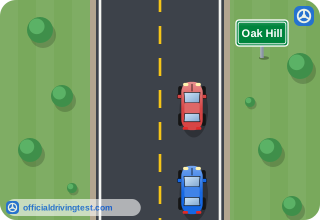
- Up to four seconds
- Up to one second
- Up to eight seconds
- Up to ten seconds
Show answer
Correct answer: Up to four seconds
The two-second rule is a minimum, and most driving instructors recommend up to four seconds.
Source: Nevada Driver's Handbook (March 2024 (DMV 700)), page 42 · Open this page in the manual (Manual page 42)
-
After the vehicle ahead passes a fixed sign, you reach the sign before you have counted “one thousand two.” What does this mean?
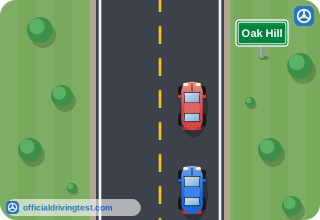
- You are following at a good distance
- You should speed up to close the gap
- You are following too closely
- You are too far behind to see traffic ahead
Show answer
Correct answer: You are following too closely
If you reach the sign before you have counted “one thousand two,” you are following too closely.
Source: Nevada Driver's Handbook (March 2024 (DMV 700)), page 42 · Open this page in the manual (Manual page 42)
-
About how long would you need to stop at 55 mph with perfect brakes and ideal road conditions?
- About two seconds
- Almost seven seconds
- About four seconds
- About ten seconds
Show answer
Correct answer: Almost seven seconds
At 55 mph you would need almost seven seconds to stop with perfect brakes and ideal road conditions.
Source: Nevada Driver's Handbook (March 2024 (DMV 700)), page 42 · Open this page in the manual (Manual page 42)
-
According to the handbook's following-distance guide, how many seconds should commercial vehicles allow behind the vehicle ahead?
- 2 seconds or more
- 3 seconds or more
- 12 seconds or more
- 5 seconds or more
Show answer
Correct answer: 5 seconds or more
Commercial vehicles should follow 5 seconds or more behind the vehicle ahead.
Source: Nevada Driver's Handbook (March 2024 (DMV 700)), page 42 · Open this page in the manual (Manual page 42)
-
How should you position yourself in traffic to give yourself room to maneuver?
- Between the clusters of vehicles ahead and behind you
- Inside a cluster of vehicles so you can stay with the group
- Directly beside another vehicle in the next lane
- In the lane with the most traffic so others can see you
Show answer
Correct answer: Between the clusters of vehicles ahead and behind you
To give yourself room to maneuver, you want to be between the clusters of vehicles in front of and behind you.
Source: Nevada Driver's Handbook (March 2024 (DMV 700)), page 42 · Open this page in the manual (Manual page 42)
-
What kind of lane position should you choose in traffic?
- One as close as possible to the vehicle ahead
- One that keeps you beside the vehicle next to you
- One that gives you the most options for movement
- One that keeps you in the blind spot of other drivers
Show answer
Correct answer: One that gives you the most options for movement
You should choose a lane position that allows you the most options for movement.
Source: Nevada Driver's Handbook (March 2024 (DMV 700)), page 42 · Open this page in the manual (Manual page 42)
-
When driving at night, where should you look instead of directly into the headlights of oncoming vehicles?
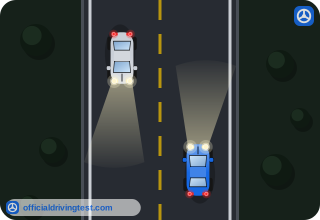
- Down and to the right side of your lane
- Up and to the left side of your lane
- Straight at the oncoming vehicle
- At your rearview mirror
Show answer
Correct answer: Down and to the right side of your lane
Looking into oncoming headlights adds to the difficulty of night driving, so the handbook says to look down and to the right side of your lane.
Source: Nevada Driver's Handbook (March 2024 (DMV 700)), page 56 · Open this page in the manual (Manual page 56)
-
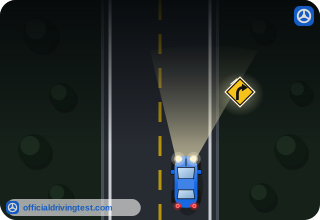
At night, within what should you always make sure you can stop?
- The first 100 feet of the road
- The reach of the road edge line
- The range of your headlights
- The lit part of the next intersection
Show answer
Correct answer: The range of your headlights
At night you cannot see as far, so you must always be able to stop within the range of your headlights.
Source: Nevada Driver's Handbook (March 2024 (DMV 700)), page 56 · Open this page in the manual (Manual page 56)
-
What does the handbook say about wearing sunglasses when driving at night?
- Wear them only when there is glare
- Never wear them
- Wear them only on lit streets
- Wear them only if lightly tinted
Show answer
Correct answer: Never wear them
The handbook lists never wearing sunglasses when driving at night as a way to make night driving safer.
Source: Nevada Driver's Handbook (March 2024 (DMV 700)), page 56 · Open this page in the manual (Manual page 56)
-
What can you use as a guide when driving at night?
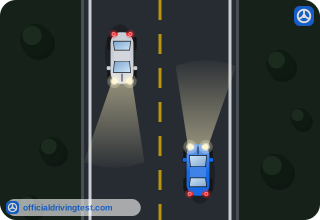
- The glare of oncoming headlights
- The shadows along the roadside
- The brightness of street lights
- The road edge line or center line
Show answer
Correct answer: The road edge line or center line
The handbook advises using the road edge line or center line as a guide at night.
Source: Nevada Driver's Handbook (March 2024 (DMV 700)), page 56 · Open this page in the manual (Manual page 56)
-
What does the handbook say about keeping your windshield clean when driving at night?
- Keep it clean on the outside only
- Keep it clean on the inside only
- Keep it clean only when it rains
- Keep it clean inside and out
Show answer
Correct answer: Keep it clean inside and out
Keeping the windshield clean inside and out is one of the ways to make night driving safer.
Source: Nevada Driver's Handbook (March 2024 (DMV 700)), page 56 · Open this page in the manual (Manual page 56)
-
What is the most important thing to do when driving in bad weather?
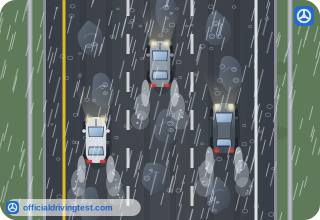
- Slow down
- Turn on your high beams
- Follow other vehicles closely
- Use your four-way flashers
Show answer
Correct answer: Slow down
The handbook says the most important thing to do when driving in bad weather is slow down.
Source: Nevada Driver's Handbook (March 2024 (DMV 700)), page 57 · Open this page in the manual (Manual page 57)
-
Stopping distances on slippery roads may be how much greater than on dry pavement?
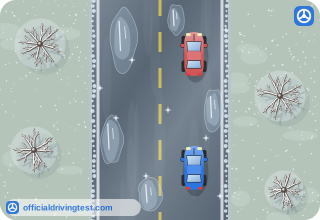
- 1 to 2 times
- About half as much
- 2 to 10 times
- 15 to 20 times
Show answer
Correct answer: 2 to 10 times
Stopping distances on slippery roads may be 2 to 10 times greater than on dry pavement.
Source: Nevada Driver's Handbook (March 2024 (DMV 700)), page 57 · Open this page in the manual (Manual page 57)
-
When driving in bad weather, to what should you pay special attention?
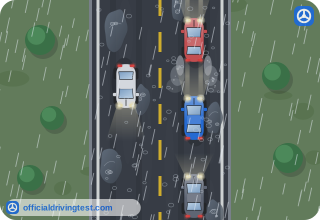
- The headlights of oncoming vehicles
- The tail lights on vehicles in front of you
- The turn signals of parked vehicles
- The brake lights of vehicles behind you
Show answer
Correct answer: The tail lights on vehicles in front of you
The handbook says to give other drivers plenty of space and pay special attention to the tail lights on vehicles in front of you.
Source: Nevada Driver's Handbook (March 2024 (DMV 700)), page 57 · Open this page in the manual (Manual page 57)
-
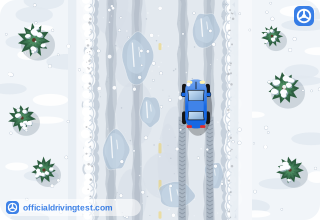
What tire equipment does the handbook say to use when driving on snow and ice?
- Smooth racing tires with a shallow tread
- Temporary spare tires
- Standard summer tires only
- All-weather radial tires, snow tires or chains
Show answer
Correct answer: All-weather radial tires, snow tires or chains
The handbook says to use all-weather radial tires, snow tires or chains on snow and ice.
Source: Nevada Driver's Handbook (March 2024 (DMV 700)), page 57 · Open this page in the manual (Manual page 57)
-
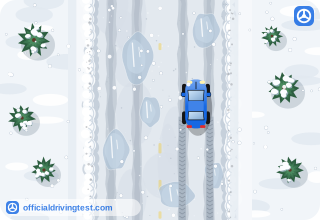
When starting out on a snow-packed or icy road, how do you find out how well you can stop?
- Start out very slowly, then gently test your brakes
- Brake hard at the first intersection
- Drive at normal speed and watch how the road feels
- Rely on your tires to tell you
Show answer
Correct answer: Start out very slowly, then gently test your brakes
The handbook says to get the feel of the roadway by starting very slowly and then gently testing your brakes.
Source: Nevada Driver's Handbook (March 2024 (DMV 700)), page 57 · Open this page in the manual (Manual page 57)
-
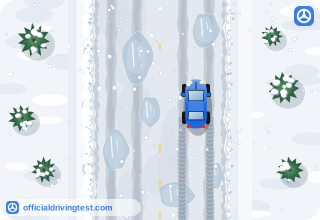
On snow or ice, when should you start slowing down for an intersection or turn?
- At the crosswalk line
- Only when other vehicles stop
- Long before you come to it
- Once you are in the intersection
Show answer
Correct answer: Long before you come to it
The handbook says to start slowing down long before you come to an intersection or turn.
Source: Nevada Driver's Handbook (March 2024 (DMV 700)), page 57 · Open this page in the manual (Manual page 57)