Nevada: Speed and following distance
The basic speed rule, Nevada speed limits, stopping distances, following distance and towing speed. Split into 4 shorter tests so you're not stuck in one long quiz.
Independent educational site · not affiliated with any government agency or DMV
Choose a part
Speed and following distance — Part 1
Questions in this part include: “In school zones, what is the speed limit?”
StartSpeed and following distance — Part 2
Questions in this part include: “According to highway safety studies, what are normal reaction times?”
StartSpeed and following distance — Part 3
Questions in this part include: “About how long would you need to stop at 55 mph with perfect brakes and ideal road conditions?”
StartSpeed and following distance — Part 4
Questions in this part include: “On what dates may studded snow tires be used?”
StartAll 70 Speed and following distance questions with answers
Choose a part above to take a practice test, or study every question and answer here.
Show the questions and answersHide the questions
-
In school zones, what is the speed limit?
- Either 10 or 20 mph
- Either 20 or 30 mph
- Either 15 or 35 mph
- Either 15 or 25 mph
Show answer
Correct answer: Either 15 or 25 mph
In school zones the speed limit is either 15 or 25 mph.
Source: Nevada Driver's Handbook (March 2024 (DMV 700)), page 33 · Open this page in the manual (Manual page 33)
-
Unless otherwise posted, when are school zone speed limits in effect?
- On school days, from a half hour before school begins until a half hour after it ends
- On school days, from one hour before school begins until one hour after it ends
- On school days, from the moment school begins until the last child leaves the playground
- On all days of the week, from a half hour before sunrise until a half hour after sunset
Show answer
Correct answer: On school days, from a half hour before school begins until a half hour after it ends
School zone speed limits are in effect on school days from a half hour before school begins to a half hour after school ends, unless otherwise posted.
Source: Nevada Driver's Handbook (March 2024 (DMV 700)), page 33 · Open this page in the manual (Manual page 33)
-
What may some areas use to tell drivers when the school zone speed limit is in effect?
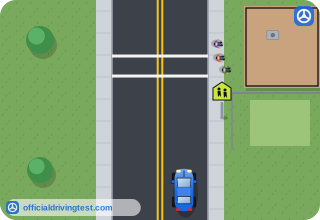
- Flashing red lights
- Steady green lights
- Flashing yellow lights
- Blinking white beacons
Show answer
Correct answer: Flashing yellow lights
Some areas use flashing yellow lights to tell drivers when the school zone speed limit is in effect.
Source: Nevada Driver's Handbook (March 2024 (DMV 700)), page 33 · Open this page in the manual (Manual page 33)
-
The flashing yellow school zone lights are turned off during hours students are actually in classes. What speed limit applies then?
- The school zone speed limit still applies
- The limit posted for non-school hours
- A limit of 15 mph
- No speed limit applies
Show answer
Correct answer: The limit posted for non-school hours
When the lights are off during class hours, the speed limit reverts to the one posted for non-school hours.
Source: Nevada Driver's Handbook (March 2024 (DMV 700)), page 33 · Open this page in the manual (Manual page 33)
-
What kind of speed does Nevada's Basic Rule require drivers to use?
- The highest speed posted on the road
- The speed of the vehicle ahead
- A reasonable or proper speed
- The same speed at all times
Show answer
Correct answer: A reasonable or proper speed
Nevada has a Basic Rule for driving at a “reasonable or proper” speed, in addition to any posted speed limits.
Source: Nevada Driver's Handbook (March 2024 (DMV 700)), page 35 · Open this page in the manual (Manual page 35)
-
Which of these must drivers consider under Nevada's Basic Rule, in addition to any posted speed limits?
- The color of the vehicle
- The condition of the road surface
- The size of the vehicle's engine
- The age of the vehicle's tires
Show answer
Correct answer: The condition of the road surface
Drivers must consider the amount and type of traffic, the weather and visibility, the road surface condition and the type of road.
Source: Nevada Driver's Handbook (March 2024 (DMV 700)), page 35 · Open this page in the manual (Manual page 35)
-
Depending on conditions, how may the safe speed compare with the posted speed limit?
- It is always equal to the posted speed limit
- It may be slightly above the posted limit on dry roads
- It is set only by the speed of other traffic
- It may be considerably less than the posted speed limit
Show answer
Correct answer: It may be considerably less than the posted speed limit
Drivers are never to drive at a speed that endangers anyone, and the safe speed may be considerably less than the posted limit.
Source: Nevada Driver's Handbook (March 2024 (DMV 700)), page 35 · Open this page in the manual (Manual page 35)
-
Which speed is listed in the handbook's examples of Nevada speed limits for rural interstate freeways?
- 70+ mph
- 15 mph
- 25 mph
- 45 mph
Show answer
Correct answer: 70+ mph
The examples of speed limits in Nevada list 70+ mph for rural interstate freeways.
Source: Nevada Driver's Handbook (March 2024 (DMV 700)), page 35 · Open this page in the manual (Manual page 35)
-
Which speed is listed in the handbook's examples of Nevada speed limits for urban freeways and rural highways?
- 15 mph
- 25 mph
- 65 mph
- 45 mph
Show answer
Correct answer: 65 mph
The examples of speed limits in Nevada list 65 mph for urban freeways and rural highways.
Source: Nevada Driver's Handbook (March 2024 (DMV 700)), page 35 · Open this page in the manual (Manual page 35)
-
Which type of area is listed with 45 mph in the handbook's examples of Nevada speed limits?
- Rural interstate freeways
- Reduced speed areas going into towns
- Urban freeways and rural highways
- Business and residential areas
Show answer
Correct answer: Reduced speed areas going into towns
The examples of speed limits in Nevada list 45 mph for reduced speed areas going into towns.
Source: Nevada Driver's Handbook (March 2024 (DMV 700)), page 35 · Open this page in the manual (Manual page 35)
-
Which speed is listed in the handbook's examples of Nevada speed limits for business and residential areas?
- 45 mph
- 65 mph
- 70+ mph
- 25 mph
Show answer
Correct answer: 25 mph
The examples of speed limits in Nevada list 25 mph for business and residential areas.
Source: Nevada Driver's Handbook (March 2024 (DMV 700)), page 35 · Open this page in the manual (Manual page 35)
-
What does the handbook say speed limits are set for?
- Normal driving conditions
- The worst weather conditions
- Heavy traffic only
- Daytime driving only
Show answer
Correct answer: Normal driving conditions
Speed limits are set for normal driving conditions.
Source: Nevada Driver's Handbook (March 2024 (DMV 700)), page 35 · Open this page in the manual (Manual page 35)
-
What do drivers need to do when bad weather makes it hard to see or makes the road slick?
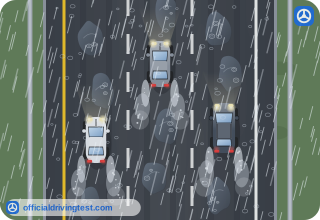
- Keep exactly to the posted speed limit
- Move to the extreme left lane
- Adjust their speed
- Follow the vehicle ahead more closely
Show answer
Correct answer: Adjust their speed
When bad weather makes it hard to see or makes the road slick, drivers need to adjust their speed.
Source: Nevada Driver's Handbook (March 2024 (DMV 700)), page 35 · Open this page in the manual (Manual page 35)
-
When there are two or more lanes of traffic moving in the same direction, what must slower traffic do?
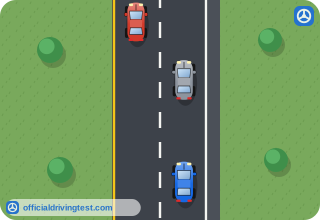
- Move to the left lane and keep its speed
- Move to the right and allow other drivers to pass
- Speed up to match the traffic in the left lane
- Slow down until all other drivers have passed
Show answer
Correct answer: Move to the right and allow other drivers to pass
When there are two or more lanes moving the same way, slower traffic must move to the right and allow other drivers to pass.
Source: Nevada Driver's Handbook (March 2024 (DMV 700)), page 35 · Open this page in the manual (Manual page 35)
-
Why can driving too slowly be unsafe?
- It causes other drivers to lose sight of the road signs ahead and stop suddenly
- It prevents drivers behind you from seeing the traffic signals ahead of them
- It reduces the distance that other drivers can see on the road ahead
- It may make other drivers impatient and lead them to attempt unsafe passing
Show answer
Correct answer: It may make other drivers impatient and lead them to attempt unsafe passing
Driving too slowly can cause traffic to stack up and may cause other drivers to become impatient and attempt passing when it is not safe.
Source: Nevada Driver's Handbook (March 2024 (DMV 700)), page 35 · Open this page in the manual (Manual page 35)
-
According to the handbook, how long does it take to travel 5 miles at 60 mph?
- 5 minutes
- 4 minutes, 17 seconds
- 5 minutes, 27 seconds
- 4 minutes, 43 seconds
Show answer
Correct answer: 5 minutes
The handbook's example says that traveling 5 miles at 60 mph takes 5 minutes.
Source: Nevada Driver's Handbook (March 2024 (DMV 700)), page 35 · Open this page in the manual (Manual page 35)
-
According to the handbook, how long does it take to travel 15 miles at 55 mph?
- 15 minutes
- 12 minutes, 51 seconds
- 16 minutes, 22 seconds
- 5 minutes, 27 seconds
Show answer
Correct answer: 16 minutes, 22 seconds
The handbook's example says that traveling 15 miles at 55 mph takes 16 minutes, 22 seconds.
Source: Nevada Driver's Handbook (March 2024 (DMV 700)), page 35 · Open this page in the manual (Manual page 35)
-
Which of these affects how far it takes to stop your vehicle?
- How alert or tired you are
- The color of your vehicle
- Whether the radio is on
- The age of your driver license
Show answer
Correct answer: How alert or tired you are
Stopping distance depends on factors such as your speed, the road surface, the condition of the tires and brakes, and how alert or tired you are.
Source: Nevada Driver's Handbook (March 2024 (DMV 700)), page 41 · Open this page in the manual (Manual page 41)
-
In stopping a vehicle, what is “perception”?
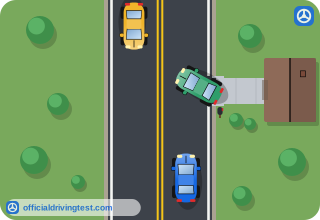
- Moving your foot to the brake pedal and pushing down
- The friction between the road and tires
- Seeing and understanding the reason for stopping
- Judging the speed of the vehicle behind you
Show answer
Correct answer: Seeing and understanding the reason for stopping
Perception is when you see and understand the reason for stopping, the first of three things that must happen to stop.
Source: Nevada Driver's Handbook (March 2024 (DMV 700)), page 41 · Open this page in the manual (Manual page 41)
-
What is “reaction time”?
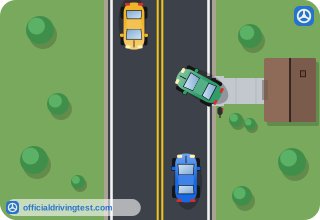
- The time it takes the brakes and tires to stop the vehicle
- The time from seeing the need to stop until you step on the brakes
- The time from pressing the brake until the vehicle is stopped
- The time it takes to see and signal that you are stopping
Show answer
Correct answer: The time from seeing the need to stop until you step on the brakes
Reaction time is the amount of time from the moment you see that you need to stop until you step on the brakes.
Source: Nevada Driver's Handbook (March 2024 (DMV 700)), page 41 · Open this page in the manual (Manual page 41)
-
When does your reaction time increase?
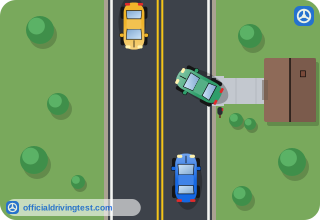
- When you drive faster than the posted speed limit
- When the driver has just started the engine
- When the road surface is dry and traffic is light
- When decisions are complex or events are unexpected
Show answer
Correct answer: When decisions are complex or events are unexpected
Reaction time increases as driving decisions become more complex or when unexpected events occur.
Source: Nevada Driver's Handbook (March 2024 (DMV 700)), page 41 · Open this page in the manual (Manual page 41)
-
According to highway safety studies, what are normal reaction times?
- 2 to 2.5 seconds
- 0.5 to 1 second
- 1 to 1.5 seconds
- 3 to 4 seconds
Show answer
Correct answer: 2 to 2.5 seconds
Highway safety studies show normal reaction times are 2 to 2.5 seconds.
Source: Nevada Driver's Handbook (March 2024 (DMV 700)), page 41 · Open this page in the manual (Manual page 41)
-
What is “braking distance”?
- How far the vehicle travels before you step on the brake
- How far ahead you can see when you are driving
- How far the vehicle travels while the brakes bring it to a stop
- The space you leave between your car and the next one
Show answer
Correct answer: How far the vehicle travels while the brakes bring it to a stop
Braking distance is how far your vehicle travels during the braking time, while the brakes and friction between road and tires stop it.
Source: Nevada Driver's Handbook (March 2024 (DMV 700)), page 41 · Open this page in the manual (Manual page 41)
-
If you double your speed, how does your braking distance change?
- It doubles
- It becomes four times as long
- It becomes three times as long
- It becomes eight times as long
Show answer
Correct answer: It becomes four times as long
If you double your speed, your braking distance does not become twice as long; it becomes four times as long.
Source: Nevada Driver's Handbook (March 2024 (DMV 700)), page 41 · Open this page in the manual (Manual page 41)
-
Compared with dry pavement, how may stopping distances on a wet highway differ?
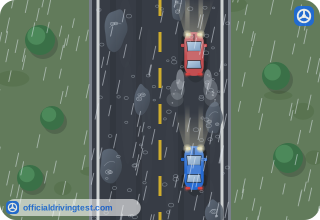
- They are usually the same
- They are slightly shorter
- They may be about 10 percent longer
- They may be more than double
Show answer
Correct answer: They may be more than double
Stopping distances on a wet highway may be more than double those on dry pavement.
Source: Nevada Driver's Handbook (March 2024 (DMV 700)), page 41 · Open this page in the manual (Manual page 41)
-
Why should you be especially careful during the first rain of a season?
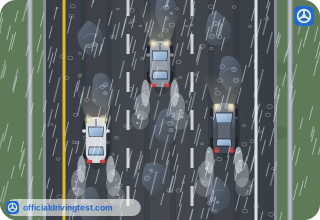
- Oil and water on the pavement mix and are very dangerous
- Rain freezes on the pavement in the first storm
- Brake lights are harder to see in the first rain
- Tires are stiffer and grip poorly after a dry spell
Show answer
Correct answer: Oil and water on the pavement mix and are very dangerous
The mixture of oil and water on the pavement during the first rain of a season is very dangerous.
Source: Nevada Driver's Handbook (March 2024 (DMV 700)), page 41 · Open this page in the manual (Manual page 41)
-
If you are going 30 mph, how long is your stopping distance on ice?
- 173 feet
- 273 feet
- 373 feet
- 473 feet
Show answer
Correct answer: 373 feet
At 30 mph, the stopping distance on ice would be 373 feet, well over the length of a football field.
Source: Nevada Driver's Handbook (March 2024 (DMV 700)), page 41 · Open this page in the manual (Manual page 41)
-
In heavy rainfall, most cars begin to lose traction and hydroplane at what speeds?
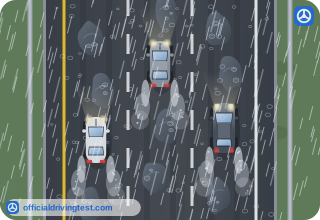
- Between 10 and 25 mph
- Between 35 and 55 mph
- Between 60 and 80 mph
- Between 20 and 30 mph
Show answer
Correct answer: Between 35 and 55 mph
Most cars begin to lose traction and hydroplane between speeds of 35 and 55 mph in heavy rainfall.
Source: Nevada Driver's Handbook (March 2024 (DMV 700)), page 41 · Open this page in the manual (Manual page 41)
-
For a typical passenger car with perfect brakes on dry, level pavement and a 2.5-second reaction time, what is the total stopping distance at 55 mph?
- 278 feet
- 494 feet
- 196 feet
- 370 feet
Show answer
Correct answer: 370 feet
At 55 mph the total stopping distance is 370 feet (6.66 seconds): 202 feet of perception and reaction plus 168 feet of braking.
Source: Nevada Driver's Handbook (March 2024 (DMV 700)), page 41 · Open this page in the manual (Manual page 41)
-
For a typical passenger car with perfect brakes on dry, level pavement and a 2.5-second reaction time, what is the braking distance at 45 mph?
- 113 feet
- 68 feet
- 168 feet
- 256 feet
Show answer
Correct answer: 113 feet
At 45 mph the braking distance is 113 feet, after 165 feet of perception and reaction distance, for a total of 278 feet.
Source: Nevada Driver's Handbook (March 2024 (DMV 700)), page 41 · Open this page in the manual (Manual page 41)
-
For a typical passenger car with perfect brakes on dry, level pavement and a 2.5-second reaction time, what is the perception and reaction distance at 65 mph?
- 202 feet
- 256 feet
- 238 feet
- 165 feet
Show answer
Correct answer: 238 feet
At 65 mph the perception and reaction distance is 238 feet, followed by 256 feet of braking distance.
Source: Nevada Driver's Handbook (March 2024 (DMV 700)), page 41 · Open this page in the manual (Manual page 41)
-
For a typical passenger car with perfect brakes on dry, level pavement and a 2.5-second reaction time, what is the total stopping distance at 25 mph?
- 92 feet
- 127 feet
- 35 feet
- 196 feet
Show answer
Correct answer: 127 feet
At 25 mph the total stopping distance is 127 feet (4.40 seconds): 92 feet of perception and reaction plus 35 feet of braking.
Source: Nevada Driver's Handbook (March 2024 (DMV 700)), page 41 · Open this page in the manual (Manual page 41)
-
What is the minimum number of seconds ahead you should look when driving?
- 3 seconds
- 6 seconds
- 9 seconds
- 12 seconds
Show answer
Correct answer: 12 seconds
Defensive driving means looking ahead at least 12 seconds, to where your vehicle will be 12 seconds from now.
Source: Nevada Driver's Handbook (March 2024 (DMV 700)), page 42 · Open this page in the manual (Manual page 42)
-
You count “one thousand one” and so on until the front of your vehicle passes a fixed object ahead. When do you need to look farther ahead?
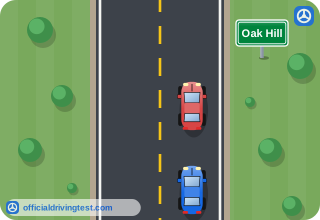
- If you have not yet counted to “one thousand twelve”
- If you have counted past “one thousand twelve”
- If you reach exactly “one thousand twelve”
- If you reach “one thousand twenty” at the object
Show answer
Correct answer: If you have not yet counted to “one thousand twelve”
If you have not reached “one thousand twelve” when your vehicle passes the object, you need to be looking farther ahead.
Source: Nevada Driver's Handbook (March 2024 (DMV 700)), page 42 · Open this page in the manual (Manual page 42)
-
At 30 mph, about how far ahead should you be able to see when looking 12 seconds ahead?
- About half a mile
- Less than half a block
- A little over a block
- About a quarter mile
Show answer
Correct answer: A little over a block
At 30 mph you should see a little over a block ahead.
Source: Nevada Driver's Handbook (March 2024 (DMV 700)), page 42 · Open this page in the manual (Manual page 42)
-
If you are driving 40 mph or less, what is the minimum following time behind the vehicle in front of you?
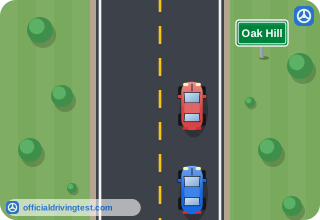
- One second
- Half a second
- Six seconds
- Two seconds
Show answer
Correct answer: Two seconds
At 40 mph or less, stay at least two seconds behind the vehicle in front of you; this is a minimum following distance.
Source: Nevada Driver's Handbook (March 2024 (DMV 700)), page 42 · Open this page in the manual (Manual page 42)
-
How many seconds of following distance do most driving instructors recommend?
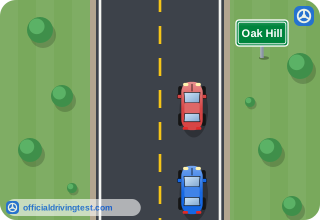
- Up to four seconds
- Up to one second
- Up to eight seconds
- Up to ten seconds
Show answer
Correct answer: Up to four seconds
The two-second rule is a minimum, and most driving instructors recommend up to four seconds.
Source: Nevada Driver's Handbook (March 2024 (DMV 700)), page 42 · Open this page in the manual (Manual page 42)
-
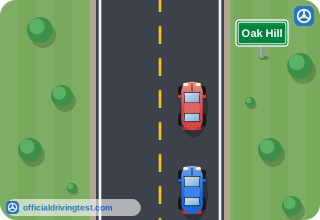
After the vehicle ahead passes a fixed sign, you reach the sign before you have counted “one thousand two.” What does this mean?
- You are following at a good distance
- You should speed up to close the gap
- You are following too closely
- You are too far behind to see traffic ahead
Show answer
Correct answer: You are following too closely
If you reach the sign before you have counted “one thousand two,” you are following too closely.
Source: Nevada Driver's Handbook (March 2024 (DMV 700)), page 42 · Open this page in the manual (Manual page 42)
-
About how long would you need to stop at 55 mph with perfect brakes and ideal road conditions?
- About two seconds
- Almost seven seconds
- About four seconds
- About ten seconds
Show answer
Correct answer: Almost seven seconds
At 55 mph you would need almost seven seconds to stop with perfect brakes and ideal road conditions.
Source: Nevada Driver's Handbook (March 2024 (DMV 700)), page 42 · Open this page in the manual (Manual page 42)
-
According to the handbook's following-distance guide, how many seconds should commercial vehicles allow behind the vehicle ahead?
- 2 seconds or more
- 3 seconds or more
- 12 seconds or more
- 5 seconds or more
Show answer
Correct answer: 5 seconds or more
Commercial vehicles should follow 5 seconds or more behind the vehicle ahead.
Source: Nevada Driver's Handbook (March 2024 (DMV 700)), page 42 · Open this page in the manual (Manual page 42)
-
How should you position yourself in traffic to give yourself room to maneuver?
- Between the clusters of vehicles ahead and behind you
- Inside a cluster of vehicles so you can stay with the group
- Directly beside another vehicle in the next lane
- In the lane with the most traffic so others can see you
Show answer
Correct answer: Between the clusters of vehicles ahead and behind you
To give yourself room to maneuver, you want to be between the clusters of vehicles in front of and behind you.
Source: Nevada Driver's Handbook (March 2024 (DMV 700)), page 42 · Open this page in the manual (Manual page 42)
-
What kind of lane position should you choose in traffic?
- One as close as possible to the vehicle ahead
- One that keeps you beside the vehicle next to you
- One that gives you the most options for movement
- One that keeps you in the blind spot of other drivers
Show answer
Correct answer: One that gives you the most options for movement
You should choose a lane position that allows you the most options for movement.
Source: Nevada Driver's Handbook (March 2024 (DMV 700)), page 42 · Open this page in the manual (Manual page 42)
-
When driving at night, where should you look instead of directly into the headlights of oncoming vehicles?
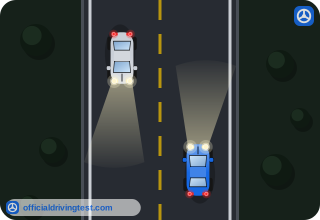
- Down and to the right side of your lane
- Up and to the left side of your lane
- Straight at the oncoming vehicle
- At your rearview mirror
Show answer
Correct answer: Down and to the right side of your lane
Looking into oncoming headlights adds to the difficulty of night driving, so the handbook says to look down and to the right side of your lane.
Source: Nevada Driver's Handbook (March 2024 (DMV 700)), page 56 · Open this page in the manual (Manual page 56)
-
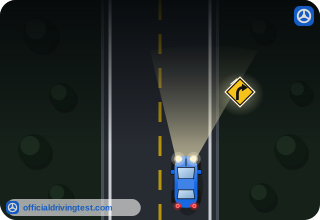
At night, within what should you always make sure you can stop?
- The first 100 feet of the road
- The reach of the road edge line
- The range of your headlights
- The lit part of the next intersection
Show answer
Correct answer: The range of your headlights
At night you cannot see as far, so you must always be able to stop within the range of your headlights.
Source: Nevada Driver's Handbook (March 2024 (DMV 700)), page 56 · Open this page in the manual (Manual page 56)
-
What does the handbook say about wearing sunglasses when driving at night?
- Wear them only when there is glare
- Never wear them
- Wear them only on lit streets
- Wear them only if lightly tinted
Show answer
Correct answer: Never wear them
The handbook lists never wearing sunglasses when driving at night as a way to make night driving safer.
Source: Nevada Driver's Handbook (March 2024 (DMV 700)), page 56 · Open this page in the manual (Manual page 56)
-
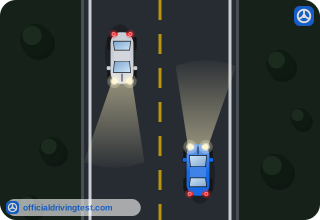
What can you use as a guide when driving at night?
- The glare of oncoming headlights
- The shadows along the roadside
- The brightness of street lights
- The road edge line or center line
Show answer
Correct answer: The road edge line or center line
The handbook advises using the road edge line or center line as a guide at night.
Source: Nevada Driver's Handbook (March 2024 (DMV 700)), page 56 · Open this page in the manual (Manual page 56)
-
What does the handbook say about keeping your windshield clean when driving at night?
- Keep it clean on the outside only
- Keep it clean on the inside only
- Keep it clean only when it rains
- Keep it clean inside and out
Show answer
Correct answer: Keep it clean inside and out
Keeping the windshield clean inside and out is one of the ways to make night driving safer.
Source: Nevada Driver's Handbook (March 2024 (DMV 700)), page 56 · Open this page in the manual (Manual page 56)
-
What is the most important thing to do when driving in bad weather?
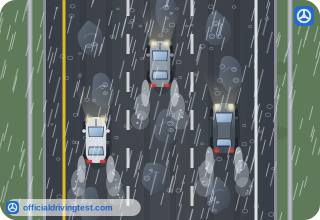
- Slow down
- Turn on your high beams
- Follow other vehicles closely
- Use your four-way flashers
Show answer
Correct answer: Slow down
The handbook says the most important thing to do when driving in bad weather is slow down.
Source: Nevada Driver's Handbook (March 2024 (DMV 700)), page 57 · Open this page in the manual (Manual page 57)
-
Stopping distances on slippery roads may be how much greater than on dry pavement?
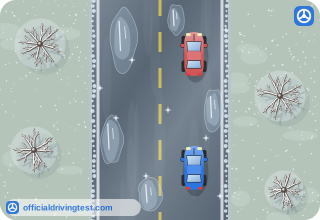
- 1 to 2 times
- About half as much
- 2 to 10 times
- 15 to 20 times
Show answer
Correct answer: 2 to 10 times
Stopping distances on slippery roads may be 2 to 10 times greater than on dry pavement.
Source: Nevada Driver's Handbook (March 2024 (DMV 700)), page 57 · Open this page in the manual (Manual page 57)
-
When driving in bad weather, to what should you pay special attention?
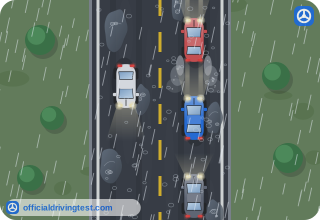
- The headlights of oncoming vehicles
- The tail lights on vehicles in front of you
- The turn signals of parked vehicles
- The brake lights of vehicles behind you
Show answer
Correct answer: The tail lights on vehicles in front of you
The handbook says to give other drivers plenty of space and pay special attention to the tail lights on vehicles in front of you.
Source: Nevada Driver's Handbook (March 2024 (DMV 700)), page 57 · Open this page in the manual (Manual page 57)
-
What tire equipment does the handbook say to use when driving on snow and ice?
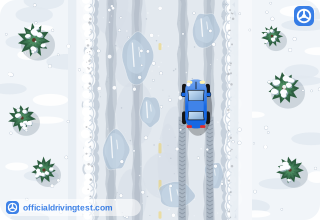
- Smooth racing tires with a shallow tread
- Temporary spare tires
- Standard summer tires only
- All-weather radial tires, snow tires or chains
Show answer
Correct answer: All-weather radial tires, snow tires or chains
The handbook says to use all-weather radial tires, snow tires or chains on snow and ice.
Source: Nevada Driver's Handbook (March 2024 (DMV 700)), page 57 · Open this page in the manual (Manual page 57)
-
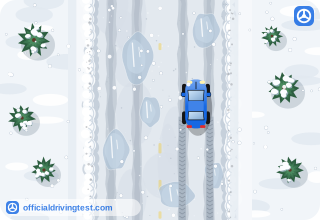
When starting out on a snow-packed or icy road, how do you find out how well you can stop?
- Start out very slowly, then gently test your brakes
- Brake hard at the first intersection
- Drive at normal speed and watch how the road feels
- Rely on your tires to tell you
Show answer
Correct answer: Start out very slowly, then gently test your brakes
The handbook says to get the feel of the roadway by starting very slowly and then gently testing your brakes.
Source: Nevada Driver's Handbook (March 2024 (DMV 700)), page 57 · Open this page in the manual (Manual page 57)
-
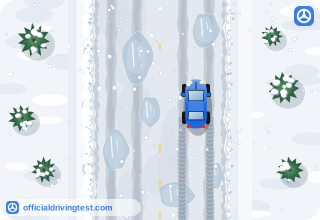
On snow or ice, when should you start slowing down for an intersection or turn?
- At the crosswalk line
- Only when other vehicles stop
- Long before you come to it
- Once you are in the intersection
Show answer
Correct answer: Long before you come to it
The handbook says to start slowing down long before you come to an intersection or turn.
Source: Nevada Driver's Handbook (March 2024 (DMV 700)), page 57 · Open this page in the manual (Manual page 57)
-
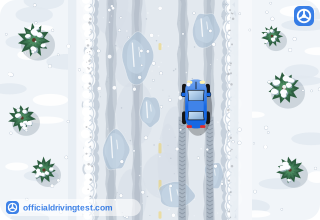
What does the handbook say about speed on snow and ice?
- Half the posted limit is always safe
- There is no such thing as a completely safe speed
- The posted limit is always safe
- Speeds under 30 mph are always completely safe
Show answer
Correct answer: There is no such thing as a completely safe speed
Each stretch of road may differ depending on sun, shade and sanding, so there is no completely safe speed on snow and ice.
Source: Nevada Driver's Handbook (March 2024 (DMV 700)), page 57 · Open this page in the manual (Manual page 57)
-
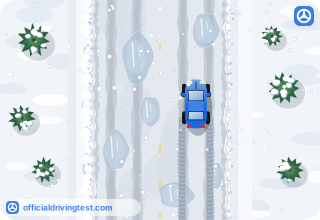
In general, what braking will let you slow down and stop safely on snow and ice?
- Sudden hard braking to stop in the shortest distance
- Quick, repeated stabs at the pedal with full force
- Locking the wheels and steering sharply
- Gentle braking with a slow, light, touch-and-release pattern
Show answer
Correct answer: Gentle braking with a slow, light, touch-and-release pattern
Gentle braking with a slow, light, touch-and-release pattern lets you slow down and stop safely on snow and ice.
Source: Nevada Driver's Handbook (March 2024 (DMV 700)), page 57 · Open this page in the manual (Manual page 57)
-
On snow and ice, how should you brake if your vehicle has an anti-lock braking system (ABS)?
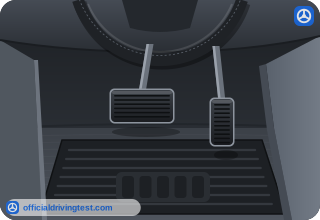
- With firm, continuous pressure on the brake pedal
- With a slow, light touch-and-release pattern
- With sudden, repeated taps on the pedal
- With the emergency parking brake
Show answer
Correct answer: With firm, continuous pressure on the brake pedal
With ABS, a firm, continuous pressure on the brake pedal is needed to activate the anti-lock feature.
Source: Nevada Driver's Handbook (March 2024 (DMV 700)), page 57 · Open this page in the manual (Manual page 57)
-
What should you avoid when driving on snow and ice?
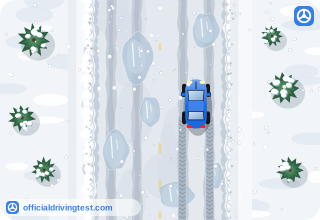
- Using your windshield wipers
- Keeping a safe distance
- Sudden changes in speed or direction
- Leaving extra time for your trip
Show answer
Correct answer: Sudden changes in speed or direction
The handbook says to avoid sudden changes in speed or direction on snow and ice.
Source: Nevada Driver's Handbook (March 2024 (DMV 700)), page 57 · Open this page in the manual (Manual page 57)
-
On what dates may studded snow tires be used?
- November 1 through March 31
- October 1 through April 30
- September 1 through May 31
- Any time of year
Show answer
Correct answer: October 1 through April 30
Studded snow tires may only be used from October 1 through April 30.
Source: Nevada Driver's Handbook (March 2024 (DMV 700)), page 57 · Open this page in the manual (Manual page 57)
-
When may tires with retractable studs be used?
- Only from October 1 through April 30
- Only from October 1 through April 30, with studs extended
- Only when chains are not available
- Any time of year, but studs may be extended only on certain dates
Show answer
Correct answer: Any time of year, but studs may be extended only on certain dates
Tires with retractable studs are allowed any time of year, but the studs may be extended or engaged only during the dates indicated.
Source: Nevada Driver's Handbook (March 2024 (DMV 700)), page 57 · Open this page in the manual (Manual page 57)
-
What can overloading a trailer negatively affect, according to the handbook?
- Only the fuel supply and the engine oil
- Steering, braking and speed control
- Only the tire tread wear and alignment
- Only the headlight aim and wiper speed
Show answer
Correct answer: Steering, braking and speed control
The handbook says overloading can have negative effects on steering, braking and speed control.
Source: Nevada Driver's Handbook (March 2024 (DMV 700)), page 68 · Open this page in the manual (Manual page 68)
-
What are overloaded vehicles likely to do on uphill grades?
- Hold a steady speed
- Pick up speed quickly
- Need less braking
- Go very slowly
Show answer
Correct answer: Go very slowly
Overloaded vehicles are likely to go very slowly on uphill grades.
Source: Nevada Driver's Handbook (March 2024 (DMV 700)), page 68 · Open this page in the manual (Manual page 68)
-
What can happen to an overloaded vehicle on downhill grades?
- It may gain too much speed
- It may slow down by itself
- It may stop more quickly
- It may need less braking
Show answer
Correct answer: It may gain too much speed
Overloaded vehicles may gain too much speed on downhill grades.
Source: Nevada Driver's Handbook (March 2024 (DMV 700)), page 68 · Open this page in the manual (Manual page 68)
-
What happens to the stopping distance of an overloaded vehicle whose brakes are forced to work too hard?
- The distance stays the same and the brakes hold
- The distance becomes much shorter than normal
- The distance increases and the brakes can fail
- The brakes grip better as they warm
Show answer
Correct answer: The distance increases and the brakes can fail
Stopping distance increases and brakes can fail when forced to work too hard.
Source: Nevada Driver's Handbook (March 2024 (DMV 700)), page 68 · Open this page in the manual (Manual page 68)
-
Why do empty trucks actually require greater stopping distances?
- They have less traction
- They have heavier brakes
- They absorb more heat in the brakes
- They have softer springs than loaded trucks
Show answer
Correct answer: They have less traction
Empty trucks need greater stopping distances because they have less traction, and an empty truck can bounce and lock up its wheels.
Source: Nevada Driver's Handbook (March 2024 (DMV 700)), page 70 · Open this page in the manual (Manual page 70)
-
When are the brakes, tires, springs and shock absorbers on heavy vehicles designed to work best?
- When the vehicle is completely empty
- When the vehicle is parked
- When the vehicle is fully loaded
- When the vehicle is lightly loaded
Show answer
Correct answer: When the vehicle is fully loaded
Brakes, tires, springs and shock absorbers on heavy vehicles are designed to work best when the vehicle is fully loaded.
Source: Nevada Driver's Handbook (March 2024 (DMV 700)), page 70 · Open this page in the manual (Manual page 70)
-
Compared with other vehicles, what do large vehicles require when managing space?
- Less space for stopping and turning
- More space for stopping and turning
- The same space as a car
- More space only for passing
Show answer
Correct answer: More space for stopping and turning
Large vehicles take up more space and require more space for stopping and turning.
Source: Nevada Driver's Handbook (March 2024 (DMV 700)), page 70 · Open this page in the manual (Manual page 70)
-
Compared with a car, how large a gap may a large vehicle need to enter traffic?
- A much larger gap
- A smaller gap
- The same gap
- A gap only when empty
Show answer
Correct answer: A much larger gap
Because of slow acceleration and the space large vehicles require, you may need a much larger gap to enter traffic than you would in a car.
Source: Nevada Driver's Handbook (March 2024 (DMV 700)), page 72 · Open this page in the manual (Manual page 72)
-
How does a heavy load affect the room you should allow when entering traffic?
- Allow less room because the load adds speed
- Allow the same room as when empty
- Allow more room if your vehicle is heavily loaded
- Allow more room only when empty
Show answer
Correct answer: Allow more room if your vehicle is heavily loaded
Acceleration varies with the load, so you should allow more room if your vehicle is heavily loaded.
Source: Nevada Driver's Handbook (March 2024 (DMV 700)), page 72 · Open this page in the manual (Manual page 72)
-
Why do lightly loaded large combination vehicles lock up their wheels very easily?
- The soft suspension springs and weak brakes give too much grip
- The extra weight on the wheels gives too much traction
- The tires are always under-inflated when lightly loaded
- The very stiff suspension springs and strong brakes give poor traction
Show answer
Correct answer: The very stiff suspension springs and strong brakes give poor traction
When lightly loaded, the very stiff suspension springs and strong brakes give poor traction and make it very easy to lock up the wheels.
Source: Nevada Driver's Handbook (March 2024 (DMV 700)), page 74 · Open this page in the manual (Manual page 74)
-
In any combination rig, how should you plan to brake?
- Allow a lot of following distance and look far enough ahead to brake early
- Follow closely behind the vehicle ahead and brake as late as you can
- Look only at the vehicle ahead and brake hard when needed
- Rely on the engine to slow the rig down instead of the brakes
Show answer
Correct answer: Allow a lot of following distance and look far enough ahead to brake early
In any combination rig, allow a lot of following distance and look far enough ahead so you can brake early, so you are not caught by surprise and forced into a panic stop.
Source: Nevada Driver's Handbook (March 2024 (DMV 700)), page 74 · Open this page in the manual (Manual page 74)