Nevada: Speed and following distance — Part 2 Practice Test
Questions in this part include: “According to highway safety studies, what are normal reaction times?” · “If you are going 30 mph, how long is your stopping distance on ice?”
Independent educational site · not affiliated with any government agency or DMV
Ready? Test yourself
- Instant feedback with an explanation
- Every answer cites its source in the manual
- Your best score is saved on this device
- Keyboard: press 1 to 4 to answer and Enter for the next question
Questions are original and based on the official manual "Nevada Driver's Handbook" (March 2024 (DMV 700)), Nevada Department of Motor Vehicles.
All 18 questions in this practice test
Take the test above first, then use this list to study. Tap “Show answer” to see the correct answer and explanation.
Show the questions and answersHide the questions
-
In stopping a vehicle, what is “perception”?
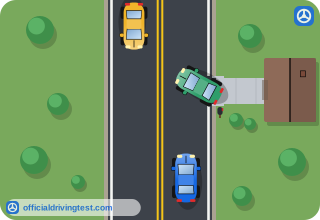
- Moving your foot to the brake pedal and pushing down
- The friction between the road and tires
- Seeing and understanding the reason for stopping
- Judging the speed of the vehicle behind you
Show answer
Correct answer: Seeing and understanding the reason for stopping
Perception is when you see and understand the reason for stopping, the first of three things that must happen to stop.
Source: Nevada Driver's Handbook (March 2024 (DMV 700)), page 41 · Open this page in the manual (Manual page 41)
-
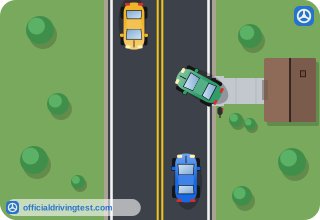
What is “reaction time”?
- The time it takes the brakes and tires to stop the vehicle
- The time from seeing the need to stop until you step on the brakes
- The time from pressing the brake until the vehicle is stopped
- The time it takes to see and signal that you are stopping
Show answer
Correct answer: The time from seeing the need to stop until you step on the brakes
Reaction time is the amount of time from the moment you see that you need to stop until you step on the brakes.
Source: Nevada Driver's Handbook (March 2024 (DMV 700)), page 41 · Open this page in the manual (Manual page 41)
-
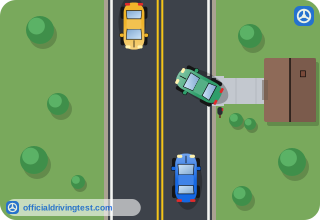
When does your reaction time increase?
- When you drive faster than the posted speed limit
- When the driver has just started the engine
- When the road surface is dry and traffic is light
- When decisions are complex or events are unexpected
Show answer
Correct answer: When decisions are complex or events are unexpected
Reaction time increases as driving decisions become more complex or when unexpected events occur.
Source: Nevada Driver's Handbook (March 2024 (DMV 700)), page 41 · Open this page in the manual (Manual page 41)
-
According to highway safety studies, what are normal reaction times?
- 2 to 2.5 seconds
- 0.5 to 1 second
- 1 to 1.5 seconds
- 3 to 4 seconds
Show answer
Correct answer: 2 to 2.5 seconds
Highway safety studies show normal reaction times are 2 to 2.5 seconds.
Source: Nevada Driver's Handbook (March 2024 (DMV 700)), page 41 · Open this page in the manual (Manual page 41)
-
What is “braking distance”?
- How far the vehicle travels before you step on the brake
- How far ahead you can see when you are driving
- How far the vehicle travels while the brakes bring it to a stop
- The space you leave between your car and the next one
Show answer
Correct answer: How far the vehicle travels while the brakes bring it to a stop
Braking distance is how far your vehicle travels during the braking time, while the brakes and friction between road and tires stop it.
Source: Nevada Driver's Handbook (March 2024 (DMV 700)), page 41 · Open this page in the manual (Manual page 41)
-
If you double your speed, how does your braking distance change?
- It doubles
- It becomes four times as long
- It becomes three times as long
- It becomes eight times as long
Show answer
Correct answer: It becomes four times as long
If you double your speed, your braking distance does not become twice as long; it becomes four times as long.
Source: Nevada Driver's Handbook (March 2024 (DMV 700)), page 41 · Open this page in the manual (Manual page 41)
-
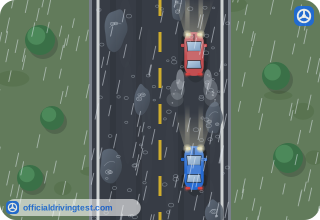
Compared with dry pavement, how may stopping distances on a wet highway differ?
- They are usually the same
- They are slightly shorter
- They may be about 10 percent longer
- They may be more than double
Show answer
Correct answer: They may be more than double
Stopping distances on a wet highway may be more than double those on dry pavement.
Source: Nevada Driver's Handbook (March 2024 (DMV 700)), page 41 · Open this page in the manual (Manual page 41)
-
Why should you be especially careful during the first rain of a season?
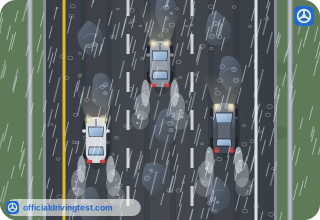
- Oil and water on the pavement mix and are very dangerous
- Rain freezes on the pavement in the first storm
- Brake lights are harder to see in the first rain
- Tires are stiffer and grip poorly after a dry spell
Show answer
Correct answer: Oil and water on the pavement mix and are very dangerous
The mixture of oil and water on the pavement during the first rain of a season is very dangerous.
Source: Nevada Driver's Handbook (March 2024 (DMV 700)), page 41 · Open this page in the manual (Manual page 41)
-
If you are going 30 mph, how long is your stopping distance on ice?
- 173 feet
- 273 feet
- 373 feet
- 473 feet
Show answer
Correct answer: 373 feet
At 30 mph, the stopping distance on ice would be 373 feet, well over the length of a football field.
Source: Nevada Driver's Handbook (March 2024 (DMV 700)), page 41 · Open this page in the manual (Manual page 41)
-
In heavy rainfall, most cars begin to lose traction and hydroplane at what speeds?
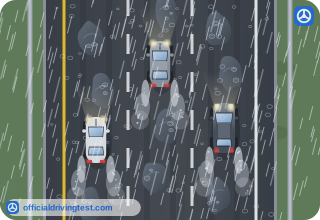
- Between 10 and 25 mph
- Between 35 and 55 mph
- Between 60 and 80 mph
- Between 20 and 30 mph
Show answer
Correct answer: Between 35 and 55 mph
Most cars begin to lose traction and hydroplane between speeds of 35 and 55 mph in heavy rainfall.
Source: Nevada Driver's Handbook (March 2024 (DMV 700)), page 41 · Open this page in the manual (Manual page 41)
-
For a typical passenger car with perfect brakes on dry, level pavement and a 2.5-second reaction time, what is the total stopping distance at 55 mph?
- 278 feet
- 494 feet
- 196 feet
- 370 feet
Show answer
Correct answer: 370 feet
At 55 mph the total stopping distance is 370 feet (6.66 seconds): 202 feet of perception and reaction plus 168 feet of braking.
Source: Nevada Driver's Handbook (March 2024 (DMV 700)), page 41 · Open this page in the manual (Manual page 41)
-
For a typical passenger car with perfect brakes on dry, level pavement and a 2.5-second reaction time, what is the braking distance at 45 mph?
- 113 feet
- 68 feet
- 168 feet
- 256 feet
Show answer
Correct answer: 113 feet
At 45 mph the braking distance is 113 feet, after 165 feet of perception and reaction distance, for a total of 278 feet.
Source: Nevada Driver's Handbook (March 2024 (DMV 700)), page 41 · Open this page in the manual (Manual page 41)
-
For a typical passenger car with perfect brakes on dry, level pavement and a 2.5-second reaction time, what is the perception and reaction distance at 65 mph?
- 202 feet
- 256 feet
- 238 feet
- 165 feet
Show answer
Correct answer: 238 feet
At 65 mph the perception and reaction distance is 238 feet, followed by 256 feet of braking distance.
Source: Nevada Driver's Handbook (March 2024 (DMV 700)), page 41 · Open this page in the manual (Manual page 41)
-
For a typical passenger car with perfect brakes on dry, level pavement and a 2.5-second reaction time, what is the total stopping distance at 25 mph?
- 92 feet
- 127 feet
- 35 feet
- 196 feet
Show answer
Correct answer: 127 feet
At 25 mph the total stopping distance is 127 feet (4.40 seconds): 92 feet of perception and reaction plus 35 feet of braking.
Source: Nevada Driver's Handbook (March 2024 (DMV 700)), page 41 · Open this page in the manual (Manual page 41)
-
What is the minimum number of seconds ahead you should look when driving?
- 3 seconds
- 6 seconds
- 9 seconds
- 12 seconds
Show answer
Correct answer: 12 seconds
Defensive driving means looking ahead at least 12 seconds, to where your vehicle will be 12 seconds from now.
Source: Nevada Driver's Handbook (March 2024 (DMV 700)), page 42 · Open this page in the manual (Manual page 42)
-
You count “one thousand one” and so on until the front of your vehicle passes a fixed object ahead. When do you need to look farther ahead?
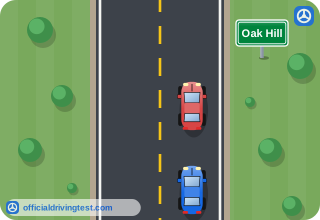
- If you have not yet counted to “one thousand twelve”
- If you have counted past “one thousand twelve”
- If you reach exactly “one thousand twelve”
- If you reach “one thousand twenty” at the object
Show answer
Correct answer: If you have not yet counted to “one thousand twelve”
If you have not reached “one thousand twelve” when your vehicle passes the object, you need to be looking farther ahead.
Source: Nevada Driver's Handbook (March 2024 (DMV 700)), page 42 · Open this page in the manual (Manual page 42)
-
At 30 mph, about how far ahead should you be able to see when looking 12 seconds ahead?
- About half a mile
- Less than half a block
- A little over a block
- About a quarter mile
Show answer
Correct answer: A little over a block
At 30 mph you should see a little over a block ahead.
Source: Nevada Driver's Handbook (March 2024 (DMV 700)), page 42 · Open this page in the manual (Manual page 42)
-
If you are driving 40 mph or less, what is the minimum following time behind the vehicle in front of you?
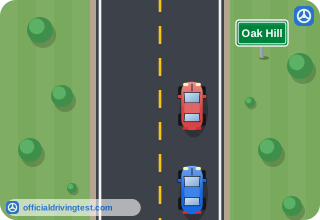
- One second
- Half a second
- Six seconds
- Two seconds
Show answer
Correct answer: Two seconds
At 40 mph or less, stay at least two seconds behind the vehicle in front of you; this is a minimum following distance.
Source: Nevada Driver's Handbook (March 2024 (DMV 700)), page 42 · Open this page in the manual (Manual page 42)