Nevada: Sharing the road — Part 2 Practice Test
Questions in this part include: “If you cannot see a truck driver's face in the truck's side view mirror, what does that mean?” · “With the consent of the drivers, how many motorcycles or mopeds may be operated abreast in a single traffic lane?”
Independent educational site · not affiliated with any government agency or DMV
Ready? Test yourself
- Instant feedback with an explanation
- Every answer cites its source in the manual
- Your best score is saved on this device
- Keyboard: press 1 to 4 to answer and Enter for the next question
Questions are original and based on the official manual "Nevada Driver's Handbook" (March 2024 (DMV 700)), Nevada Department of Motor Vehicles.
All 16 questions in this practice test
Take the test above first, then use this list to study. Tap “Show answer” to see the correct answer and explanation.
Show the questions and answersHide the questions
-
If you cannot see a truck driver's face in the truck's side view mirror, what does that mean?
- The truck driver cannot see you
- The truck driver is about to change lanes
- You are a safe distance behind the truck
- The truck's mirrors need adjusting
Show answer
Correct answer: The truck driver cannot see you
If you cannot see the driver's face in the side view mirror, the truck driver cannot see you.
Source: Nevada Driver's Handbook (March 2024 (DMV 700)), page 62 · Open this page in the manual (Manual page 62)
-
How much time and distance do large commercial trucks and buses need to stop, compared with cars?
- About half as much
- About the same
- Nearly twice as much
- Slightly less
Show answer
Correct answer: Nearly twice as much
The handbook says large vehicles need nearly twice the time and distance to stop as cars.
Source: Nevada Driver's Handbook (March 2024 (DMV 700)), page 63 · Open this page in the manual (Manual page 63)
-
What can happen if you cut in front of a large truck too soon after passing and then immediately slow down?
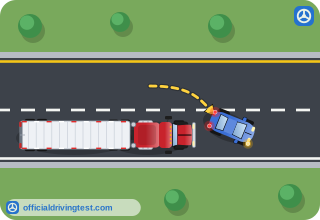
- The truck will move into the left lane to give you room
- The truck driver will see you better in the side mirrors
- The truck driver may have to slam on the brakes and rear-end you
- Nothing, because the truck can stop as quickly as a car
Show answer
Correct answer: The truck driver may have to slam on the brakes and rear-end you
Cutting in too soon and slowing down can force truck and bus drivers to slam on their brakes and rear-end you.
Source: Nevada Driver's Handbook (March 2024 (DMV 700)), page 63 · Open this page in the manual (Manual page 63)
-
When passing a large commercial truck or bus, what should you see in your rearview mirror before pulling into its lane?
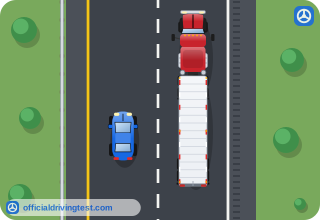
- The whole front of the truck or bus
- Only the truck's headlights in the mirror
- The truck's right turn signal flashing
- The driver's face in its side mirror
Show answer
Correct answer: The whole front of the truck or bus
Before pulling into the truck's lane, look for the whole front of the commercial truck or bus in your rearview mirror.
Source: Nevada Driver's Handbook (March 2024 (DMV 700)), page 63 · Open this page in the manual (Manual page 63)
-
What should you never do around a commercial truck that is backing up?
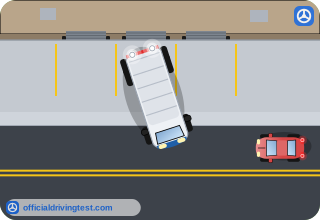
- Pass in front of it
- Stay stopped beside it
- Sound your horn once
- Pass behind it
Show answer
Correct answer: Pass behind it
The handbook says never to pass behind a commercial truck that is backing up, because the driver cannot see small vehicles directly behind it.
Source: Nevada Driver's Handbook (March 2024 (DMV 700)), page 63 · Open this page in the manual (Manual page 63)
-
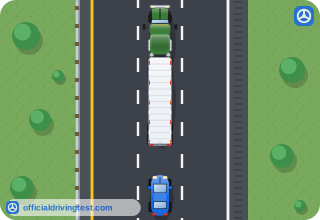
What is true about the area directly behind a large commercial truck or bus?
- The driver's mirrors give a clear view of it
- The driver cannot see your car there
- It is a safe place to follow closely
- It is a small no-zone, like a car's
Show answer
Correct answer: The driver cannot see your car there
Large trucks and buses have huge no-zones directly behind them, and the driver cannot see your car there.
Source: Nevada Driver's Handbook (March 2024 (DMV 700)), page 63 · Open this page in the manual (Manual page 63)
-
What is the danger of tailgating a large commercial truck or bus?
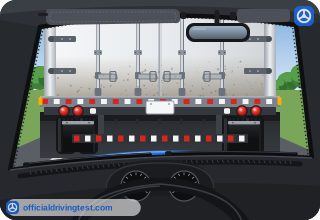
- Its exhaust will damage your paint and windshield
- If it brakes or stops suddenly, you have no place to go
- It may swing wide and strike the front of your car
- Your headlights will blind the truck driver ahead
Show answer
Correct answer: If it brakes or stops suddenly, you have no place to go
Because you cannot see beyond the truck or bus, you could run into it if it brakes or stops suddenly.
Source: Nevada Driver's Handbook (March 2024 (DMV 700)), page 63 · Open this page in the manual (Manual page 63)
-
What does the handbook warn about trying to squeeze between a turning commercial vehicle and the curb?
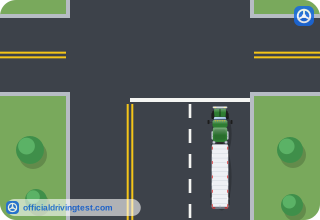
- It is safe if you use your turn signal
- It is the preferred way to pass a turning truck
- It is allowed only in residential areas
- It could be an invitation to disaster
Show answer
Correct answer: It could be an invitation to disaster
The handbook warns that trying to squeeze between a commercial vehicle and the curb could be an invitation to disaster.
Source: Nevada Driver's Handbook (March 2024 (DMV 700)), page 63 · Open this page in the manual (Manual page 63)
-
What right do motorcycle operators have on the road?
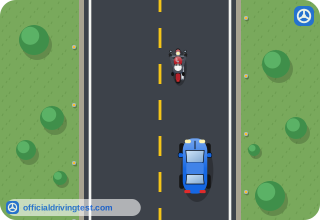
- The right to use half of a lane
- The right to ride only on the shoulder
- The right to use a complete traffic lane
- The right to pass cars on either side
Show answer
Correct answer: The right to use a complete traffic lane
The handbook says motorcycle operators have the right to use a complete traffic lane.
Source: Nevada Driver's Handbook (March 2024 (DMV 700)), page 63 · Open this page in the manual (Manual page 63)
-
With the consent of the drivers, how many motorcycles or mopeds may be operated abreast in a single traffic lane?
- No more than two
- Only one
- No more than three
- No more than four
Show answer
Correct answer: No more than two
The handbook quotes the law: with the consent of the drivers, motorcycles and mopeds may be operated no more than two abreast in a single traffic lane.
Source: Nevada Driver's Handbook (March 2024 (DMV 700)), page 63 · Open this page in the manual (Manual page 63)
-
Without the consent of the driver, how must motorcycles ride in a lane?
- In a staggered formation
- Side by side
- In single file with a lane gap
- On the shoulder
Show answer
Correct answer: In a staggered formation
Without the driver's consent, motorcycles couldn't ride side by side and would have to remain in a staggered formation.
Source: Nevada Driver's Handbook (March 2024 (DMV 700)), page 63 · Open this page in the manual (Manual page 63)
-
Why can a motorcycle appear to be farther away than it really is?
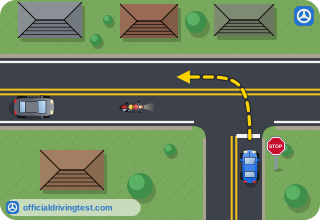
- Because its headlight is always dim
- Because its engine is quiet
- Because of its smaller size, it is less visible
- Because it rides in the left part of the lane
Show answer
Correct answer: Because of its smaller size, it is less visible
The handbook says that because of their smaller size, motorcycles are less visible and may appear to be farther away than they really are.
Source: Nevada Driver's Handbook (March 2024 (DMV 700)), page 63 · Open this page in the manual (Manual page 63)
-
What is difficult for other drivers to judge about a motorcycle?
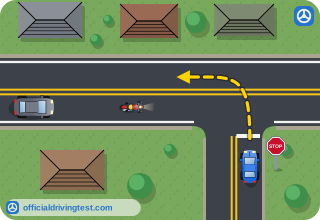
- How wide its lane is
- How fast it is going
- Whether it has headlights
- Whether its rider is licensed
Show answer
Correct answer: How fast it is going
The handbook says it is difficult for other drivers to judge how fast a motorcycle is going.
Source: Nevada Driver's Handbook (March 2024 (DMV 700)), page 63 · Open this page in the manual (Manual page 63)
-
What can force a motorcycle out of its position on the road?
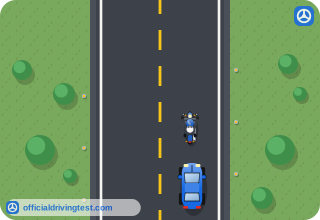
- Only a passing large truck or bus nearby
- Only wet leaves or standing water on the road
- Only another vehicle's high beams at night
- Strong winds or a rough road surface
Show answer
Correct answer: Strong winds or a rough road surface
The handbook says motorcycles may be forced from their position by strong winds or a rough road surface.
Source: Nevada Driver's Handbook (March 2024 (DMV 700)), page 63 · Open this page in the manual (Manual page 63)
-
Why should you be sure you know what a motorcyclist is doing before you change lanes or turn?
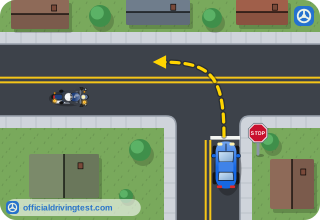
- Motorcycles are not required to have turn signals
- Motorcycle turn signals only work in daylight hours
- Motorcyclists never use their turn signals at all
- Turn signals are not self-canceling on most motorcycles
Show answer
Correct answer: Turn signals are not self-canceling on most motorcycles
Turn signals are not self-canceling on most motorcycles, so before a lane change or turn that depends on a motorcycle's path, be sure you know what the motorcyclist is doing.
Source: Nevada Driver's Handbook (March 2024 (DMV 700)), page 63 · Open this page in the manual (Manual page 63)
-
Which is a clue that a motorcyclist may be about to change direction?
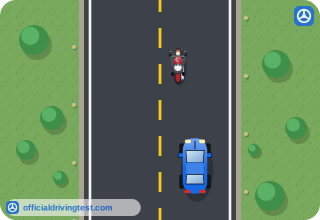
- The motorcycle's headlight is on in the daytime
- The rider or passenger turns their head to look behind
- The rider is wearing a helmet and bright clothing
- The motorcycle's engine makes a loud noise
Show answer
Correct answer: The rider or passenger turns their head to look behind
The handbook tells drivers to watch for operators or passengers turning their heads to look behind, or operators beginning to lean or tilt their motorcycles.
Source: Nevada Driver's Handbook (March 2024 (DMV 700)), page 63 · Open this page in the manual (Manual page 63)