Nevada: Sharing the road — Part 5 Practice Test
Questions in this part include: “What does the handbook say about the right of motorists and cyclists to use the roadways?” · “What happens to the crack-the-whip effect as more trailers are added?”
Independent educational site · not affiliated with any government agency or DMV
Ready? Test yourself
- Instant feedback with an explanation
- Every answer cites its source in the manual
- Your best score is saved on this device
- Keyboard: press 1 to 4 to answer and Enter for the next question
Questions are original and based on the official manual "Nevada Driver's Handbook" (March 2024 (DMV 700)), Nevada Department of Motor Vehicles.
All 16 questions in this practice test
Take the test above first, then use this list to study. Tap “Show answer” to see the correct answer and explanation.
Show the questions and answersHide the questions
-
What does the handbook say about the right of motorists and cyclists to use the roadways?
- Motorists have the first right to the road
- They have an equal right and need to cooperate
- Cyclists have the first right to the road
- Cyclists may use only bike lanes and paths
Show answer
Correct answer: They have an equal right and need to cooperate
The handbook says motorists and cyclists have an equal right to use the roadways and need to be mutually courteous and cooperative.
Source: Nevada Driver's Handbook (March 2024 (DMV 700)), page 65 · Open this page in the manual (Manual page 65)
-
Before you start across a road with a large vehicle, what should you make sure of?
- That the other traffic will slow down to let you go across
- That you can get all the way across before traffic reaches you
- That you are able to stop halfway across the road if needed
- That the road you are crossing is at least two lanes wide
Show answer
Correct answer: That you can get all the way across before traffic reaches you
Before you start across a road, make sure you can get all the way across before traffic reaches you.
Source: Nevada Driver's Handbook (March 2024 (DMV 700)), page 72 · Open this page in the manual (Manual page 72)
-
Why should you not assume that the height posted at a bridge or overpass is correct?
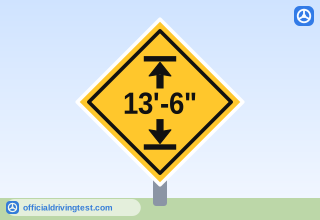
- Posted heights always include a safety margin of several feet at every bridge
- Bridges grow taller in hot weather and shorter in cold weather every year
- Posted heights apply only to empty trailers and not to loaded vehicles
- Repaving or packed snow may have reduced the clearance since the height was posted
Show answer
Correct answer: Repaving or packed snow may have reduced the clearance since the height was posted
Repaving or packed snow may have reduced the clearances since the height was posted.
Source: Nevada Driver's Handbook (March 2024 (DMV 700)), page 72 · Open this page in the manual (Manual page 72)
-
How does the weight of a trailer change its height?
- An empty trailer is higher than a loaded one
- A loaded trailer is higher than an empty one
- Weight never changes the height
- Only a loaded trailer's height can change
Show answer
Correct answer: An empty trailer is higher than a loaded one
An empty trailer is higher than a loaded one, so a bridge you cleared when loaded may be too low when empty.
Source: Nevada Driver's Handbook (March 2024 (DMV 700)), page 72 · Open this page in the manual (Manual page 72)
-
What should you do if you are not sure you can pass under a low bridge or underpass?
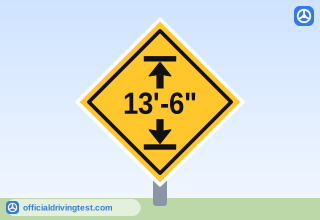
- Speed up so you can clear it
- Follow closely behind a taller truck
- Take another route
- Pass under it and hope for the best
Show answer
Correct answer: Take another route
If you doubt you have enough space, go slowly, and if you are not sure you can make it, take another route.
Source: Nevada Driver's Handbook (March 2024 (DMV 700)), page 72 · Open this page in the manual (Manual page 72)
-
What should you do if you doubt you have enough space to pass under an object?
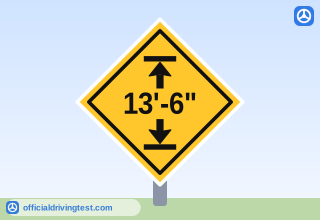
- Go at normal speed
- Go slowly
- Go faster to get through
- Stop and sound the horn
Show answer
Correct answer: Go slowly
If you doubt you have enough space to pass under an object, go slowly.
Source: Nevada Driver's Handbook (March 2024 (DMV 700)), page 72 · Open this page in the manual (Manual page 72)
-
On a road that tilts your vehicle toward objects along the edge, what should you do if clearing signs or trees is a problem?
- Drive a little closer to the edge of the road
- Speed up to clear the objects
- Drive on the shoulder
- Drive a little closer to the center of the road
Show answer
Correct answer: Drive a little closer to the center of the road
Where clearing objects along the road edge is a problem, drive a little closer to the center of the road.
Source: Nevada Driver's Handbook (March 2024 (DMV 700)), page 72 · Open this page in the manual (Manual page 72)
-
Before you back into an area, what should you check for?
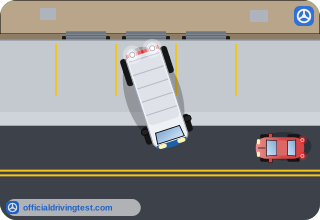
- Overhanging objects such as trees, branches or electric wires
- Only the width of the road and the speed limit on it
- Only the color of the pavement and the type of surface
- Only parked vehicles behind you and the vehicles beside you
Show answer
Correct answer: Overhanging objects such as trees, branches or electric wires
Before you back into an area, get out and check for overhanging objects, such as trees, branches, or electric wires, and for other hazards.
Source: Nevada Driver's Handbook (March 2024 (DMV 700)), page 72 · Open this page in the manual (Manual page 72)
-
How should you cross drainage channels across a road?

- Quickly, so that the vehicle is not hung up on it
- Carefully, because the end of some vehicles can drag
- At the same speed as the rest of the traffic around you
- Only while backing the vehicle slowly across them
Show answer
Correct answer: Carefully, because the end of some vehicles can drag
Drainage channels across roads can cause the end of some vehicles to drag, so such depressions should be crossed carefully.
Source: Nevada Driver's Handbook (March 2024 (DMV 700)), page 72 · Open this page in the manual (Manual page 72)
-
When towing a combination of vehicles, which vehicle must always be in the first position behind the towing vehicle?
- The lightest vehicle
- The shortest vehicle
- The newest vehicle
- The heaviest vehicle
Show answer
Correct answer: The heaviest vehicle
The heaviest vehicle must always be in the first position behind the towing vehicle, with the lighter vehicle in the rear.
Source: Nevada Driver's Handbook (March 2024 (DMV 700)), page 73 · Open this page in the manual (Manual page 73)
-
What can the crack-the-whip effect do during a quick lane change?
- Turn a trailer over
- Lock the steering wheel
- Disconnect the electric lines
- Shorten the stopping distance
Show answer
Correct answer: Turn a trailer over
When you make a quick lane change, the crack-the-whip effect can turn a trailer over.
Source: Nevada Driver's Handbook (March 2024 (DMV 700)), page 73 · Open this page in the manual (Manual page 73)
-
What happens to the crack-the-whip effect as more trailers are added?
- It decreases
- It disappears
- It increases
- It stays the same
Show answer
Correct answer: It increases
Vehicles with trailers have a dangerous crack-the-whip effect which increases with multiple trailers.
Source: Nevada Driver's Handbook (March 2024 (DMV 700)), page 73 · Open this page in the manual (Manual page 73)
-
What causes the crack-the-whip effect?
- Forward braking force
- Rearward amplification
- Excess tire pressure
- Slack in the safety chains
Show answer
Correct answer: Rearward amplification
Rearward amplification causes the crack-the-whip effect.
Source: Nevada Driver's Handbook (March 2024 (DMV 700)), page 73 · Open this page in the manual (Manual page 73)
-
What does a rearward amplification of 2.0 mean?
- The rear trailer is half as likely to turn over as the truck
- The rear trailer is 3.5 times as likely to turn over as the truck
- The rear trailer is not able to turn over at all
- The rear trailer is twice as likely to turn over as the truck
Show answer
Correct answer: The rear trailer is twice as likely to turn over as the truck
Rearward amplification of 2.0 means the rear trailer is twice as likely to turn over as the truck.
Source: Nevada Driver's Handbook (March 2024 (DMV 700)), page 73 · Open this page in the manual (Manual page 73)
-
What rearward amplification do triples have?
- 3.5
- 1.0
- 2.0
- 4.5
Show answer
Correct answer: 3.5
Triples have a rearward amplification of 3.5, which means the last trailer of a triple can roll 3.5 times as easily.
Source: Nevada Driver's Handbook (March 2024 (DMV 700)), page 73 · Open this page in the manual (Manual page 73)
-
How should you steer when pulling trailers?
- Quickly and sharply
- With sudden corrections
- Gently and smoothly
- Only in short, quick moves
Show answer
Correct answer: Gently and smoothly
Steer gently and smoothly when pulling trailers, because trailers flip over from quick steering moves more easily than many vehicles.
Source: Nevada Driver's Handbook (March 2024 (DMV 700)), page 73 · Open this page in the manual (Manual page 73)