Nevada: Sharing the road
Trucks and their no-zones, motorcycles, mopeds, school buses, bicycles and passengers in a truck bed. Split into 5 shorter tests so you're not stuck in one long quiz.
Independent educational site · not affiliated with any government agency or DMV
Choose a part
Sharing the road — Part 1
Questions in this part include: “In a crash between a commercial vehicle and a small car, who is much more likely to be killed or injured?”
StartSharing the road — Part 2
Questions in this part include: “If you cannot see a truck driver's face in the truck's side view mirror, what does that mean?”
StartSharing the road — Part 3
Questions in this part include: “What is the maximum horsepower of a moped, as Nevada defines it?”
StartSharing the road — Part 4
Questions in this part include: “What may a motorist be charged with for causing even a minor collision with a bicycle?”
StartSharing the road — Part 5
Questions in this part include: “What does the handbook say about the right of motorists and cyclists to use the roadways?”
StartAll 81 Sharing the road questions with answers
Choose a part above to take a practice test, or study every question and answer here.
Show the questions and answersHide the questions
-
Which vehicles are permitted to use the truck apron around the center island of a roundabout?
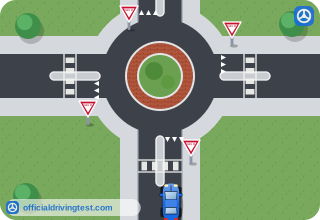
- Passenger cars in a hurry
- Any vehicle that cannot find a gap in traffic
- Only vehicles carrying hazardous materials
- Large commercial trucks and trailers
Show answer
Correct answer: Large commercial trucks and trailers
Large commercial trucks and trailers may use the truck apron to negotiate the tight turning radius, while cars should not use it.
Source: Nevada Driver's Handbook (March 2024 (DMV 700)), page 44 · Open this page in the manual (Manual page 44)
-
When a large commercial truck uses the raised truck apron of a roundabout, which wheels usually drive on it?
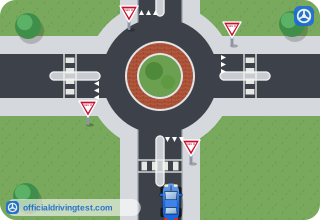
- Usually just the rear wheels
- All of the wheels
- Only the front wheels
- Only the wheels on the trailer's left side
Show answer
Correct answer: Usually just the rear wheels
The handbook says trucks usually drive with just the rear wheels on the raised pavement of the truck apron.
Source: Nevada Driver's Handbook (March 2024 (DMV 700)), page 44 · Open this page in the manual (Manual page 44)
-
A bicyclist is unsure about using a roundabout. What does the handbook say to do?
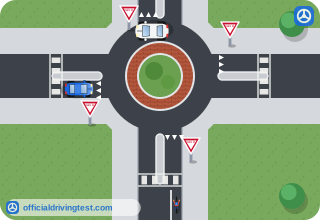
- Ride on the truck apron
- Ride against the flow of traffic around the central island
- Dismount and walk the bike in the designated crosswalks
- Ride through the roundabout in the center of the lane without signaling
Show answer
Correct answer: Dismount and walk the bike in the designated crosswalks
A bicyclist who is unsure about using the roundabout should dismount and walk the bike in the designated crosswalks.
Source: Nevada Driver's Handbook (March 2024 (DMV 700)), page 44 · Open this page in the manual (Manual page 44)
-
Why should a bicyclist ride at the speed of traffic in a roundabout?
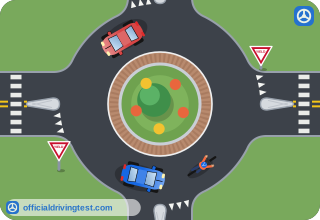
- To be able to use the truck apron
- To discourage cars from wanting to pass
- To avoid having to yield when entering
- To be exempt from using hand signals
Show answer
Correct answer: To discourage cars from wanting to pass
Riding at the speed of traffic in the roundabout discourages cars from wanting to pass.
Source: Nevada Driver's Handbook (March 2024 (DMV 700)), page 44 · Open this page in the manual (Manual page 44)
-
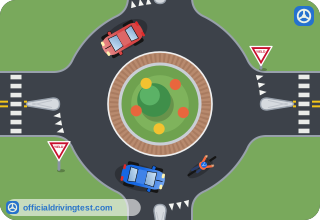
How should a bicyclist signal when exiting a roundabout?
- With a horn only
- No signal is needed in a roundabout
- With a flashing light on the center island
- With hand signals
Show answer
Correct answer: With hand signals
Bicyclists should use hand signals when exiting the roundabout.
Source: Nevada Driver's Handbook (March 2024 (DMV 700)), page 44 · Open this page in the manual (Manual page 44)
-
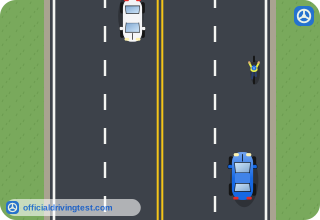
When passing a cyclist on a road with more than one lane in your direction, and moving over is reasonably safe, what must a motorist do?
- Move into the lane to the left
- Pass on the right side of the bicycle
- Stay in your lane and sound the horn
- Slow down and follow the cyclist until the road ends
Show answer
Correct answer: Move into the lane to the left
A motorist passing a cyclist must move into the lane to the left when more than one lane for traffic in the same direction exists and doing so is reasonably safe.
Source: Nevada Driver's Handbook (March 2024 (DMV 700)), page 48 · Open this page in the manual (Manual page 48)
-
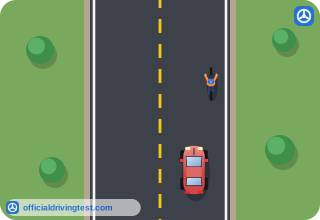
If there is no adjacent lane, what is the minimum distance a motorist must leave when passing a bicycle?
- One foot
- Two feet
- Three feet
- Five feet
Show answer
Correct answer: Three feet
When no adjacent lane exists, the motorist passes to the left of the bicycle at a safe distance, which must be at least three feet.
Source: Nevada Driver's Handbook (March 2024 (DMV 700)), page 48 · Open this page in the manual (Manual page 48)
-
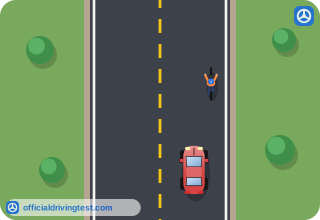
After passing a bicycle, when may the motorist move back to the right?
- When the cyclist has moved into the bicycle lane
- When the vehicle is safely clear of the bicycle
- After signaling for at least three seconds
- After driving at least 200 feet past the cyclist
Show answer
Correct answer: When the vehicle is safely clear of the bicycle
The motorist may not move back to the right until the vehicle is safely clear of the bicycle.
Source: Nevada Driver's Handbook (March 2024 (DMV 700)), page 48 · Open this page in the manual (Manual page 48)
-
While passing a cyclist, what does the handbook say about traveling in a marked bicycle lane?
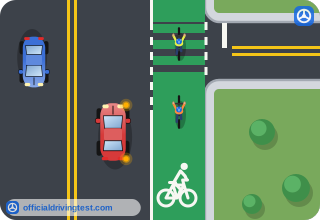
- It is allowed if you signal first
- It is allowed for up to 200 feet
- It is allowed at a low speed
- It is prohibited
Show answer
Correct answer: It is prohibited
The handbook states that traveling in a marked bicycle lane is prohibited when passing a cyclist.
Source: Nevada Driver's Handbook (March 2024 (DMV 700)), page 48 · Open this page in the manual (Manual page 48)
-
When driving past parked vehicles, which of these is a sign that a vehicle may be pulling out in front of you?
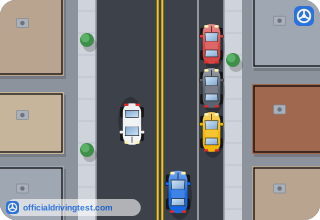
- The vehicle's hood is raised
- Its tires are turned toward the curb
- Its windows are covered with frost
- Exhaust is coming from the tailpipe
Show answer
Correct answer: Exhaust is coming from the tailpipe
The handbook lists exhaust coming from the tailpipe, along with a turn signal, white backup lights or red brake lights, as a sign that a parked vehicle may be pulling out.
Source: Nevada Driver's Handbook (March 2024 (DMV 700)), page 48 · Open this page in the manual (Manual page 48)
-
When driving past parked vehicles, who should you watch for trying to cross between the parked cars?
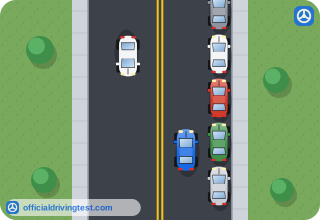
- Only pedestrians in marked crosswalks
- Pedestrians, bicyclists or skateboarders
- Only drivers entering from side streets
- Police officers directing traffic
Show answer
Correct answer: Pedestrians, bicyclists or skateboarders
The handbook tells drivers to watch for pedestrians, bicyclists or skateboarders trying to cross between parked cars.
Source: Nevada Driver's Handbook (March 2024 (DMV 700)), page 48 · Open this page in the manual (Manual page 48)
-
When driving past parked vehicles, what should you also watch for in front of or beside you?
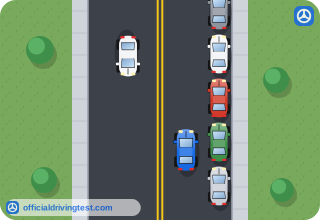
- Vehicle doors opening
- Parked vehicles' mirrors folding in
- Parking meters running out of time
- Parked vehicles rolling backward
Show answer
Correct answer: Vehicle doors opening
The handbook says to watch for vehicle doors opening in front of or beside you when passing parked vehicles.
Source: Nevada Driver's Handbook (March 2024 (DMV 700)), page 48 · Open this page in the manual (Manual page 48)
-
Compared with a car, what do large commercial vehicles need in order to slow down or stop?
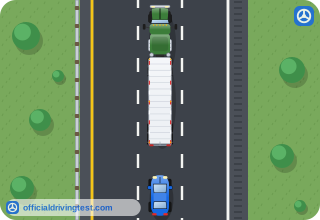
- More time and space
- The same time and space when the brakes are in good repair
- Less time but more space
- Less space but more time
Show answer
Correct answer: More time and space
The handbook says large commercial vehicles take more time and space to slow down or stop.
Source: Nevada Driver's Handbook (March 2024 (DMV 700)), page 62 · Open this page in the manual (Manual page 62)
-
How do the blind spots of large commercial vehicles compare with those of smaller vehicles?
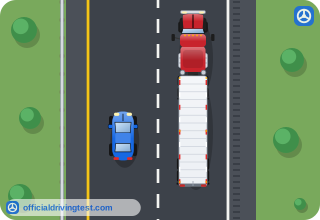
- They are about the same size
- They are smaller, because the driver sits higher
- They are much larger
- They are larger only on the left side
Show answer
Correct answer: They are much larger
The handbook states that large commercial vehicles have much larger blind spots than smaller vehicles.
Source: Nevada Driver's Handbook (March 2024 (DMV 700)), page 62 · Open this page in the manual (Manual page 62)
-
In a crash between a commercial vehicle and a small car, who is much more likely to be killed or injured?
- The driver of the commercial vehicle
- Both are equally likely to be hurt
- Only people outside the vehicles
- The people in the car
Show answer
Correct answer: The people in the car
The handbook says the people in cars are much more likely to be killed or injured than the driver of the commercial vehicle.
Source: Nevada Driver's Handbook (March 2024 (DMV 700)), page 62 · Open this page in the manual (Manual page 62)
-
What is a "no-zone" around a large commercial truck or bus?
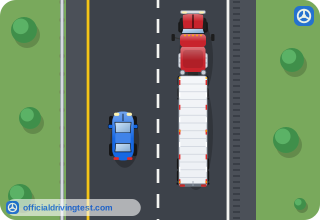
- The area where passing is prohibited
- The area the truck's headlights light up
- A lane used only by trucks and buses
- The area where cars disappear into blind spots
Show answer
Correct answer: The area where cars disappear into blind spots
The no-zone is the area around large trucks or buses where cars disappear into blind spots.
Source: Nevada Driver's Handbook (March 2024 (DMV 700)), page 62 · Open this page in the manual (Manual page 62)
-
Why is the right-side blind spot of a truck or bus described as doubly dangerous?
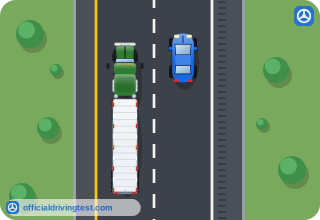
- Trucks and buses brake harder on the right
- Trucks and buses make wide right turns
- Truck drivers cannot use a right mirror
- Trucks and buses stay in the right lane
Show answer
Correct answer: Trucks and buses make wide right turns
The right-side blind spot is doubly dangerous because trucks and buses make wide right turns.
Source: Nevada Driver's Handbook (March 2024 (DMV 700)), page 62 · Open this page in the manual (Manual page 62)
-
If you cannot see a truck driver's face in the truck's side view mirror, what does that mean?
- The truck driver cannot see you
- The truck driver is about to change lanes
- You are a safe distance behind the truck
- The truck's mirrors need adjusting
Show answer
Correct answer: The truck driver cannot see you
If you cannot see the driver's face in the side view mirror, the truck driver cannot see you.
Source: Nevada Driver's Handbook (March 2024 (DMV 700)), page 62 · Open this page in the manual (Manual page 62)
-
How much time and distance do large commercial trucks and buses need to stop, compared with cars?
- About half as much
- About the same
- Nearly twice as much
- Slightly less
Show answer
Correct answer: Nearly twice as much
The handbook says large vehicles need nearly twice the time and distance to stop as cars.
Source: Nevada Driver's Handbook (March 2024 (DMV 700)), page 63 · Open this page in the manual (Manual page 63)
-
What can happen if you cut in front of a large truck too soon after passing and then immediately slow down?
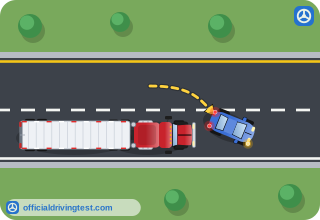
- The truck will move into the left lane to give you room
- The truck driver will see you better in the side mirrors
- The truck driver may have to slam on the brakes and rear-end you
- Nothing, because the truck can stop as quickly as a car
Show answer
Correct answer: The truck driver may have to slam on the brakes and rear-end you
Cutting in too soon and slowing down can force truck and bus drivers to slam on their brakes and rear-end you.
Source: Nevada Driver's Handbook (March 2024 (DMV 700)), page 63 · Open this page in the manual (Manual page 63)
-
When passing a large commercial truck or bus, what should you see in your rearview mirror before pulling into its lane?
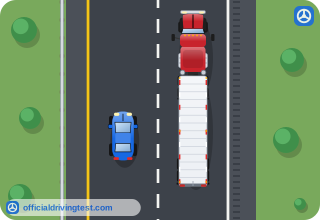
- The whole front of the truck or bus
- Only the truck's headlights in the mirror
- The truck's right turn signal flashing
- The driver's face in its side mirror
Show answer
Correct answer: The whole front of the truck or bus
Before pulling into the truck's lane, look for the whole front of the commercial truck or bus in your rearview mirror.
Source: Nevada Driver's Handbook (March 2024 (DMV 700)), page 63 · Open this page in the manual (Manual page 63)
-
What should you never do around a commercial truck that is backing up?
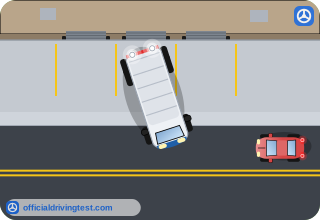
- Pass in front of it
- Stay stopped beside it
- Sound your horn once
- Pass behind it
Show answer
Correct answer: Pass behind it
The handbook says never to pass behind a commercial truck that is backing up, because the driver cannot see small vehicles directly behind it.
Source: Nevada Driver's Handbook (March 2024 (DMV 700)), page 63 · Open this page in the manual (Manual page 63)
-
What is true about the area directly behind a large commercial truck or bus?
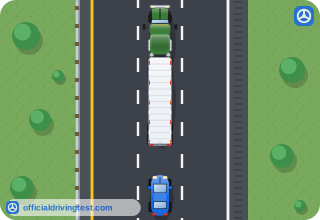
- The driver's mirrors give a clear view of it
- The driver cannot see your car there
- It is a safe place to follow closely
- It is a small no-zone, like a car's
Show answer
Correct answer: The driver cannot see your car there
Large trucks and buses have huge no-zones directly behind them, and the driver cannot see your car there.
Source: Nevada Driver's Handbook (March 2024 (DMV 700)), page 63 · Open this page in the manual (Manual page 63)
-
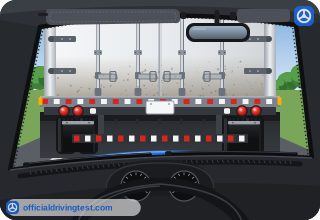
What is the danger of tailgating a large commercial truck or bus?
- Its exhaust will damage your paint and windshield
- If it brakes or stops suddenly, you have no place to go
- It may swing wide and strike the front of your car
- Your headlights will blind the truck driver ahead
Show answer
Correct answer: If it brakes or stops suddenly, you have no place to go
Because you cannot see beyond the truck or bus, you could run into it if it brakes or stops suddenly.
Source: Nevada Driver's Handbook (March 2024 (DMV 700)), page 63 · Open this page in the manual (Manual page 63)
-
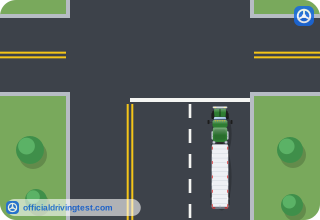
What does the handbook warn about trying to squeeze between a turning commercial vehicle and the curb?
- It is safe if you use your turn signal
- It is the preferred way to pass a turning truck
- It is allowed only in residential areas
- It could be an invitation to disaster
Show answer
Correct answer: It could be an invitation to disaster
The handbook warns that trying to squeeze between a commercial vehicle and the curb could be an invitation to disaster.
Source: Nevada Driver's Handbook (March 2024 (DMV 700)), page 63 · Open this page in the manual (Manual page 63)
-
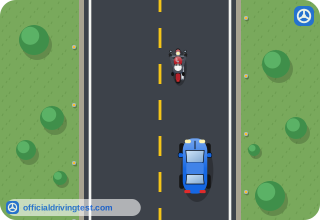
What right do motorcycle operators have on the road?
- The right to use half of a lane
- The right to ride only on the shoulder
- The right to use a complete traffic lane
- The right to pass cars on either side
Show answer
Correct answer: The right to use a complete traffic lane
The handbook says motorcycle operators have the right to use a complete traffic lane.
Source: Nevada Driver's Handbook (March 2024 (DMV 700)), page 63 · Open this page in the manual (Manual page 63)
-
With the consent of the drivers, how many motorcycles or mopeds may be operated abreast in a single traffic lane?
- No more than two
- Only one
- No more than three
- No more than four
Show answer
Correct answer: No more than two
The handbook quotes the law: with the consent of the drivers, motorcycles and mopeds may be operated no more than two abreast in a single traffic lane.
Source: Nevada Driver's Handbook (March 2024 (DMV 700)), page 63 · Open this page in the manual (Manual page 63)
-
Without the consent of the driver, how must motorcycles ride in a lane?
- In a staggered formation
- Side by side
- In single file with a lane gap
- On the shoulder
Show answer
Correct answer: In a staggered formation
Without the driver's consent, motorcycles couldn't ride side by side and would have to remain in a staggered formation.
Source: Nevada Driver's Handbook (March 2024 (DMV 700)), page 63 · Open this page in the manual (Manual page 63)
-
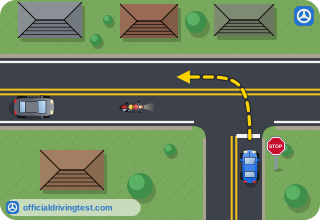
Why can a motorcycle appear to be farther away than it really is?
- Because its headlight is always dim
- Because its engine is quiet
- Because of its smaller size, it is less visible
- Because it rides in the left part of the lane
Show answer
Correct answer: Because of its smaller size, it is less visible
The handbook says that because of their smaller size, motorcycles are less visible and may appear to be farther away than they really are.
Source: Nevada Driver's Handbook (March 2024 (DMV 700)), page 63 · Open this page in the manual (Manual page 63)
-
What is difficult for other drivers to judge about a motorcycle?
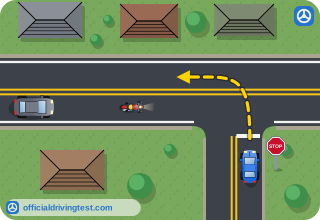
- How wide its lane is
- How fast it is going
- Whether it has headlights
- Whether its rider is licensed
Show answer
Correct answer: How fast it is going
The handbook says it is difficult for other drivers to judge how fast a motorcycle is going.
Source: Nevada Driver's Handbook (March 2024 (DMV 700)), page 63 · Open this page in the manual (Manual page 63)
-
What can force a motorcycle out of its position on the road?
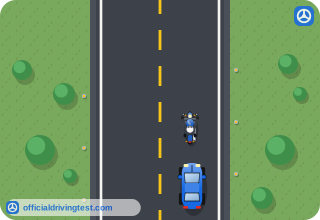
- Only a passing large truck or bus nearby
- Only wet leaves or standing water on the road
- Only another vehicle's high beams at night
- Strong winds or a rough road surface
Show answer
Correct answer: Strong winds or a rough road surface
The handbook says motorcycles may be forced from their position by strong winds or a rough road surface.
Source: Nevada Driver's Handbook (March 2024 (DMV 700)), page 63 · Open this page in the manual (Manual page 63)
-
Why should you be sure you know what a motorcyclist is doing before you change lanes or turn?
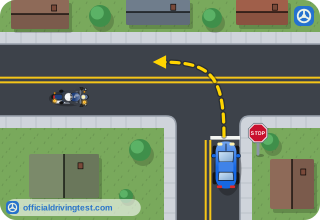
- Motorcycles are not required to have turn signals
- Motorcycle turn signals only work in daylight hours
- Motorcyclists never use their turn signals at all
- Turn signals are not self-canceling on most motorcycles
Show answer
Correct answer: Turn signals are not self-canceling on most motorcycles
Turn signals are not self-canceling on most motorcycles, so before a lane change or turn that depends on a motorcycle's path, be sure you know what the motorcyclist is doing.
Source: Nevada Driver's Handbook (March 2024 (DMV 700)), page 63 · Open this page in the manual (Manual page 63)
-
Which is a clue that a motorcyclist may be about to change direction?
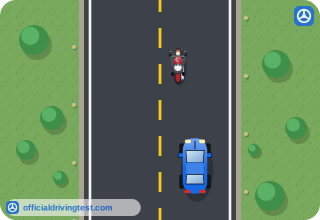
- The motorcycle's headlight is on in the daytime
- The rider or passenger turns their head to look behind
- The rider is wearing a helmet and bright clothing
- The motorcycle's engine makes a loud noise
Show answer
Correct answer: The rider or passenger turns their head to look behind
The handbook tells drivers to watch for operators or passengers turning their heads to look behind, or operators beginning to lean or tilt their motorcycles.
Source: Nevada Driver's Handbook (March 2024 (DMV 700)), page 63 · Open this page in the manual (Manual page 63)
-
What should you do if you are coming up behind a motorcycle?
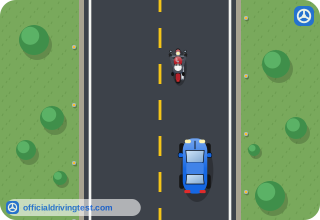
- Slow down sooner than usual and leave plenty of space
- Move up close behind so that the rider can see you
- Stay in position and honk to warn the rider ahead
- Slow down later than you would for another vehicle
Show answer
Correct answer: Slow down sooner than usual and leave plenty of space
The handbook says to slow down sooner than you would for another vehicle and leave plenty of space behind a motorcycle.
Source: Nevada Driver's Handbook (March 2024 (DMV 700)), page 63 · Open this page in the manual (Manual page 63)
-
What should you do with your headlights when approaching a motorcycle?
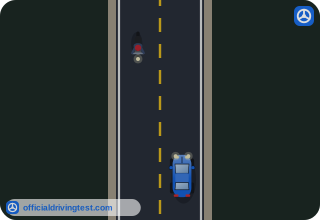
- Leave the high beams on
- Turn them off
- Dim them
- Flash them repeatedly
Show answer
Correct answer: Dim them
The handbook says to always dim your headlights when approaching a motorcycle.
Source: Nevada Driver's Handbook (March 2024 (DMV 700)), page 64 · Open this page in the manual (Manual page 64)
-
Why are high beams especially dangerous to a motorcyclist?
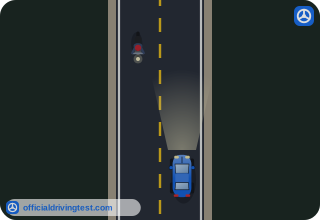
- Motorcycle headlights are weaker than car headlights
- Motorcycles do not have mirrors to block the glare
- Riders steer by balance, so being blinded is more dangerous
- Motorcycles cannot stop as quickly as large trucks
Show answer
Correct answer: Riders steer by balance, so being blinded is more dangerous
Because motorcyclists use their balance to steer, the blinding effect of high beams can be far more dangerous to them than to drivers of cars or large trucks.
Source: Nevada Driver's Handbook (March 2024 (DMV 700)), page 64 · Open this page in the manual (Manual page 64)
-
What should you allow around a motorcycle when it is raining or the road is slippery?
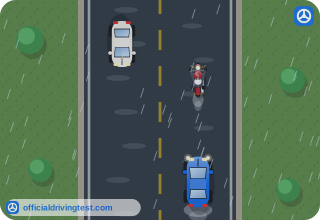
- Even more following distance
- The same following distance as in dry weather
- Less following distance, so the rider sees you
- A position directly beside the motorcycle
Show answer
Correct answer: Even more following distance
The handbook says to allow even more following distance behind motorcyclists when it is raining or the road is slippery.
Source: Nevada Driver's Handbook (March 2024 (DMV 700)), page 64 · Open this page in the manual (Manual page 64)
-
What is the maximum horsepower of a moped, as Nevada defines it?
- One brake horsepower
- Two brake horsepower
- Five brake horsepower
- Ten brake horsepower
Show answer
Correct answer: Two brake horsepower
Nevada defines mopeds partly by a maximum of two brake horsepower.
Source: Nevada Driver's Handbook (March 2024 (DMV 700)), page 64 · Open this page in the manual (Manual page 64)
-
What is the maximum speed of a moped on a flat or near-flat surface, as Nevada defines it?
- 20 miles per hour
- 30 miles per hour
- 40 miles per hour
- 45 miles per hour
Show answer
Correct answer: 30 miles per hour
Nevada defines mopeds partly by a 30 miles per hour maximum speed on a flat or near-flat surface.
Source: Nevada Driver's Handbook (March 2024 (DMV 700)), page 64 · Open this page in the manual (Manual page 64)
-
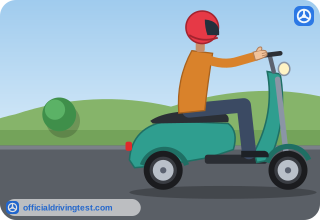
Where must moped operators remain on a road, unless an exception applies?
- In the left-hand lane
- In the center of the road
- On the shoulder
- In the extreme right-hand lane
Show answer
Correct answer: In the extreme right-hand lane
Moped operators must remain in the extreme right-hand lane of any road unless an exception applies.
Source: Nevada Driver's Handbook (March 2024 (DMV 700)), page 64 · Open this page in the manual (Manual page 64)
-
In which situation may a moped operator leave the extreme right-hand lane?
- When the moped is slower than other traffic
- When it is raining
- When directed by a police officer
- When passing a parked vehicle
Show answer
Correct answer: When directed by a police officer
The handbook lists exceptions, including when a police officer directs the moped operator.
Source: Nevada Driver's Handbook (March 2024 (DMV 700)), page 64 · Open this page in the manual (Manual page 64)
-
A moped operator preparing to make a left turn may leave the extreme right-hand lane. Within what distance from entering the lane must the turn be made?
- One-quarter mile
- One-eighth mile
- One-half mile
- One mile
Show answer
Correct answer: One-quarter mile
The handbook says the left turn must be made within one-quarter mile from entering the lane.
Source: Nevada Driver's Handbook (March 2024 (DMV 700)), page 64 · Open this page in the manual (Manual page 64)
-
Who is required to wear a helmet on a moped in Nevada?
- Operators only
- Passengers only
- Operators and passengers
- Only operators under 18
Show answer
Correct answer: Operators and passengers
The handbook says moped operators and passengers are required to wear helmets in Nevada.
Source: Nevada Driver's Handbook (March 2024 (DMV 700)), page 64 · Open this page in the manual (Manual page 64)
-
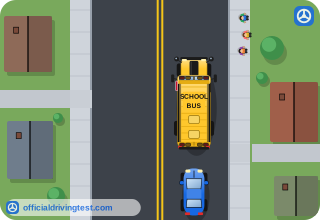
When must you stop for a school bus?
- Only when it shows flashing yellow lights on the road
- When it loads or unloads students with flashing red lights
- Only when children are crossing in front of the bus
- Only when a police officer directs you to stop
Show answer
Correct answer: When it loads or unloads students with flashing red lights
You are required to stop for school buses that are loading or unloading students and displaying a flashing red signal.
Source: Nevada Driver's Handbook (March 2024 (DMV 700)), page 64 · Open this page in the manual (Manual page 64)
-
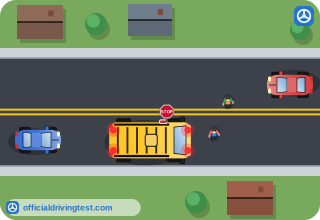
When may you proceed past a school bus that has stopped with flashing red lights?
- As soon as the last child is out of the traffic lane
- After you have waited a full thirty seconds or more
- When the bus begins to pull away from the stop
- After the bus driver has turned off the flashing red lights
Show answer
Correct answer: After the bus driver has turned off the flashing red lights
You may not overtake or proceed past the school bus until the bus driver has turned off the flashing red lights.
Source: Nevada Driver's Handbook (March 2024 (DMV 700)), page 64 · Open this page in the manual (Manual page 64)
-
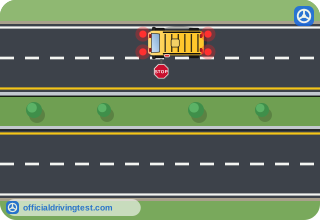
On a divided highway, when are you required to stop for a school bus with flashing red lights?
- Never, because of the median between the roadways
- Only when traveling opposite to the bus's direction
- Only when children are actually crossing the road
- Only when traveling in the same direction as the bus
Show answer
Correct answer: Only when traveling in the same direction as the bus
On divided highways, you are only required to stop when you are traveling in the same direction as the school bus.
Source: Nevada Driver's Handbook (March 2024 (DMV 700)), page 64 · Open this page in the manual (Manual page 64)
-
What happens when a school bus driver reports a violation to the school district and the Department of Motor Vehicles?
- The driver's license is canceled at once
- The registered owner is sent a warning letter
- The owner must appear in court within 30 days
- The registration is canceled
Show answer
Correct answer: The registered owner is sent a warning letter
The registered owner of the vehicle is sent a warning letter explaining the seriousness of the violation.
Source: Nevada Driver's Handbook (March 2024 (DMV 700)), page 64 · Open this page in the manual (Manual page 64)
-
Which rules must cyclists obey?
- The same rules and regulations as other vehicles
- Only the rules for pedestrians
- Only the rules posted on bicycle paths
- None, because bicycles are not motor vehicles
Show answer
Correct answer: The same rules and regulations as other vehicles
The handbook says cyclists must obey the same rules and regulations as other types of vehicles.
Source: Nevada Driver's Handbook (March 2024 (DMV 700)), page 65 · Open this page in the manual (Manual page 65)
-
Who is responsible for the safe interaction between bicyclists and motorists?
- Only the motorist
- Only the bicyclist
- Both parties
- Only a police officer
Show answer
Correct answer: Both parties
The handbook says the safe interaction between bicyclists and motorists is the responsibility of both parties.
Source: Nevada Driver's Handbook (March 2024 (DMV 700)), page 65 · Open this page in the manual (Manual page 65)
-
What may a motorist be charged with for causing even a minor collision with a bicycle?
- Failure to yield only
- A parking violation
- Reckless driving
- Nothing, if no one is hurt
Show answer
Correct answer: Reckless driving
Motorists who cause even a minor collision with a bicycle or pedestrian may be charged with reckless driving.
Source: Nevada Driver's Handbook (March 2024 (DMV 700)), page 65 · Open this page in the manual (Manual page 65)
-
Bicyclists may not intentionally do what?
- Interfere with the movement of a motor vehicle
- Ride in a traffic lane with other vehicles
- Use hand signals when turning at intersections
- Ride on streets that have a marked bike lane
Show answer
Correct answer: Interfere with the movement of a motor vehicle
The handbook says bicyclists may not intentionally interfere with the movement of a motor vehicle.
Source: Nevada Driver's Handbook (March 2024 (DMV 700)), page 65 · Open this page in the manual (Manual page 65)
-
Where should a cyclist riding in a traffic lane stay?
- In the center of the lane
- As far to the left as practicable
- On the sidewalk
- As far to the right as practicable
Show answer
Correct answer: As far to the right as practicable
Cyclists may ride in a traffic lane, staying as far to the right as practicable unless preparing to turn or overtaking another vehicle.
Source: Nevada Driver's Handbook (March 2024 (DMV 700)), page 65 · Open this page in the manual (Manual page 65)
-
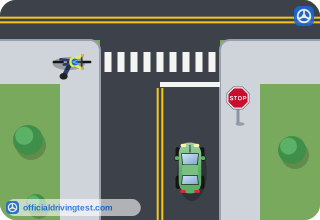
What should a cyclist do if choosing to cross an intersection in a crosswalk?
- Ride across quickly
- Dismount and cross as a pedestrian
- Ride across giving a hand signal
- Walk the bike on the left side
Show answer
Correct answer: Dismount and cross as a pedestrian
If a cyclist chooses to cross an intersection in a crosswalk, they should dismount and cross as a pedestrian.
Source: Nevada Driver's Handbook (March 2024 (DMV 700)), page 65 · Open this page in the manual (Manual page 65)
-
Why must cyclists use hand signals?
- To show other road users that they are under 18
- To let others know what they plan to do
- To request the right-of-way from every driver
- To warn only the pedestrians who are nearby
Show answer
Correct answer: To let others know what they plan to do
The handbook says cyclists must use hand signals to let others know what they plan to do.
Source: Nevada Driver's Handbook (March 2024 (DMV 700)), page 65 · Open this page in the manual (Manual page 65)
-
Which arm may a cyclist use to signal a right turn?
- The left arm only
- Either hand on the handlebar
- No arm signal is allowed
- The right arm
Show answer
Correct answer: The right arm
The handbook says the cyclist may use their right arm to signal a right turn.
Source: Nevada Driver's Handbook (March 2024 (DMV 700)), page 65 · Open this page in the manual (Manual page 65)
-
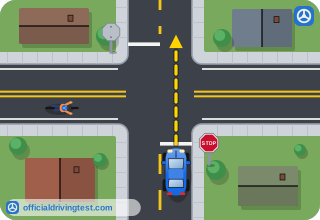
At intersections, how must motorists treat cyclists?
- Expect them to yield at all times to every vehicle
- Ignore them unless they are riding in a crosswalk
- Yield to them as for other vehicles and pedestrians
- Pass them before the intersection if you can
Show answer
Correct answer: Yield to them as for other vehicles and pedestrians
At intersections, motorists must yield to cyclists as they would for other vehicles and pedestrians.
Source: Nevada Driver's Handbook (March 2024 (DMV 700)), page 65 · Open this page in the manual (Manual page 65)
-
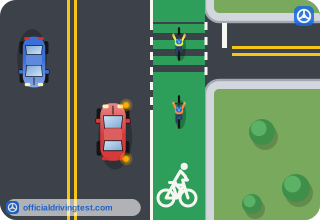
Who must yield the right-of-way on a bicycle path or in a bike lane?
- Cyclists
- Motorists
- Whoever arrived first
- No one
Show answer
Correct answer: Motorists
Motorists must yield the right-of-way to a cyclist on a bicycle path or in a bike lane.
Source: Nevada Driver's Handbook (March 2024 (DMV 700)), page 65 · Open this page in the manual (Manual page 65)
-
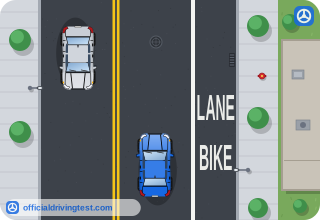
In which situation may a motorist stop or drive on a designated bicycle lane?
- When no bicyclists are in sight
- When turning right at the next intersection
- When passing a slower vehicle
- When directed by a police officer
Show answer
Correct answer: When directed by a police officer
Motorists may not stop, park or drive on a designated bicycle path or lane unless entering or leaving an alley or driveway, directed by a police officer, or in an emergency.
Source: Nevada Driver's Handbook (March 2024 (DMV 700)), page 65 · Open this page in the manual (Manual page 65)
-
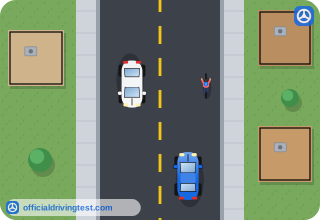
How should you treat inexperienced riders, especially children?
- Expect them to know all rules
- Pass them as closely as possible
- Sound your horn to warn them
- With special courtesy and care
Show answer
Correct answer: With special courtesy and care
Inexperienced riders require special courtesy and care and may not always follow traffic rules.
Source: Nevada Driver's Handbook (March 2024 (DMV 700)), page 65 · Open this page in the manual (Manual page 65)
-
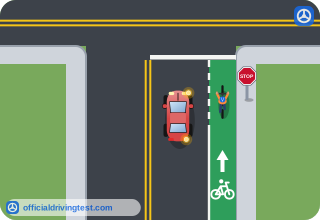
What should you do when turning at an intersection or driveway?
- Check only the direction of traffic
- Check both ways for cyclists
- Turn before checking for cyclists
- Rely on cyclists to yield
Show answer
Correct answer: Check both ways for cyclists
The handbook says to check both ways for cyclists when turning at an intersection or driveway.
Source: Nevada Driver's Handbook (March 2024 (DMV 700)), page 65 · Open this page in the manual (Manual page 65)
-
What should you never do just before you make a turn?
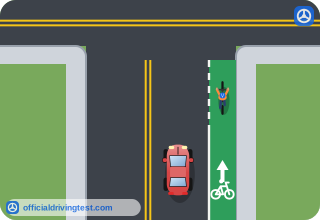
- Speed up to pass a cyclist
- Slow down for a cyclist
- Check your mirrors
- Use your turn signal
Show answer
Correct answer: Speed up to pass a cyclist
The handbook says to never speed up to pass a cyclist just before you make a turn.
Source: Nevada Driver's Handbook (March 2024 (DMV 700)), page 65 · Open this page in the manual (Manual page 65)
-
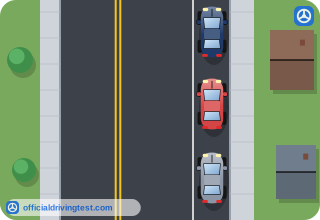
When parked on the street, what should you check before opening your car door?
- For pedestrians in front of the car only
- That your engine is turned off and keys out
- For cyclists approaching from behind
- For parking signs on the curb behind you
Show answer
Correct answer: For cyclists approaching from behind
The handbook says to check for cyclists approaching from behind before you open your car door.
Source: Nevada Driver's Handbook (March 2024 (DMV 700)), page 65 · Open this page in the manual (Manual page 65)
-
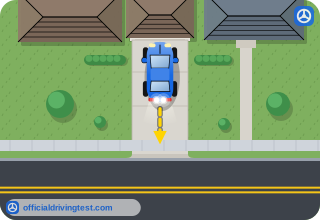
What should you do when backing out of a driveway or parking lot?
- Check behind only
- Honk once
- Check both ways for cyclists
- Back out quickly to clear the area
Show answer
Correct answer: Check both ways for cyclists
The handbook says to check both ways for cyclists when backing out of a driveway or parking lot.
Source: Nevada Driver's Handbook (March 2024 (DMV 700)), page 65 · Open this page in the manual (Manual page 65)
-
Which is something the handbook says cyclists should do?
- Wear a helmet
- Wear a headset when riding
- Ride on the wrong side of the road
- Ride at night without lights
Show answer
Correct answer: Wear a helmet
The handbook says cyclists should obey the law, wear a helmet, wear brightly colored clothing, and keep bikes in good repair.
Source: Nevada Driver's Handbook (March 2024 (DMV 700)), page 65 · Open this page in the manual (Manual page 65)
-
Which is something the handbook says cyclists should not do?
- Wear a helmet
- Wear brightly colored clothing
- Keep bikes in good repair
- Wear a headset when riding
Show answer
Correct answer: Wear a headset when riding
The handbook says cyclists should not wear a headset, such as headphones or a cellular phone earpiece, when riding.
Source: Nevada Driver's Handbook (March 2024 (DMV 700)), page 65 · Open this page in the manual (Manual page 65)
-
What does the handbook say about the right of motorists and cyclists to use the roadways?
- Motorists have the first right to the road
- They have an equal right and need to cooperate
- Cyclists have the first right to the road
- Cyclists may use only bike lanes and paths
Show answer
Correct answer: They have an equal right and need to cooperate
The handbook says motorists and cyclists have an equal right to use the roadways and need to be mutually courteous and cooperative.
Source: Nevada Driver's Handbook (March 2024 (DMV 700)), page 65 · Open this page in the manual (Manual page 65)
-
Before you start across a road with a large vehicle, what should you make sure of?
- That the other traffic will slow down to let you go across
- That you can get all the way across before traffic reaches you
- That you are able to stop halfway across the road if needed
- That the road you are crossing is at least two lanes wide
Show answer
Correct answer: That you can get all the way across before traffic reaches you
Before you start across a road, make sure you can get all the way across before traffic reaches you.
Source: Nevada Driver's Handbook (March 2024 (DMV 700)), page 72 · Open this page in the manual (Manual page 72)
-
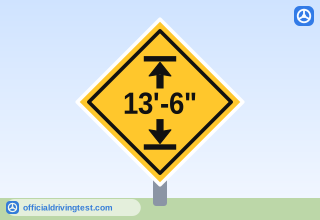
Why should you not assume that the height posted at a bridge or overpass is correct?
- Posted heights always include a safety margin of several feet at every bridge
- Bridges grow taller in hot weather and shorter in cold weather every year
- Posted heights apply only to empty trailers and not to loaded vehicles
- Repaving or packed snow may have reduced the clearance since the height was posted
Show answer
Correct answer: Repaving or packed snow may have reduced the clearance since the height was posted
Repaving or packed snow may have reduced the clearances since the height was posted.
Source: Nevada Driver's Handbook (March 2024 (DMV 700)), page 72 · Open this page in the manual (Manual page 72)
-
How does the weight of a trailer change its height?
- An empty trailer is higher than a loaded one
- A loaded trailer is higher than an empty one
- Weight never changes the height
- Only a loaded trailer's height can change
Show answer
Correct answer: An empty trailer is higher than a loaded one
An empty trailer is higher than a loaded one, so a bridge you cleared when loaded may be too low when empty.
Source: Nevada Driver's Handbook (March 2024 (DMV 700)), page 72 · Open this page in the manual (Manual page 72)
-
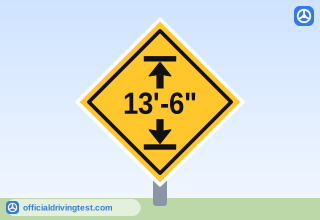
What should you do if you are not sure you can pass under a low bridge or underpass?
- Speed up so you can clear it
- Follow closely behind a taller truck
- Take another route
- Pass under it and hope for the best
Show answer
Correct answer: Take another route
If you doubt you have enough space, go slowly, and if you are not sure you can make it, take another route.
Source: Nevada Driver's Handbook (March 2024 (DMV 700)), page 72 · Open this page in the manual (Manual page 72)
-
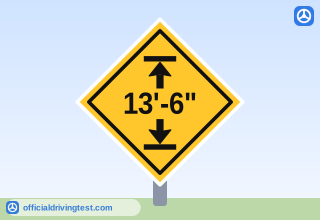
What should you do if you doubt you have enough space to pass under an object?
- Go at normal speed
- Go slowly
- Go faster to get through
- Stop and sound the horn
Show answer
Correct answer: Go slowly
If you doubt you have enough space to pass under an object, go slowly.
Source: Nevada Driver's Handbook (March 2024 (DMV 700)), page 72 · Open this page in the manual (Manual page 72)
-
On a road that tilts your vehicle toward objects along the edge, what should you do if clearing signs or trees is a problem?
- Drive a little closer to the edge of the road
- Speed up to clear the objects
- Drive on the shoulder
- Drive a little closer to the center of the road
Show answer
Correct answer: Drive a little closer to the center of the road
Where clearing objects along the road edge is a problem, drive a little closer to the center of the road.
Source: Nevada Driver's Handbook (March 2024 (DMV 700)), page 72 · Open this page in the manual (Manual page 72)
-
Before you back into an area, what should you check for?
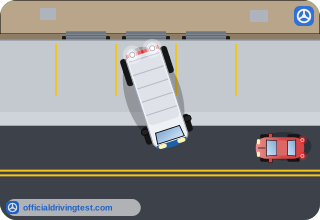
- Overhanging objects such as trees, branches or electric wires
- Only the width of the road and the speed limit on it
- Only the color of the pavement and the type of surface
- Only parked vehicles behind you and the vehicles beside you
Show answer
Correct answer: Overhanging objects such as trees, branches or electric wires
Before you back into an area, get out and check for overhanging objects, such as trees, branches, or electric wires, and for other hazards.
Source: Nevada Driver's Handbook (March 2024 (DMV 700)), page 72 · Open this page in the manual (Manual page 72)
-
How should you cross drainage channels across a road?
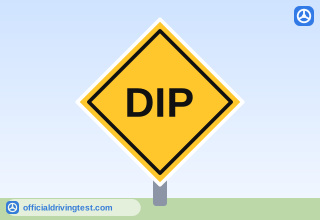
- Quickly, so that the vehicle is not hung up on it
- Carefully, because the end of some vehicles can drag
- At the same speed as the rest of the traffic around you
- Only while backing the vehicle slowly across them
Show answer
Correct answer: Carefully, because the end of some vehicles can drag
Drainage channels across roads can cause the end of some vehicles to drag, so such depressions should be crossed carefully.
Source: Nevada Driver's Handbook (March 2024 (DMV 700)), page 72 · Open this page in the manual (Manual page 72)
-
When towing a combination of vehicles, which vehicle must always be in the first position behind the towing vehicle?
- The lightest vehicle
- The shortest vehicle
- The newest vehicle
- The heaviest vehicle
Show answer
Correct answer: The heaviest vehicle
The heaviest vehicle must always be in the first position behind the towing vehicle, with the lighter vehicle in the rear.
Source: Nevada Driver's Handbook (March 2024 (DMV 700)), page 73 · Open this page in the manual (Manual page 73)
-
What can the crack-the-whip effect do during a quick lane change?
- Turn a trailer over
- Lock the steering wheel
- Disconnect the electric lines
- Shorten the stopping distance
Show answer
Correct answer: Turn a trailer over
When you make a quick lane change, the crack-the-whip effect can turn a trailer over.
Source: Nevada Driver's Handbook (March 2024 (DMV 700)), page 73 · Open this page in the manual (Manual page 73)
-
What happens to the crack-the-whip effect as more trailers are added?
- It decreases
- It disappears
- It increases
- It stays the same
Show answer
Correct answer: It increases
Vehicles with trailers have a dangerous crack-the-whip effect which increases with multiple trailers.
Source: Nevada Driver's Handbook (March 2024 (DMV 700)), page 73 · Open this page in the manual (Manual page 73)
-
What causes the crack-the-whip effect?
- Forward braking force
- Rearward amplification
- Excess tire pressure
- Slack in the safety chains
Show answer
Correct answer: Rearward amplification
Rearward amplification causes the crack-the-whip effect.
Source: Nevada Driver's Handbook (March 2024 (DMV 700)), page 73 · Open this page in the manual (Manual page 73)
-
What does a rearward amplification of 2.0 mean?
- The rear trailer is half as likely to turn over as the truck
- The rear trailer is 3.5 times as likely to turn over as the truck
- The rear trailer is not able to turn over at all
- The rear trailer is twice as likely to turn over as the truck
Show answer
Correct answer: The rear trailer is twice as likely to turn over as the truck
Rearward amplification of 2.0 means the rear trailer is twice as likely to turn over as the truck.
Source: Nevada Driver's Handbook (March 2024 (DMV 700)), page 73 · Open this page in the manual (Manual page 73)
-
What rearward amplification do triples have?
- 3.5
- 1.0
- 2.0
- 4.5
Show answer
Correct answer: 3.5
Triples have a rearward amplification of 3.5, which means the last trailer of a triple can roll 3.5 times as easily.
Source: Nevada Driver's Handbook (March 2024 (DMV 700)), page 73 · Open this page in the manual (Manual page 73)
-
How should you steer when pulling trailers?
- Quickly and sharply
- With sudden corrections
- Gently and smoothly
- Only in short, quick moves
Show answer
Correct answer: Gently and smoothly
Steer gently and smoothly when pulling trailers, because trailers flip over from quick steering moves more easily than many vehicles.
Source: Nevada Driver's Handbook (March 2024 (DMV 700)), page 73 · Open this page in the manual (Manual page 73)